Paper commentary
HaiRuo: Forecasting Ocean Eddies as Fields and Objects with a Satellite-Altimetry Foundation Model
HaiRuo forecasts ocean eddies by predicting their paths alongside ocean fields
- Problem Eddy forecasts are usually made by running an ocean forecaster and then applying a fixed tracker afterwards. The tracker misplaces eddies because the forecast never uses the eddy's own path.
- Method HaiRuo pairs a 1.05 billion parameter satellite-altimetry foundation model with XuanJi, a decoder that samples the forecast along each eddy's co-moving path. XuanJi refines the 15-day path over three rounds.
- Results HaiRuo scored 25.20 km on 15-day eddy-centre error on the global test, compared to 30.58 km for PredRNN-V2.
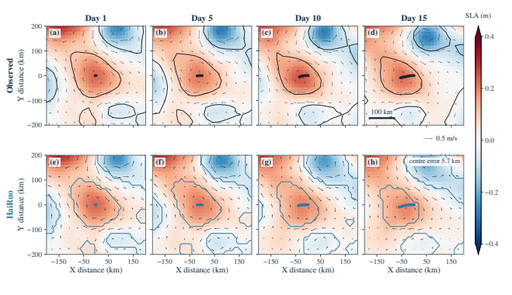
Figure 4 . HaiRuo follows an anticyclone through its own forecast. A window of the global evaluation issued on 12 August 2022 in the Kuroshio Extension: observed (top) and forecast (bottom, seed 42) sea-level anomaly with geostrophic velocity (arrows), eddy contours (atlas above, forecast mask below) and the centre track (dots) at leads 1, 5, 10 and 15, in a fixed 400 km frame centred on the eddy’s day-0 position. The eddy drifts 56 km in 15 days; the forecast centre ends 5.7 km from the observed one (PredRNN-V2: 8.4 km; Figure 8); over the global evaluation the median eddy forecast of HaiRuo ends 17 km from the observed centre (PredRNN-V2: 22 km).
Original paper · CC BY 4.0 · Xukun Qin, Haochen Sun, Yuyang Tian, Ge Chen · HaiRuo: Forecasting Ocean Eddies as Fields and Objects with a Satellite-Altimetry Foundation Model · Original paper figure · Extracted the figure area from page 5 of the original PDF.Why eddy forecasts stall at the tracker
Eddy forecasts go wrong at the point where a fixed tracker is applied after the forecast is finished. Mesoscale eddies are coherent vortices 50 to 300 km across that carry most of the ocean's kinetic energy. They move heat, salt and nutrients across basins, so a forecast that misplaces them loses useful information. The authors ran a state-of-the-art AI ocean forecaster and tracked its eddies with a fixed tracker.
Nothing in them follows an eddy, so the forecast never uses the eddy's own path.
The authors treat eddy forecasting as coupled field-and-object forecasting on continuous spherical fields. The authors' bet is that a forecaster should learn ocean dynamics at scale from what satellites observe. Reading the path from the forecast keeps the flow information that a post-hoc tracker lacks.
HaiRuo answers this with two parts that divide the work. Under one pre-registered global evaluation, HaiRuo improves on fourteen methods on every endpoint.
Pretraining HaiRuo-1B on altimetry
HaiRuo-1B reads 30 daily altimetry maps, each with ten channels, on a 0.125° grid cut into 512 × 512 tiles. Each tile covers a 64° × 64° patch, so the backbone sees a regional window of the ocean at every step. Two spherical stride-2 convolutions then build a three-level pyramid at 0.5°, 1° and 2°, with depths 6, 10 and 20. A learned quality gate damps poorly observed swaths before they reach the pyramid.
Keeping all 30 days at full resolution would make the attention cost too high, so the history is compressed at two rates. That routing fills eight chronological memory slots, giving 15 steps in total, while keeping all 30 days on a differentiable path. The three levels stack 36 eddy-focused spatio-temporal blocks.
HaiRuo-1B trains without labels on every daily window from 1993 to 2016, which gives 8,722 windows. The second is swath-aware multi-axis masked reconstruction, which masks 40 % of spatial tokens and reads through cross-attention to the compressed timeline. The third is a geostrophic flow-advected InfoNCE contrast that pairs a day-t token with its day-(t+1) counterpart.
That counterpart is sampled after advection along the observed spherical geostrophic velocity, and training ran from random initialisation for 93 epochs.
The field decoder writes each lead as the last observed field plus a scaled residual. Here F0 is the last observed field and δl is the training RMS of the l-day change. Because the residual rl starts at zero, every model begins exactly at persistence and learns departures from it. The same zero-initialised design carries into XuanJi, which reads HaiRuo-1B's per-lead features through zero-initialised 1×1 projections.
Reading eddy paths out of the forecast
XuanJi reads the HaiRuo-1B forecast and turns it into one predicted path for each eddy. The shared stem takes the last seven days of altimetry, the past eddy masks and the ocean mask, plus the 15-lead forecast. HaiRuo-1B's per-lead features enter through zero-initialised 1×1 projections, so their contribution starts at zero. A proposal head integrates a velocity correction on the sphere, which a GRU computes over the eddy's seven-day track.
Every head starts at persistence or constant-velocity extrapolation, so the untrained path is a simple baseline guess. The XuanJi decoder has 7.85M parameters, while HaiRuo-1B has 1.06B in total.
Object attention then samples features on five rings at r/R of 0.5, 1, 1.5, 2 and 3, with 16 azimuths each. The rings sit at the current position in the eddy's co-moving frame, so they move with the eddy rather than a fixed grid. Each ring reduces to azimuthal Fourier modes m = 0, 1, 2, which cover the mean, the dipole and the quadrupole.
The rings read the stem features, the six forecast fields, and HaiRuo-1B's per-lead features and its own orbit.
Sampling and correction run for K=3 rounds, and each round updates the whole path at once. Each round adds a weighted displacement to the accumulated one, while the initial path stays fixed. The last round applies its displacement as it is, while earlier rounds carry lead states and ring deformations forward.
Four refiners read complementary evidence: the spatial-stem and forecast rings, the HaiRuo-1B orbit, the 22-day life cycle and the geostrophic contrast. During training one primary refiner takes weight 0.76 and the others take 0.08 each, which stops them co-adapting. At inference the four refiners are averaged with weight 1/4 each. Positions and daily displacements are trained with a smooth-ℓ1 loss, alongside the Huber loss on fields.
Global test against fourteen baselines
On the 2020–2022 global test, HaiRuo's D15 is 25.20 km, compared to 30.58 km for PredRNN-V2. That is an 18 % reduction relative to PredRNN-V2, and every paired interval excludes zero. The margin is measured on the whole ocean, so the comparison covers every tile in the evaluation rather than a single region. The authors attribute the lead to the pretrained representation and the decoder together, and the ablations separate the two.
Outside the four labelled training regions, HaiRuo's margin holds at 17 to 18 % in both ENSO phases. Figure 3 maps the D15 gain over PredRNN-V2 eddy by eddy, with the four training regions outlined. The absolute regional gap is the smallest among the baselines, at 4.9 km, where the others span 5.2 to 6.1 km.
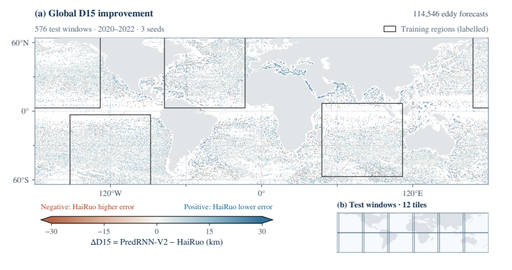
Figure 3 .HaiRuo lowers the 15-day centre error across the whole ocean, including the regions never seen in labelled training.(a) Day-0 position of every evaluated eddy, coloured by the 15-day centre error (D15) of PredRNN-V2 minus that of HaiRuo (three-seed mean; blue favours HaiRuo), with the four labelled training regions outlined. (b) The 12 evaluation tiles.
Original paper · CC BY 4.0Across the 114 546 evaluated global eddies, the share with a day-15 centre error above 50 km falls from 15.2 % for PredRNN-V2 to 10.8 %. The 15-day drift matches observations with r = 0.98 and slope 1.14, and it reverses to eastward at 50 to 60°S. Constant-velocity extrapolation reverses the poleward deflection, whereas HaiRuo's forecasts show cyclones drifting poleward relative to anticyclones in both hemispheres.
The authors read this as the forecast having learned the dynamics, but the test shows that the statistics match, not the mechanism.
Which parts carry the gain on Dev48
On Dev48, the decoder alone reads out 25.07 km of D15 with no backbone. Under the same XuanJi readout, frozen HaiRuo-1B cuts that to 23.85 km and lifts field skill from 0.63 to 0.77. The authors credit the pretrained representation with all of the field gain, most of the mask gain and over half of the trajectory gain. Frozen HaiRuo-1B also adds 1.09 mIoU points over the decoder alone.
Training the same 1B architecture from scratch gives 24.22 km, 66.52 % mIoU and 0.662 field skill. That from-scratch run loses 1.35 km of D15 to HaiRuo. It also trails even frozen HaiRuo-1B by 0.93 km.
Two-round XuanJi object attention removes 1.91 km on frozen HaiRuo-1B, from 25.76 km to 23.85 km. Dropping the second sampling round costs 0.28 km of D15. Removing cross-lead attention adds 0.12 km of D15. Full three-round four-expert refinement with EMA lowers Dev48 D15 to 23.29 km. Joint fine-tuning brings HaiRuo to 22.87 km, a further 0.42 km on Dev48.
Measured against the 25.76 km readout, the XuanJi and joint fine-tuning total is 2.89 km.
Even with plain base heads and no object attention, frozen HaiRuo-1B reaches 25.76 km, 67.10 % mIoU and 0.771 field skill. That plain-head model beats all 14 baselines. The self-supervised PredRNN-V2 reaches 30.36 km frozen on the same global altimetry record. PredRNN-V2 was pretrained for 22 epochs, while HaiRuo-1B ran for 93 epochs.
Against WenHai and XiHe
The authors ran the released WenHai and XiHe forecasters on the 48 test dates and tracked their fields with the same fixed tracker. HaiRuo's forecast field scores 29.5 km, compared to 47.1 km for WenHai and 51.6 km for XiHe, a cut of 37–43 %. Through the same tracker, the true altimetry scores 29.0 km, so HaiRuo's field lands within 0.52 km of it.
The comparison runs at two levels, and the field-for-field test is the first of them.
The second level compares the forecasters' own initial states, not their forecasts, against HaiRuo. WenHai and XiHe degrade by 4.3 and 8.7 km beyond their day-0 state of 42.9 km. The authors read this as the gain coming from the forecast itself rather than from the tracker.
Used directly as objects, HaiRuo's trajectories score 10.1 km on Test48 and 11.2 km globally. That is 77–78 % below the object trajectories of WenHai at 48.0 km and XiHe at 52.0 km. The tracker alone adds an 18.8 km offset on true altimetry and a 10.6 km offset on day-0 reanalysis. So the object comparison includes pipeline error, which the authors state rather than remove.
Limits of the evidence
HaiRuo's evaluation reads daily 1/8◦ delayed-time DUACS maps and META4.0 eddy atlas labels. The authors note that operational forecasting would use near-real-time streams, and this study doesn't evaluate on them. The split assigns 1993 to 2016 to pretraining and labelled training, 2017 to 2019 to Dev48 and 2020 to 2022 to Test48.
Labelled windows come from four fixed 512 × 512 regions: North Atlantic, North Pacific, South Pacific and Indian Ocean. Every model trains on the same 1 024 labelled windows under the same training budget. The other regions are the rest of the ocean, which the labelled training never sees. That outside-region result is the main test of how well the models transfer to unseen areas.
Outside those regions, HaiRuo stays 18 % ahead of TAU, the strongest baseline there. Its absolute gap is the smallest, at 4.9 km against 5.2 to 6.1 km for the other methods.
The authors re-implemented the baselines as complete systems under one labelled-training budget, so their numbers depend on that re-implementation. Fourteen methods enter the comparison, and twelve of them are field methods that share the same base readout heads. The seed standard deviation of D15 is 0.03 km for HaiRuo. For the field baselines it ranges from 0.11 to 0.80 km, a wider spread than HaiRuo's.
The paper reports its differences with 95 % paired bootstrap intervals.
Paper info
- Authors
- Xukun Qin, Haochen Sun, Yuyang Tian, Ge Chen
- Venue
- arXiv · Preprint
- First published
- 2026-11-10
- Added
- 2026-11-11
- Updated
- 2026-11-10
- Version
- v1
- arXiv
- 2611.14136
- Category
- cs.LG · cs.CV
- Original paper terms
- CC BY 4.0
- What we show
- Paper info, commentary and permitted figures from the original paper
AI commentary is a separate explanation from the original paper and may contain errors. The original paper and figures follow each source's terms of use and any rights noted separately.
Abstract
Mesoscale eddies carry most of the ocean's kinetic energy and move heat, salt and nutrients across basins, yet where an eddy will be two weeks ahead is still read off ocean models with post-hoc tracking heuristics. We introduce HaiRuo, which forecasts eddies as fields and as objects at once: from 30 days of satellite sea-level maps, one forward pass returns 15 days of sea level and geostrophic velocity, daily eddy masks and the trajectory of every eddy alive today. HaiRuo pairs two components with a clear division of labour: (1) HaiRuo-1B, an open-weight 1.05-billion-parameter foundation model pretrained without labels on 24 years of global satellite-altimetry observations, which supplies the 15-day physical fields and masks (+0.14 field skill and +1.1 mIoU points under the same decoder) and further lowers 15-day centre error by 1.2 km frozen (1.35 km over training from scratch); and (2) XuanJi, a Lagrangian object decoder that samples the evolving forecast in each eddy's co-moving polar frame and refines the 15-day path across three look-ahead rounds, removing 2.5 km on HaiRuo-1B (2.9 km with joint fine-tuning) and 2.5-3.3 km via its object attention across six published backbones. Under one pre-registered global evaluation over the whole ocean, HaiRuo improves on fourteen methods on every endpoint (25.2 vs. 30.6 km 15-day centre error, -18%), holding its margin outside the labelled regions and through both phases of the El Nino-Southern Oscillation (ENSO), while reproducing westward drift, 50-60 deg S eastward reversal and poleward cyclone-anticyclone deflection. Over ten days through one fixed tracker, HaiRuo's forecast field cuts the eddy-centre error of WenHai and XiHe by 37-43% (-2.8 km vs. day 0 while they degrade +4.3-8.7 km), and its object trajectories cut pipeline error by 77-78% globally. Open-weight checkpoints, code and project page: https://github.com/xkqin/HaiRuo
Quote from the paper
Xukun Qin, Haochen Sun, Yuyang Tian, Ge Chen (2026). HaiRuo: Forecasting Ocean Eddies as Fields and Objects with a Satellite-Altimetry Foundation Model. arXiv:2611.14136v1. https://arxiv.org/abs/2611.14136v1
BibTeX
@misc{qin2026hairuo,
  title = {{HaiRuo: Forecasting Ocean Eddies as Fields and Objects with a Satellite-Altimetry Foundation Model}},
  author = {Xukun Qin and Haochen Sun and Yuyang Tian and Ge Chen},
  year = {2026},
  eprint = {2611.14136},
  archivePrefix = {arXiv},
  url = {https://arxiv.org/abs/2611.14136v1}
}