Paper commentary
Spatial-Spectral Coupling as Attention: Scaling Shape Correspondence to High-Resolution Surfaces
Geo-FlashAttention scales exact shape correspondence to high-resolution surface meshes
- Problem Functional-map methods couple two shapes through a dense matrix that grows quadratically with mesh resolution. Downsampling avoids that cost but loses fine geometric detail.
- Method Geo-FlashAttention treats the coupling as attention and keeps the softmax exact only over geometry-selected surface patches, so most vertex pairs get zero weight.
- Results At 60k vertices, Geo-FlashAttention cuts peak training memory from 106.08 to 5.67 GiB while keeping the correspondence accuracy of exact methods.
Why the dense coupling stops scaling
The dense coupling becomes the bottleneck because the soft assignment is a full similarity matrix between the vertices of two shapes. Functional-map methods rely on this spectral-to-spatial conversion both in axiomatic methods and in learned methods. The conversion's cost therefore sits exactly where the high-resolution regime needs the most headroom.
The dominant cost is the intermediate product ΠΦ_M, where Π is a dense soft correspondence and Φ_M is a truncated spectral basis. Although Π contains n_N n_M pairwise weights, only the product ΠΦ_M is needed to build the induced functional map. A naive implementation still materializes Π, which costs O(n_N n_M) memory and limits use on high-resolution meshes.
Magnet and Ovsjanikov observed that the intermediate matrix can be avoided by computing the product ΠΦ_M directly. That removes the need to store the dense feature assignment while preserving the resulting point map.
A common workaround is to downsample the shapes, run the method on the coarse meshes, and transfer predictions back to the full mesh. This workaround introduces approximation errors and can discard fine-scale geometric information. The authors instead want to keep the coupling exact at full resolution.
The authors' answer is to treat the coupling as scaled dot-product attention, which lets optimized attention kernels compute it. FlashAttention removes the quadratic memory of the coupling while keeping the correspondence up to floating-point rounding. Linearised couplings, in contrast, are a real approximation that significantly compromises accuracy.
Reading the coupling as attention
The coupling in functional-map methods already has the form of a softmax-weighted average, which is what scaled dot-product attention computes. Written out, the product is the softmax of the descriptor similarity matrix, scaled by 1/τ, multiplied by the spectral basis Φ_M. The learned descriptors F_N and F_M play the roles of queries and keys, while the spectral basis Φ_M takes the role of values.
The only difference from standard attention is the scale, which is 1/τ instead of 1/√d.
The learned shape descriptors determine the correspondence weights, which form the attention matrix. The spectral basis functions are the values, because they are the quantities transported through that correspondence. Because the product is ordinary attention, exact kernels such as FlashAttention can compute it by tiling, without storing the full matrix.
FlashAttention reduces the memory of the coupling layer from O(nN nM) to O(nN + nM). The authors state that FlashAttention removes this memory while preserving the correspondence up to floating-point rounding.
Exact attention still has quadratic time, so the authors also considered linear attention as an alternative. Linear attention replaces the exponential kernel with a non-negative feature map, which reassociates the product into linear time and memory. The factorized kernel has rank at most r, so the authors see linearized couplings as lossy at practical feature dimensions.
This is why the paper motivates a sparse alternative rather than a linearized one.
Why restrict the softmax instead of linearizing it
The authors keep the softmax exact because linearizing it changes the correspondence itself, not just the arithmetic. Linear attention replaces the exponential kernel with a non-negative feature map, which reassociates the product into linear time and memory. They also evaluate Performer's random-feature softmax estimator as a second approximate map.
Whatever the map, the factorized kernel has rank at most r, so the approximation stays lossy at practical feature dimensions.
Geo-FlashAttention keeps the softmax exact but lets each target row see only a small set of source patches. The method partitions both shapes into patches using geodesic farthest-point-sampled centers and geodesic nearest-center assignment. Each source patch is summarised by the mean of its keys, so scoring needs only one vector per patch.
A target patch scores each source patch by the maximum over its queries of the dot product with that mean key. Each target row then keeps the R best-scoring source patches, so every row keeps exactly R patches.
The softmax is taken only over the vertices in the kept patches, so the support stays exact while most pairs get zero weight. Each target row attends to at most R m_max source vertices, which gives a restricted attention cost of O(n_N R m_max (d+k)). The coarse selection adds O(n_N |B| d), and the fused Triton kernel never materializes the restricted matrix.
Table 1 shows that the exact patch-restricted coupling matches the dense coupling on the tested benchmarks. For HybridFMaps on SMAL, the dense error is 3.68±0.11 and Geo-FlashAttention reaches 3.41±0.27. Because the authors keep the softmax exact, the sparsity only removes candidates, which is why they argue sparsification fits the problem better than linearization.
Do the couplings match on standard benchmarks
The authors keep the model, data and protocol fixed and vary only how the point-to-point coupling is computed. They compare dense, FlashAttention and Geo-FlashAttention couplings across ULRSSM, HybridFMaps and ZoomOut. The benchmarks cover FAUST, SCAPE, SHREC'19, SMAL, DT4D-intra and DT4D-inter, each run with five seeds. Each method block of Table 1 changes only the computation of ΠΦ, so any gap comes from the coupling itself.
Across these benchmarks, no alternative coupling differs significantly from the dense one. Bonferroni-corrected Welch confidence intervals for the mean differences all include zero.
The sign of the differences changes across methods and benchmarks, which the authors summarise as no systematic gap. The differences are generally small compared with the observed seed variability. Exact FlashAttention and fp32 SDPA change only the arithmetic, so they keep the correspondence intact.
Linearized couplings behave differently, because linear attention changes the correspondence itself rather than only the arithmetic. Performer is significantly worse on five of the six benchmarks. The largest differences appear on the strongly non-isometric SMAL and DT4D-inter benchmarks.
Sparse couplings can also act as a regulariser when the geometry is unreliable. Implausible correspondences therefore receive exactly zero weight during training. The authors didn't use this regularisation effect as a claim on the standard benchmarks.
What the coupling costs at 12k and 60k vertices
Every exact or sparse alternative needs only 5.67 GiB at that size. The authors measured all runs on one exclusively allocated H200 NVL, so the numbers share one hardware setting. KeOps is so slow that the authors estimate 29.9 days for one 100-epoch run. That slowdown comes from the constant overhead of symbolic reduction, which materializes a general-purpose fp32 kernel.
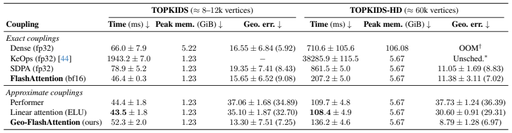
Table 2 .Cost and accuracyof ULRSSM [12] couplings on the two released TOPKIDS datasets [35]. Time and peak memory are for one training step at≈12k and≈60k, mean±standard deviation over five repeats; geodesic error (×100) uses25test pairs of the released datasets, mean±standard deviation over fixed seeds with the best seed in parentheses (seed counts and protocol: Sec. 7.1). ∗Unschedulable:
Original paper · CC BY 4.0 · Bence Demeter, Kilian Ehrenreich, Amelie Kleber, Ioana Oprisiu, Philipp Spohn, Christian Wachinger, Fabian Bongratz, Lennart Bastian · Spatial-Spectral Coupling as Attention: Scaling Shape Correspondence to High-Resolution Surfaces · Original paper figure · Extracted the figure area from page 7 of the original PDF.FlashAttention in bf16 takes 207.2 ms per training step at 60k vertices. Geo-FlashAttention takes 136.2 ms for the same step, which is the fastest feasible exact or sparse option at that size. The restricted product touches only the selected patches, so its cost sits below that of full tiled attention. Geo-FlashAttention reaches a mean geodesic error of 8.79±1.28 at 60k, against 11.38±3.11 for FlashAttention and 11.05±1.69 for fp32 SDPA.
At about 12k vertices, Performer reaches 37.06 and linear attention 35.10, compared to 16.55 for the dense coupling. Both linearized couplings stay far above the dense error, so the approximation changes the correspondence itself.
Cortical surfaces at native resolution
They run ULRSSM coupled by Geo-FlashAttention with R=64, using WKS and anatomical features as input. Fast Brain Matching is the classical spectral correspondence, and this run uses its geometry-only configuration without anatomical features.
Cortical surfaces lack ground-truth dense correspondence, so the geodesic error of Table 1 can't be computed here. Instead, the authors transfer the manually corrected DKT31 parcellation, with 31 regions per hemisphere, through each map. They report vertex accuracy and region-averaged IoU. Those labels were initialized by FreeSurfer before manual correction, so agreement with FreeSurfer is partly built in.
To add a label-free score, they subdivide M into S geodesic Voronoi regions and compute the mean absolute log-area ratio D area(S).
The Geo-FlashAttention model has the lowest area distortion at every scale in Table 4. FreeSurfer stays ahead because it generated the reference labels, so that metric favors it. D area scores only the correspondence map, so it doesn't reward the label source. Figure 5 shows the transferred labels and the local disagreements in two zoomed regions.
Limitations of the method and its evaluation
Geo-FlashAttention's scope stops at a fixed candidate budget, because each target patch keeps exactly R source patches. The method has no approximation guarantees, so its scaling is measured empirically rather than proven. Geo-FlashAttention works on cortical surfaces with R=64, using WKS and anatomical features as input.
Cortical surfaces lack ground-truth dense correspondence, so the geodesic error of Tab. 1 is unavailable. The authors transfer the manually corrected DKT31 parcellation through each map and report vertex accuracy and region-averaged IoU. Because those labels were FreeSurfer-initialized, the authors add a label-free area distortion score, D area(S).
They didn't test cortical correspondence against dense ground truth, so accuracy there rests on label transfer and area distortion.
The authors name adaptive candidate selection and stronger evaluation protocols as future directions.
Paper info
- Authors
- Bence Demeter, Kilian Ehrenreich, Amelie Kleber, Ioana Oprisiu, Philipp Spohn, Christian Wachinger, Fabian Bongratz, Lennart Bastian
- Venue
- arXiv · Preprint
- First published
- 2026-11-10
- Added
- 2026-11-11
- Updated
- 2026-11-10
- Version
- v1
- arXiv
- 2611.13870
- Category
- cs.CV
- Original paper terms
- CC BY 4.0
- What we show
- Paper info, commentary and permitted figures from the original paper
AI commentary is a separate explanation from the original paper and may contain errors. The original paper and figures follow each source's terms of use and any rights noted separately.
Abstract
Establishing dense correspondence between high-resolution 3D shapes remains challenging due to the spatial--spectral coupling at the core of many functional-map methods, which grows quadratically with mesh resolution. We observe that this coupling is equivalent to a scaled dot-product attention formulation, with learned descriptors serving as queries and keys and spectral basis functions as values. This connection makes efficient attention implementations directly applicable to shape matching and an effective mechanism for scaling spatial-spectral coupling. We show that optimized quadratic attention implementations can scale modern deep functional map pipelines to large mesh sizes, improving both runtime and memory consumption, while sub-quadratic methods introduce errors, particularly for non-isometric shape pairs, where an exact coupling proves most necessary. These insights motivate \textit{Geo-FlashAttention}, which restricts the exact softmax to geometry-selected surface patches and achieves near-linear empirical scaling while preserving correspondence accuracy of exact implementations. Across six standard benchmarks and three functional-map pipelines, rigorous analysis shows that efficient couplings preserve correspondence accuracy. At $60k$ vertices, these insights reduce peak training memory from 106.08 to 5.67\,GiB, with Geo-FlashAttention being $1.5\times$ faster per training step than FlashAttention. This enables end-to-end learning for correspondence problems on large meshes such as cortical surfaces, where high resolution is required to preserve disease-relevant intricacies of the surface geometry. Project page available https://spatial-spectral-attention.github.io/
Quote from the paper
Bence Demeter, Kilian Ehrenreich, Amelie Kleber, Ioana Oprisiu, Philipp Spohn, Christian Wachinger, Fabian Bongratz, Lennart Bastian (2026). Spatial-Spectral Coupling as Attention: Scaling Shape Correspondence to High-Resolution Surfaces. arXiv:2611.13870v1. https://arxiv.org/abs/2611.13870v1
BibTeX
@misc{demeter2026spatial,
  title = {{Spatial-Spectral Coupling as Attention: Scaling Shape Correspondence to High-Resolution Surfaces}},
  author = {Bence Demeter and Kilian Ehrenreich and Amelie Kleber and Ioana Oprisiu and Philipp Spohn and Christian Wachinger and Fabian Bongratz and Lennart Bastian},
  year = {2026},
  eprint = {2611.13870},
  archivePrefix = {arXiv},
  url = {https://arxiv.org/abs/2611.13870v1}
}