Paper commentary
Multi-Future Drafting: Mixture Block Drafters for Tree-Verified Speculative Decoding
Multi-future drafting keeps speculative decoding trees from splicing futures into chimeras
- Problem Product-ranked draft trees split probability across spliced prefixes that the target never produces. Those chimeras take budget from real futures, so tree verification accepts fewer tokens.
- Method MFD adds K learned mode embeddings to a block drafter, so it drafts K coherent blocks in one pass. A mixture DDTree then ranks prefixes from all modes, and the verifier picks the future the target takes.
- Results On four Qwen targets at batch size 1, MFD reaches up to 7.8× speedup. It is 5 to 8% faster than the best single-mode tree trained the same way.
Why a product-ranked tree splits futures
DFlash drafts a whole block in one forward pass and gives one distribution per position. DDTree turns those distributions into a tree of B candidate prefixes, ranked by their product. The positions are not independent, because one reasoning step can be phrased in several ways.
On a GSM8K context for Qwen3-4B, the target's continuation splits into future A with p=0.61 and future B with p=0.37. The drafter's distribution at each position mixes the two futures, so the product's best path takes the likeliest token at each position. That path jumps between the two futures and forms a chimera, a prefix the target never says.
Over 628 prompts, 27–33% of the nodes of a 64-node product tree were chimeras. The best path passed through a chimera in 61–65% of rounds.
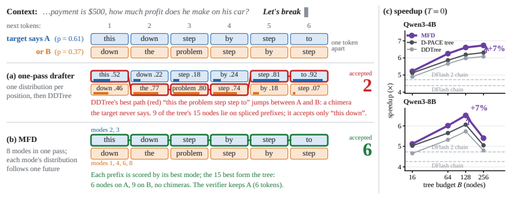
Figure 1 .Why a one-pass drafter needs several futures.(a, b) A real GSM8K context for Qwen3-4B: afterLet’s break, the target says future A (p=0.61) or future B (p=0.37). (a) A one-pass drafter (DFlash fine-tuned with D-PACE) gives one distribution per position, each mixing A’s token and B’s; DDTree’s best path jumps between the futures, a chimera. 9 of the tree’s 15 nodes lie on prefixes that splice A and B, and it accepts 2 tokens. (b) MFD’s 8 modes run in the same pass; six follow A or B, two neither. Every prefix is scored by its best mode and the 15 best form the tree: 6 nodes on A, 9 on B, none a chimera; the verifier keeps A, 6 tokens. (c) Speedup ( T=0 , 5-task mean) against the tree budget B: MFD leads the strongest D-PACE tree under the same recipe at every budget, by about 2% at B=16and 6–7% fromB=64on. DDTree uses the released drafter; dashed: chain drafters.
Original paper · CC BY 4.0 · Haoyu Huang, Jialiang Kang, Linlin Yang, Xiao Yang, Baochang Zhang · Multi-Future Drafting: Mixture Block Drafters for Tree-Verified Speculative Decoding · Original paper figure · Extracted the figure area from page 2 of the original PDF.Barring ties, two futures disagreeing at m positions force 2m−1−1 chimeras into any product-ranked tree. That fix brings back sequential drafting, which the one-pass design was meant to avoid.
The chimera count depends on the depth and fork structure of the target, not only on the drafter's quality. At forks, the two continuations of a 64-node product tree differ at most of the remaining positions. The paper's question is therefore how to keep futures apart while staying in one forward pass.
Mode embeddings and a mixture tree
MFD restores the coupling with a latent variable that names the future, so that once the future is fixed, the positions are independent. K learned mode embeddings are added to the drafter's input, and the drafter then drafts K coherent blocks in one forward pass. The extra cost is K+1 vectors of the drafter's width, with no extra drafting pass.
The authors train the modes winner-take-all, weighting a block's loss by 1−ε for its winning mode and by ε/(K−1) for the others. The main setting uses ε=0.1 with K=8 modes on 64 anchors. A gate picks the mode a block follows before verification, and it is trained with its own loss. Changing ε to 0.3 lowers the gain slightly, from 5.4% to 4.9% at B=64 with T=0.
The tree ranks prefixes across all modes, and each prefix is scored by its best mode, with the score for mode k written as log π_k plus log Q_k(v). The merged heap starts each mode from its most likely first token, and it pops entries in order of decreasing key. On 900 random instances, the merged heap returned exactly the B largest prefixes, and with K=1 it reproduced DDTree's tree node for node.
A log-sum-exp score adds the modes up instead of keeping only the best one. Its tree isn't a merge of the per-mode searches, so the authors evaluated it only in simulation.
Chimeras and budget coverage in mixture trees
The mixture tree does put less budget on chimeras, and the paper counts them on all 628 prompts of the five tasks. A chimera is a prefix that splices tokens from different futures, and a product tree holds 27 to 33% of them at B=64. The mixture tree holds 22 to 24% chimeras at B=64, and forks drive most of that difference. The same forks add 3.6 and 3.9 chimeras to the mixture tree, so the mixture tree removes 54 to 57% of them.
Chimeras also show up as dead and live nodes, and the live share separates the two trees. The mixture tree has 57 to 60% live nodes at B=64, while D-PACE's tree has 50 to 53%. In probability terms, the paper uses the exact target probabilities from the verify pass with 24 prompts per task on Qwen3-4B. At B=64 MFD trees cover 8.3% more probability mass than D-PACE's trees, and 10.3% more at B=256.
In accepted tokens, that is 6.78 against 6.26 at B=64 and 7.58 against 6.87 at B=256. So 64 MFD nodes cover nearly as much as 256 D-PACE nodes, which the authors read as budget moving from spliced prefixes to real futures. The gain sits mostly at forks, where MFD accepts 9.7 to 12.1% more tokens at B=64 and 2.4 to 3.8% more elsewhere.
Decoded as a chain that follows the gate's choice, every MFD mixture is worse than the single-mode drafter. That loss grows with K, because each mode is narrower than the averaged drafter. For K=4 the gate picks the best mode for 38% of training blocks, while chance is 25%. The same drafters decoded as a tree gain up to 8.7%, since the tree keeps the other modes' prefixes.
Speedups over baselines at batch size 1
MFD's batch-size-1 speedups are measured against a broad set of baselines on four Qwen targets, and the paper's Table 1 holds the main comparison. Under a matched recipe, the three-epoch D-PACE tree scores 6.22× on Qwen3-4B at T=0, with τ of 8.78. Across the four targets the strongest baseline is usually D-PACE with DDTree, while the released DDTree wins at T=1 on Qwen3.5-4B.
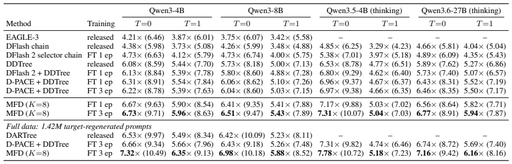
Table 1 .Speedup over autoregressive decoding and acceptance length τ (5-task means). Each tree method except DARTree is at its best budget, B∈ {16,64,128,256} on Qwen3-4B and Qwen3-8B and {16,64,256} on the thinking-mode targets (Section H). DFlash 2 + DDTree: DFlash 2’s distributions in the same tree; its selector chain at T=1 is the faster of its greedy and sampled chains. FT: fine-tuned under our recipe for 1 or 3 epochs (on Qwen3.6-27B, the 1-epoch rows are the first-epoch checkpoints of the 3-epoch runs). Bottom block: fine-tuned on the 1.42M target-regenerated prompts of Domino (Huang et al., 2026), the data of DARTree’s drafter; DARTree verifies 64 nodes with its released drafter and code. Bold: best within each block.
Original paper · CC BY 4.0The tree of DFlash 2 trails D-PACE with DDTree by 0.6 to 2.5% in the same run. Against concurrent tree drafters, DARTree is the released configuration with its Domino drafters and a 64-node pruned tree, timed on the same prompts. DARTree accepts more tokens per round at 64 nodes, but its per-depth correction takes 2.6 to 2.7 ms per round, against about 0.35 ms for MFD.
Its tree building cost, rather than acceptance, is the reason the authors give for MFD's lead over DARTree. MFD at its best budget is 1.4 to 8.7% faster than DARTree's 64-node tree, even with 14 times less fine-tuning data.
In SGLang at batch size 1, MFD reaches 5.93× on Qwen3-4B at T=0, against 4.06× for the DFlash chain on SGLang's own engine paths. That gap is 45 to 46% faster than the fastest released drafter. Against D-PACE fine-tuned on the same data in the same engine, MFD is 7 to 9% faster. At full data the full-data MFD reaches 3.7% and 7.5% faster than DARTree at T=0 and T=1 on Qwen3-4B.
JetSpec's released head trails the released DFlash drafter, and MFD is 24% and 20% faster than JetSpec at B=64 on Qwen3-8B.
Where the lead stops holding at larger batch sizes
MFD's lead at batch size 1 shrinks as more requests run at once, and the authors trace the drop to draft cost. From batch 8 it falls behind DDTree with the released drafter, and from batch 16 it falls behind SGLang's own paths. The authors explain this with a simple cost story: the draft cost grows with the batch while the acceptance length does not.
The batch-size figure runs the drafters with their linear layers in FP8, which leaves the acceptance length nearly unchanged. The single-mode drafters gain much less from FP8, so the comparison tilts further toward MFD at moderate batches. Under the same FP8 setting, MFD is 10–18% faster than every released option at batch 1–2, while 1–6% behind DDTree at batch 8.
The DARTree comparison at 64 nodes also shows the lead is not uniform across settings. On Qwen3-4B with the 100K-prompt data at 64 nodes, MFD is 4.4% slower than DARTree at T=0 and 0.4% faster at T=1. MFD's tree building takes 0.35 ms, so the cost of the tree, not its acceptance, decides the comparison here.
The mixture tree still holds chimeras at 64 nodes, 22–24% of its nodes, against 27–33% for the product trees. The log-sum-exp scoring that does better in simulation was not run in timed decoding. They didn't time the log-sum-exp tree, so its speed at batch size 1 is left open.
Paper info
- Authors
- Haoyu Huang, Jialiang Kang, Linlin Yang, Xiao Yang, Baochang Zhang
- Venue
- arXiv · Preprint
- First published
- 2026-11-9
- Added
- 2026-11-11
- Updated
- 2026-11-9
- Version
- v1
- arXiv
- 2611.13017
- Category
- cs.AI · cs.LG
- Original paper terms
- CC BY 4.0
- What we show
- Paper info, commentary and permitted figures from the original paper
AI commentary is a separate explanation from the original paper and may contain errors. The original paper and figures follow each source's terms of use and any rights noted separately.
Abstract
Block drafters such as DFlash draft a block of future tokens in one forward pass, and draft trees such as DDTree verify the prefixes ranked highest by the product of the drafter's per-position distributions. Under tree verification, the expected number of accepted tokens is the probability mass the tree covers. We show that a product misallocates it: when the continuation can follow several futures, it splices them into chimeras, prefixes stitched together from different futures that the target never produces, and gives them as much budget as the futures themselves. Barring ties, no product-ranked tree can hold two futures that disagree in $m$ positions without $2^{m-1}-1$ chimeras, however well the drafter is trained, and in practice chimeras make up 27-33% of a 64-node tree. We propose Multi-Future Drafting (MFD), which restores the coupling with a latent variable instead of the chain rule: $K$ learned mode embeddings at the drafter's input draft $K$ coherent blocks in the same pass, and a mixture DDTree lets the verifier pick the future the target takes, losslessly and with $K+1$ extra vectors. On four Qwen targets from 4B to 27B parameters, at batch size 1, MFD reaches up to 7.8$\times$ speedup, 5-8% faster than the best single-mode tree trained identically and, on Qwen3-4B and Qwen3-8B, 9-16% faster than the released DARTree trained on the same prompts.
Quote from the paper
Haoyu Huang, Jialiang Kang, Linlin Yang, Xiao Yang, Baochang Zhang (2026). Multi-Future Drafting: Mixture Block Drafters for Tree-Verified Speculative Decoding. arXiv:2611.13017v1. https://arxiv.org/abs/2611.13017v1
BibTeX
@misc{huang2026multi,
  title = {{Multi-Future Drafting: Mixture Block Drafters for Tree-Verified Speculative Decoding}},
  author = {Haoyu Huang and Jialiang Kang and Linlin Yang and Xiao Yang and Baochang Zhang},
  year = {2026},
  eprint = {2611.13017},
  archivePrefix = {arXiv},
  url = {https://arxiv.org/abs/2611.13017v1}
}