Paper commentary
Bellman Contraction under MMD: A Unified Framework
Bellman contraction under MMD reduces to a kernel positivity test
- Problem Only a few kernels were known to make the distributional Bellman operator contract under MMD. Practitioners using the RBF kernel had no general criterion to check contraction.
- Method The authors reduce contraction to conditional positive definiteness of a Bellman difference kernel built from the base kernel. For radial kernels, Schoenberg's theorem turns this check into a test on a Bernstein function.
- Results The authors prove that the Bellman operator contracts whenever the Bellman difference kernel is conditionally positive definite. The search finds 11 new kernels that induce contraction.
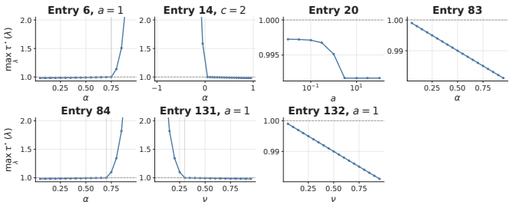
Figure 10 : Each panel shows, for one entry of Table 8, the largest estimate of τ ⋆(λ) over λ as a function of the entry’s parameter. The entry induces contraction where the curve is below the dashed line. The dotted lines mark where the curve crosses 1, found by a root search. Entry numbers refer to [29].
Original paper · CC BY 4.0 · Baptiste Debes, Tinne Tuytelaars · Bellman Contraction under MMD: A Unified Framework · Original paper figure · Extracted the figure area from page 71 of the original PDF.Why contraction under MMD is hard to settle
That property governs whether the resulting learning objective is principled.
Known results cover only a handful of kernels, and the paper's summary table lists the power-distance and multiquadric kernels as contracting. The Gaussian RBF kernel is known not to induce contraction in general, even though it still performs among the best in practice. The multivariate MMD result, proved only for kernels satisfying those same conditions, leaves the RBF outside its reach.
So a practitioner who wants to use the RBF or a new kernel has no general criterion to check.
The paper's answer begins with a definiteness property of an associated kernel, namely conditional positive definiteness. Conditional positive definiteness requires the quadratic form to be nonnegative for every set of weights that sum to zero. Theorem 3.1 turns this into the Bellman difference kernel, built from the base kernel k and the discount γ.
This reduction is the starting point for the rest of the framework.
A definiteness test for contraction
The key idea is that contraction becomes a sign condition on a new kernel built from the base kernel. A kernel is conditionally positive definite when its quadratic form is nonnegative for every set of points whose weights sum to zero. The quadratic form is the sum over i and j of w_i w_j k(x_i, x_j), so the constraint on the weights does most of the work.
Conditional negative definiteness is the mirror case, with the inequality reversed. Defining the property this way lets the authors test contraction with a fixed set of weights rather than with full distributions.
The authors build a Bellman difference kernel for each reward value q. The kernel is tau times k(x, y) minus k(q + gamma x, q + gamma y), with tau in [0, 1). The base kernel k is evaluated once at the points x and y and once at their rescaled, shifted images. The factor tau sets the target contraction rate that the difference kernel must satisfy.
The first condition is that the Bellman operator is a tau-contraction in MMD squared for every MDP with discount gamma and every fixed policy. The second condition is that the Bellman difference kernel is CPD for every reward value q. Under this equivalence, the smallest contraction factor is the smallest tau for which the second condition holds.
The authors stress that the test is sharp for the uniform statement over all MDPs. If the CPD condition fails, there exist an MDP with discount gamma and a fixed policy where the operator is not a tau-contraction. The test therefore doesn't certify contraction for one specific MDP, since the claim is about all of them. The proof of this equivalence is deferred to Appendix C, so the reader can check it there.
Radial kernels are the class where this CPD condition becomes easiest to check, and the next step uses that structure.
Checking radial kernels through Bernstein functions
A radial kernel depends only on the distance between its two arguments, so it can be written as g of the norm of x minus y. Schoenberg's theorem says such a kernel is conditionally negative definite in every dimension exactly when h(r) equals phi(r squared) for some Bernstein function phi. A Bernstein function has a Lévy–Khintchine representation with a nonnegative drift term and a Lévy measure that satisfies the integrability condition with min{1, s}.
The paper also calls phi a complete Bernstein function when the Lévy measure has a completely monotone density m.
For a radial kernel, the authors assume the difference h(r) equals g(0) minus g(r) can be written as phi(r squared), and they call phi the Bernstein profile. They then define the Bellman difference profile psi_tau(t) as tau phi(t) minus phi(gamma squared t), for tau in [0, 1). If psi_tau is a Bernstein function, the operator is a tau-contraction in MMD squared.
The same condition is necessary for every MDP with discount gamma, every fixed policy, and every ambient dimension d at least 1.
The test turns a question about a full kernel on R^d into a question about one nonnegative function of t. Checking whether psi_tau is Bernstein then reduces to examining a single real function, which is easier than checking the kernel condition directly. The mean embedding argument in the appendix is a separate tool and isn't needed for this check.
How the numerical search estimates the contraction factor
The search writes the scale as s equal to e to the u and works over a window of u values. Instead of maximizing the ratio directly, the search maximizes its logarithm, which avoids overflow and underflow when the density is very large or very small. Because the logarithm is increasing, the supremum of the ratio is recovered as the exponential of the supremum of the log ratio.
The search first evaluates the log ratio at n grid equally spaced points on the window [-U, U] and keeps the K largest values. It then runs K local maximizations with minimize_scalar from SciPy, each on an interval of half-width c loc times the grid step around a selected point. The grid guards against a single local search stopping at a local maximum below the supremum, while the local searches refine the best points.
The search returns exp of the best log ratio as its estimate, and it reports whether the best point sits at an end of the window.
The density values are computed with mpmath at 80 significant digits, and only their logarithms are rounded to double precision. Entries 1 and 2 serve as checks, since the search recovers their known closed-form contraction factors up to rounding errors.
Its estimate therefore stays below 1 while the ratio keeps increasing towards 1 further left. Because the window cuts the search off, the estimate can miss a larger value further out. The authors conclude that the contraction factor equals 1 for every lambda in (0,1) for Entry 78.
Which kernel entries contract
The numerical search can be checked against kernels whose contraction factors are already known in closed form. For the power-distance and generalized multiquadric entries, the search recovers those closed-form smallest contraction factors across dimensions up to rounding errors. The multiquadric kernel is the case beta equal to 1/2 of the generalized multiquadric family.
Entry 2 with alpha equal to 1/2 gives the multiquadric kernel studied in earlier work.
Entries 3, 4 and 26 do not induce contraction, and the authors prove this in Proposition G.1. The search agrees with that proof, so the numerical and analytic checks point the same way for these entries. The authors also use Corollary E.5.1, which rules out contraction for any entry whose Lévy density has a finite limit as s tends to 0 from above.
Entries 99, 100, 102, 103, 108 and 109 meet this condition. The authors list only these entries because the limit is immediate for them.
Table 8 lists the entries that induce contraction, and most of them hold only for some values of their parameter. Entry 6 contracts for alpha up to 3/4, while Entry 14 contracts for every positive alpha. Entries 1, 2, 5, 18, 20, 38, 64, 82 and 132 contract for every value of their parameter. For the other seven parameterized entries, the authors ran the search over many parameter values and located the crossing of 1 with a root search.
Entry 5 is Entry 6 with alpha equal to 1/2.
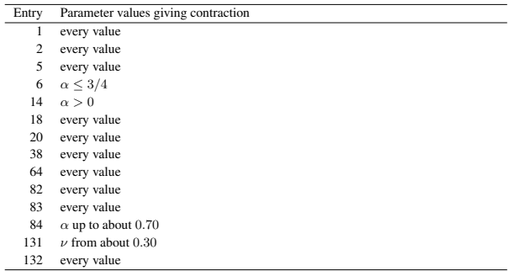
Table 8 : Entries that induce contraction. Entry numbers refer to [29]. The second column gives the parameter values for which the entry induces contraction, among those allowed in [29]. Entry 1 gives the power-distance kernel studied in [25], and Entry 2 with α= 1/2 gives the multiquadric kernel studied in [19]. Entry 5 is Entry 6 withα= 1/2.
Original paper · CC BY 4.0The power-distance kernel with exponent alpha has smallest contraction factor gamma to the alpha across dimensions. The authors use this kernel family in the higher-dimension tradeoff check, where the constraint becomes gamma to the alpha at most the budget. Entry 1 gives the power-distance kernel studied in earlier work.
Contraction speed against discriminative power
The authors measure discriminative power as the rejection rate of a level-alpha kernel two-sample test built on the biased MMD statistic. The test statistic is the quadratic form of a two-sample weight vector with a Gram matrix over the pooled sample. Under the null hypothesis the labels are exchangeable, so permuting the labels produces a null distribution for the statistic.
The permutation p-value counts how often a permuted statistic reaches the observed one, with a plus-one correction. Figure 16 shows one such null distribution for the RBF kernel with lengthscale 1.05 at level 0.05.
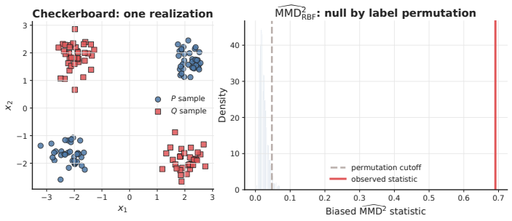
Figure 16 : One example of the permutation test used for power estimation, using the RBF kernel with lengthscale ℓ= 1.05 at level α= 0.05 . Left, one realization of the checkerboard two-sample
Original paper · CC BY 4.0Each power value is a rejection fraction over 1000 outer repetitions of fresh dataset draws. Each repetition uses 1000 label permutations, and the level alpha is 0.05. Algorithm 4 fixes a contraction budget and keeps only the kernel parameters whose estimated smallest contraction factor on the ball stays below it. Among these parameters, the authors report the best power, and cells with no feasible parameter stay empty.
The smallest contraction factor is estimated on a ball B(0, R), where the radius R clips the sampled data.
The datasets include the Checkerboard, the Two-Gaussian Location and the 1D Mean Shift problems, each with its own clipping radius. The heatmaps vary the discount factor gamma and the contraction budget, and they show the best power for each cell. The dotted curve marks the smallest possible contraction factor gamma squared. The authors read these heatmaps as a tradeoff between speed of contraction and power.
In higher dimensions, the power-distance kernels have smallest contraction factor gamma to the alpha, with no estimation on a ball. For the mean shift task, the power doesn't depend on alpha, so faster contraction costs no power in any dimension. The tradeoff therefore isn't uniform across tasks, and the heatmaps only show the effect on the chosen datasets.
Limitations of the numerical search and the power experiments
The numerical search for the supremum of the ratio runs on a bounded window, so it can miss a supremum approached only at the ends of the range. The window is written as [−U, U] in the logarithmic variable u, which covers s from e^−U to e^U. A single local search can stop at a local maximum below the supremum, which the authors mitigate with a fine grid and several local searches.
Its estimate in Figure 7 stays below 1, yet the ratio keeps increasing towards 1 further left, so the estimate may miss a larger value. The authors conclude that τ⋆(λ) = 1 for every λ in (0,1) for Entry 78, while the plotted estimate remains below 1. Entries whose estimate equals 1 up to numerical precision do not induce contraction, but they may be non-expansive.
The power experiments use a fixed set of datasets, and each dataset is clipped to a radius R that contains most of its mass. The power is a rejection fraction over B = 1000 outer repetitions with a permutation budget of 1000, so its conclusions apply to those tasks and settings. The kernel families in the tradeoff study are restricted to the parameter grids of Table 11, so other parameter values were not tested.
Paper info
- Authors
- Baptiste Debes, Tinne Tuytelaars
- Venue
- arXiv · Preprint
- First published
- 2026-11-12
- Added
- 2026-11-14
- Updated
- 2026-11-12
- Version
- v1
- arXiv
- 2611.17116
- Category
- cs.LG
- Original paper terms
- CC BY 4.0
- What we show
- Paper info, commentary and permitted figures from the original paper
AI commentary is a separate explanation from the original paper and may contain errors. The original paper and figures follow each source's terms of use and any rights noted separately.
Abstract
We introduce a mathematical framework for studying contraction of the distributional Bellman operator under Maximum Mean Discrepancy (MMD). We show that contraction reduces to conditional positive definiteness of an associated kernel constructed from the base kernel, which we call the Bellman difference kernel. Focusing on radial kernels, we use Schoenberg's theorem to connect this condition to Bernstein functions. This gives contraction criteria that hold in any dimension and can be verified analytically or tested numerically. Our framework unifies known results for the Gaussian RBF, power-distance, and multiquadric kernels. A numerical search identifies 11 new kernels that induce contraction. We also propose chaining, a general construction that produces kernels inducing contraction with any prescribed factor. To reconcile theory with practice, we show that contraction on a set only requires conditional positive definiteness on that set. This explains why the RBF kernel can remain a valid choice when rewards are bounded, despite its lack of global contraction. Finally, we identify a fundamental tradeoff between contraction rate and discriminative power, where kernels that contract faster tend to discriminate less between distributions. Code is available at https://github.com/BaptisteDebes/BellmanContractionMMD
Quote from the paper
Baptiste Debes, Tinne Tuytelaars (2026). Bellman Contraction under MMD: A Unified Framework. arXiv:2611.17116v1. https://arxiv.org/abs/2611.17116v1
BibTeX
@misc{debes2026bellman,
  title = {{Bellman Contraction under MMD: A Unified Framework}},
  author = {Baptiste Debes and Tinne Tuytelaars},
  year = {2026},
  eprint = {2611.17116},
  archivePrefix = {arXiv},
  url = {https://arxiv.org/abs/2611.17116v1}
}