Paper commentary
Benchmarking LLM Inference on Desktop-Scale NVIDIA Grace Blackwell Clusters
Tensor parallelism beats pipeline parallelism on two linked desktop Grace Blackwell systems
- Problem Two linked DGX Sparks have no NVLink, so the usual advice to keep tensor parallelism inside one server may not hold. Teams lacked benchmarks showing whether splitting one model across both systems beats running two independent replicas.
- Method The authors benchmark 17 open-weight checkpoints on one Spark and on two Sparks linked by 200 GbE. They compare tensor parallelism (TP=2) and pipeline parallelism (PP=2) with a two-replica baseline, using vLLM at concurrency 1 to 64.
- Results TP=2 raised median peak throughput by 1.59× over one Spark, versus 1.39× for PP=2. It also cut unloaded inter-token latency to 0.52× to 0.73× of one Spark, while PP=2 gave little reduction.
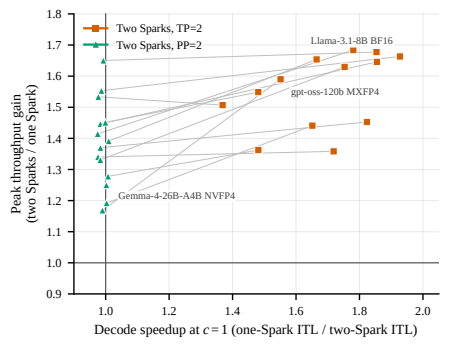
Fig. 1 . Performance gains from distributing a model across two DGX Sparks. Each marker represents one checkpoint under one parallel deployment, with lines connecting TP=2 and PP=2 results for the same checkpoint. The horizontal axis shows unloaded decode speedup, defined as the ratio of one- Spark to two-Spark inter-token latency at concurrency 1. The vertical axis shows peak throughput speedup, defined as the ratio of two-Spark to one- Spark peak throughput over concurrency levels up to 64. TP=2 improves both decode latency and peak throughput, whereas PP=2 improves peak throughput with little change in unloaded decode latency.
Original paper · CC BY 4.0 · Kevin Bhimani, Christian Escobar, Daniel Mihovch, Rudolf Eigenmann, Sunita Chandrasekaran · Benchmarking LLM Inference on Desktop-Scale NVIDIA Grace Blackwell Clusters · Original paper figure · Extracted the figure area from page 2 of the original PDF.Why two linked Sparks are not a simple doubling
Two Sparks linked through their ConnectX-7 ports double the memory capacity available for one model. Usual multi-GPU serving guidance keeps tensor parallelism inside a server, because NVLink supports frequent collective operations. A Spark pair has no NVLink, so its two GPUs exchange data over a pair of 200 GbE connections. The platform also lacks GPUDirect RDMA, and each GPU reads unified LPDDR5x memory rather than dedicated HBM.
These differences make it hard to predict whether the usual splitting rules hold on this hardware.
Pipeline parallelism instead assigns different layers to each GPU and passes activations between the two stages. The authors ask whether splitting one model beats running two independent replicas, since replicas avoid that communication. They judge both options on throughput, latency, goodput and GPU energy efficiency.
The study covers 17 open-weight checkpoints, from 8B to 235B parameters, across four weight precisions. Three of these checkpoints need two Sparks for the evaluated configurations. Both strategies run over NCCL on RoCEv2, with all four network rails configured.
How the two splits move data over the link
Tensor parallelism shards each layer's weight matrices across both Sparks, so each Spark reads roughly half the weights per decode step. Each pipeline node reads only its own stage's weights and sends intermediate activations across the stage boundary. At concurrency 1 the stages run sequentially, so pipeline parallelism can't cut decode latency through stage overlap.
With several requests in flight or long prompts split into prefill chunks, the stages can work on different batches at once.
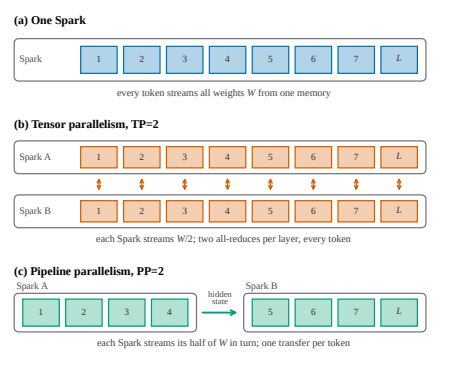
Fig. 2 . Three serving deployments. (a) One Spark executes all layers and reads the model weightsWfrom local memory. (b) TP=2 distributes each layer across both Sparks, requiring two all-reduces per layer. (c) PP=2 assigns half the layers to each Spark and transfers activations between stages.
Original paper · CC BY 4.0Tensor parallelism pays for its speedup in communication, since a dense model with L layers needs about 2L all-reduces per decode step. For Llama-3.1-8B with a hidden size of 4096 in BF16, one decode token produces an 8 KiB payload. A batch of 64 tokens raises that payload to 512 KiB, so the message size grows with batch size. A 2,048-token prefill chunk produces a 16 MiB payload, which is much larger than a decode message.
At low concurrency the fixed latency of each collective dominates the communication cost, while larger batches make message size matter more. For pipeline parallelism, the transferred hidden state and residual together carry twice the payload of one TP all-reduce in Llama-style models.
The two Sparks connect through ConnectX-7 ports without a network switch, and NCCL runs over RoCEv2 instead of TCP sockets. NCCL can silently fall back to TCP when RDMA devices are unavailable inside the container, so the authors checked the transport of every dual-node launch. The authors audited all 148 dual-node launches, and every one used NET/IB across four RoCEv2 devices.
DGX Spark doesn't support GPUDirect RDMA, so NCCL staged transfers through host-registered buffers. Because CPU and GPU share LPDDR5x memory, that staging adds memory copies instead of moving data between separate pools. Every deployment used the same vLLM engine settings with a 2,048-token batched-token budget, so the split is the variable that changes.
Tensor parallelism wins on peak throughput and single-request latency
Tensor parallelism raised peak throughput over one Spark more than pipeline parallelism did across the 13 complete checkpoints. TP=2 reached a median 1.59× peak-throughput gain, while PP=2 reached a median 1.39×. Welch intervals put TP=2 above PP=2 in 93 of 96 matched checkpoint and concurrency comparisons, and none favored PP=2. The gap is widest at low concurrency, which the top row of Fig.
4 shows curve by curve.
At concurrency 1, Llama-3.1-8B BF16 reached 25.0 tok/s under TP=2, versus 13.2 tok/s on one Spark. PP=2 delivered 13.1 tok/s, roughly matching one Spark, because its stages run one after another for a single request. Under TP=2 both GPUs read their own weight partitions at the same time, so the second Spark helps before any pipeline overlap.
At concurrency 1, TP=2 cut inter-token latency to 0.52 to 0.73× of one Spark across all 13 complete checkpoints, with a median of 0.58×. Every one of those differences is separated, so the Welch interval excludes zero. Dense checkpoints reached 0.52 to 0.58×, while MoE checkpoints reached 0.60 to 0.73×. The authors attribute the smaller MoE gain to communication and other overheads that weigh more when the active weight footprint is small.
So the advantage shows up in both peak throughput and unloaded latency, but only TP=2 delivers the latency reduction. PP=2's throughput gains grow mainly as concurrency rises enough to overlap pipeline stages.
Where pipelining helps prefill, and where goodput favors tensor parallelism
Prefill is the one metric where PP=2 has the larger median gain, at 1.62× against TP=2's 1.49×. Relative to one Spark, TP=2 raised prefill rate by 1.29–1.70×, while PP=2 reached 1.48–1.68×. The two splits help prefill through different mechanisms, and pipelining's benefit comes from stages working on different prefill chunks at the same time.
For 8,192-token prompts at concurrency 1, PP=2 brought median TTFT to 0.63–0.69× of one Spark. Under an idealized two-stage pipeline, a prompt split into k chunks finishes in (k+1)/(2k) of the single-Spark time.
Under TP=2, both GPUs process each prefill chunk concurrently, which cut TTFT for 8,192-token prompts to 0.60–0.82× of one Spark. Short prompts pay for collective communication instead, and on Llama-3.1-8B TP=2 added 24–47 ms for 128-token prompts. The NCCL microbenchmarks offer one explanation: a 128-token prompt produces 1 MiB all-reduce payloads costing 593–658 µs per collective.
Across 64 such collectives, Llama-3.1-8B spends roughly 41 ms on communication, comparable to its 37–86 ms one-Spark 128-token prefill time.
Goodput uses a strict tier with a 3 s TTFT limit and a 100 ms mean ITL limit, so latency decides which concurrency levels count. Among checkpoints with nonzero one-Spark strict-tier goodput, TP=2 reached a median gain of 2.00× over one Spark. PP=2 reached a median gain of 1.23× on the same checkpoints, so the gap is wide. TP=2's advantage follows from its lower decode latency, which keeps the median ITL under 100 ms at more concurrency levels.
At the concurrency where TP=2 reaches its maximum goodput, the advantage over PP=2 is separated on 10 of 12 checkpoints.
Splitting against replicating, and what each costs in energy
The replica pair is built from single-Spark runs rather than from a measured two-replica setup. The baseline assumes zero routing cost, independent nodes, and matching performance on both Sparks. At total concurrency c, the pair delivers twice the one-Spark throughput at c/2, with the same latency and energy per token.
At concurrency 8, TP=2 beats the replica pair on throughput for 10 of 13 complete checkpoints, reaching 0.95 to 1.55× of its throughput. At that same load, TP=2 also shows lower ITL on 10 checkpoints and lower energy per token on 10. At concurrency 64, replication wins on throughput for 11 checkpoints, while TP=2 reaches 0.75 to 1.05× of the pair.
Replication also gives lower ITL on 12 checkpoints and lower energy per token on 12 at that load. TP=2 stays ahead in throughput only on gpt-oss-120b MXFP4, and Gemma-4-31B NVFP4 is undecided.
PP=2 is never separated above replication in throughput, latency or energy at any evaluated load. Its best case reaches 0.92× of the replica pair's throughput. The gap reflects a tradeoff between speeding up one request and serving separate batches. At low concurrency, TP=2 cuts decode latency by splitting each layer across both GPUs.
One Spark uses less GPU energy per token than either two-Spark deployment in all 78 comparisons with TP=2 and all 78 with PP=2. Every one of those margins is separated. From concurrency 1 to 64, single-Spark throughput rose 3.7 to 15×, while GPU power rose only 1.2 to 1.8×. At concurrency 64, TP=2 used a median 1.18× and PP=2 a median 1.19× the single-Spark energy per token.
These figures count GPU power only, excluding CPU, networking and power-supply energy. Total system energy was not measured, so the energy comparison stays GPU-only.
Did lower collective cost cause the reversal?
The earlier TCP campaign favored PP=2 over TP=2, which matches conventional multi-node guidance. The authors reran the comparison over RDMA and used NCCL microbenchmarks to see how lower communication overhead could produce the reversal. RDMA gave 2.4–9.0× the all-reduce bus bandwidth of TCP across the 8 KiB to 1 MiB decode payload range.
Llama-3.1-8B performs 64 such operations per step, so the estimated collective cost drops from 9.1 ms over TCP to 1.7 ms over RDMA. The estimated saving of 7.4 ms per token is close to the observed reductions of 11, 7 and 10 ms across its BF16, FP8 and NVFP4 checkpoints. Send/recv stays more communication-efficient than all-reduce, but TP=2 also gains because both GPUs read their weight partitions concurrently.
Relative to TCP, TP=2 peak throughput rose by 1.68× at BF16, 2.37× at FP8 and 2.58× at NVFP4. PP=2 improved by only 1.04–1.07× over the same campaigns.
One-Spark throughput stayed within approximately 1 % of its earlier value, so the gain is tied to the two-Spark link rather than the node. The largest relative improvement appears in TP=2 time to first token, where TTFT at c=1 fell by 231–246 ms to 0.28–0.40× of its TCP value. For the median 1,024-token prompt, the NCCL microbenchmarks predict about 207 ms of collective savings across 64 all-reduces.
The authors read these NCCL estimates as explaining much of the TP=2 improvement, but they don't isolate the interconnect from other changes.
Limitations of the deployment rules
The study covers one vLLM version, two GB10 systems and pipeline depth two, so the findings may not carry over to other setups. Model quality under quantization was not evaluated, so the precision advice speaks only to speed and throughput. The synthetic workload used fixed-length greedy decoding, closed-loop concurrency and disabled prefix caching.
Its mix of about 10 prompt tokens per generated token may shift the relative benefits of prefill and decode optimizations.
One planned configuration never ran: TP=2 for Gemma-4-26B-A4B NVFP4, because the FlashInfer CUTLASS MoE implementation lacks the weight-padding support that tensor parallelism needs. The FP8 variant of Nemotron-3-Super-120B-A12B also has no comparable PP=2 result, because all three PP=2 launches failed before measurement. The authors note that actual replica performance may differ from that model.
Strict-tier goodput is the noisiest metric, with a maximum coefficient of variation of 86.6 % across replicates. The median throughput CV is 0.4 %, so the throughput rankings hold up better than the goodput ones.
Paper info
- Authors
- Kevin Bhimani, Christian Escobar, Daniel Mihovch, Rudolf Eigenmann, Sunita Chandrasekaran
- Venue
- arXiv · Preprint
- First published
- 2026-11-15
- Added
- 2026-11-17
- Updated
- 2026-11-15
- Version
- v1
- arXiv
- 2611.20289
- Category
- cs.DC · cs.AI
- Original paper terms
- CC BY 4.0
- What we show
- Paper info, commentary and permitted figures from the original paper
AI commentary is a separate explanation from the original paper and may contain errors. The original paper and figures follow each source's terms of use and any rights noted separately.
Abstract
Two NVIDIA DGX Spark GB10 systems connect directly over 200 GbE to serve larger language models and increase inference capacity, but the benefits depend on how they are deployed. We benchmark 17 open-weight checkpoints spanning dense and mixture-of-experts architectures, 8B to 235B parameters and four weight precisions on one and two RDMA-connected systems. Using vLLM, we compare tensor parallelism (TP=2), pipeline parallelism (PP=2) and a two-replica baseline at concurrency 1 to 64, with three independent launches per configuration. TP=2 delivers a median 1.59x peak-throughput gain over one Spark, versus 1.39x for PP=2 and has higher throughput in 93 of 96 matched comparisons with separated 95% Welch intervals. It reduces unloaded inter-token latency to 0.52x to 0.73x of one Spark, whereas PP=2 provides little reduction. TP=2 also achieves the highest goodput under a strict 100 ms inter-token latency objective wherever both strategies are supported and the objective is met. For models fitting on one Spark, TP=2 generally favors low-concurrency serving, while replication offers higher throughput at high concurrency. One Spark uses less GPU energy per output token at matched concurrency. Across three precision ladders, NVFP4 reduces unloaded latency more than adding a second Spark at BF16. NCCL microbenchmarks and comparisons with an earlier TCP campaign suggest that collective communication overhead contributes to the advantage of TP=2. These results provide deployment guidance for desktop-scale inference.
Quote from the paper
Kevin Bhimani, Christian Escobar, Daniel Mihovch, Rudolf Eigenmann, Sunita Chandrasekaran (2026). Benchmarking LLM Inference on Desktop-Scale NVIDIA Grace Blackwell Clusters. arXiv:2611.20289v1. https://arxiv.org/abs/2611.20289v1
BibTeX
@misc{bhimani2026benchmarking,
  title = {{Benchmarking LLM Inference on Desktop-Scale NVIDIA Grace Blackwell Clusters}},
  author = {Kevin Bhimani and Christian Escobar and Daniel Mihovch and Rudolf Eigenmann and Sunita Chandrasekaran},
  year = {2026},
  eprint = {2611.20289},
  archivePrefix = {arXiv},
  url = {https://arxiv.org/abs/2611.20289v1}
}