Paper commentary
Benchmarking LLM Next-Step Recommendations with Knowledge Space Theory
Knowledge space theory lets us score LLM next-step recommendations against a reference
- Problem Fluent LLM learning recommendations can hide structural errors, and plausibility checks miss them. General benchmarks like MMLU measure subject knowledge, not whether next steps fit a learner's prerequisites.
- Method The benchmark computes a reference set of next steps from the task catalogue and prerequisite relation, without any model. Each model's returned set is then compared with that reference, instead of judging how plausible the text sounds.
- Results Exact-set accuracy rose from 61.3% with descriptions only to 96.3% with supplied prerequisite relations across 2,400 responses from six models. The gain came from the supplied relations, not from asking models to rebuild them.
Why fluent recommendations need a structural check
Choosing an LLM and prompt for a learning tool is a selection problem with a concrete target: which next learning steps a learner should see. A fluent recommendation can hide a structural error that a reader may not notice. A model may treat prerequisite tasks as parallel, leave out a feasible task, or propose a task the learner has already mastered.
Plausibility ratings and text-quality judgements don't confirm that a recommendation fits the intended progression.
Whether a recommendation is valid depends on its context, so the same answer can be right in one setting and wrong in another. Some prerequisites come from the mathematics of a task, such as finding a linear function's slope and intercept before its equation. Other prerequisites come from the instructional order that a curriculum or classroom adopts.
A benchmark therefore needs an explicit account of the intended progression, so one procedure can serve different domains without treating one sequence as universally correct.
General benchmarks don't settle this question, because MMLU covers knowledge and problem-solving across 57 academic and professional subjects. Answering subject-matter questions and choosing next learning steps are different tasks, so general accuracy doesn't transfer directly. Gevers et al. (2025) propose adding targeted test suites for downstream use cases to standardized benchmarks.
Knowledge Space Theory gives the paper an evaluation reference for this problem, because it models the prerequisite structure within a domain. The reference lets a researcher compare an LLM's recommendations with a KST-derived set rather than judging how plausible the text sounds.
A reference computed from prerequisites
The benchmark's reference is the outer fringe, computed from the task catalogue and the prerequisite relation rather than from any model output. Knowledge Space Theory builds the knowledge space as the family of task subsets closed under prerequisites, and each such subset is a learning state. The surmise relation behind it is reflexive and transitive, so mastering a task implies mastering its prerequisites.
The outer fringe of a state K holds each unmastered task q that can be added to K alone while K plus q remains a valid state. In these acyclic structures, the check reduces to confirming that every prerequisite of the candidate task is already mastered. The full task set has an empty fringe, so a terminal state has an empty reference recommendation set.
The benchmark can compute each selected state's fringe before any model is queried. For a known prerequisite relation, the fringe comes from checking prerequisites, so the knowledge space never has to be enumerated. No LLM is needed for this computation, so the model appears only on the side being tested.
Alternatively, the prompt can add prerequisite relations or admissible states, which changes how much structure the model sees. This set comparison doesn't require judging the wording of the explanations that accompany each recommendation.
How one benchmark call is scored
Each response must name every admissible next step and nothing else before the scorer can use it. The scorer maps each returned item to a canonical task identifier, so wording never enters the comparison. Responses with malformed JSON, repeated or out-of-range positions, extra prose, or truncation count as incorrect. A transport failure without model output is recorded as technical missingness, not as an empty prediction.
The scorer treats the model's set P and the reference fringe T as unordered sets. The symmetric difference D counts each added or omitted recommendation once, so it is zero only when the sets match. Jaccard similarity divides shared recommendations by all recommendations in either set, and it reaches one only for complete agreement. Precision, recall and F1 read the same comparison as a classifier, with additions as false positives and omissions as false negatives.
F1 is the harmonic mean of precision and recall, which separates inadmissible additions from missed alternatives.
Exact-set accuracy is the strictest measure, because a response passes only when it equals the reference fringe. It doesn't separate a response with one error from one with several errors, so the partial measures stay necessary. For terminal states the reference is empty, so an empty answer there is fully correct. An empty prediction against a nonempty reference scores zero on every measure.
A nonempty prediction against an empty reference gets recall of one, while its other measures are zero. Macro F1 is the plain mean of the response-level F1 scores.
The four prompt conditions differ in what the model sees: P0 gives only descriptions, while P2 supplies the direct cover relations. P1 adds a graph output requirement, so its comparison with the other conditions includes that extra requirement. Crossing 50 states, four conditions, six models and two orders gives 2,400 calls. Component names become temporary positions, and two permutations per domain come from SHA-256 seeds.
Structural information drives exact-set accuracy
Figure 1 places exact-set accuracy beside macro F1 for the four prompt conditions. With descriptions alone, P0 reached 61.3% exact-set accuracy over 600 responses. Asking the model to rebuild the prerequisite graph in P1 gave 62.8%, only 1.5 percentage points higher. The F1 gap was slightly negative at –1.2 points, mostly because recall fell by 2.6 points.
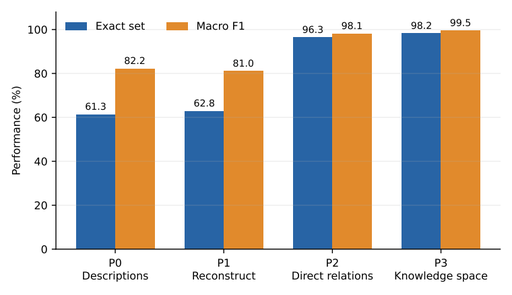
Figure 1 : Exact-set accuracy and macro F1 across structural-information conditions. Each condition contains 600 responses: 50 states, six models, and two component orders.
Original paper · CC BY 4.0 · Peter Steiner, Jan Hochweber · Benchmarking LLM Next-Step Recommendations with Knowledge Space Theory · Original paper figure · Extracted the figure area from page 9 of the original PDF.Supplying the direct prerequisite relations in P2 raised exact-set accuracy to 96.3%. That result sits 33.5 points above P1, with a 95% interval of [22.7, 44.7] and an adjusted p below .0001. The largest observed gain came from the supplied reference relation, not from reconstruction. Macro F1 rose from 81.0% in P1 to 98.1% in P2.
P3, which supplied the admissible states, reached 98.2% exact-set accuracy. It exceeded P2 by 1.8 exact points, with a 95% interval of [0.5, 3.2]. The adjusted randomization p of .0505 sits just above .05. The interval and the test describe the same small difference, and they don't show that P2 and P3 are equivalent.
All 192 terminal-state responses returned an empty recommendation set. Terminal states have an empty reference fringe, so an empty answer counts as fully correct.
Domains and models rank differently by condition
Domain effects concentrate in the two conditions that supply no structure, P0 and P1. Slope was the weakest domain overall at 65.0%, against 97.0% for Equation to Graph. Under P0, Slope reached 36.4%, and under P1 it fell to 25.8%. Under P2, Slope rose to 98.5%, and domain-specific accuracy stayed between 94.6% and 98.5%. Domain differences therefore shrink once the reference structure is supplied.
Averaged over all four conditions, the six models' exact-set accuracy ranged from 75.5% to 86.0%. That spread is narrower than the 36.8-point range the same models showed across conditions. Every one of the six models scored higher in P2 than in P1. For choosing a model for one application, the authors prefer estimates split by condition over a cross-prompt mean.
Claude Fable 5 ranked first under P0 at 76% and under P1 at 70%. In P2, GPT-5.6 Sol, Gemini 3.1 Pro Preview and Gemini 3.7 Flash each scored 100%, while Claude Fable 5 scored 98%. Gemini 3.1 Pro Preview moved from 51% under P0 to joint second place under P1. On Graph to Equation under P1, Claude Fable 5 and GPT-5.6 Sol each recovered 17 of 18 reference sets.
Gemini 3.7 Flash recovered 14 of those sets, and the three-response gap is descriptive because each model saw the same nine states.
No model consistently achieved the highest score across all 16 domain–condition combinations, even counting shared first places. Under P1, Claude Fable 5 led Linear Modelling at 71.7%, whereas Gemini 3.7 Flash led Slope at 36.4%. Gemini 3.7 Flash ranked last in pooled P1 results despite leading Slope.
Agreement across catalogue orders
The study ran each model, condition and state in both catalogue orders, which gives 1,200 pairs to compare. Each domain received two deterministic random permutations of its component IDs, generated from SHA-256 seeds. The two orders present the same component catalogue in different positions, so each pair compares two equivalent presentations.
Because these calls aren't identical-prompt repeats, a disagreement may come from presentation effects or from stochastic variation.
Recommendation sets matched exactly in 85.25% of the 1,200 pairs. The mean pairwise Jaccard similarity across these pairs was 92.5%. Roughly one pair in seven therefore differed in at least one recommendation. Both orders appeared in every model, condition and state combination, so presentation coverage stayed balanced.
The authors attribute the disagreement to two sources: order effects and stochastic response variability. The design can't separate these two sources, so the 85.25% figure mixes them. Agreement between two predictions measures consistency, not correctness. Two answers may match each other and still both miss the reference fringe. The agreement figures come from four linear-function domains, so they don't establish performance across other subjects or curricula.
Comparing two orders shows whether recommendations stay stable, but it doesn't reveal which order is correct.
Limits of the evidence
The benchmark scores measure agreement with one specified domain structure, so a high score doesn't show that a given progression is universally appropriate. The implementation uses quasi-ordinal knowledge spaces, and other combinations of prerequisites would need richer KST representations. The scores don't decide which admissible option is pedagogically preferable, because the evaluation target only fixes the complete set of next steps.
They also don't grade the severity of different errors or the quality of the accompanying explanations. Learning benefit and usefulness weren't tested, so they need evaluation with learners and in educational practice.
The condition contrasts were fixed by the design, but no inferential hierarchy was frozen before the analysis. The p-values are therefore read as controlled descriptive evidence, not as a preregistered confirmatory family. No identical-prompt repeats were run, so order effects and stochastic variability remain mixed in the agreement results.
Larger structures, other subjects, languages and curricular traditions aren't covered, so the results can't be carried over to them. Exhaustive state coverage is feasible here, but larger domains would need a documented sampling procedure.
Paper info
- Authors
- Peter Steiner, Jan Hochweber
- Venue
- arXiv · Preprint
- First published
- 2026-11-10
- Added
- 2026-11-11
- Updated
- 2026-11-10
- Version
- v1
- arXiv
- 2611.13667
- Category
- cs.AI
- Original paper terms
- CC BY 4.0
- What we show
- Paper info, commentary and permitted figures from the original paper
AI commentary is a separate explanation from the original paper and may contain errors. The original paper and figures follow each source's terms of use and any rights noted separately.
Abstract
Selecting an LLM for next-step recommendation requires benchmarks that reflect the intended educational task and domain. We present a benchmarking method that uses Knowledge Space Theory (KST) as a formal evaluation reference. Given a task catalogue and an existing prerequisite relation, the method derives admissible knowledge states and the complete set of immediate next steps for each state. Recommendations generated by a model under a specified prompt are compared with these reference sets. A sample evaluation study uses 2,400 responses from six models across four mathematics domains, four prompt conditions, and two catalogue orders. Exact-set accuracy was 61.3% with descriptions only, 62.8% when models were asked to reconstruct prerequisites, 96.3% with supplied prerequisite relations, and 98.2% with the complete knowledge space. Performance varied across models and domains, and recommendation sets agreed across the two presentations in 85.25% of pairs. The benchmark supports comparisons of model-prompt combinations against a context-specific reference. Its scores describe structural recommendation accuracy under the evaluated conditions; they do not establish learning benefit or the necessity of using an LLM for selection.
Quote from the paper
Peter Steiner, Jan Hochweber (2026). Benchmarking LLM Next-Step Recommendations with Knowledge Space Theory. arXiv:2611.13667v1. https://arxiv.org/abs/2611.13667v1
BibTeX
@misc{steiner2026benchmarking,
  title = {{Benchmarking LLM Next-Step Recommendations with Knowledge Space Theory}},
  author = {Peter Steiner and Jan Hochweber},
  year = {2026},
  eprint = {2611.13667},
  archivePrefix = {arXiv},
  url = {https://arxiv.org/abs/2611.13667v1}
}