Paper commentary
LF-VideoQA: Evaluating Long-Video Understanding with Long-Form Theory-of-Mind Questions
LF-VideoQA tests long-video understanding with open-ended belief questions and claim rubrics
- Problem Most long-video QA benchmarks use multiple-choice or short answers, so a model can score well by retrieving a few moments without synthesizing evidence across the film. Captions or subtitles alone can also score well.
- Method LF-VideoQA is a dataset of theory-of-mind questions over 94 films, with reference answers and rubrics. Questions are generated automatically from annotated screenplays, and answers are graded for recall and precision against each rubric.
- Results The best non-oracle model reaches barely half the oracle's recall. Video input also scores above captions and subtitles, unlike on prior long-video benchmarks.
Why long-video QA stays shallow
Most long-video QA benchmarks use multiple-choice or short-answer formats, even when the videos run for an hour or more. The multiple-choice format also lets a model win by elimination, so a correct pick doesn't prove the model synthesized anything. Captions, subtitles, or even the question alone can score well on many of these benchmarks.
A high score on such a benchmark therefore may not show that the model used the video at all.
Long-form open-ended benchmarks exist, but their answers stay short. Answers average 1.9 words in ActivityNet-QA and 2.6 words in NExT-QA. Even the film-focused MovieChat-1K averages 2.3 words per answer. Video summarization produces multi-sentence outputs, but it describes the video rather than answering a question about it. DeepMovieQA reference answers run 19 to 27 tokens, far short of the connected explanation a belief question needs.
The field therefore lacked a test in which one answer must combine evidence from many scenes. LF-VIDEOQA fills this gap with reference answers averaging 61 words, decomposed into verified claims. Its theory-of-mind questions ask about a character's beliefs, which requires several linked claims. A question such as how Logan's trust in Wade evolved spans 83 minutes of the film.
Belief questions force distant evidence
Theory-of-mind questions need evidence from many scenes because a character's belief depends on everything that character has seen or been told. A false belief therefore can't be read off any single scene, since the belief and its correction usually sit in separate moments. Answering such a question means tracing who saw or heard what across the whole film, and that evidence stays scattered.
The Deadpool & Wolverine example shows the scale of this problem. Wade promises Logan at minute 35 that the TVA can repair his world, which sets up Logan's false belief.
The authors don't score these answers against one reference string. A good answer has several parts, so each question carries a rubric, a list of claims that a correct answer should make. Each rubric claim is grounded in the screenplay scenes that support it, which lets the authors check the claims one by one. Given a model's answer, the authors check which required claims it states for recall and which committed claims it states correctly for precision.
Table 1 lists eleven question types, which shows how the same belief-driven design covers both single moments and whole-film arcs. The dataset includes more than 6,300 questions on 94 films, with scenes spanning an average of 23 minutes per question.
From screenplay to question triples
The pipeline starts from each film's screenplay, which the authors treat as a structured text view of the film. Each scene is first annotated with its canonical events, which are the atomic world-events that the later belief steps cite by ID. The screenplay-based annotation is the basis for every later stage, and the paper says it is fully automatic.
The belief step runs in two calls for each character and scene, and the first call decides only presence and the events the character directly witnessed. Presence is chosen from a ladder of four rungs, and a voice-over speaker doesn't count as present. The second call takes that result as ground truth and records what the character was told, what they inferred, which false beliefs they hold, and any revisions.
Meta-beliefs are modelled in a separate prompt, limited to second-order beliefs, where one character's belief about another character's belief is recorded.
An LLM then drafts a question and an answer outline, under rules that forbid yes-or-no framing and forbid revealing the answer inside the question. The gold answer is written only from that outline, and the prompt says every claim must be asserted by the prose. Each claim is tagged as core or context, depending on whether a complete answer to the question must assert it.
Verification then checks every claim against the screenplay text, because the belief annotation is sometimes wrong and the script is the ground truth.
Figure 1 follows one example, Deadpool & Wolverine, through preprocessing, belief annotation, and question generation and verification. In that example the center character is Wolverine and the anchor is scene 113. The authors also run human studies to validate the quality of the resulting questions, answers, and rubrics.
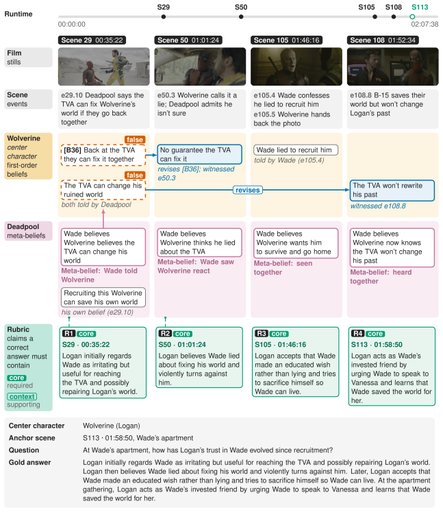
Figure 1 :Dataset Construction on an Example.This figure shows (question, answer, rubric) fromDeadpool & Wolverine(2024).Preprocessing:screenplay scenes are time-stamped against the subtitles and decomposed into scene events.Character belief annotation:scene by scene, we extract and verify each character’s first-order beliefs and meta-beliefs.Question generation and verification:for a center character (Wolverine) and an anchor (scene 113), we generate the triple and verify every rubric claim against the screenplay.
Original paper · CC BY 4.0 · Shaden Shaar, Bradon Thymes, Majd Aldaye, Claire Cardie, Bharath Hariharan · LF-VideoQA: Evaluating Long-Video Understanding with Long-Form Theory-of-Mind Questions · Original paper figure · Extracted the figure area from page 2 of the original PDF.Scoring answers by claim recall and precision
For each required claim, the scorer checks whether a model's answer states it. Recall is the share of required claims the answer states, computed over core claims alone. Precision looks only at the rubric claims an answer commits to and asks how many it states correctly.
The rubric supports recall and precision scoring beyond surface similarity to a reference answer. Each rubric claim describes a single event or state and is grounded in the screenplay scenes that support it. Core claims are those a complete, correct answer must assert, while context claims are premise or background. A correct answer may omit context claims, and only contradicting one counts as an error.
The construction asks for at least two core claims, since fewer means the outline didn't carry the question's content. A padded core set would punish correct answers for the padding, so unsure claims are labelled context. A claim that can't be honestly asserted in the reference prose is dropped, because an unasserted claim would poison the grades.
The scorer is an LLM judge, and gpt-5.6-luna plays that role.
What the released questions contain
The released set holds 6,327 questions drawn from 94 recent films. The authors group these questions into eleven types, split between belief-state types and arc types. Questions follow a film's cast rather than one protagonist, with a median of 15.5 characters per film.
Answering one question takes an average of 4.2 scenes covering 23 minutes of runtime. Belief-state types ask about one moment in the film, while arc types ask about the whole film. The epistemic arc type N1 has the widest reach, with 7.9 cited scenes and a 68-minute span.
Reference answers average 61 words, far longer than the phrase-length answers in earlier benchmarks. ActivityNet-QA answers average 1.9 words, NExT-QA answers 2.6 words, and MovieChat-1K answers 2.3 words. Each question carries an average of 2.4 core claims and 1.4 context claims. Recall is scored over the core claims, so a correct answer can skip context claims without losing credit.
Questions average 21 tokens, while each rubric claim averages 16 tokens. The full pipeline is automatic, with screenplays annotated for scene events and character beliefs. Human studies validate the quality of the questions, reference answers, and rubrics.
Oracle and non-oracle recall gap on LF-VideoQA
Even with the screenplay, the oracle setting doesn't produce complete answers on LF-VideoQA. The oracle reads the screenplay and still falls well short of complete answers. The best non-oracle model reaches barely half the oracle's recall. The authors read this as a gap between finding relevant information and folding it into a complete explanation.
Recall is the main bottleneck across models and settings. Recall gets the most weight here because omitted claims cost more than wrong phrasing in these long answers. Precision is scored separately, so a missed claim and a contradicted claim are kept apart in the evaluation.
Oracle evidence improves on regular retrieval, so evidence localization is a real bottleneck. A gap remains even with oracle access, so retrieval alone isn't enough to produce complete answers. They conclude that feature-length video understanding isn't only a context-length problem.
Video against captions and subtitles on LF-VIDEOQA
On LF-VIDEOQA, video input scores above captions and subtitles, which reverses the pattern seen on many prior long-video benchmarks. The authors read this as evidence that the questions need visual information that text representations drop. Captions and subtitles can support strong performance on many long-video benchmarks, so this reversal is the notable part.
Across the settings, models do best when a movie is represented by a narratively structured screenplay. Performance drops with subtitles, with generated video captions, and with direct video input. The screenplay is therefore the strongest representation in the study, and the video sits above the text-only inputs.
Adding subtitles to the video recovers some missing information. It does not close the representation gap with the screenplay.
Limits of the automatic pipeline
The construction pipeline is fully automatic, so its errors trace back to the belief annotation that feeds question generation. The belief annotation is sometimes wrong, so the screenplay serves as the ground truth when each rubric claim is verified. Verification judges each claim only from the text shown, so it cannot catch errors the screenplay itself does not reveal.
The evaluation covers four families of open-source VLMs, each tested across three settings. The paper doesn't test any closed-source models, so its results describe open-source systems only. The best non-oracle model reaches barely half of the oracle's recall level. Recall is the main bottleneck, because answers omit many of the required rubric claims.
LF-VIDEOQA contains more than 6,300 questions on 94 recent films. The authors don't release the videos, screenplays, or subtitles with the dataset. Instead, users download screenplays, subtitles, and cast photos from public sources through provided scripts. The scripts don't cover the videos, so users obtain them legally on their own.
Paper info
- Authors
- Shaden Shaar, Bradon Thymes, Majd Aldaye, Claire Cardie, Bharath Hariharan
- Venue
- arXiv · Preprint
- First published
- 2026-10-30
- Added
- 2026-11-3
- Updated
- 2026-10-30
- Version
- v1
- arXiv
- 2611.00383
- Category
- cs.CV · cs.AI · cs.CL
- Original paper terms
- CC BY 4.0
- What we show
- Paper info, commentary and permitted figures from the original paper
AI commentary is a separate explanation from the original paper and may contain errors. The original paper and figures follow each source's terms of use and any rights noted separately.
Abstract
The hardest part of understanding a long video is not pinpointing any one moment but synthesizing many, e.g., answering a question that requires tracking what develops across hours of content and articulating how the pieces fit together. To date, most long-video QA datasets require only a short answer or a multiple-choice selection, oversimplifying the long-video understanding task to retrieval. We introduce LF-VideoQA, a dataset for long-form, open-ended question answering over long narrative videos built on theory-of-mind questions: a character's belief depends on everything they have seen or been told, so each question demands assembling and reasoning from evidence distributed across the video. The dataset contains more than 6,300 questions on 94 recent films; each requires reasoning over scenes spanning an average of 23 minutes and comes with a question-specific rubric for recall and precision scoring. The dataset is created entirely automatically by annotating screenplays with scene events and each character's first-order beliefs and meta-beliefs, then generating (question, answer, rubric) triples through LLM-based question generation and verification; human studies validate their quality. We evaluate four families of state-of-the-art open-source VLMs across three settings and find the task highly challenging: (i) even an oracle with access to the screenplay falls well short of complete answers; (ii) the best non-oracle model attains barely half of the recall level of the oracle; (iii) unlike on prior long-video benchmarks, captions and subtitles underperform the video itself, indicating that the questions need visual evidence; and (iv) recall is the predominant bottleneck, with answers omitting many required rubric claims.
Quote from the paper
Shaden Shaar, Bradon Thymes, Majd Aldaye, Claire Cardie, Bharath Hariharan (2026). LF-VideoQA: Evaluating Long-Video Understanding with Long-Form Theory-of-Mind Questions. arXiv:2611.00383v1. https://arxiv.org/abs/2611.00383v1
BibTeX
@misc{shaar2026videoqa,
  title = {{LF-VideoQA: Evaluating Long-Video Understanding with Long-Form Theory-of-Mind Questions}},
  author = {Shaden Shaar and Bradon Thymes and Majd Aldaye and Claire Cardie and Bharath Hariharan},
  year = {2026},
  eprint = {2611.00383},
  archivePrefix = {arXiv},
  url = {https://arxiv.org/abs/2611.00383v1}
}