Paper commentary
V-JEPA-LM: Video-Language Models That Read Dynamics Beyond Static, Text-Aligned Representations
- Problem Video LLMs trained on captions and question-answer pairs leave motion information unread, even when the frozen predictive encoder beneath them carries it. A linear probe reads speed from those encoder features, but the language model answers at chance.
- Method Measures which frozen encoder features change consistently across videos under pixel transformations, then trains a single-stage model on answer-balanced variants of public videos whose answers are set by the transformation.
- Results Reached 72.14 on the twelve-score average with the 4B Qwen3 model, against 61.08 for the best open 4B model. Counterfactual rows added 4.5 points to the 2B model's average at a matched budget.
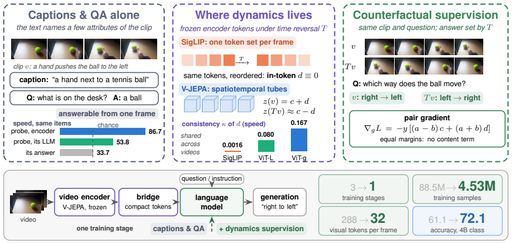
Figure 1 . Top: what captions and QA teach (left), where the dynamics lives in the encoder (middle), and the supervision built from it (right). Bottom: the model, trained in one stage, and what the recipe changes (before→after: the V-JEPA 2 video LLM [4]; accuracy: the best open 4B model).
Original paper · CC BY 4.0 · Keuntae Kim, Dongjun Kim, Yong Suk Choi · V-JEPA-LM: Video-Language Models That Read Dynamics Beyond Static, Text-Aligned Representations · Original paper figure · Extracted the figure area from page 2 of the original PDF.Why captions and questions leave motion unread
V-JEPA 2 and 2.1 are made into video LLMs by following the recipe used for image-text VLMs, with alignment, pre-training and instruction stages built on captions and question-answer pairs. Many of these items can be answered from a single frame, so the training signal rarely demands motion.
The clearest symptom appears on held-out speed-ratio items.
A stronger encoder does not repair this on its own. The authors cite Meta's controlled comparison, in which V-JEPA 2.1 scores lower than V-JEPA 2 on TemporalBench and TOMATO under the same recipe. The missing piece is therefore supervision whose correct answer changes when the motion changes.
Locating the shared change in frozen encoders
The analysis takes the frozen tokens \(z(v)\) of a video \(v\) and a pixel transformation \(T\) with its answer map and token permutation.
Consistency is \(\kappa=\|\mathbb E[y\,d]\|^2/\mathbb E\|d\|^2\), where \(y=\pm1\) gives the direction of the change. A value near 1 means every video moves by the same vector, while random directions give about 0.001.
For a frame-wise encoder whose tokens depend only on single frames, time reversal only reorders the tokens, so the in-token change is exactly zero. The arrow of time then has to be read from token positions, because no token's content carries it, and a speed change only selects other frames.
For a predictive spatiotemporal encoder, the proposition assumes a training loss invariant to the transformation and features that differ between minimizers only by an invertible linear map, which gives \(\Pi_T^{-1}E(Tv)=A_TE(v)\).
On frozen V-JEPA ViT-L features, reversal, mirroring and re-timing move tokens along a change direction that is 20 to 100 times more consistent across videos than in SigLIP. For mirroring, SigLIP's consistency is 0.0014. A text-aligned video encoder with attention across frames behaves like SigLIP in this analysis.
These measurements use 1,200 clips, with 70% used for fitting and 30% held out, and features pooled to 4×4 cells per tubelet. On speed-ratio items, a three-way probe reads 36.4 from a frozen SigLIP encoder and 86.7 from V-JEPA.
Counterfactual pairs that cancel content
Fourteen constructions in six families are rendered from public videos by pixel transformations, without new annotation. The generator writes the question, options and answer, and balances answer letters, option length and each option's prior under a text-only language model. Adding a new video collection needs only a short script that lists its clips and names the constructions to apply.
Because the two clips share their frames, the content cannot separate the answers, and only the change can. With equal margins, the gradient's content term cancels, which the authors state holds in expectation.
Relative speed shows one clip twice, above and below, over nested time spans with ratios of 2:1, 3:1 or equal, and the copy covering the longer span plays more motion in the same number of frames. Frames are placed at even spacing, so the answer cannot be read from time codes.
Training is a single stage in which the bridge and the language model learn from the counterfactual rows together with captions and QA, using 4.53M public samples and 32 visual tokens per frame. The encoder is a frozen V-JEPA 2.1 forward, ViT-L for the 1B and 2B models and ViT-g for the rest.
Benchmark results against open video LLMs
The twelve scores come from eleven video benchmarks, including MVBench, PerceptionTest, TVBench, TempCompass, TOMATO, TemporalBench, MVP, MotionBench, NExT-QA, SSv2 and Vinoground.
The 2B Qwen3 model reached 66.02, which is 13.6 points above the best open 2B model. The 4B Qwen3 model reached 72.14, which is 11.1 points above the best open 4B model, Molmo2-4B at 61.08. The 8B class leads the best open 8B model by 7.4 points, and the best open 8B model scores 64.8. The Llama variants also lead their classes, at 68.97 for Llama-3.2-3B and 62.21 for Llama-3.2-1B.
The largest margins are on dynamics benchmarks. TOMATO reaches 53.5 for the 4B model, against at most 36.5 for open 4B models. On Vinoground video the same model scores 66.8, against at most 33.8. On reversed or mirrored versions of natural items, the 4B model answers both the original and the transformed version correctly for 47.7% and 50.4%, against at most 35.4% for open 4B models.
The comparison with Meta's V-JEPA video LLMs uses numbers quoted from their papers, because those video LLMs are not released and only the encoders are. On the six benchmarks both report, the authors' 8B models lead by 6.7 points with Qwen3-8B and by 4.9 points with Llama-3.1-8B.
The count covers each model's vision-language training stages as its paper reports them, and excludes pre-training of the vision and language models. The 4B and 2B models took 499 and 229 H100-hours of training.
Encoder and supervision at a matched budget
Four 2B models cross the V-JEPA ViT-L and SigLIP so400m encoders with and without counterfactual rows, on the same mixture and schedule. The training curves of these four arms appear in Figure 4, with solid lines for runs that include the counterfactual rows.
At the final step the counterfactual rows add 4.5 points to V-JEPA and 3.6 to SigLIP. V-JEPA ViT-L rises from 61.53 to 66.02, and SigLIP so400m from 58.52 to 62.13. At 8k steps the gains are 4.5 points for V-JEPA and 3.3 for SigLIP.
On speed, V-JEPA with counterfactual rows scores 65.3 at 8k, against 32.4 without them, a gain of 32.8 points. Without counterfactual rows the two encoders are level on speed, with a difference of -1.5 whose interval includes zero. At the final step the speed gain on V-JEPA is 38.1 in the ability table, with TOMATO speed items gaining 62.9 and TempCompass gaining 21.8.
The mixture's 22 annotation-based temporal-QA sources at the same weight give 58.21. The authors attribute the gain to the counterfactual construction rather than to more temporal questions.
On V-JEPA the counterfactual rows add 6.8 points on camera and 4.1 on state change, while on SigLIP they add nothing to those groups.
Generalization to unseen constructions
Six held-out sets of 3,294 items change one factor each, including speed ratios of 1.6, 2.5 and 4.0, a new source corpus, unseen combinations and an unseen simulator. Training uses equal, 2:1 and 3:1 speed ratios, so 1.6 and 2.5 lie between trained ratios and 4.0 lies beyond them. On the three unseen ratios, the 4B model scores 97.2, 100 and 99.4.
Across the six sets the authors' models average 94.5 to 96.3, and open models average 43.5 to 55.5. V-JEPA trained without counterfactual rows scores 64.3 at the final step, against 95.0 with them. SigLIP trained on the same rows averages 74.8 and reaches only 55.7 on unseen ratios, against 98.7 for the V-JEPA model.
The authors' models score 92.5 to 99.2 on it, against 19.4 to 51.9 for open models.
When the middle frame is repeated so that no motion remains, the six sets drop from 95.0 to 37.9 for the 2B model and from 96.3 to 37.6 for the 4B model, against chance at 33.3. The authors read this as single-frame cues not solving the sets.
Removing the top speed directions from the bridge input, without retraining, lowers unseen speed combinations from 98.9 to 65.7. This is a removal test on one checkpoint, so it shows that this model's readout depends on the speed subspace, not that the subspace is the only route to speed.
Limitations
All models read 32 frames per clip, so the study does not cover hour-long video, which would need memory, retrieval across clips and long-context training data. The authors regard the compact 1,024-token clip representation as a possible building block for that setting and leave it to future work.
Image question answering is outside the scope, because V-JEPA was trained only to predict masked video regions in latent space and never to align with or read text.
The held-out sets reuse the training generator's wordings and option pools, so only the tested factor is new. The counterfactual effect on the 4B model is 4.8 points at 8k steps, and the matched controls were run at 2B. Meta's video LLM numbers are quoted from their papers and were not rerun under the authors' protocol.
Paper info
- Authors
- Keuntae Kim, Dongjun Kim, Yong Suk Choi
- Venue
- arXiv · Preprint
- First published
- 2026-11-13
- Added
- 2026-11-16
- Updated
- 2026-11-13
- Version
- v1
- arXiv
- 2611.17831
- Category
- cs.CV · cs.AI
- Original paper terms
- CC BY 4.0
- What we show
- Paper info, commentary and permitted figures from the original paper
AI commentary is a separate explanation from the original paper and may contain errors. The original paper and figures follow each source's terms of use and any rights noted separately.
Abstract
World-model video encoders such as V-JEPA learn how scenes change (direction, speed, order, state) from video alone. To answer questions, they are joined to a language model trained on captions and question-answer pairs. But each caption or question names only a few attributes of a clip, so the model learns to retrieve those attributes rather than to read the clip, and the dynamics the encoder carries go unused: on the same items, a linear probe reads speed from frozen V-JEPA features at 87% while the VLM answers at chance. We show where dynamics lives in a frozen encoder: in a subspace shared across videos for predictive encoders such as V-JEPA, but not as a shared component of frame-wise, text-aligned encoders such as SigLIP. We then build counterfactual supervision that makes the language model read it: pixel transformations turn public videos into answer-balanced variants whose answers are set by the transformation and differ only in the change. Trained in a single stage on 4.53M public samples with 32 visual tokens per frame, where open video LLMs use several stages, 9M to 172M samples and 64 to 256 tokens per frame on average, the resulting V-JEPA-LM models (1B to 8B, Qwen3 and Llama) lead every size class in average score across eleven video benchmarks; our 4B model scores 72.1, against 61.1 for the best open 4B and 64.8 for the best open 8B model. A controlled encoder x supervision study shows that the encoder decides what can be read and the supervision what is read: at a matched budget, counterfactual supervision adds 4.5 points on average and 38 on the speed questions of natural benchmarks. Code and models: https://github.com/kkt94/Llama-V-JEPA-LM.
Quote from the paper
Keuntae Kim, Dongjun Kim, Yong Suk Choi (2026). V-JEPA-LM: Video-Language Models That Read Dynamics Beyond Static, Text-Aligned Representations. arXiv:2611.17831v1. https://arxiv.org/abs/2611.17831v1
BibTeX
@misc{kim2026jepa,
  title = {{V-JEPA-LM: Video-Language Models That Read Dynamics Beyond Static, Text-Aligned Representations}},
  author = {Keuntae Kim and Dongjun Kim and Yong Suk Choi},
  year = {2026},
  eprint = {2611.17831},
  archivePrefix = {arXiv},
  url = {https://arxiv.org/abs/2611.17831v1}
}