Paper commentary
Half-precision inference of AI weather prediction models: negligible loss of skill at a fraction of the cost
Half precision keeps AI weather forecasts nearly unchanged
- Problem AI weather models ship with 32-bit weights and run in fp32 by default, so each forecast costs more time, energy and GPU memory than necessary. Few studies have measured how much forecast skill a 16-bit run loses.
- Method The authors run only the network in fp16 and keep the physical state in fp32. Converting the whole model would round the state, which overflows in fp16 and loses information in bf16.
- Results Across five models on a 16 GB GPU, fp16 changed global RMSE by at most 1.4 percent. A 10-day forecast ran 1.3 to 3.5 times faster.
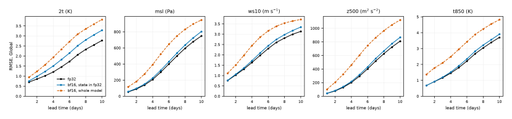
Figure 15 : Mean global RMSE against ERA5 of Aurora’s fp32 forecasts, of its forecasts with the network in bf16 and the state in fp32, and of its forecasts with the whole model converted with model.to(torch.bfloat16), which also rounds the state in physical units; 52 dates in 2024.
Original paper · CC BY 4.0 · Stefan Siegert · Half-precision inference of AI weather prediction models: negligible loss of skill at a fraction of the cost · Original paper figure · Extracted the figure area from page 39 of the original PDF.Why fp32 is the default cost
Running these models in fp32 limits a single researcher because every forecast costs time, energy and GPU memory. Ensembles, sensitivity experiments and many initial dates all repeat the forecast, so the cost adds up quickly. Memory is the other limit, because a consumer GPU with 16 GB, such as the RTX 5080 used here, launched at half the price of a 32 GB model.
Storing the weights in 16 bits halves their memory, and recent GPUs run 16-bit arithmetic considerably faster than fp32.
Energy follows the same pattern, since inference is the larger part of machine-learning energy use. AI weather models are distributed with fp32 weights and run in fp32 by default, even though fp32 carries about seven significant decimal digits. The two 16-bit formats trade digits for range: fp16 carries about three significant digits and stops at 65,504, while bf16 keeps the range of fp32.
Aurora keeps its weights in fp32 in the released code, and that configuration doesn't fit in the 16 GB of GPU memory used here at full resolution. None of the sources that use reduced precision reports how much forecast skill the reduction costs. This paper therefore asks what happens to forecasts when a model released with fp32 weights runs in 16 bits.
It also asks how much faster and more energy-efficient the model becomes, and how much skill it loses.
Convert the network, not the state
The key idea is to convert only the network to 16 bits and keep the physical state in fp32, including its normalisation and denormalisation. The state is the one thing carried from one forecast step to the next, so rounding it would compound over the forecast. In the fp16 and bf16 runs, every weight and computation of the network is in the 16-bit format.
The simplest route is a one-line conversion of the whole model, which also converts the inputs. A layer can only multiply inputs that share its weights' precision, so the inputs must be converted too. Aurora's code converts its input fields to the weights' precision before normalising them, and Pangu-Weather normalises inside its first layer.
Table 5 shows what 16 bits do to the physical state of ERA5 initial states. bf16 represents these fields, but coarsely: rounding an ERA5 initial state to bf16 changes 2t and t850 by 0.57 K, msl by 148 Pa and z500 by 74 m2 s−2 (RMS). Rounding after normalisation shrinks these changes by 16 to 80 times, so the normalised fields keep their information.
Converting the whole model has concrete consequences in the forecasts. Keeping the state in fp32 costs one copy of the state, about 0.7 GB for Aurora, which is 6% of its peak memory in fp16.
How the conversion is built per model
Each model normalises its inputs at a different point, so the conversion point differs from model to model. Pangu-Weather moves its normalisation out of the first layer, so the first layer no longer receives 16-bit inputs. FastNet carries a normalised state that is kept in fp32 between steps.
Automatic mixed precision keeps the weights in fp32 and converts values only for individual operations, which protects accuracy but saves little memory. In that mode, Aurora 1.5 runs out of memory on the 16 GB GPU in the first forecast step. The persistently converted model needs at most 11.6 GB, so the persistent conversion is the configuration that fits on this card.
The authors verified on test data that this streaming gives bit-identical results, although it makes the fp32 runs slower.
Every weight is rounded once, and in bf16 Aurora's weights change by 0.14% on average. Current GPUs sum the products of a 16-bit matrix multiplication in fp32, so the stored 16-bit values are the main error source.
Why rounding the state fails
Converting a whole model also rounds its physical state, so the authors measured what 16 bits do to ERA5 initial states. They rounded each field to bf16 and fp16 in physical units, and again after normalisation. Rounding to bf16 changes 2t and t850 by 0.57 K and msl by 148 Pa in RMS terms. These errors are comparable to the models' fp32 errors at day 1, which span 0.70 to 1.03 K for 2t.
The same rounding recurs at every step, so the error keeps entering the forecast. After normalisation the values are of order one, and the same rounding changes them 16 to 80 times less.
In fp16 the main problem is overflow, because any value above 65,504 becomes infinite. Every value of mean sea-level pressure exceeds that limit, and 97% of surface pressure does too. Geopotential above 400 hPa is affected as well, with 81% of values at 400 hPa over the limit.
Whole-model bf16 Aurora stays finite, but its RMSE rises by up to 167%. With the network alone in bf16 and the state in fp32, the RMSE rises by at most 25%.
Keeping the state in fp32 costs one fp32 copy of it, about 0.7 GB for Aurora's 84 fields. That copy equals 6% of Aurora's peak memory in fp16.
Skill change at fp16 versus fp32
The paired design compares each fp16 forecast with the fp32 forecast that starts from the same initial state. Initialisations about a week apart give forecast errors that are close to independent between dates. For each model, variable, lead time and area, the authors report the change in mean RMSE with a 95% confidence interval from a paired t-test.
For four of the five models, the fp16 network changes global RMSE by about 0.5% or less. Pangu-Weather's RMSE rises by up to 0.2%, a small increase that is significant at the 5% level for 45 of 50 combinations.
Up to day 8, fp16 costs less than one hour of lead time for each model and variable. At day 10 the largest losses are 1.7 h for FastNet and 1.5 h for Aurora, both for 10 m wind speed. SFNO loses at most 0.3 h at any lead time.
Although skill barely changes, the fp16 forecasts drift from the fp32 forecasts, reaching as much as 40% of the forecast error by day 10.
Drift without loss of skill
The fp16 forecasts keep drifting away from the fp32 forecasts as lead time grows, reaching as much as 40% of the forecast error by day 10. The authors read the two as behaving like two equally skilful ensemble members, instead of one forecast and one degraded copy. Pangu-Weather departs by 1 to 3% of the fp32 error at day 1 and by 5 to 10% at day 10, while SFNO departs by 1 to 2% and then 3 to 9%.
Aurora moves 2 to 4% at day 1 and 13 to 26% at day 10, and FastNet moves 2 to 8% and then 19 to 32%. FourCastNet's departure at day 1 averages 8% across variables, against 1 to 5% for the others. That correlation equals minus half the relative departure, which gives -0.2 for a departure of 40% of the error.
For Aurora's ensemble checkpoint, fp16 changes the global CRPS by at most +0.8%, at z500 on day 1, and mostly by 0.0 to 0.3%. The ensemble spread changes by less than 0.5%. Each fp16 member departs from its same-seed fp32 member by 3 to 11% of the ensemble spread up to day 5 and by 31 to 43% at day 10. The rounding thus acts like a small extra perturbation, much smaller than the perturbations the ensemble samples by design.
Over the three regions the changes stay within about ±2%, with FourCastNet over South Asia reaching up to +5%. At the five locations, changes reach about ±10% for the other models, but few more combinations are significant than chance would give. Across latitude bands, FastNet, Pangu-Weather, SFNO and Aurora stay within ±1.3% in every band.
The exception is Aurora's tropical msl, which reaches +2.6% at days 5 and 10. FourCastNet shows a tropical z500 penalty of up to 12%, and the authors have not isolated its cause, though they suspect its adaptive Fourier filters.
Step length, resolution and how fast a model amplifies small perturbations all affect how far its fp16 forecasts drift.
Speed, memory and energy on one consumer GPU
Speed is the first thing fp16 buys on a single consumer GPU, measured as the time per model step. FastNet's step falls from 0.294 s in fp32 to 0.105 s in fp16, a speed-up of 2.8 times. Pangu-Weather's 24-hour step drops from 0.785 s to 0.371 s, a speed-up of 2.1 times. Across the five models, a 10-day forecast in fp16 runs 1.3 to 3.5 times faster than in fp32.
Aurora gains the most, at 3.5 times, partly because fp32 must stream its weights from CPU memory on a 16 GB GPU. SFNO gains only 1.3 times, which the authors plausibly tie to its spherical harmonic transforms staying in fp32. They didn't profile SFNO, so that explanation remains unverified.
In fp32, peak memory ranges from 1.2 GB for FourCastNet to 15.4 GB for SFNO, which leaves SFNO little headroom. Pangu-Weather and FastNet need roughly half the peak memory in fp16. Pangu-Weather's peak memory drops from 9.5 GB to 5.2 GB, and FastNet's from 2.2 GB to 1.2 GB. Aurora's peak memory drops by a fifth, and SFNO's by a sixth, while FourCastNet's drops by 29%.
Running the network in bf16 changes time per step by at most 2% and peak memory by at most 1% from fp16. A 10-day FastNet forecast needs 1.07 Wh in fp32 and 0.29 Wh in fp16. Pangu-Weather uses 2.5 times less energy for a 10-day forecast in fp16, and SFNO uses 1.4 times less.
The fp32 reference costs range from 0.12 s to 5.4 s per step, so a 10-day forecast takes between 5 s and 3.6 minutes. Board power was sampled every 50 ms within the timed steps, with the GPU used exclusively.
Headroom in fp16's numeric range
The authors attach forward hooks to every module of each network to check whether fp16 overflows during a forecast. They run the hooks on all 52 dates, so the check covers every initial date in the study. An overflow there would still make the module's output infinite or undefined, so the hooks would catch it.
No module of any of the five models returned a non-finite value over the 52 dates, so no fp16 overflow occurred. The largest magnitudes are 120 for Pangu-Weather, 208 for SFNO, 225 for FastNet, 559 for FourCastNet and 1,733 for Aurora. These sit 544, 315, 291, 117 and 38 times below the fp16 limit of 65,504, respectively. For four of the models the largest magnitudes stay constant over the 10 days.
That same MLP dominates Aurora's fp16 departure for 2t.
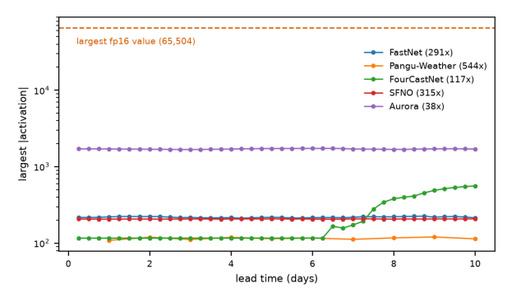
Figure 11 : Largest magnitude of any fp16 value returned by any module of each model, per model step, over the 52 dates of 2024, against the largest finite fp16 value (65,504, dashed). In parentheses: the ratio of 65,504 to the largest value over all steps.
Original paper · CC BY 4.0Values below 6.1×10 −5 keep fewer significant bits, so the authors counted them separately from the overflow check. The exceptions are outputs naturally close to zero, such as Pangu-Weather's attention weights after the softmax, at up to 24%. FourCastNet and Aurora's activations after the GELU reach up to 17% and 9%, and some FastNet normalisation outputs reach 11%.
The margins are model-specific, and the authors don't assume they transfer to other models. The one model clearly more affected by fp16, FourCastNet, has its largest activations late in the forecast rather than early.
Where the rounding matters
The authors locate the rounding with a one-at-a-time design, running one component in fp16 while the rest of the network stays in fp32. Each component's departure is measured against the fp32 forecast from the same initial conditions, not against ERA5. The authors express each component's departure as its share of the departure that the whole fp16 network causes.
One-at-a-time designs miss interactions, so the authors compare the component effects with the whole network and also run every component in fp16 together.
The authors also test three ideas from other reduced-precision work: sensitivity in normalisation and softmax, in channels with outsized values, and towards the end of the network. For the layer-type test, all layers of one type stay in fp32 with their original weights while the rest of the network runs in fp16. They also record the largest output magnitude per channel and the relative fp16-to-fp32 difference of each module during the first model step.
These sensitivity experiments use every fourth of the 52 dates, which gives 13 dates, and FastNet runs in deterministic mode.
The first and last components cause most of the departure for Pangu-Weather, Aurora and FastNet, so keeping them in fp32 should remove much of it. FourCastNet's sensitivity is spread over the whole network, so the same fix may not work for it.
The sensitivity experiments measure departures over the first day only, so they don't show how these errors affect skill at longer lead times. Because the rules transfer only partly, each model needs its own check of where fp16 rounding enters the forecast.
bf16 and 8-bit quantisation as alternatives to fp16
bf16 keeps the wide range of fp32, so it needs no attention to range, but it carries fewer mantissa bits than fp16. Rounding a value to bf16 changes it by up to 2 to the power of minus 8, about 0.4%, which is eight times more than fp16. The authors found that bf16 costs more skill than fp16 for every model, and this matters most where the network is run at 16 bits.
Google's TPUs multiply matrices in bf16, so there bf16 is the natural format, and the authors' results suggest it costs more skill.
The 8-bit test rounds every matrix weight to int8 or fp8 with one scale per output channel, inside the fp16 network with the state in fp32. Linear and convolution layers and FourCastNet's and SFNO's spectral filters are included, with SFNO's real and imaginary parts treated separately. Biases, normalisation layers and embeddings stay in fp16, as is usual.
This is round-to-nearest without calibration or the outlier treatment that language models need, so it reproduces 8-bit accuracy but not 8-bit speed or memory.
The 8-bit tests show that simple quantisation costs far more skill than fp16, so 8-bit weights are not a substitute here. Block scaling, which shares a scale among small blocks of values, addresses the failure the authors found in FastNet.
Limitations of the half-precision study
All forecasts start in 2024, a single year, so the results don't show how the picture shifts across other years.
The recommendation assumes fast fp16 arithmetic, which NVIDIA GPUs from 2017 on provide.
The storms are four cases and the ensemble is one model on 13 dates. They show that fp16 doesn't visibly degrade these forecasts, but they don't show that it never does. The TPU question is open here, since Google's TPUs multiply matrices in bf16 and the results suggest bf16 costs more skill. Block scaling, a newer format that shares a scale among small blocks, is not tested in this study.
Paper info
- Authors
- Stefan Siegert
- Venue
- arXiv · Preprint
- First published
- 2026-11-6
- Added
- 2026-11-9
- Updated
- 2026-11-6
- Version
- v1
- arXiv
- 2611.09573
- Category
- physics.ao-ph · cs.LG · cs.PF
- Original paper terms
- CC BY 4.0
- What we show
- Paper info, commentary and permitted figures from the original paper
AI commentary is a separate explanation from the original paper and may contain errors. The original paper and figures follow each source's terms of use and any rights noted separately.
Abstract
AI weather prediction models are released with 32-bit (fp32) weights and run in fp32 by default, although current GPUs compute much faster in 16-bit formats. We run five publicly available models -- Aurora, Pangu-Weather, FourCastNet, SFNO and FastNet -- on a single 16 GB GPU from 52 initial dates in 2024, in fp32 and with their networks in half precision (fp16), and verify the forecasts against ERA5. The physical state must stay in fp32: converting the whole model rounds it in physical units, which in fp16 overflows and in bf16 discards meaningful information. With the state, its normalisation and denormalisation in fp32, running the network in fp16 changes the global RMSE by at most 1.4%, and by about 0.5% or less for four of the five models, equivalent to less than one hour of lead time up to day 8 and at most two hours at day 10. The differences show no systematic pattern by region, scale or for tropical and extratropical storms, apart from a small tropical penalty in FourCastNet, and fp16 leaves the CRPS, spread and calibration of Aurora's ensemble almost unchanged. No value overflowed fp16's numeric range (+/-65,504); the largest stay 38 to 544 times below it. A 10-day forecast in fp16 is 1.3-3.5 times faster than in fp32 and uses 1.4-3.7 times less energy. Sensitivity experiments show that rules of thumb from other applications of reduced precision carry over only partly: the first and last layers dominate for some models but not for others, and no type of layer is sensitive on its own. For running AI weather models on a single GPU, fp16 with the state in fp32 is practically lossless at a fraction of the cost. bf16, often preferred for its wider range, is as fast but less accurate than fp16 for every model, and simple 8-bit quantisation costs far more skill.
Quote from the paper
Stefan Siegert (2026). Half-precision inference of AI weather prediction models: negligible loss of skill at a fraction of the cost. arXiv:2611.09573v1. https://arxiv.org/abs/2611.09573v1
BibTeX
@misc{siegert2026half,
  title = {{Half-precision inference of AI weather prediction models: negligible loss of skill at a fraction of the cost}},
  author = {Stefan Siegert},
  year = {2026},
  eprint = {2611.09573},
  archivePrefix = {arXiv},
  url = {https://arxiv.org/abs/2611.09573v1}
}