Paper commentary
Say the Same, Act Differently: Diagnosing and Steering Text-Action Divergence in Reasoning VLAs
Visual perturbations can change robot actions while the rationale stays identical
- Problem Earlier attacks corrupt the reasoning text, so their evidence stays visible to a supervisor. A rationale-only monitor cannot catch an unsafe action when the words stay the same.
- Method TNAS finds the direction that moves the action most, then removes the part the text responds to. Image attacks are steered along what remains.
- Results TNAS-guided attacks caused a new collision under an identical rationale in 52.6% of driving scenes, versus 4.55% for unguided action attacks.
Why a readable rationale can hide an unsafe action
Reasoning VLAs attach a natural-language rationale to continuous action predictions, so a supervisor can read the model's account before the action runs. A supervisor can check that account for a missed obstacle or a wrong target object, which makes the rationale a useful safety signal. Because the rationale collapses continuous states into discrete words, many different hidden states can produce identical text.
Under ordinary inputs the text and the action move together, which is why the rationale helps in typical operation.
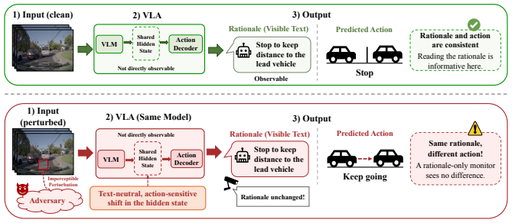
Figure 1 :Rationale-preserving action divergence in reasoning VLAs.On a clean driving input, the VLM and action decoder read the same unobservable hidden state to produce a matching rationale and stopping action. Adding an imperceptible perturbation to the input shifts that shared hidden state along a text-neutral, action-sensitive direction. The model still outputs “Stop to keep distance to the lead vehicle” word for word, but its predicted action flips from stopping to continuing into the lead vehicle.
Original paper · CC BY 4.0 · Zihao Feng, Qingzhao Zhang, Chunyu Xia, Bo Yu, Z. Morley Mao, Ramesh Govindan · Say the Same, Act Differently: Diagnosing and Steering Text-Action Divergence in Reasoning VLAs · Original paper figure · Extracted the figure area from page 2 of the original PDF.The question that matters for safety is whether the action can turn unsafe while the model's words stay the same. A rationale-only monitor gets identical evidence in both cases when this happens, so it can't tell them apart. A rationale monitor only certifies safety if every unsafe action change also alters the words.
Earlier attacks on reasoning VLAs change the text itself, so the evidence stays visible to a supervisor. TRAP steers chain-of-thought and downstream actions with adversarial patches, while Trinh et al. corrupt the reasoning trace directly by substituting object names. Those attacks show that altering the text alters the action, but they leave open the converse question.
The open question is whether the shared hidden state holds action-sensitive variation the text doesn't register, and whether an image can reach it.
The paper answers with a TNAS diagnostic that identifies the locally most action-sensitive direction and projects out the text-gradient component. It then tests the resulting direction dTNAS by perturbing the hidden state and by aligning image perturbations with it during optimization. The authors run these tests on Alpamayo for driving and InstructVLA for manipulation, and they find the same geometric decoupling in both.
A text-neutral direction in the hidden state
The core idea is to find the direction that moves the action most, then strip out the part of it that the text readout responds to. TNAS starts from the action-Jacobian direction d_act, which is taken from the action output with respect to the hidden state. The authors don't use the gradient of the displacement norm, because that norm is zero at the clean point.
Action change is the mean L2 displacement of the planar waypoints from the clean plan over 64 waypoints at 10Hz for Alpamayo. For InstructVLA, the same measure is the mean chunk displacement over 16 steps. Selecting the block with the strongest action response gives layers 32 to 35 for reasoning tokens in Alpamayo and layers 14 to 17 for response tokens in InstructVLA.
Teacher-forced KL and clipped hinge losses have zero gradient at the clean point, so they can't serve as the text side of the decomposition. The authors use the target negative log-likelihood instead, because it tracks the probability mass on the clean token across the vocabulary. Both losses stay active when the clean token is still top-ranked, so their gradients are nonzero at the clean point.
Gram-Schmidt on their clean-state gradients gives an orthonormal basis for the text-loss span. That span has rank 2 on every evaluated example.
Projecting d_act off this text-loss span and normalizing gives d_TNAS, the text-neutral action residual. By construction, d_TNAS is orthogonal to both text-loss gradients at the clean point. The authors then test this claim with the hidden-state intervention probes that follow.
Before any intervention, the authors measure how much of d_act the text span captures. A frozen Qwen3-14B reads only the clean rationale and predicts whether the Alpamayo plan comes to rest. The reader matches the trajectory outcome on 84.3% of clips, so the text carries much of the action signal. Even so, the text doesn't pin down the action, which is why the residual is needed.
Does the residual move the action more than the text?
The authors first ask how much of the action the text itself carries, and the answer is only partial. A frozen Qwen3-14B reader predicts from the clean rationale alone whether the Alpamayo plan comes to rest within the 6.4 s horizon. The reader matches the trajectory outcome on 84.3% of the 1,181 clips, yet it can't pin down the action. Clips sharing a rationale often carry the opposite outcome, since 36.9% of them do.
At the shared interface, the projection ratio of d_act onto the text span averages 1.87% in Alpamayo and 5.28% in InstructVLA. The random baseline is 0.978%, so the action direction overlaps the text span only about twice as much as chance. Removing the span keeps more than 99.8% of d_act's norm, so the text span barely covers the action direction.
Probe 2 asks a different question: how much action change a hidden-state perturbation produces before the rationale visibly moves. Probe 2 holds teacher-forced text KL at a fixed budget B and compares the action shifts that each direction produces. Its step size is chosen per direction so that every direction hits the same text KL budget.
That shift matches d_act and exceeds the controls, which move the trajectory by at most 5.10 mm, by 63.3× to 212×. In InstructVLA, d_TNAS and d_act again give the largest action shifts at both budgets. Fixed-KL matching can still favor directions that barely touch the text, so the authors needed a fairer test.
Probe 3 fixes the perturbation norm for every direction, so step size no longer confounds the comparison. Each direction is added with norm |q|·S_clip, where S_clip = |<h_clean, d_TNAS>| and q takes the values 0.5, 1, and 2. In Alpamayo, the trajectory shift along d_TNAS grows to 0.142 m at q = 2. In InstructVLA, at q = 2 the action shift of d_TNAS is 0.156, which is 4.64× to 5.51× the text-gradient controls and 12.6× the random control.
So d_TNAS moves the action more per unit norm than the text does, and it barely moves the text.
Steering image perturbations toward the residual
The attacker is white-box and perturbs the normalized, processed visual tensor just before the visual encoder.
Text-preserving PGD adds a penalty on the clean tokens' NLL increase and margin drop. It keeps 83.0% of Alpamayo rationales exact, and it raises silent collisions to 48.7%. The two objectives fight over the same pixels, because the text penalty holds target tokens in place while the action loss pushes trajectory displacement.
TNAS-guided PGD adds a cosine term that rewards alignment between the input-induced hidden-state shift and dTNAS. That is a 68.4% reduction relative to Text-preserving PGD. Exact match rises to 89.5% at that weight, up from 83.0% without TNAS guidance. The authors attribute this gain to lower distributional drift during stochastic decoding.
The cost is fixed-prefix displacement, which shrinks from 69.2 m under Text-preserving PGD to 53.0 m at λcos = 30. Silent collisions still reach 52.6% at that weight, the highest in the sweep.
In InstructVLA the response is one task-intention sentence averaging 9.60 words over a 16-step 7-DoF action chunk. That coarser bottleneck already keeps 72.5% of responses unchanged under Action-only PGD. Guided attacks raise exact match from 77.5% to 85.0% at λcos = 0.20. Teacher-forced KL drops by 40.5% relative to Text-preserving PGD at that weight.
The action shift of 1.73 at λcos = 0.20 keeps 87.5% of the displacement of Text-preserving PGD.
Localized patch attack
Full-image attacks need edits to the preprocessed tensor, which requires access to the model's software pipeline. The authors instead confine the perturbation to a localized patch and keep the TNAS-guided objective, to test whether the effect survives.
Free-generation exact match rises from 70.5% to 80.5% across the same sweep. Fixed-prefix displacement reaches 38.7 m ADE at λcos = 5 and 39.8 m at λcos = 10, then falls to 30.0 m at λcos = 30 as text stability grows.
With the remaining 84% of the image untouched, the patch shifts the action chunk by 1.32 and keeps 76.4% of the 1.73 displacement from the full-image attack.
So the decoupling survives a restricted spatial budget in both embodiments, though the displacement it produces is smaller than in the full-image case. The patch results therefore support the claim that a rationale can stay identical while the action moves under a local perturbation.
Limits of the evidence
The silent collision numbers come from open-loop safety checks, not from closed-loop driving runs. The authors don't execute these plans, so they don't measure what the vehicle does after a perturbed plan.
The main results use 200 Alpamayo clips and 200 InstructVLA examples, with InstructVLA drawn from the Bridge distribution. The reported values are cohort means over those examples, so each number summarizes the whole cohort. The collision analysis covers only the 154 Alpamayo clips that carry obstacle annotations.
The threat model is white-box and digital, with the perturbation applied to the preprocessed visual input tensor. The authors note that full-image attacks assume an attacker who can edit that tensor, which requires access to the software pipeline.
The TNAS geometry is measured at one selected block, layers 32 to 35 in Alpamayo and layers 14 to 17 in InstructVLA. The authors pair rationale monitors with execution-channel monitors, and the experiments here don't test that pairing. So the recommendation that monitors verify the action channel rests on the argument, not on a monitor evaluation.
Paper info
- Authors
- Zihao Feng, Qingzhao Zhang, Chunyu Xia, Bo Yu, Z. Morley Mao, Ramesh Govindan
- Venue
- arXiv · Preprint
- First published
- 2026-11-3
- Added
- 2026-11-5
- Updated
- 2026-11-3
- Version
- v1
- arXiv
- 2611.04166
- Category
- cs.LG · cs.CR · cs.CV · cs.RO
- Original paper terms
- CC BY 4.0
- What we show
- Paper info, commentary and permitted figures from the original paper
AI commentary is a separate explanation from the original paper and may contain errors. The original paper and figures follow each source's terms of use and any rights noted separately.
Abstract
Reasoning vision-language-action (VLA) models pair physical control with natural-language rationales that supervisors can read to monitor embodied safety. Prior attacks on VLA reasoning corrupt the rationale itself and leave visible evidence in the text. We show that visual perturbations can instead alter the physical action while keeping the generated rationale word-for-word identical. At the shared text/action interface of Alpamayo for driving and InstructVLA for manipulation, our text-neutral action-subspace (TNAS) diagnostic shows that the locally most action-sensitive direction is nearly orthogonal to the active text-loss gradients, with 1.87% and 5.28% norm overlap. At equal hidden-state perturbation norms across both models, interventions along this text-neutral residual shift actions 4.64x to 47.8x more than text-gradient perturbations, whereas text-gradient perturbations induce 21.2x to 277x more text drift. Steering visual perturbations along this direction reaches the same decoupling from the image. Across 154 obstacle-annotated driving scenes in Alpamayo, TNAS-guided attacks induce a new collision under a word-for-word identical rationale in 52.6% of scenes under full-image perturbations and 35.1% under a localized forward-camera patch, compared with 4.55% for unguided action attacks. Relative to a text-preserving baseline, TNAS guidance raises exact rationale preservation from 83.0% to 89.5% and cuts teacher-forced text drift by 68.4% at a comparable collision rate. In InstructVLA, TNAS guidance cuts text drift by 40.5% and preserves the exact response on 85.0% of examples alongside a 1.73-unit action-chunk shift. An unchanged rationale therefore cannot certify a safe action, so monitors for reasoning VLAs must verify the predicted action channel directly.
Quote from the paper
Zihao Feng, Qingzhao Zhang, Chunyu Xia, Bo Yu, Z. Morley Mao, Ramesh Govindan (2026). Say the Same, Act Differently: Diagnosing and Steering Text-Action Divergence in Reasoning VLAs. arXiv:2611.04166v1. https://arxiv.org/abs/2611.04166v1
BibTeX
@misc{feng2026same,
  title = {{Say the Same, Act Differently: Diagnosing and Steering Text-Action Divergence in Reasoning VLAs}},
  author = {Zihao Feng and Qingzhao Zhang and Chunyu Xia and Bo Yu and Z. Morley Mao and Ramesh Govindan},
  year = {2026},
  eprint = {2611.04166},
  archivePrefix = {arXiv},
  url = {https://arxiv.org/abs/2611.04166v1}
}