Paper commentary
Payoff-Aware Prediction of Population Game Dynamics
PA-RmD predicts population game dynamics under payoffs never observed before
- Problem Learned models of population dynamics blend the payoff incentive with the population's response, so they cannot predict the trajectory under a new payoff design. Standard learners fit only the motion seen under training payoffs.
- Method PA-RmD keeps the payoff explicit and splits motion into a payoff-dependent gain and a payoff-independent cost. It learns the cost from trajectories and plugs a new payoff into the gain.
- Results PA-RmD gets a one-step error of (1.29±0.05)E-3 on held-out payoffs, against (4.05±0.00)E-2 for SINDy under replicator dynamics with K = 3.
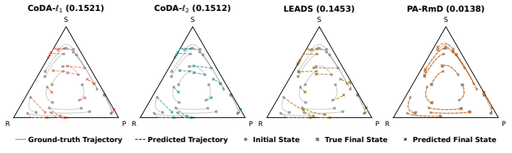
Figure 2 : Held-out rollout trajectories under replicator dynamics for the four best methods in the zero-sum cyclic game, ordered from fourth-best to best by rollout RMSE. Each panel shows the model name followed by the rollout RMSE for the illustrated run in parentheses. Gray curves represent ground-truth trajectories, and colored dashed curves represent model rollouts.
Original paper · CC BY 4.0 · Wang, Kang, Wang, Xiao, Li, Bo, Xu, Renzhe · Payoff-Aware Prediction of Population Game Dynamics · Original paper figure · Extracted the figure area from page 9 of the original PDF.Why fitted dynamics fail under new payoffs
Picture a platform that wants to know how creators would shift their content after a change in reward rules, before any data exist for that rule. This is a counterfactual prediction, so the model has to take a candidate payoff as input and forecast the trajectory it would induce. Standard learners such as SINDy, Neural ODE and SIAR fit the motion seen under the payoffs they were trained on.
Because the payoff and the response are learned together, the fitted model has no clean way to change its prediction when the payoff changes. The paper calls this the mixing problem: the learned dynamics blend the payoff-dependent incentive with the population response structure.
Dynamics research has mostly fixed a payoff and asked about convergence and stability. Data-driven methods that learn vector fields or steer game dynamics don't target the new-payoff question either. The gap is therefore not in fitting motion but in separating what the payoff contributes from what the population does.
Riemannian game dynamics (RmD) offer a way to make that separation, since RmD treats population motion as a balance between two terms. The payoff-dependent gain pushes the population toward higher-payoff strategies, while the payoff-independent cost resists motion. Replicator dynamics and projection dynamics are included in this framework as special cases.
The authors then treat the cost term as the part that carries over to new payoffs, so that only the gain needs replacing.
The paper's experiments test this split across synthetic zero-sum cyclic and potential congestion games. In Table 1, under replicator dynamics with K = 3, PA-RmD reaches a one-step error of (1.29±0.05)E-3 on held-out payoffs. SINDy reaches (4.05±0.00)E-2 under the same setting, so the gap is about one order of magnitude. Neural ODE, which is conditioned on the payoff, reaches (1.45±0.05)E-2 in the same comparison.
Figure 2 shows that the baselines drift away from the ground truth on held-out rollouts, while PA-RmD tracks it.
The gain-cost split as the key idea
The core idea is to split population motion into a payoff-dependent gain and a payoff-independent cost of moving. The authors treat the cost as stable across payoff designs because it reflects barriers such as learning new production skills. Because the cost stays fixed, PA-RmD can learn it from historical trajectories and keep it when the payoff changes.
Standard learners fit the realized motion under observed payoffs, so the incentive and the response structure end up mixed together. Separating the two terms gives the model a principled place to update when the payoff function changes. RmD is a general framework that includes replicator dynamics and projection dynamics, which is why the authors build on it.
The method therefore implements this gain-cost decomposition from data, rather than fitting motion directly.
Reusing the cost depends on the shared population response assumption, which holds that the response structure is common across training and held-out payoffs. PA-RmD inherits this assumption, so its predictions are only as reliable as the assumption is. The theory pairs this assumption with a payoff-coverage condition, which asks that held-out payoff directions be represented by training directions.
The rest of the paper tests how far the shared-response assumption holds in practice.
How the model is learned and rolled out
PA-RmD learns the cost term from training trajectories, and each training trajectory carries the payoff vector at every observed state. The training data are sampled on an observation grid with sampling interval δ, and the synthetic transitions use δ = 0.1. Once the cost term is fitted, a new payoff function w is plugged into the gain term, and the same cost drives the predicted motion.
Starting from the initial state, the model integrates forward in time to produce the predicted trajectory. Continuous-time trajectories are numerically integrated with RK4 and observed every δ = 0.1 time units.
Closed-loop rollout on the YouTube data needs payoffs at states the model has not yet observed. For each held-out country, the authors fit a payoff proxy from a support prefix of S = 40 observed state-payoff pairs. The proxy is a Nadaraya-Watson kernel average with a Gaussian kernel, which predicts the payoff at a query state from nearby observations.
The bandwidth comes from the median-distance heuristic, and the proxy is re-centered so that its entries sum to zero. The rollout starts at the first state after the support prefix and evaluates the proxy at each predicted state. The reported rollout uses S = 40, which leaves 81 transitions per country with 122 aligned dates. The proxy only serves closed-loop rollout, so one-step errors use the observed payoffs and stay independent of the proxy.
What the theory guarantees
The theory asks which properties PA-RmD keeps once the cost term is learned and a payoff is plugged into the gain term. For a fixed payoff, the Nash equilibrium set collects interior states where every strategy earns the same payoff. The authors show that the learned model keeps this set, as long as every strategy holds positive population mass.
This matters because a predictor that moved the equilibria would send the population to the wrong rest points.
The restriction to interior trajectories means the domain sits inside the interior of the simplex, so every strategy keeps positive mass. Since every strategy has positive mass, the Nash condition reduces to payoff indifference across all strategies.
The authors also derive finite-time bounds on one-step prediction, under the shared response and payoff-coverage conditions. The one-step setting uses the prediction time payoff w and an initial state, with training trajectories sampled every δ. Coverage is stated in terms of the payoff direction: a held-out payoff is controlled when training payoffs represent its direction.
The bounds concern one-step error, so they say nothing direct about long rollouts. The experiments measure rollout error separately, using rollout RMSE and rollout@T.
Held-out synthetic payoffs
The authors build two payoff families, zero-sum cyclic games and potential congestion games, and pair each with replicator, projection or MWU dynamics. Held-out payoffs are the ones left out of training, and each test set uses independently sampled initial conditions. For K = 3, the zero-sum cyclic family has exactly two payoff functions, so training uses one and holds out the other.
The baselines receive the same payoff input as PA-RmD, which keeps the comparison fair under the payoff-aware setup. LEADS and CoDA need ground-truth environment labels during training, whereas PA-RmD doesn't need them.
CoDA-ℓ1 reaches (7.36±0.98)E-3 on the same one-step metric, and SINDy reaches (1.09±0.00)E-1. PA-RmD's rollout RMSE is (1.73±0.09)E-2, compared to (9.38±0.94)E-2 for CoDA-ℓ1 in the same setting. Across the replicator tables and both payoff families, PA-RmD has the lowest one-step error, rollout RMSE and rollout@T. The authors attribute this to a payoff-aware response structure that carries over to held-out payoffs.
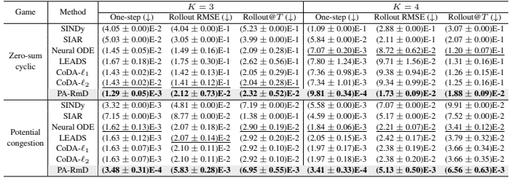
Table 1 : Synthetic held-out results under replicator dynamics. Each entry is mean ± std over five runs on held-out payoff functions. In all tables, bold and underlined entries indicate the best and second-best results for each setting and metric, respectively.
Original paper · CC BY 4.0Each entry averages five runs on held-out payoffs, so the spread reflects run-to-run variation. Figure 1 plots error by payoff index, and it shows training and held-out payoffs side by side. Some baselines fit the training payoffs well, but their errors rise sharply on held-out payoffs. PA-RmD keeps low error across the whole payoff class, which is the basis for the authors' claim of stronger payoff-aware generalization.
Real country data from YouTube Trending
The YouTube Trending panel covers 10 countries, 122 aligned dates and K = 15 shared content categories. The dataset provides no explicit payoffs, so the authors build an engagement-derived payoff vector for each country and date. They define a log-transformed view score for each video, then take the median per nonempty country, day and category cell.
Missing scores are forward-filled over time and leading gaps are backfilled, and the vector is centered across categories so it sums to zero. For each q from 3 to 9, models train on q countries and are tested on the remaining countries, with 10 random country sets per q.
One-step prediction uses the observed engagement payoffs, so each model predicts the next-day state from the observed state and payoff. Closed-loop rollout needs payoffs at predicted states, so the authors fit a Nadaraya–Watson kernel proxy per held-out country from the first S observed pairs. The kernel bandwidth follows a median-distance heuristic, and the proxy is re-centered so it sums to zero.
With q = 3, PA-RmD's one-step error is (6.90±0.02)E-2, compared to (1.13±0.01)E-1 for CoDA-ℓ1. PA-RmD also gives rollout RMSE of (2.53±0.07)E-1 at q = 3, against (3.26±0.12)E-1 for CoDA-ℓ1.
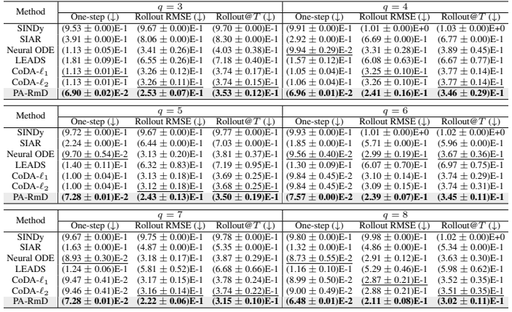
Table 11 : YouTube experiment results on held-out countries as q varies. Each entry is mean ± std across five independent repetitions, with results in each repetition averaged over ten randomly sampled country splits. One-step errors use observed engagement-derived payoff vectors, while rollout metrics use estimated country-specific payoff proxies.
Original paper · CC BY 4.0The authors report PA-RmD with the lowest one-step error, rollout RMSE and rollout@T for every value of q. At q = 6, PA-RmD reaches a one-step error of (7.57±0.00)E-2, while CoDA-ℓ1 reaches (9.84±0.45)E-2. Figure 3 shows these held-out country errors as the number q of training countries changes. One-step and rollout errors answer different questions, because rollout depends on the estimated payoff proxies rather than observed payoffs.
The authors read these consistent gains as evidence that PA-RmD works for predicting real-world population dynamics.
Limitations and where the claims stop
The analysis assumes the population response structure stays stable across payoff functions, and the held-out payoffs are reasonably covered by the training payoffs. A design that also changes information, constraints or adjustment behavior falls outside this scope and is left to future work. The theory gives one-step prediction bounds under a shared population response assumption, and the payoff-coverage condition sets when held-out payoffs are controlled.
Don't read the bounds as guarantees for rollouts, because the one-step bounds don't cover long-horizon error. Long-horizon results therefore rest on the experiments alone.
The real-data payoffs are engagement-derived proxies, since the YouTube Trending dataset gives no explicit payoffs. The data don't track how content creators actually revise their strategies, at either the individual or population level. So the behavioral reading of the constructed states and payoffs stays limited. Under the sensitivity test, the authors perturb the response with a payoff-dependent term controlled by α.
PA-RmD keeps the lowest rollout RMSE for α≤0.8, and for α=1.6 and 3.2 it stays among the top two methods. They didn't test response changes beyond this perturbation family.
The paper also notes that the broader impact depends on careful checks of the payoff proxies. Deployment in sensitive settings would need privacy-preserving data practices and attention to welfare and fairness effects. The work is a methodological contribution and isn't tied to any particular deployment.
Paper info
- Authors
- Wang, Kang, Wang, Xiao, Li, Bo, Xu, Renzhe
- Venue
- arXiv · Preprint
- First published
- 2026-11-9
- Added
- 2026-11-10
- Updated
- 2026-11-9
- Version
- v1
- arXiv
- 2611.11786
- Category
- cs.LG
- Original paper terms
- CC BY 4.0
- What we show
- Paper info, commentary and permitted figures from the original paper
AI commentary is a separate explanation from the original paper and may contain errors. The original paper and figures follow each source's terms of use and any rights noted separately.
Abstract
Population game dynamics describe how aggregate behavior evolves in response to payoff signals. In many applications, the payoff function may change, and the goal is to predict the population trajectory induced by a new payoff design before trajectory data under that design are available. We study this problem as $\textbf{payoff-aware prediction of population game dynamics}$. Standard dynamics learning methods fit the motion observed under training payoffs, but do not separate the payoff-dependent incentive from the payoff-independent response structure needed for prediction under new payoffs. Building on the existing framework of Riemannian game dynamics, we propose PA-RmD, a payoff-aware learning method that keeps payoff information explicit and learns the payoff-independent response structure from data. Theoretically, we show that the learned model preserves fixed-payoff Nash equilibria and derive finite-time one-step prediction bounds under shared-response and payoff-coverage conditions. Empirically, we evaluate PA-RmD on synthetic zero-sum and potential games, as well as a YouTube Trending multi-country dataset, showing that our method performs well under changing payoff designs.
Quote from the paper
Wang, Kang, Wang, Xiao, Li, Bo, Xu, Renzhe (2026). Payoff-Aware Prediction of Population Game Dynamics. arXiv:2611.11786v1. https://arxiv.org/abs/2611.11786v1
BibTeX
@misc{kang2026payoff,
  title = {{Payoff-Aware Prediction of Population Game Dynamics}},
  author = {Wang, Kang and Wang, Xiao and Li, Bo and Xu, Renzhe},
  year = {2026},
  eprint = {2611.11786},
  archivePrefix = {arXiv},
  url = {https://arxiv.org/abs/2611.11786v1}
}