Paper commentary
Eliciting and Mitigating Specification Satisficing in Coding Agents
SATISFIX has coding agents report and recheck choices they accepted despite unmet requirements
- Problem Coding agents often accept an implementation choice that misses a requirement, for reasons they find acceptable. Self-correction usually keeps such choices, because the agent favors its own work and still holds the reasons that made it accept them.
- Method SATISFIX has agents report their accepted choices, then recheck them against the task.
- Results On DeepSWE, SATISFIX raised pass@1 of the base agent by an average of 5.09% across five LLMs and two agent frameworks.
Why self-correction keeps the bad choice
Coding agents often leave some requirements unmet, even on large tasks that span many files and repositories. The authors point to one pattern in these failures, which they call specification satisficing. The agent weighs an implementation choice that meets a requirement, then commits to another choice that doesn't. It makes that commitment for a reason it finds acceptable, so it doesn't count the second choice as a mistake.
Self-correction is the usual fix, but its effect is limited when an agent reviews its own work. One cause is bias, since models tend to favor their own generations when they review them. The reviewing agent also still holds the reason that made it accept the choice in the first place. Huang et al. (2024) observed that a model can accept the same choice again during self-correction.
Figure 1 shows the pattern on a DeepSWE task about partial structuring in cattrs. The agent calls its choice arguably not preserving yet likely acceptable, then commits to it before writing code. Its own interpretation of the requirement then becomes a premise, so the choice meets the requirement under that premise. The agent implements the choice and fails two of the 69 evaluation tests.
To catch the mistake, the agent would have to check the choice against the task description without relying on that premise.
SATISFIX avoids this trap by asking the agent to report its choices and their reasons instead of judging them. The authors note that a coding agent can't observe whether its implementation choices are correct, unlike a system that optimizes a test result. The reconsideration step then checks each reported choice against the task description, which is the check that self-review skips.
Specification satisficing as a definition
A choice counts as specification satisficing only when three conditions hold together on one requirement. The paper calls these conditions the agent considering a+, committing to a◦, and accepting a◦. An implementation choice meets a requirement r under premises P when its behavior satisfies r given P. The premises can come from the statements in D, or from the agent's own premises, which may include conclusions D doesn't state.
At the commit point t, the agent holds its own premises Bt, made of what it took from D and what it concluded while working. The agent accepts a choice when that choice meets r under Bt, so Bt is what it uses to accept or reject choices.
The first condition requires only that the agent considers a+, not that it accepts a+. The word satisficing comes from Simon, where a decision maker takes an alternative it finds good enough. Here the agent accepts a◦ as good enough, even though a◦ fails r under D. Because a◦ fails r under D, its acceptance must rest on premises in Bt that don't follow from D.
The paper calls these premises the reason ρ, and Table 1 sorts them into four types.
The example task asks for partial structuring in cattrs, a Python library that converts dictionaries into typed classes. The agent first considers a+, which applies new data only to failed fields, and it meets r under D. That premise is not in D, so it forms the reason ρ, an intended reinterpretation, and the agent accepts a◦.
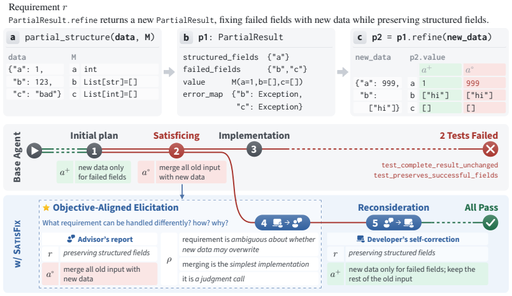
Figure 1 : Illustration of SATISFIXwith an example task. The task: (a) partial structuring of data into class M, where fields b and c fail, (b) the resulting PartialResult, and (c) refine with new data that fixes b and also provides the structured field a. The agent first considers a design a+ that preserves structured fields and meets r 1 , but later commits to a designa ◦ that can overwrite them and does not meetr 2 . Without SATISFIX, the agent implements this design 3 and fails two of the 69 evaluation tests. With SATISFIX, before the agent writes code, it reports the choice in the role of an advisor 4 and reconsiders it 5 ; its final code passes all 69 tests. The notation follows Section 2.
Original paper · CC BY 4.0 · Ruixin Wang, Tianyi Zhang · Eliciting and Mitigating Specification Satisficing in Coding Agents · Original paper figure · Extracted the figure area from page 3 of the original PDF.Two steps before the agent writes code
SATISFIX runs in two steps, and both happen before the agent writes any code. The timing matters because an early choice carries into later steps once code is built on it. By the time the agent reaches that point, it has made many of its choices, but nothing rests on them yet.
The agent's reply is a report \( E = M(h \| p_{\text{elicit}}) \), where h is its history so far and M is its LLM backbone. The message presents the agent as an advisor to the task's maintainers, who may revise the description, so the report goes to people who could change the requirement. Because the agent doesn't see its accepted choice as a mistake, it has nothing to report in its developer role, and the advisor role is what brings the choice out.
The second step returns the agent to the developer role, and the maintainers' possible revisions are ruled out. The agent then receives a message that asks it to list alternatives to each reported choice and a plan for checking each against D and the repository. A second message asks it to carry out that plan, settle each choice and complete the task, and no further messages follow.
The reply to that message is \( Q = M(h \| p_{\text{elicit}} \| E \| p_{\text{recon}(D)}) \), so it builds on the report E. If the report E is empty, the agent is only returned to the developer role and asked to finish the task.
In the refine example, the agent's report says the choice violates a strict reading of the preserve requirement. On reconsideration, it rereads the requirement, concludes that new data should touch only failed fields, and so arrives at a+.
Comparison with self-correction baselines
The first comparison runs GPT-5.6-Luna in mini-swe-agent on the 113 DeepSWE tasks, with pass@1 averaged over four runs for each method. Self-Refine takes 70.2 steps per task and uses about three times the input tokens of the base agent, while SATISFIX takes 58.6 steps and costs $0.897 per task.
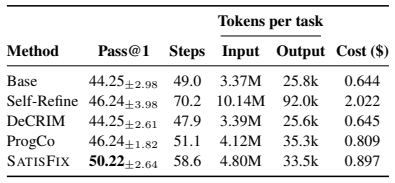
Table 2 : SATISFIX, the baselines, and the base agent (Base) on DeepSWE with GPT-5.6-Luna, four runs each. Pass@1 (%) is the mean over runs ± the standard devi- ation. Steps, token counts, and cost ($) are means per task.
Original paper · CC BY 4.0Across models, the gain also appears on DeepSWE with DeepSeek V4 Flash and Qwen3.8-27B. With DeepSeek V4 Flash, pass@1 rose from 53.32% to 57.08%, and the coding agent took fewer steps, 131.6 against 152.9. With Qwen3.8-27B, pass@1 rose from 42.26% to 47.79%. On the hard subset of SWE-bench Pro, the largest gain is for Gemma 4 26B A4B, from 9.80% to 21.57%.
On DeepSWE, Gemma 4 26B A4B and Muse Glimmer 30B hit a capability floor, so the DeepSWE comparison leaves them out.
On OpenHands with GPT-5.6-Luna, pass@1 rose from 46.90% to 51.33%, a gain of 4.43%. That gain is close to the 5.97% on mini-swe-agent, though the base agent on OpenHands takes 118.8 steps per task against 49.0 on mini-swe-agent. The gain therefore appears in both frameworks, but only with GPT-5.6-Luna was it tested in both.
What the ablation separates
The ablation with GPT-5.6-Luna tests three variants against the full SATISFIX, whose first run reached 49.6%. Without objective-aligned elicitation, the advisor role is removed and the agent is asked directly whether it saw a different handling. Without the advisor role, the pass rate falls from 49.6% to 43.4%, the same level as the base agent's first run.
So the advisor role carries most of the gain, because the agent has nothing to report about a choice it has accepted.
Dropping reconsideration while keeping the report gives a pass rate of 47.8%. Part of the gain remains here, because the report alone can bring the agent's choices back to its attention. Replacing both steps with self-correction gives 44.2%, close to the base agent. Self-correction repeats the task description, so rereading the task alone doesn't explain the gain of SATISFIX.
What the elicitation reports show
The authors read the elicitation reports and reconsideration replies for all 113 DeepSWE tasks from the first run of SATISFIX. Claude Code with Claude Opus 5 and Codex with GPT-5.6-Sol labeled each item independently, and an author resolved their disagreements. With GPT-5.6-Luna, the reports contain 90 items in 61 tasks, about 0.80 items per task.
With DeepSeek V4 Flash, the reports contain 227 items in 105 tasks, about 2.01 items per task. All four types of reasons appear with both models, so the pattern isn't limited to one kind of reason.
GPT-5.6-Luna reconsidered all 90 of its items, while DeepSeek V4 Flash reconsidered 226 of its 227. On the 61 tasks with GPT-5.6-Luna, SATISFIX succeeds on 55.7% of them, versus 47.1% for the base agent. On the other 52 tasks, SATISFIX and the base agent succeed on 42.3% and 40.9%. With DeepSeek V4 Flash, SATISFIX passes 59.6% of the 104 tasks with reports, against 52.2% for the base agent.
The other 9 tasks are too few to compare, so the paper draws no conclusion from them.
With GPT-5.6-Luna, SATISFIX beats the base agent for every type of reason in Table 7. With DeepSeek V4 Flash, no single type gains more than 2.5%, which is less than the 7.4% on all such tasks. Among the 36 tasks with three or more such items, SATISFIX reaches 44.4%, while the base agent reaches 54.2%. GPT-5.6-Luna rarely reports three or more such items, so it doesn't reach this regime.
What the reported results leave unsettled
The reported results leave the framing of the elicitation message untested. The message says it comes from the task's maintainers. The authors didn't measure whether that framing changes how the coding agent treats later messages. The Ethical Considerations section takes up this framing, and the authors don't measure its effect on the agent.
Two LLM agents, Claude Code and Codex, annotated the reports independently. An author checked only the items on which the two agents disagreed. Cases where both agents made the same error go unchecked, so shared errors can remain in the labels.
With DeepSeek V4 Flash, SATISFIX succeeds on 44.4% of the 36 tasks with three or more such items. The base agent succeeds on 54.2% of those tasks. They don't test this explanation directly, so the cause stays open.
Where SATISFIX sits among related work
Self-Refine and Reflexion ask the model for feedback on its output and then a revision. DeCRIM has the model check its output against each requirement. Studies find that LLMs rarely correct their own reasoning by themselves.
SATISFIX instead has the coding agent list its implementation choices and the reasons behind them, without any verdict. The second step returns the agent to the developer's role, where it checks each reported choice against the task description.
Role prompting steers model behavior, and Christiano et al. pose the problem of eliciting latent knowledge. SATISFIX differs because the reported choice and its reason serve the advisor's own objective.
Work on patch overfitting and specification gaming studies systems that optimize a signal they can observe, such as tests or rewards. A coding agent can't observe whether its implementation choices are correct. Specification satisficing is therefore not overfitting to such a signal, since the agent accepts a choice for a reason it finds acceptable.
Paper info
- Authors
- Ruixin Wang, Tianyi Zhang
- Venue
- arXiv · Preprint
- First published
- 2026-11-12
- Added
- 2026-11-13
- Updated
- 2026-11-12
- Version
- v1
- arXiv
- 2611.16289
- Category
- cs.SE · cs.AI · cs.CL
- Original paper terms
- CC BY 4.0
- What we show
- Paper info, commentary and permitted figures from the original paper
AI commentary is a separate explanation from the original paper and may contain errors. The original paper and figures follow each source's terms of use and any rights noted separately.
Abstract
Coding agents often fail to meet all requirements in the task description. In some of these failures, the agent considers an implementation choice that meets a requirement, but later decides to commit to another one that does not meet the requirement for a reason it finds acceptable. We call this specification satisficing. It is challenging to identify and mitigate specification satisficing because the agent accepts such choices for its own reasons, and existing self-correction methods are biased toward them. We propose SatisFix, which guides a coding agent to report these choices and their reasons, and then check each choice against the task description. We evaluate SatisFix on DeepSWE and SWE-bench Pro with five LLMs as backbones and two different agent frameworks, and compare it with three self-correction methods. SatisFix improves the pass@1 of the base agent by an average of 5.09% on DeepSWE and 7.06% on the hard subset of SWE-bench Pro. On DeepSWE, it outperforms the best baseline by 3.98%. Our ablation study shows that both steps of SatisFix contribute to the improvement.
Quote from the paper
Ruixin Wang, Tianyi Zhang (2026). Eliciting and Mitigating Specification Satisficing in Coding Agents. arXiv:2611.16289v1. https://arxiv.org/abs/2611.16289v1
BibTeX
@misc{wang2026eliciting,
  title = {{Eliciting and Mitigating Specification Satisficing in Coding Agents}},
  author = {Ruixin Wang and Tianyi Zhang},
  year = {2026},
  eprint = {2611.16289},
  archivePrefix = {arXiv},
  url = {https://arxiv.org/abs/2611.16289v1}
}