Paper commentary
D3D: Decoupled Diffusion Drafting for Asynchronous Speculative Decoding
D3D drafts successor blocks during verification so speculative decoding runs asynchronously
- Problem Diffusion drafters like DFlash must wait for fresh target hidden states before each new block. Drafting and verification therefore run back to back, which limits speedup.
- Method D3D is a standalone diffusion drafter that predicts blocks from the token prefix alone. Unlike DFlash, it drafts successor blocks during verification in one packed pass.
- Results D3D averages 5.00× decoding speedup with Qwen3-8B, compared with 4.03× for DFlash across seven benchmarks.
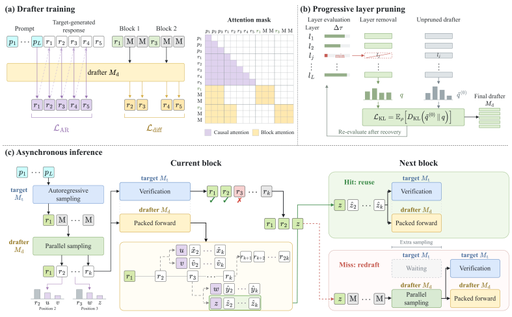
Figure 1 : Overview of D3D.(a) Drafter training.Target-generated responses supervise blockwise denois- ing and auxiliary autoregressive prediction. Packed attention shares causal prefix computation while isolat- ing diffusion blocks and allowing bidirectional attention within each block.(b) Progressive layer pruning. Each iteration removes the layer causing the smallest decrease in validation acceptance length, followed by recovery and reevaluation of layer importance. Recovery uses distillation from a fixed unpruned drafter whose output distribution is adjusted toward the supervised token.(c) Asynchronous inference.During target verification, one packed drafter pass prepares successor blocks for alternative rejection outcomes and full acceptance. A branch matching the verified prefix is reused; otherwise, the drafter generates a new block synchronously.
Original paper · CC BY 4.0 · Baoyou Chen, Ruiqiao Mei, Guancong Lin, Tao Song, Weihao Yuan, Qun Liu, Siyu Zhu · D3D: Decoupled Diffusion Drafting for Asynchronous Speculative Decoding · Original paper figure · Extracted the figure area from page 4 of the original PDF.Why the next draft has to wait
Speculative decoding lets a lightweight draft model propose several future tokens, and the target model then checks them in parallel. Parallel drafters cut the cost of that proposal step, and DFlash goes furthest by producing a whole candidate block in one forward pass. The catch is that DFlash conditions on target-model features, so every new block depends on what the verifier has just produced.
Those representations come from newly accepted tokens, so the drafter has to wait for verification to finish before drafting the next round. A block can be drafted in one pass, but that wait still adds to every round. Drafting latency also grows with drafter depth, because larger drafters accept more tokens but take longer per block. When these steps run back to back, the extra latency can cancel the gain from longer accepted prefixes.
The authors frame the goal as long accepted prefixes without target hidden states, with drafting fast enough to finish inside the verification interval.
A standalone drafter that reads only the prefix
The key idea is to give the drafter its own prefix representations, so it never needs the target's hidden states. D3D starts from a pretrained autoregressive model, so it keeps that model's language priors while learning to predict blocks. Given a prefix, it fills one block in a single forward pass, and the target then verifies the block with rejection sampling.
Training samples K anchor positions in each response, and each anchor starts a block of size B. The anchor token stays visible, and the remaining B-1 positions are filled with a mask token. The block is written as \(\tilde{B}_k = (r_{s_k}, [M], \ldots, [M])\), with B-1 mask tokens after the anchor. Only the next \(b_k = \min(B-1, T-s_k)\) response tokens are supervised, so positions past the response end don't contribute to the loss.
All K blocks are packed into one sequence, so one forward pass gives supervision for every anchor. A shared causal encoding of the prompt and response avoids recomputing the prefix for each block. Each block attends to the prefix before its anchor and to its own tokens, with bidirectional attention inside the block.
Training with blockwise denoising and an AR loss
Each masked position in a D3D block gets a negative log-likelihood of its true token, conditioned on the prefix and the block. The drafter packs K diffusion blocks into one sequence, so one forward pass supplies denoising supervision for every anchor. Each block attends only to the prefix before its anchor and to its own tokens, with bidirectional attention inside the block.
Only the next b_k response tokens are supervised, so masked positions past the response end stay in attention but drop out of the loss.
Verification keeps candidate tokens only up to the first rejection, so early block positions carry more weight than later ones. Following DFlash, D3D uses exponentially decaying position weights w_j, with the decay rate set by γ greater than 0. The position-weighted diffusion loss L_diff divides the weighted sum by Z_diff, the total of the weights over all supervised positions.
The autoregressive term L_AR applies next-token prediction to the unmasked target-generated response, so the pretrained model keeps its language modeling ability. The authors add L_AR to the diffusion loss as L_train = L_diff + λL_AR, where λ sets how much the autoregressive term counts.
The authors explain that blockwise denoising trains parallel predictions, while the AR objective supervises next-token prediction from unmasked prefixes. In the GSM8K training curves, nonzero AR weights keep a higher acceptance length than diffusion-only training throughout training.
Pruning layers by their effect on acceptance
Layer pruning starts from the 36-layer D3D-8B drafter and cuts it down to 31 Transformer layers. Each remaining layer is removed alone, and the drop in validation acceptance length is measured against the intact drafter. The layer whose removal lowers average acceptance length the least is deleted, and the pruned drafter then undergoes recovery training.
Recovery training distills from the trained, unpruned drafter, which stays fixed for the whole pruning run. Each stage gets 10k recovery steps, and the pruning runs reuse the target-aligned training data. Plain distillation can pull the pruned drafter toward a competing token when the teacher's most probable guess differs from the supervised token.
The authors mix the teacher distribution with the one-hot supervised token, so the supervised token gains weight. They choose the smallest mixing weight that puts the supervised token above every other token by a fixed positive margin, which keeps as much of the teacher's soft distribution as possible. The distillation term is a position-weighted forward KL divergence, and the recovery loss adds it to the diffusion and autoregressive terms.
Below 31 layers, acceptance length and speedup both fall, so the authors select the final checkpoint by validation decoding speedup.
The authors also compare pretrained Qwen3-8B initialization with random initialization, holding architecture and training budget fixed. At the final measured step, pretrained initialization reaches τ ≈ 9.8 on GSM8K, while random initialization reaches τ ≈ 4.5. A pretrained drafter already predicts plausible continuations from a token prefix, so training can focus on target alignment and parallel block prediction.
Packing successor blocks during verification
While the target verifies the current block, D3D fills one packed drafter pass with continuations for every possible rejection outcome and one for full acceptance. The packed input holds the block under verification, (C-1)F rejection blocks, and one full-acceptance block. Because the drafter needs no target hidden states, it can run these branches without waiting for the verifier's output.
On a cache hit, D3D reuses the remaining draft tokens of the matching branch in the next verification round. On a cache miss, the target must wait while the drafter synchronously generates a new block from the verified prefix.
Position coverage C includes the first C-1 rejection positions and the full-acceptance case. Token fan-out F is the number of alternative anchors per selected rejection position, taken from the drafter's most probable tokens excluding the proposed token. The asynchronous draft budget is N_async = B[(C-1)F+2], so with B = 16, C = 12 and F = 2 it comes to 384 tokens.
On AIME25, the sweeps show that increasing C from 12 to 16 at F = 2 raises the hit rate from 71.3% to 78.3% but reduces speedup. Raising F from 2 to 5 at C = 12 lifts the hit rate to 81.8% with a 912-token budget, and speedup falls below the F = 2 setting. The authors select the budget by decoding speedup, because extra coverage adds computation to every packed pass, including branches verification never selects.
Speedup and acceptance against baselines
The peak speedup is 7.48× on GSM8K with Qwen3-32B, the largest single speedup in Table 1. The authors read this as high acceptance from conditioning on the token prefix alone.
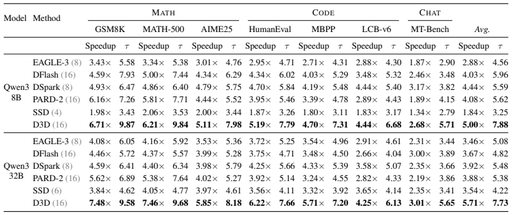
Table 1 : Speedup and average acceptance lengthτacross mathematical reasoning, code generation, and chat benchmarks. LCB denotes LiveCodeBench. Numbers in parentheses indicate block sizes.
Original paper · CC BY 4.0Acceptance length tells a similar story, and D3D is ahead on every benchmark for both targets. With Qwen3-8B, D3D is the fastest method on five of seven benchmarks. With Qwen3-32B, it is the fastest on all seven benchmarks.
The baselines don't share one block size: EAGLE-3 uses 8, SSD uses 4 with Qwen3-8B, and PARD-2 uses 16. PARD-2 and SSD run with asynchronous inference, while DFlash, DSpark and EAGLE-3 run synchronously. Each baseline runs with its own checkpoint or training data, so the comparison reflects the full system setup. The authors also trained DFlash and PARD-2 for both targets on the same target-generated data as D3D.
Table 2 adds a concurrency view for D3D-1.7B with Qwen3-32B, where relative speedup falls as requests increase. At 16 requests, MATH-500 reaches 864 tokens/s (2.7×), while MT-Bench reaches 386 tokens/s (1.5×). Single-request speedup therefore doesn't capture how the gain changes under load.
Scale and initialization ablations
The scale ablation asks whether D3D's acceptance advantage needs a larger parameter budget. The authors train D3D-1.7B, D3D-4B and D3D-8B for one epoch and compare them with DFlash. On MATH-500, D3D-1.7B scores 8.16 τ, compared to 6.87 for DFlash. The gains shrink as the drafter grows, which is why the authors prune the 8B drafter rather than train a larger one.
The initialization ablation holds the architecture and training budget fixed and changes only the starting weights. It compares Qwen3-8B weights against random initialization, so the gap isolates the contribution of pretraining. At the final measured training step on GSM8K, pretrained initialization gives τ of about 9.8. Random initialization reaches only about 4.5 at the same step.
The advantage appears early in training and persists throughout it. That prior lets adaptation focus on target alignment and parallel block prediction, while a random drafter must learn this capability within the same budget.
Draft budget and serving under load
The asynchronous draft budget sets how many tokens the packed drafter must produce during each verification round. Position coverage C and token fan-out F trade speculative coverage against drafting cost, so the authors swept each one separately. Both sweeps use the 31-layer D3D-8B drafter on AIME25, with Qwen3-8B as the target and B = 16.
Both sweeps peak at about 5.0× at C = 12, F = 2, and a 384-token budget. Raising C from 12 to 16 at F = 2 lifts the cache hit rate from 71.3% to 78.3%, yet speedup drops. At C = 12, raising F from 2 to 5 lifts the hit rate to 81.8% and the budget to 912 tokens, again with lower speedup than at F = 2. A cache hit saves the drafting pass that would otherwise follow verification, which shortens the wait before the next round.
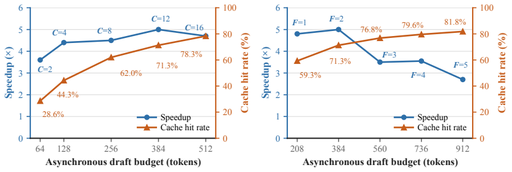
Figure 3 : Decoding speedup and cache hit rate versus asynchronous draft budget on AIME25, using the 31-layer D3D-8B drafter with Qwen3-8B andB= 16. Left: varying position coverageCatF= 2. Right: varying token fan-outFatC= 12.
Original paper · CC BY 4.0The serving experiment tests how the gain changes when several requests share the GPU. The authors used the Transformers backend with SDPA and D3D-1.7B with Qwen3-32B as the target. They measured aggregate throughput across 1 to 16 concurrent requests on MATH-500, HumanEval, and MT-Bench. At 16 requests, MATH-500 reaches 864 tokens/s, a 2.7× speedup.
MT-Bench reaches 386 tokens/s at 16 requests, a 1.5× speedup. A single-request speedup therefore doesn't show how the gain shifts under load.
The budget results and the serving results point to the same tension: more packed work helps only until drafting starts to delay verification.
What the experiments leave untested
The serving study uses the Transformers backend with SDPA, so it doesn't show how D3D performs in a production serving stack. The authors measure aggregate throughput for D3D-1.7B on Qwen3-32B across 1 to 16 concurrent requests. The serving table covers only MATH-500, HumanEval and MT-Bench, so the other benchmarks stay outside that load test.
D3D, SSD and PARD-2 run on two H800 GPUs, while the synchronous DFlash, DSpark and EAGLE-3 baselines run on one. Because of this split, the main comparison doesn't settle throughput per GPU. The authors don't compare D3D against other uses of the same two-GPU budget, such as tensor-parallel target inference. A cache miss forces the drafter to generate a new block synchronously before the next verification round can start.
Most ablations train for one epoch with Qwen3-8B as the target, which covers a narrower setting than the main table. They didn't run these ablations with Qwen3-32B as the target, although the main table reports both targets. The implementation runs on Transformers, so evaluation in SGLang or vLLM, with their batching and scheduling, remains untested.
The conclusion reports the speedups for both targets, but it doesn't add results beyond the tested serving setup.
Paper info
- Authors
- Baoyou Chen, Ruiqiao Mei, Guancong Lin, Tao Song, Weihao Yuan, Qun Liu, Siyu Zhu
- Venue
- arXiv · Preprint
- First published
- 2026-11-4
- Added
- 2026-11-6
- Updated
- 2026-11-4
- Version
- v1
- arXiv
- 2611.06425
- Category
- cs.AI · cs.LG
- Original paper terms
- CC BY 4.0
- What we show
- Paper info, commentary and permitted figures from the original paper
AI commentary is a separate explanation from the original paper and may contain errors. The original paper and figures follow each source's terms of use and any rights noted separately.
Abstract
Target-conditioned diffusion drafters predict candidate tokens in parallel, yet each new block must wait for updated target-model hidden states. This forces drafting and verification to run sequentially, limiting speedup even though each block is generated in one pass. We introduce D3D, a standalone diffusion drafter that removes this inter-round dependency. D3D combines blockwise denoising with auxiliary autoregressive supervision to achieve long accepted prefixes without target hidden states. This independence lets D3D draft successor blocks during verification in one packed pass, enabling asynchronous speculative decoding. We progressively prune layers according to their effect on acceptance length to reduce the cost of packed drafting. Removing five of 36 layers retains over 99\% of mean acceptance length across three benchmarks with Qwen3-8B as the target. Across seven benchmarks, D3D averages 5.00$\times$ and 5.71$\times$ decoding speedup with Qwen3-8B and Qwen3-32B targets, compared with 4.03$\times$ and 3.67$\times$ for DFlash. On GSM8K with Qwen3-32B, speedup reaches 7.48$\times$. Code is publicly available at https://github.com/fudan-generative-vision/D3D.
Quote from the paper
Baoyou Chen, Ruiqiao Mei, Guancong Lin, Tao Song, Weihao Yuan, Qun Liu, Siyu Zhu (2026). D3D: Decoupled Diffusion Drafting for Asynchronous Speculative Decoding. arXiv:2611.06425v1. https://arxiv.org/abs/2611.06425v1
BibTeX
@misc{chen2026decoupled,
  title = {{D3D: Decoupled Diffusion Drafting for Asynchronous Speculative Decoding}},
  author = {Baoyou Chen and Ruiqiao Mei and Guancong Lin and Tao Song and Weihao Yuan and Qun Liu and Siyu Zhu},
  year = {2026},
  eprint = {2611.06425},
  archivePrefix = {arXiv},
  url = {https://arxiv.org/abs/2611.06425v1}
}