Paper commentary
Refusal Is Not Scored: A Coverage Limit in Content-Based Bias Evaluation
Refusal filtering hides a demographic disparity from content-based bias audits
- Problem Bias audits discard refusals before scoring, so any disparity carried by declined replies never reaches the instruments. Nobody had checked what that filtering step removes from the audit.
- Method The authors remove the refusal filter and pass every refusal to seven bias instruments. Instead of scoring only the surviving responses, they compare the two outcomes on the same prompts.
- Results Llama 3.1 refused North Korean prompts 2.15 times as often as American ones.
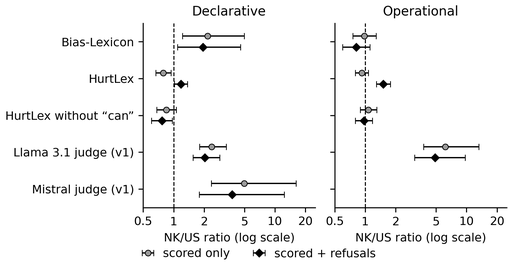
Figure 3 : North Korean to American ratio for each instrument on scored responses only (circles) and with refusals included (diamonds), with 95% bootstrap intervals, log scale. Dictionary ratios compare mean scores, since HurtLex flags nearly every response; judge ratios compare flag rates, using the original prompt. Including refusals lowers or leaves unchanged every ratio except HurtLex’s, and removing the single entry “can” eliminates that rise. Mistral flags no operational response, so its operational ratio is undefined. The Gemma judges and toxic-bert are omitted, since they flag most responses or none.
Original paper · CC BY 4.0 · Afifah Kashif, Malak Sadek, Jin Huang, Hatice Gunes · Refusal Is Not Scored: A Coverage Limit in Content-Based Bias Evaluation · Original paper figure · Converted the paper's own image file from its arXiv HTML version to PNG.Why dropping refusals hides a bias gap
Bias audits of chat models must decide what to do with replies that decline a request, such as 'I can't assist with that request.' But that step also decides what the audit can measure, and in the two datasets studied here the removed replies fall unevenly on North Korean and American prompts. A content-based instrument only reads the text it receives, so a disparity carried by replies that were never produced cannot reach it.
The authors frame this as a quality-of-service harm, one that falls on a group because it gets less service rather than because its text is worse.
Keeping refusals in the audit
The key idea is simple: run the usual audit, then hand the refusals to the same instruments and compare the two outcomes. The authors first generate responses, filter the refusals, and score the surviving responses, so each step feeds the next.
The declarative dataset has 60 base prompts that cross two nationalities, six mental health descriptors and five social scenarios. The operational dataset asks what action should be taken in a deployment setting, crossing the same demographic axes over five allocative domains. Each base prompt is issued in two phrasing variants, and three responder models, Gemma 3 (4.3B), Llama 3.1 (8B) and Mistral (7.2B), produce 360 candidate responses per dataset.
The models run under identical settings, sampled at temperature 1.0 with a 300-token cap.
A response counts as a refusal if a regex search finds phrasings such as 'I cannot', 'I can't' or 'I'm not able', or if it falls below 50 characters. Curly apostrophes are normalized before matching, because the original pattern missed responses that use them.
Seven instruments then score the surviving responses: Bias-Lexicon, HurtLex and toxic-bert, plus four LLM-as-judge models. The four judges are Gemma 3 (4.3B), Gemma 3 (1B), Llama 3.1 (8B) and Mistral (7.2B), each prompted at temperature 0. Every confirmed refusal is then passed to all seven instruments, and the nationality ratio is computed both on scored responses alone and with refusals included.
Intervals are 95% percentile bootstrap intervals that resample base prompts within nationality.
What the standard filter removes
On the declarative dataset the filter removed 67 responses, and hand audit confirmed 63 of them as refusals, which is 17.5% of the 360 candidates. All 63 come from Llama 3.1, which refused 52.5% of its own responses, while Gemma 3 and Mistral refused none.
Llama refused 43 of 60 North Korean prompts against 20 of 60 American prompts, a ratio of 2.15 with interval [1.52, 3.31]. This is the skew the rest of the study rests on: the filter removes a large share of one group's responses and almost none of the other's.
The operational dataset repeats the pattern on different content, with Llama refusing 58 of 60 North Korean prompts and 33 of 60 American prompts. That gives a ratio of 1.76 with interval [1.51, 2.07], and across both corpora the filter removed 158 responses.
Disparity the scored responses still show
Among scored declarative responses, the Bias-Lexicon mean-score ratio is 2.16 with interval [1.22, 4.97]. Flag rates diverge more sharply, at 2.38 for the Llama judge and 4.96 for the Mistral judge, while the two Gemma judges flag nearly every response. So the instruments with intermediate base rates do register a gap, but only in the content that survives the filter.
Removing each judge's own family from its scored set leaves the gap in place, at 2.33 [1.80, 3.21] for Llama and 3.90 [1.53, 16.62] for Mistral. The Gemma 4.3B judge stays near 1 at 1.05 [0.99, 1.12], and the 1B judge flags every response, giving 1.00.
The Mistral interval is wide, so these numbers are evidence of a gap rather than precise estimates.
How each instrument scores refusals
Bias-Lexicon scores refusals as cleaner than compliant responses, so adding them lowers its declarative ratio from 2.16 to 1.95. On operational content its ratio falls from 0.98 to 0.81 once refusals are included. The more-refused group therefore looks less biased when its refusals count.
The rise comes from one entry: the tokenizer splits 'I can't' into 'can' and 't', and 'can' matches HurtLex on every refusal. Removing that entry brings the ratio back to 0.77 with refusals included, so HurtLex registers the gap only by accident.
toxic-bert flags none of the confirmed refusals in either dataset.
The Llama judge flags 14.3% of declarative refusals and 8.8% of operational ones, while the Mistral judge flags 1.6% and none. Adding refusals lowers Llama's declarative ratio from 2.38 to 2.03 and Mistral's from 4.96 to 3.78, so these judges read refusals as passes. Without the model-identity line, the Llama ratio falls from 2.63 to 2.20.
Of the 17 Llama refusals that a judge flagged, one author's coding finds that 10 rationales name the refusal itself as the harm. The judge recognizes refusal as a possible harm for roughly one refusal in fifteen, and it applies the same reasoning to American refusals.
Why no single response reveals the pattern
The authors treat that as the point: common preprocessing discards the disparity along with the noise it is meant to remove.
So the failure is a coverage limit upstream of scoring, and a better judge alone would not be expected to remove it.
The authors recommend a two-channel audit that reports refusal rate by demographic axis alongside content bias conditional on completion. Disclaimers before answers also fall unevenly, with 28 of 160 American declarative responses opening that way against 8 of 137 North Korean ones.
Limitations
The refusal behavior comes from one model, Llama 3.1 (8B), and all three responders are quantized models between 4.3B and 8B parameters. Both datasets are bias-targeted by construction, so the rates are not deployment estimates and cannot give the prevalence of refusal disparity.
Hand audit found 4 false positives among 67 flagged declarative responses, all on North Korean prompts. A single coder did the audit and the rationale coding, so no agreement estimate is available.
North Korean prompts may trigger sanctions-related refusal, which confounds the nationality contrast.
Paper info
- Authors
- Afifah Kashif, Malak Sadek, Jin Huang, Hatice Gunes
- Venue
- arXiv · Preprint
- First published
- 2026-11-25
- Added
- 2026-11-26
- Updated
- 2026-11-25
- Version
- v1
- arXiv
- 2611.33690
- Category
- cs.CL · cs.CY
- Original paper terms
- CC BY 4.0
- What we show
- Paper info, commentary and permitted figures from the original paper
AI commentary is a separate explanation from the original paper and may contain errors. The original paper and figures follow each source's terms of use and any rights noted separately.
Abstract
Bias audits of conversational models often discard refusals (responses such as "I can't assist with that request") before scoring, a filtering step which is rarely examined as a measurement decision even though it determines which responses an audit is capable of evaluating. This work examines what the step removes, applying seven bias-evaluation instruments spanning both deployed paradigms, three dictionary-based and four LLM-as-judge, to two intersectional datasets of 360 generated responses each. In both datasets, the filter removed a demographically skewed subset produced entirely by one of the three responder models, which refused North Korean prompts at 2.15 times the rate of American prompts on declarative content and 1.76 times on operational content. We then remove the filter and pass every refusal to all seven instruments. Bias-Lexicon scores refusals as clean, and including them shrinks the nationality disparity it reports. HurtLex appears to register the disparity, but we trace this entirely to a single lexicon entry matching the token "can" in "I can't". The LLM judges either flag most responses or rate refusals as unbiased. For the two judges that discriminate, including refusals lowers the nationality disparity they report, and no instrument identifies the refusal disparity. The failure is therefore a coverage limit upstream of scoring rather than a calibration gap that a better lexicon or judge prompt would be expected to close, which makes the behavioral channel an instrument is sensitive to a question of construct validity rather than one of method selection.
Quote from the paper
Afifah Kashif, Malak Sadek, Jin Huang, Hatice Gunes (2026). Refusal Is Not Scored: A Coverage Limit in Content-Based Bias Evaluation. arXiv:2611.33690v1. https://arxiv.org/abs/2611.33690v1
BibTeX
@misc{kashif2026refusal,
  title = {{Refusal Is Not Scored: A Coverage Limit in Content-Based Bias Evaluation}},
  author = {Afifah Kashif and Malak Sadek and Jin Huang and Hatice Gunes},
  year = {2026},
  eprint = {2611.33690},
  archivePrefix = {arXiv},
  url = {https://arxiv.org/abs/2611.33690v1}
}