Paper commentary
SPRING-5: Measuring Tool Documentation Repair for LLM Agents by Efficiency
Benchmark scores tool documentation repair by calls spent
- Problem Repair methods are judged only on final accuracy. That misses extra calls and silent wrong answers a bad tool description causes.
- Method Spring-5 scores each repair method by tool calls spent, divided by the ideal call path. Each family has one degraded specification, and methods start only from that text.
- Results The batch rewrite closed 33% of the baseline-to-ideal cost gap, against 13% for the online self-evolution loop.
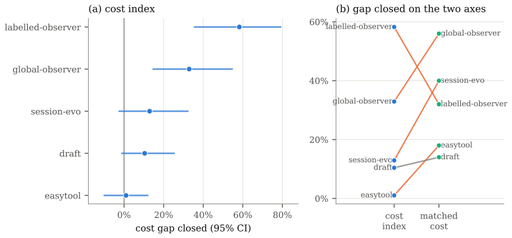
Figure 5 : (a)Cost gap closed with cluster-bootstrap intervals over families.(b)The same methods on the two axes. Lines that cross are methods the axes rank differently; orange marks a change of more than 12 points.
Original paper · CC BY 4.0 · Guan Zheng Huang · SPRING-5: Measuring Tool Documentation Repair for LLM Agents by Efficiency · Original paper figure · Extracted the figure area from page 14 of the original PDF.Why accuracy scoring misses the cost of bad documentation
Automatic documentation repair methods are usually judged on whether the agent ends with the right answer. That view misses two costs that a bad tool description can impose on an agent. The agent reports that number with no error anywhere in the transcript.
An accuracy metric can't see the first cost, because the final answer is right. The cost also repeats on every request the agent handles, so it accumulates over the life of the tool. Spring-5 therefore pairs calls per correct task with a per-session census of silent failure. The authors report that index beside both other measures for this reason.
The cost index divides the calls an arm was charged by the ideal call path, so 1 is perfect. Gap closed measures the share of the distance from the baseline's cost index down to 1 that an arm recovers. The authors use gap closed as the figure quoted throughout the paper.
The authors also hold their own dataset to a rule about saturation, which they recommend to other benchmark authors. Such a family must be named rather than averaged into a pooled score.
A cost index against an ideal call path
Spring-5 scores a documentation repair method by how many tool calls its agent spends, relative to what a correct solver needs. An index of 1 is perfect, and the baselines sit between 13 and 14. Gap closed converts the index into a share: the fraction of the distance from the baseline's index down to 1 that an arm recovered.
Charging only the calls actually made would reward an agent that gives up early, since it outscores one that solves the task in six calls. Dropping incorrect sessions would condition the measure on the outcome, so a method looks expensive for finishing the hard tasks. The cost of this design is that the index mostly tracks completion: the cap term is 93 to 97% of every charged total.
Matched cost removes the charging rule, so it can't be pushed up by the cap on wrong answers. It takes the tasks every arm answered correctly on at least one pass, and averages each arm's calls over only the passes where it was right. Matched cost is reported through Equation 2, with the honest specification's figure standing in for 1.
The intervals are a cluster bootstrap over families, because one specification is served per family. Two arms anchor the scale: baseline serves the degraded text, and optimal serves the honest text, and neither edits or reads a transcript. The labelled-observer arm uses correctness labels and so works as a ceiling rather than a deployable method.
What one family contains
A family is one tool, built around a deterministic backend that holds the real convention. Each family carries a degraded specification with exactly one planted defect, and that is the only text a method starts from. Freezing it means a proposer can't invent a field and misdescribe the function signature behind it. Every method then competes on the same action space, not on how much of the interface it may rewrite.
The honest specification states the rule, and no method is ever given it. The ceiling assertion runs automatically at build time on every family, so a failing honest text can't pass unnoticed.
Rarity means a competent engineer would not guess the rule, because an early mandatory date window was guessed from the model's prior over API design. Silence means a defect returns a well-formed wrong number rather than a backend error that the error message would repair. Two reviewers besides the author checked each defect and honest text, so the rarity judgement rests on more than one person's view.
The twenty fall into 9 output semantics, 5 cross-parameter dependency, 4 value convention and 2 operational constraint defects.
Table 1 shows where the honest specification misses its declared ideal path under luna and sol. Only event_count misses systematically, every run and never with an unfinished session, so it is the one dataset limitation the authors disclose.
How often wrong answers stay silent
Silent failure is measured per session, so the census asks a plain question of every wrong answer in the baseline runs. On sol, 153 of 303 wrong answers were silent, which is 50%. No structural rule over the transcript could fire on such a session.
Silence is a behaviour of the agent, and the design of a family doesn't decide it. Six families built to fail silently announced themselves through rejections or refusals often enough to be caught. Four families built around other defect classes were silent in practice. Figure 4 shows the share of wrong answers per family on luna, coloured by the class each family was designed around.
The census matters because neither accuracy nor the cost index separates silent failures from loud ones. Only the census can pick these sessions out, which is why the authors report it beside both measures.
The five methods in the next comparison are scored on the same families, so their silent-failure exposure is shared. Table 4 gives the luna results for those methods, with the cost gap closed and its interval for each.
Checking the ceiling before any claim
The ceiling assertion asks whether the honest specification reaches the declared ideal call path. If it doesn't, a method's failure on that family would look like a method failure, when the dataset itself is the problem. The check runs at build time, before any claim is made, across all six luna runs and four sol runs at each run's own pass count.
Six families miss the declared ideal path on luna and two on sol, and all but one of those misses is explained. The table lists each miss with its worst ratio and its count of unfinished sessions.
The event_count family is the one systematic violation, and the authors treat it as a real dataset limitation. Its honest text advertises a confirming call that the reference solver doesn't need, so the family sits at 1.46 times the declared ideal in every run. The weaker model makes that extra call about half the time, so the family can't reach 100% by construction.
A 20× violation from four capped sessions is therefore the cost metric's known behaviour, not a dataset defect.
The check also caught a failure on an earlier benchmark, Spring-2, which adapts four public APIs. The authors excluded that dataset, because it couldn't measure how much repair a method recovered, and they ran no ladder on it. Running the check cost a baseline and an optimal arm, which the authors judge a small price for catching the instrument.
The authors keep the declared ceiling for reporting, since the violation comes from the specification rather than from sampling.
Measuring evaluation noise, and a biased estimator of it
Every contrast in this benchmark is a ratio of two evaluations, so the authors measure how far that ratio moves when nothing has changed. It costs nothing extra, which is why the authors used it first.
Table 2 shows both estimators at matched aggregation, and the direct luna band runs from 0.642 to 1.557. A family yields a control cell only when no method edited it, and editing depends on how noisy the family is, so the estimator fails in the direction that understates variance.
The authors' first analysis used the opportunistic numbers and concluded that sol's noise band was less than half as wide as it is. Measured directly, the bands are 0.642 to 1.557 for luna and 0.712 to 1.405 for sol, which overlap across most of their range. The direct fix costs nothing, since repeated passes need no training, no writer call and no gate.
Figure 3 shows the baseline cost index per family, where sixteen families stay above the 1.35× dud threshold on both models.
Retiring families a stronger model solves cold
The dud rule asks which families stop measuring documentation once a stronger model is run on them. The authors apply it to the baseline cost index of each family, plotted for both models in Figure 3. Sixteen families stay above the dud threshold of 1.35 times on both models. The closest of them is account_link, at 1.66 times on sol.
These four sit between 4.0 and 18.3 times the ideal path on luna, so the weaker model still struggles with them. Averaging them into a pooled number would dilute the other families, which is why the authors name them instead.
The authors treat this loss of headroom as a property of how the benchmark ages, not as a defect in any one family. Documentation defects stay in production systems as models improve, but they leave the benchmark's ability to measure them. A successor dataset will therefore need to be harder rather than larger. The authors recommend reporting the dud count with any result and naming the families it covers.
The same figure adds a second recommendation about noise, which uses the same family-level view. A benchmark should report a directly measured noise floor.
Five methods on the benchmark: which repairs close the cost gap
The five methods are easytool, draft, session-evo, global-observer and labelled-observer, all run on luna with 20 families and two passes. easytool rewrites from the declared schema alone, so it can't state a convention the schema never contained. It closed 1.0% of the cost gap, with an interval from -10.3% to 12.3%. draft probes the tool and rewrites iteratively, and it closed 10.4% of the gap with an interval from -1.4% to 25.6%.
The draft and session-evo intervals both include zero, so the paper doesn't separate them from no repair.
global-observer reads every training transcript in one call and writes once, with no trigger, no acceptance test and no iteration. It closed 32.9% of the gap, with an interval from 14.4% to 55.0%. Over the online loop it led by 20.0 points, but that interval runs from -5.1 to +48.1 and includes zero.
labelled-observer adds ground-truth correctness labels that no deployment has, so it works as a ceiling, not a deployable method. On calls per correct task, labelled-observer falls from first to third, and session-evo rises from third to second. Among the methods that need no label, global-observer leads on both axes.
Batch advantage: architecture or evidence
global-observer beats the online loop, so the obvious objection is that the comparison isn't fair.
The authors tested this with batch arms that read fewer transcripts, so exposure could be matched directly. global-observer-k1 reads one transcript per family, about the loop's total exposure. global-observer-k3 reads three per family, which is the loop's per-family maximum. That is a contrast of +3.6pp [ −9.8, +16.3], consistent with no difference.
With three transcripts per family the batch arm closes 24.9%, and with every transcript it closes 34.0%. Writing once over everything isn't what wins; reading more is.
This result holds for a static regime, where every transcript came from one unchanging backend. A batch spanning a mid-window endpoint change would mix two behaviours into one rewrite and couldn't tell which transcripts describe which.
Catalogue size and misrouting
The effect survives when the tool sits among distractors, and the baseline cost barely moves with catalogue size. The baseline cost is 13.3 times and 13.8 times at one tool, and 13.3, 13.3 and 13.7 times at five and ten tools.
The machine-written arms did misroute, with 10 of 416 calls in one run, 5 of 417 in another, and 11 of 388 and 1 of 391 in the third. Every off-target call came from regional_index and went to capability_probe, in every run. That pair is built to be identical except for the rejection message, so it is the closest sibling pair the dataset contains.
The rewrite of regional_index added an entitlement clause that the degraded text never carried. The clause is accurate and repairs the defect, but it brings entitlement and authorisation vocabulary into a catalogue with a capability-shaped sibling. The agent followed that vocabulary to the wrong tool. The paired trial compares candidates only on the family they belong to, so it never sees a call that went elsewhere.
BFCL transfer and the partitioning result
BFCL is a third-party benchmark where one call is scored against a key and nothing executes. Because there is no backend, retry or call budget, the cost index can't be computed on it at all. The comparison therefore runs on task accuracy, which can't see the extra calls a correct answer costs. The evidence trigger can't fire either, since a one-shot setting has no error turn to read.
The authors use BFCL for two questions about the instrument: whether a benchmark can be pooled before partitioning, and whether failures sit on documentation nobody degraded.
Pooled over every held-out query, the audit loop gains 3.4 points on a 59.1% baseline. Its 95% interval runs from -0.4 to +7.4, and the scheduled variant gains +1.9 with an interval of [+0.0, +3.9]. That pooled result is a null here, because it mixes two very different populations.
On the hard stratum the audit loop moves the baseline from 2.0% to 7.1%, and schedule reaches 8.2%. The counts are small, 2 correct against 7 and 8, so the authors read this as reachability rather than a measured ceiling.
The Music_3_LookupMusic.year parameter is declared integer, yet its description says to use 'dontcare'. The remaining 49 are beyond any rewrite here, which makes the unreachable fraction 40.5%.
Limitations of the Spring-5 claims
The cost claim has never been tested on a dataset other than Spring-5, and the authors say so directly. τ-bench executes but leaves no headroom, so the cost index can't be scored on it. BFCL has headroom but doesn't execute, so the cost index can't be computed on it either. The authors treat that absence as the reason the dataset exists and as the largest open question about it.
They consider the instruments, not the effect sizes, the best supported part of the contribution.
Four families are solved cold by sol, so they carry no headroom for measurement on that model.
Catalogue realism is a second limit: the families were built to be semantically distant. draft and easytool are reimplementations on the authors' channel and action space. That supports a controlled comparison of architectures but isn't a replication of the originally reported results.
global-observer keeps every training transcript until it writes, while an online loop discards each transcript after review. Spring-5 serves one version of each tool, so a batch never spans a change in behaviour.
Paper info
- Authors
- Guan Zheng Huang
- Venue
- arXiv · Preprint
- First published
- 2026-11-5
- Added
- 2026-11-10
- Updated
- 2026-11-5
- Version
- v1
- arXiv
- 2611.10040
- Category
- cs.SE · cs.AI · cs.CL
- Original paper terms
- CC BY 4.0
- What we show
- Paper info, commentary and permitted figures from the original paper
AI commentary is a separate explanation from the original paper and may contain errors. The original paper and figures follow each source's terms of use and any rights noted separately.
Abstract
Methods that repair tool documentation automatically are mostly evaluated on task accuracy. We report a benchmark that scores them on cost. SPRING-5 is 20 tool families and 344 tasks, each with a deliberately degraded specification, a hand-written honest one, a deterministic backend and an answer key, scored on calls charged against the ideal call path. A wrong answer is charged the full call budget, so this cost index largely tracks the completion rate, and we report calls per correct task beside it, which carries no such charge. Over 2,644 baseline sessions, 54% of wrong answers arrive with no rejected call, no refusal and no retry. The benchmark carries three validity instruments. A build-time ceiling assertion requires the honest specification to reach the ideal path and fails systematically on only one family. A dud rule names the families a stronger model solves cold and catches four. A directly measured noise floor shows that two evaluations of a byte-identical specification differ by a 95% factor of 0.64 to 1.56, so about one comparison in eight crosses a conventional win threshold on noise alone, and the cheap way of estimating that floor is biased by which families happen to go unedited. Against these instruments, a schema-only method closes 1% of the baseline-to-ideal cost gap, an online self-evolution loop 13%, one batch rewrite over every training transcript 33%, and a variant given correctness labels 58%. The batch advantage over the loop is the evidence it reads: held to the loop's exposure it is no longer detectable. With five and ten tools in context the effect survives, the baseline cost does not change, and only machine-written descriptions sent calls to the wrong tool. On BFCL, 62% of held-out queries are already answered from the shipped documentation, which explains a pooled null there. Code, data and runs are released.
Figures from the paper
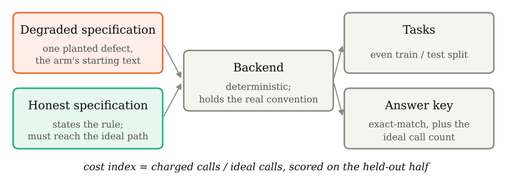
Figure 1 :OneSpring-5family. Methods start from the degraded specification and are scored on the held-out tasks. The honest specification is never given to a method; it exists to assert that the defect is repairable in principle, and that assertion is checked at build time.
Original paper · CC BY 4.0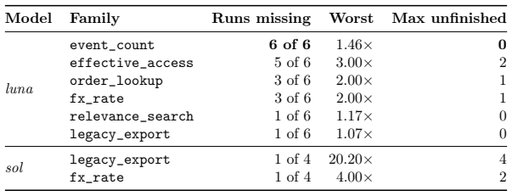
Table 1 :Families where the honest specification misses its declared ideal path.event_count is the only systematic violation: every run, and never with an unfinished session. Every other entry carries capped sessions on a small-idealfamily, where one unfinished task moves the ratio further than any specification could.
Original paper · CC BY 4.0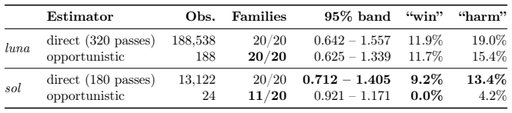
Table 2 :Evaluation noise on byte-identical specifications, two estimators at matched aggregation. Both have means within 0.03 of 1.0, so neither is biased in level; they differ in width. Passes are pooled only between evaluations over the same task set. The opportunistic one is close to the direct one where the arms leave every family with a control cell, a family that no arm edited, and collapses where they do not.
Original paper · CC BY 4.0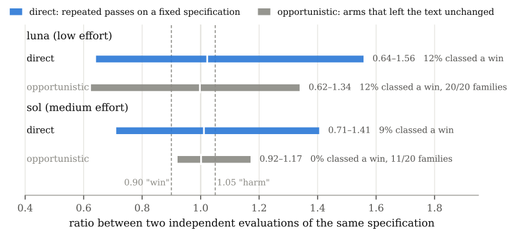
Figure 2 :Evaluation noise on identical text, by estimator. The opportunistic estimator tracks the direct one onluna, where all twenty families contribute a control cell, and collapses onsol, where only eleven do and those eleven are the quiet ones.
Original paper · CC BY 4.0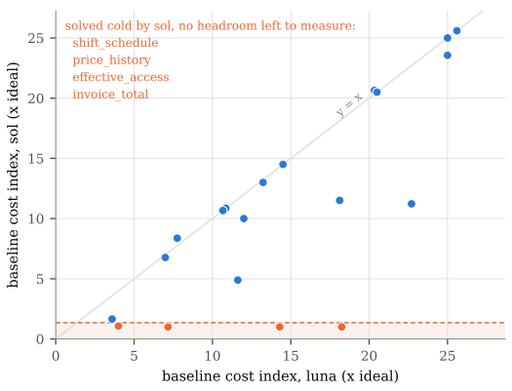
Figure 3 :Baseline cost index per family on both models. Sixteen families stay above the dud threshold of 1.35× on both, the closest beingaccount_link at 1.66× onsol. Four fall to the floor onsol: they are solved from a cold start, and any method scored on them can only be measured against noise. This is how a benchmark of this kind ages.
Original paper · CC BY 4.0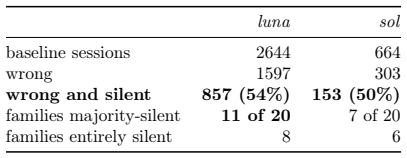
Table 3 :Silent failure measured per session. More than half of all wrong answers carry no signal any structural rule could read.
Original paper · CC BY 4.0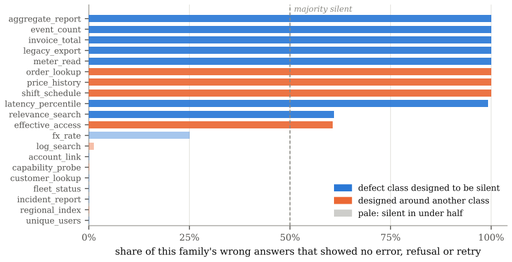
Figure 4 :Per family, the share of wrong answers that showed no error, refusal or retry, onluna. Colour is the defect class the family wasdesignedaround. The design does not determine the behaviour: six families intended to be silent are not, and four intended otherwise are.
Original paper · CC BY 4.0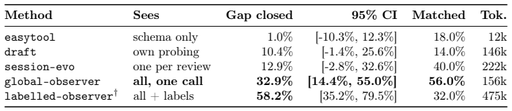
Table 4 :Five methods onSpring-5,luna, 20 families at two passes. “Gap closed” is on the cost index; “Matched” is gap closed on calls per correct task over the 60 tasks every method solved. Table 5 reports separate runs, so its figures for the same arms differ by run-to-run noise.†requires a correctness label and is a ceiling, not a deployable method.
Original paper · CC BY 4.0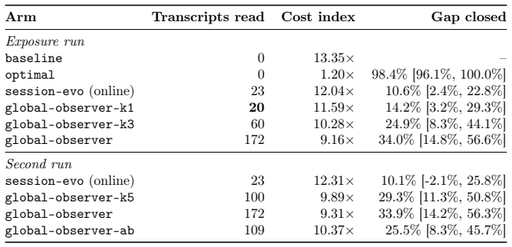
Table 5 :The batch proposer at several transcript budgets against the online loop,luna, 20 families, two evaluation passes, in two separate runs. Transcripts read is what reached a writer, not what was executed; for the online loop it is one per review.
Original paper · CC BY 4.0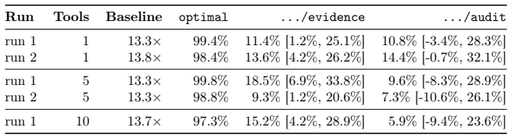
Table 6 :The ladder at three catalogue sizes,luna, two evaluation passes, with a replicate at one and five tools. The two right-hand columns are the samesession-evo online loop of Table 4 under its two triggers, abbreviated here to the trigger name;optimal is the honest specification’s own score. Baseline is the cost index; the arms are gap closed with a cluster bootstrap over families. Adding distractors does not remove the effect, and the between-run spread at a fixed catalogue size is larger than the difference between sizes.
Original paper · CC BY 4.0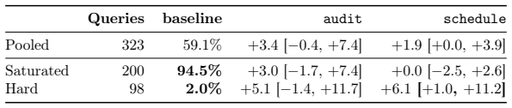
Table 7 :The BFCL transfer, pooled and split by whether the stronger model answers the query from the shipped schema. Arms are reported as the change from that stratum’s own baseline, with a cluster bootstrap over families. The two strata differ by 93 points of baseline accuracy. The two families carrying an out-of-schema query are excluded from the split rows for the reason given in Appendix A, and a family contributes to a stratum only where it has queries in it, so the split rows sum to 298 over 17 and 16 families rather than to 323 over 20.
Original paper · CC BY 4.0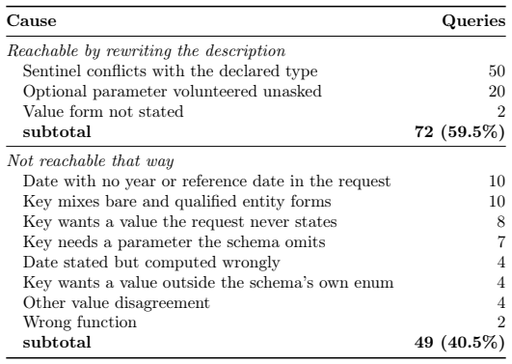
Table 8 :What blocks each of the 121 held-out queries neither model answers from the shipped schema. The division is whether the fix lies in the description of the function under test, which is the action space every method here is confined to.
Original paper · CC BY 4.0Quote from the paper
Guan Zheng Huang (2026). SPRING-5: Measuring Tool Documentation Repair for LLM Agents by Efficiency. arXiv:2611.10040v1. https://arxiv.org/abs/2611.10040v1
BibTeX
@misc{huang2026spring,
  title = {{SPRING-5: Measuring Tool Documentation Repair for LLM Agents by Efficiency}},
  author = {Guan Zheng Huang},
  year = {2026},
  eprint = {2611.10040},
  archivePrefix = {arXiv},
  url = {https://arxiv.org/abs/2611.10040v1}
}