Paper commentary
Correspondence-Free Camera Pose Estimation by Matching Moments
- Problem Blind PnP must recover a calibrated camera's pose from unordered 2D observations and 3D model points whose pairings are unknown, and existing approaches depend on initialization, search cost or learned correspondences.
- Method MomentPnP fits the six pose parameters so that bounded Fourier feature averages of the projected model match those of the observations, subtracting the expected outlier contribution, then refines the pose by expectation–maximization and labels observations by nearest projection.
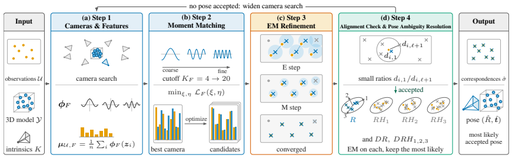
Figure 3 .Overview of MomentPnP.(a) Cameras are searched over centers and orientations, and observed features averaged once. (b) Moment matching refines the best cameras, raising the cutoff from 4 to 20. (c) EM refines fits with soft correspondences. (d) The alignment check accepts poses whose observations lie much closer to their nearest projections than to the next, and the most likely accepted pose or alternative is returned. Orange: observations. Blue: model points and projections. Gray: unmatched points, unselected poses.
Original paper · CC BY 4.0 · Subhransu S. Bhattacharjee, Dylan Campbell, Rahul Shome · Correspondence-Free Camera Pose Estimation by Matching Moments · Original paper figure · Extracted the figure area from page 4 of the original PDF.Why blind PnP is hard without pairings
Blind PnP asks for the pose of a calibrated camera from a set of 2D observations and a set of 3D model points when no pairing between the two sets is supplied. The two sets still have to share scene structure, because inlier observations are projections of model points under one common camera pose, while either set may contain points with no partner.
Local methods alternate between estimating the pose and updating correspondences, so the outcome depends on the initialization. Global methods search the pose space by branch and bound, and their cost depends on how much of that space must be examined and excluded. Learned methods predict correspondences from coordinates using what they acquired in training, which ties their accuracy to the training data.
MomentPnP starts from the whole point sets and estimates the pose before any point is matched. Mean and covariance describe the position and spread of a point set, but distinct projections can share both, so the method needs higher-order statistics.
Observation model and projection
Observations are written \(U=\{u_i\}_{i=1}^{n}\subset\mathbb{R}^2\) and model points \(Y=\{y_j\}_{j=1}^{N}\subset\mathbb{R}^3\), with an intrinsic matrix \(K\) that has zero skew and positive focal lengths. A pose \(\xi=(R,t)\) maps a model point to camera coordinates as \(x=Ry+t\), and its image is the first two entries of \(Kx/x_3\), written \(p_j(\xi)=\mathrm{proj}(Ry_j+t)\), when the depth \(x_3\) is positive.
A correspondence map \(\sigma\) sends each observation either to a model point or to nothing. The matched pairs are inliers and the rest are outliers. Complete inputs have as many observations as model points and no outliers, so \(n=N=m\).
Normalized moments and trigonometric features
Each observation is calibrated by inverting \(K\) on its homogeneous pixel coordinates and keeping the first two entries. The calibrated points are centred at their mean and divided by their root-mean-square radius, which keeps the coordinates well conditioned. The same affine map normalizes the projections of the model points at each candidate pose.
Third-order moments separate two shapes that share a centroid and covariance, and fourth-order moments separate noisy versions of them.
Monomials are unbounded, so one distant outlier can dominate their averages. The method therefore uses cosines and sines of the projection, \(\phi_F(z)=(\cos k^\top z,\sin k^\top z)_{k\in F}\), over a finite frequency set \(F\). Because these features are bounded, one outlier shifts an average by a bounded amount, which is the contrast that the outlier panel of the figure illustrates for fourth-order moments and Fourier feature averages.
Matching averages while absorbing outliers
Image outliers are assumed uniform over the rectangle bounding the observations, and model outliers are spread through the box bounding the 3D model. With a fraction \(\eta\) of outliers in each set, the averages mix the inlier averages with the outlier averages \(\mu_{U,0}\) and \(\mu_{Y,0}(\xi)\).
The objective adjusts the six pose parameters, and it is quadratic in the unknown \(\eta\), so the best \(\eta\) at each pose has a closed form. On complete inputs \(\eta=0\), so no outlier term remains and the fit is a pure comparison of the two averages.
From the fitted pose to correspondences
These kept points form the model used both for refining the pose and for the alignment check.
The pose is refined by expectation–maximization. A mirrored alternative obtained by a half-turn can also place projections near the observations, so the method refines both candidate poses and compares their likelihoods.
At the selected pose, each observation is labelled with its nearest projection, so the correspondences follow from the pose. The theory also bounds how often such a nearest-projection label can be wrong.
What the theory establishes and where it stops
In the orientation proof, the error bound comes from dividing the moment residual by a positive constant that the proof shows is bounded away from zero.
Lemma A9 bounds the matching error at the true pose: nearest-projection matching makes a wrong label with probability at most \(8\pi f_{\max}N(N-1)s^2\), where \(f_{\max}\) bounds the projection density. The bound grows with the number of points, because each extra projection that falls close to another adds a way for a label to go wrong.
Benchmark and ETH3D results
On released blind PnP benchmarks, the median rotation error of MomentPnP is 5 to 170 times smaller than that of the best learned baseline. With as many outliers as inliers, 82 to 97% of frames are within 1° in the same benchmarks.
On rendered ETH3D laser scans, the median rotation error falls to 0.00007° at one million points. The authors read the pose gain as consistent with moments averaging over all points, which is their reason for estimating the pose before the correspondences.
In full scene reconstructions, MomentPnP localizes 35 of 39 ETH3D images within 1°.
Limitations
Adversarial outliers can prevent the pose from being recovered.
Outliers that follow the inlier projection distribution change the feature average by at most 1/√m in root mean square. If the outliers come from a different distribution, the shift stays nonzero as the point sets grow.
Missing structure and unequal sampling are left for future work, which proposes reweighting the projections with unbalanced optimal transport.
Paper info
- Authors
- Subhransu S. Bhattacharjee, Dylan Campbell, Rahul Shome
- Venue
- arXiv · Preprint
- First published
- 2026-11-16
- Added
- 2026-11-17
- Updated
- 2026-11-16
- Version
- v1
- arXiv
- 2611.20797
- Category
- cs.CV · cs.LG · cs.RO · eess.IV · math.OC
- Original paper terms
- CC BY 4.0
- What we show
- Paper info, commentary and permitted figures from the original paper
AI commentary is a separate explanation from the original paper and may contain errors. The original paper and figures follow each source's terms of use and any rights noted separately.
Abstract
The blind perspective-$n$-point (PnP) problem is to estimate the pose of a calibrated camera from 2D and 3D point sets with unknown correspondences. We show that, for complete, noiseless observations, fourteen permutation-invariant image moments up to order four identify a fixed camera pose for almost every 3D point set containing at least twenty points. Our learning-free method, MomentPnP, matches these moments between the observed 2D points and the projected 3D points to initialize a camera pose without correspondences and refines the pose and correspondence weights using expectation--maximization. Across the test sets of three benchmarks, our method reduces median rotation error by $5$--$170\times$ relative to the best learned baseline, both with and without outliers. We recover accurate poses even with as many outliers as inliers. On dense ETH3D scans, pose accuracy improves as the point sets grow, even as individual correspondences become harder to resolve.
Quote from the paper
Subhransu S. Bhattacharjee, Dylan Campbell, Rahul Shome (2026). Correspondence-Free Camera Pose Estimation by Matching Moments. arXiv:2611.20797v1. https://arxiv.org/abs/2611.20797v1
BibTeX
@misc{bhattacharjee2026correspondence,
  title = {{Correspondence-Free Camera Pose Estimation by Matching Moments}},
  author = {Subhransu S. Bhattacharjee and Dylan Campbell and Rahul Shome},
  year = {2026},
  eprint = {2611.20797},
  archivePrefix = {arXiv},
  url = {https://arxiv.org/abs/2611.20797v1}
}