Paper commentary
ZEST: Zero-shot Embodied Skill Transfer for Athletic Robot Control
ZEST trains humanoid robots to copy human motion without per-skill tuning
- Problem Model-based controllers need contact schedules and per-skill tuning, so they stall on contact-rich motion. Small mismatches in contact and friction also widen the sim-to-real gap.
- Method ZEST trains one feedforward policy in a single stage from motion capture, video and animation. It outputs residual joint offsets added to the reference, instead of absolute joint targets.
- Results On the G1, box climb up and box climb down each succeeded in five out of five consecutive hardware runs.
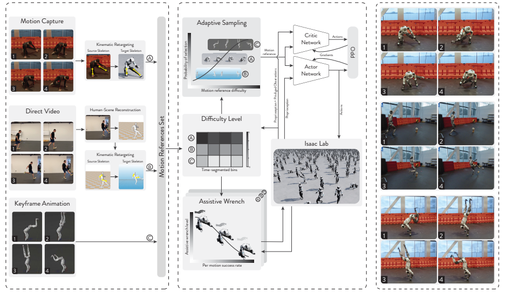
Fig. 3 .Overview ofZEST, which consists of three main stages. (1) Reference data:A diverse set of motions from MoCap, ViCap, and keyframe animation is processed; MoCap/ViCap references are kinematically retargeted to the target robot.(2) Training setup and MDP formu- lation:In simulation, the policy is trained using only on-robot signals and the next target state from the reference, while a separate critic receives privileged information (e.g., true base velocity, contact forces) to accelerate learning. To handle long-horizon clips and scale beyond single skills, an adaptive sampling scheme is proposed: trajectories are segmented into fixed-duration bins; a per-bin difficulty level metric is updated via an EMA of failure scores; and a categorical sampler biases reset-state selection toward harder bins while avoiding catastrophic forgetting of easier behaviors. A model-based virtual assistive wrench is applied at the base to stabilize training for highly dynamic behaviors; the current bin’s diffi- culty level modulates its magnitude and is automatically annealed to zero as tracking improves.(3) Zero-shot deployment:The trained policy is deployed directly to the physical robot without any fine-tuning.
Original paper · CC BY 4.0 · Extracted the figure area from page 9 of the original PDF.Why tracking controllers stall on contact-rich motion
Much legged-robot work tracks whole-body motions that are planned offline and then followed by a model-based controller. Atlas runs such motions through a two-layer stack of an MPC online planner and an optimization-based whole-body controller. It also asks a lot of the environment model, the state estimate and the reference, so these controllers are hard to deploy when uncertainty or complex contact grows.
Contact is the hard part, since high-impulse events, stick-slip transitions and body-ground contact over complex geometries are difficult to model.
Without careful shaping and regularization, a learned policy can exploit the reward structure and show unnatural or overly aggressive behaviors. Motion data used as a prior is the usual fix, and DeepMimic is an early example that imitated motion-capture clips under one consistent reward structure. Later adversarial priors replace direct imitation rewards with a discriminator that matches the distribution of demonstrations.
Even with good imitation, a hardware policy meets a sim-to-real gap that is worsened by contact-rich behaviors near actuation limits. Policies must also work under partial observability, such as missing global pose or root linear velocity. Those gaps are usually closed with a state-estimation stack or a history-conditioned policy, and both of these add complexity during training and deployment.
Contact-rich motions magnify this gap, because small mismatches in contact, friction, compliance and geometry compound over extended contact phases. Table 1 shows the pattern on hardware: foot-only walk and jog have lower errors than multi-contact skills such as forward roll and army crawl.
One simple tracker instead of per-skill engineering
ZEST removes a long list of handcrafted parts from the usual tracking pipeline, so one policy can follow many references. Training runs in a single stage, so no multi-stage pipeline is needed for each skill. The same feedforward network and one set of hyperparameters per robot cover diverse references and deploy zero-shot to hardware. The reward design doesn't use reference contact labels from the demonstrations, which keeps the reward generic across behaviors.
Early termination and the regularization terms are the only other reward pieces the authors describe beyond tracking and survival.
The actor sees only instantaneous onboard measurements, so it doesn't need a state estimator. Its proprioceptive part holds the torso IMU angular velocity, the gravity direction in the torso frame, joint positions, joint velocities and the previous action. The authors leave out global base pose and linear velocity because those quantities require a state estimator.
Keeping only the previous action as history is a hypothesis that it can recover contact states and base linear velocity on nominal terrain. The reference part holds the next target only: base height, base linear and angular velocities, gravity direction and reference joint positions.
The policy outputs residual actions, which are added to the reference joint positions before reaching the joint-level PD controllers. The Critic gets the same policy observations plus privileged signals such as base linear velocity, end-effector positions and contact forces. Residual outputs keep the feedforward reference in the loop, so the network learns only the offsets it needs.
Absolute actions performed worst in the authors' ablation, because small early outputs can cause large PD tracking errors. Per-DoF action scales set how large each residual correction can be, with hips and knees receiving larger scales.
How references become a trained policy
Motion references come from motion capture, from video reconstructed with a single camera, and from keyframe animation. ViCap pairs MegaSaM for camera and scene estimation with TRAM for human pose, which the authors found reduces jitter and foot skidding. Human-centric data are mapped onto the robot skeleton by kinematic retargeting, which is a space-time optimization.
That optimization tracks root position and orientation, aligns bones, penalizes joint velocities, and respects the robot's forward kinematics and non-penetration constraints. No contact labels are assigned to any data source.
Each trajectory is cut into fixed N-step bins, and every bin keeps a failure level updated by an exponential moving average of tracking similarity. At each reset a bin is drawn from a categorical distribution whose logits follow those failure levels, and a phase is then sampled uniformly inside it. A small floor probability keeps every bin in play, which guards against forgetting skills already learned.
The authors contrast this with uniform reference state initialization, which oversamples segments the policy has already mastered.
Highly dynamic motions with large base rotations converge slowly, so the authors add a virtual assistive wrench on the robot base. The wrench is computed in a model-based way, and its magnitude follows the per-bin difficulty levels. As tracking improves the wrench decays to zero, which removes the need for a handcrafted curriculum.
Training uses PPO in Isaac Lab, and the actor and critic are each an MLP with three hidden layers and ELU activations. The critic receives privileged simulation-only signals such as base linear velocity, end-effector states and contact forces. The actor sees only signals available on hardware, so no state estimator is needed at deployment.
Domain randomization covers sensor noise, impulsive pushes, friction coefficients and link masses.
The PD gains come from treating each joint as a critically damped second-order system. With armature \( I \) and natural frequency \( \omega_n \), the gains are \( K_p = I\omega_n^2 \) and \( K_d = 2I\omega_n \). The armature values come from an approximation of the closed-chain Parallel-Linkage Actuators in ankles, knees and waists. The reward is a sum of a tracking term, a regularization term and a survival term.
The tracking term uses a decaying exponential kernel, which keeps it bounded and smooth near the reference.
Zero-shot hardware results across sources and robots
Every hardware result comes from a policy trained on one target skill, because specialists track more consistently within a fixed time budget. A multi-skill policy stays in simulation, so it only supports the simulation-based analyses. The yaw angle is left out because the on-board IMU can't observe it and it drifts significantly. Figure 1 shows representative frames across all skills, and Table 1 reports joint, base orientation and angular velocity metrics.
Breakdance combines extended body-ground contact with rapid leg sweeps near joint limits, which induces unavoidable self-contact. On Atlas, walk measured 0.057 rad MAE(q) on hardware, while multi-contact skills such as forward roll show higher base-orientation errors. The authors claim, to their knowledge, the first dynamic multi-contact behaviors such as army crawl and breakdance on a full-size humanoid.
Converting a recorded video into a retargeted reference takes minutes, so a new clip can be captured in the morning and run that evening. On Atlas, the soccer kick and the three dance snippets keep MAE(q) and MAD(R) near 0.05 rad despite pose jitter and foot skidding in the references. The authors attribute this to a reward that does not force tight root tracking and to the absence of contact labels.
On the G1, the ballet and box skills extend the same recipe to cross-embodiment transfer from video.
The G1 box skills are proprioceptive-only, because the policy gets no box position and trains with slight randomization of the initial relative pose. In five consecutive runs near the nominal setup, box climb up and box climb down each succeeded five out of five times. Trials initialized within ±10 cm in x and ±0.3 rad in yaw all succeeded, while failures occurred outside the training distribution.
A 2 kg torso payload still allowed both climbs, and box climb up succeeded at 0.55 m. Box climb down succeeded at 0.55 m and 0.95 m, outside the randomized [0.70, 0.80] m training range.
Keyframe animation supplies motions no human could perform, such as a handstand invert that uses the continuous back-yaw joint. On Spot, the policy handled a continuous backflip and a barrel roll. The policy finished the barrel roll after the on-board IMU saturated mid-flight. For these aggressive references, the policy relaxes base-orientation tracking to stay feasible, which raises the reported means and maxima.
Ablations and the MPC comparison
The ablations train one Atlas policy over 15 motions and score success after 10 hours and after 20 hours of training. At 10 hours the full method reaches the highest mean success and clearly better lower-tail performance across behaviors. By 20 hours several ablations narrow the mean gap, but the baseline keeps higher p10 and minimum success values.
The ablated components are the curriculum, adaptive sampling, reference and observation windows, the action space, and the actor-critic observation design.
Removing the curriculum still converges, but its 20-hour result roughly matches the full method at 10 hours. The authors read this as a minimal variant that is feasible but less sample-efficient, especially on motions with large base-orientation variability. Removing adaptive sampling lowers performance because the policy undersamples hard bins.
The assistive wrench mainly helps highly dynamic motions, such as the cartwheel-to-backflip sequence, that terminate early in training.
Reference or observation windows of 20 steps, either history or future references, increase input dimensionality and slow or prevent convergence under the same budget. A finer sweep over 5, 10, 15 and 20 steps shows a gradual degradation as the window grows. The authors note this result may be specific to their hyperparameters and architecture, and they didn't test sequence-to-sequence models.
Stripping privileged observations from the critic weakens value estimates, which leads to weaker policy updates. Absolute actions give the worst performance, because small early outputs can induce large PD tracking errors and joint torques.
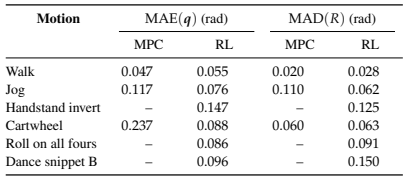
Table 2 .Simulation-based comparison of MPC vs. a multi-skill RL policy.The RL policy is trained on all Atlas motions in Table 1, but evaluations are performed over a subset of these motions. A dash (–) indicates failure to execute the behavior.
Original paper · CC BY 4.0The MPC baseline is a whole-body controller from Boston Dynamics, and the comparison uses a multi-skill RL policy trained on all Atlas motions in Table 1. MPC contact schedules come from a heuristic based on foot-to-ground distance and foot velocity. That heuristic is error-prone on MoCap and especially ViCap motions, where foot sliding and noisy contact timings cause mislabelled contacts.
The MPC stack supports only feet and hands, so army crawl, forward roll and crawl on all fours were excluded. Handstand invert, roll on all fours and dance snippet B fail under MPC, while RL completes them.
Limitations and open questions
The authors state that generalization of the multi-skill policy to motions outside the training set was not evaluated. They say such tests would show whether the policy learns transferable control primitives or merely overfits to specific references. Generalization to unseen motions is deferred to future work, which they plan to address with compact motion embeddings or zero-/few-shot adaptations.
The multi-skill policy was trained on 15 Atlas motions and was used only for simulation-based analyses, not deployed on hardware. Hardware results come from specialized policies, each trained only on the target skill, which the authors chose for stronger and more consistent tracking within a fixed time budget.
The formulation is proprioceptive and assumes flat, non-slippery terrain, so uneven or compliant environments are left for future work. Perception of such terrain is therefore outside the scope of the current policy. Sim-to-real transfer still hinges on modeling, and the authors provide a practical procedure for PLA modeling and armature-dependent PD gain selection.
The box skills faced several hardware challenges that the authors list explicitly. The simulated box differs from the physical platform in compliance and friction, and the policy receives no box-robot relative-positioning feedback. Despite these factors, box climb up and box climb down completed five out of five consecutive runs near the nominal setup.
The MPC comparison uses a heuristic that extracts contact schedules from each reference using the foot-to-ground distance and foot velocity. The comparison covers only a subset of Atlas motions, and motions with knee, torso, or forearm contacts were excluded because the MPC stack supports only feet and hands. The authors did not test these excluded motions against MPC, so no comparison exists for them.
Paper info
- Authors
- Jean Pierre Sleiman, He Li, Alphonsus Adu-Bredu, Robin Deits, Arun Kumar, Kevin Bergamin, Mohak Bhardwaj, Scott Biddlestone, Nicola Burger, Matthew A. Estrada, Francesco Iacobelli, Twan Koolen, Alexander Lambert, Erica Lin, M. Eva Mungai, Zach Nobles, Shane Rozen-Levy, Yuyao Shi, Jiashun Wang, Jakob Welner, Fangzhou Yu, Mike Zhang, Alfred Rizzi, Jessica Hodgins, Sylvain Bertrand, Yeuhi Abe, Scott Kuindersma, Farbod Farshidian
- Venue
- arXiv · Preprint
- First published
- 2026-1-30
- Added
- 2026-11-6
- Updated
- 2026-1-30
- Version
- v1
- arXiv
- 2602.00401
- Category
- cs.RO · cs.AI
- Original paper terms
- CC BY 4.0
- What we show
- Paper info, commentary and permitted figures from the original paper
AI commentary is a separate explanation from the original paper and may contain errors. The original paper and figures follow each source's terms of use and any rights noted separately.
Abstract
Achieving robust, human-like whole-body control on humanoid robots for agile, contact-rich behaviors remains a central challenge, demanding heavy per-skill engineering and a brittle process of tuning controllers. We introduce ZEST (Zero-shot Embodied Skill Transfer), a streamlined motion-imitation framework that trains policies via reinforcement learning from diverse sources -- high-fidelity motion capture, noisy monocular video, and non-physics-constrained animation -- and deploys them to hardware zero-shot. ZEST generalizes across behaviors and platforms while avoiding contact labels, reference or observation windows, state estimators, and extensive reward shaping. Its training pipeline combines adaptive sampling, which focuses training on difficult motion segments, and an automatic curriculum using a model-based assistive wrench, together enabling dynamic, long-horizon maneuvers. We further provide a procedure for selecting joint-level gains from approximate analytical armature values for closed-chain actuators, along with a refined model of actuators. Trained entirely in simulation with moderate domain randomization, ZEST demonstrates remarkable generality. On Boston Dynamics' Atlas humanoid, ZEST learns dynamic, multi-contact skills (e.g., army crawl, breakdancing) from motion capture. It transfers expressive dance and scene-interaction skills, such as box-climbing, directly from videos to Atlas and the Unitree G1. Furthermore, it extends across morphologies to the Spot quadruped, enabling acrobatics, such as a continuous backflip, through animation. Together, these results demonstrate robust zero-shot deployment across heterogeneous data sources and embodiments, establishing ZEST as a scalable interface between biological movements and their robotic counterparts.
Quote from the paper
Jean Pierre Sleiman, He Li, Alphonsus Adu-Bredu, Robin Deits, Arun Kumar, Kevin Bergamin, Mohak Bhardwaj, Scott Biddlestone, Nicola Burger, Matthew A. Estrada, Francesco Iacobelli, Twan Koolen, Alexander Lambert, Erica Lin, M. Eva Mungai, Zach Nobles, Shane Rozen-Levy, Yuyao Shi, Jiashun Wang, Jakob Welner et al. (2026). ZEST: Zero-shot Embodied Skill Transfer for Athletic Robot Control. arXiv:2602.00401v1. https://arxiv.org/abs/2602.00401v1
BibTeX
@misc{sleiman2026zest,
  title = {{ZEST: Zero-shot Embodied Skill Transfer for Athletic Robot Control}},
  author = {Jean Pierre Sleiman and He Li and Alphonsus Adu-Bredu and Robin Deits and Arun Kumar and Kevin Bergamin and Mohak Bhardwaj and Scott Biddlestone and Nicola Burger and Matthew A. Estrada and Francesco Iacobelli and Twan Koolen and Alexander Lambert and Erica Lin and M. Eva Mungai and Zach Nobles and Shane Rozen-Levy and Yuyao Shi and Jiashun Wang and Jakob Welner and Fangzhou Yu and Mike Zhang and Alfred Rizzi and Jessica Hodgins and Sylvain Bertrand and Yeuhi Abe and Scott Kuindersma and Farbod Farshidian},
  year = {2026},
  eprint = {2602.00401},
  archivePrefix = {arXiv},
  url = {https://arxiv.org/abs/2602.00401v1}
}