Paper commentary
Detecting Shadow AI: Unsanctioned LLM Agents on Enterprise Endpoints: A Taxonomy, an Open Detector and a Controlled Evaluation
Agent Detector finds unsanctioned AI agents by the remote services they reach
- Problem Structure-only rules cannot tell an unsanctioned AI agent from a benign program that talks to a non-AI service. Such a program has the same process tree, connections and timing, so rules based on behaviour flag both alike.
- Method Agent Detector ties process behaviour to the identity of the LLM service it reaches.
- Results On a bench of 12 synthetic agents, the two structural rules flagged every behavioural twin, while Agent Detector flagged none. It detected every agent in the majority of runs, and it took about 154 ms per scan.
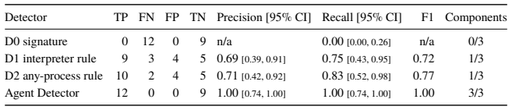
Table 11 : Detectorsonthe12agentepisodesandthe9benignepisodesofthemainset(standarduser,majority outcomeover5runs),withexact95%confidenceintervals. ThelastcolumncountstheAIcomponents(inference runtime, MCP server, LLM client without tools) that each detector flagged; they are not agents and are not countedinprecisionandrecall.
Original paper · CC BY 4.0 · Jeremy Canale, Fabien Soulis · Detecting Shadow AI: Unsanctioned LLM Agents on Enterprise Endpoints: A Taxonomy, an Open Detector and a Controlled Evaluation · Original paper figure · Extracted the figure area from page 36 of the original PDF.How agents could make shadow IT grow exponentially
Shadow IT is an old governance problem, and its remedy starts with finding the tools nobody approved. Generative AI added a first wave of chatbots that network controls could at least see. Agents form a second wave: a language model runs in a loop, picks actions, and tools carry them out on the user's machine with the user's privileges. Agents make it nearly free to build a tool, and the scripts, automations and MCP servers they leave behind are unsanctioned in their own right.
The authors make the argument explicit with a compounding model rather than a measurement. In classic shadow IT, the stock of unapproved tools follows \( S_{t+1} = (1-\delta)S_t + \kappa A_t \), so it levels off at \( \kappa N/\delta \) once adoption saturates. With agents, agent users create artifacts at a rate \( \rho \), and an agentic fraction \( \phi \) of the stock creates new artifacts at a rate \( \sigma \).
The growth factor is \( g = 1-\delta+\sigma\phi \), so the stock grows exponentially once \( \sigma\phi \) exceeds \( \delta \), whatever the number of employees.
Detection enters through the retirement rate \( \delta \), because a deliberate retirement starts with finding the artifact. Under the illustrative parameters, raising \( \delta \) from 0.05 to 0.15 bounds the super-critical curve, yet the stock still settles at 10 artifacts per employee. The authors stress that the model is linear and that they know of no measurement of \( \sigma \).
Why behaviour alone can't find agents
Behavioural detection is the obvious answer to software without a signature, because EDR products catch malware by what it does. An agent looks distinctive on that measure: it keeps a connection to a remote service and, between two messages, runs commands. The authors separate identity from behaviour operationally, so that a name of a product or service counts as identity.
Process-tree shape, process kind, file and registry activity, and connection number, timing and volume count as behaviour. Generic components such as cmd.exe and python.exe count as behavioural, because they say what a process does. The canonical structural rule holds an interpreter or runtime with an outbound connection on port 443 and a shell among its descendants.
Agents edit files, run git, install packages with npm or pip, and open HTTPS connections, as developers do. Commercial agents run inside legitimate, signed host processes, so a signature identifies the publisher, not the activity. An agent using a local runtime such as Ollama talks to a loopback port, so every rule keyed on outbound TLS misses it.
The authors call two programs behavioural twins when their behaviour matches but their remote identities differ. A detector that depends only on behaviour must treat both programs alike, so it either misses the agent or falsely flags the other. Real benign workloads are not exact twins, but they are close and numerous. A behavioural detector can therefore only trade recall for precision along that continuum.
A richer behavioural detector could use token-streaming shape or the coupling between a model response and the next command. Such features count as behavioural under the authors' definition, and nothing in the argument rules them out.
Behaviour is not useless; it is insufficient alone, because identity alone has the symmetric weakness. A chat client and an agent both connect to a model, so the connection alone cannot say that a process acts. The combination of talking to a model service and acting on the machine discriminates between them. Configuration, installation and history complete the picture, even when the process is no longer alive.
How identity and behaviour are combined
Agent Detector starts from a simple requirement: a process must talk to a model service and also act on the machine. A connection to a model API alone describes a chat client as well as an agent, so the design pairs it with local action. Agent Detector runs every hour as SYSTEM, reads only local state, never reads content and never blocks.
When it finds an agent, it shows a notice that the user must acknowledge, and it records the acknowledgement.
The detector then reads evidence that doesn't need the process to be alive, such as configuration, installation and history. Configuration here means base URLs and MCP definitions, which the detector reads without waiting for a live process. The authors separate identity from behaviour operationally: a feature is identity when it names a software product or a service.
Everything else, such as the shape of the process tree and the timing of connections, counts as behaviour. The taxonomy's six evidence layers run from software identity and runtime structure to network, installation, configuration and history.
The taxonomy defines nine classes of agents, from signed desktop applications (C2) to home-made agents that exist only as a script (C8). Classes overlap in practice, so a C1 agent may run inside a C4 IDE host and reach its model through an aggregator. Table 1 lists each class with its examples, host process and usual route to a model.
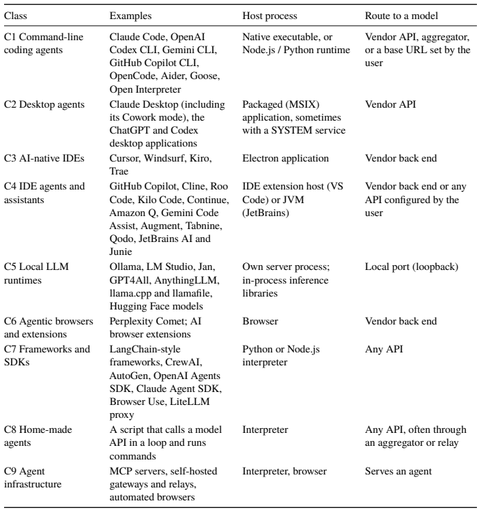
Table 1 : Classes of AI agents found on enterprise endpoints, with the catalog examples, the process that hosts themandtheirusualroutetoamodel.
Original paper · CC BY 4.0Bench results against the behavioural baselines
The bench asks whether the structural rules and Agent Detector separate agents from their behavioural twins. The authors evaluate six research questions, and the sixth compares signature-only and behaviour-only detectors on behavioural twins. The bench ran 12 synthetic agents, 3 AI components and 9 benign workloads on one workstation, repeated 5 times.
Each episode waited 8s to settle and was observed for 24s. Agent Detector scanned three times per window, while the baselines sampled about once per second. That sampling asymmetry favours the baselines on transient patterns, so the comparison is not neutral.
The three baselines run on the same samples, without any code from Agent Detector. D0 is a signature detector that flags a process whose image name matches the catalog. D1 flags an interpreter or runtime host holding an established connection to port 443 with a shell among its descendants. D2 drops the interpreter condition and flags any process with those properties.
The benign twins use the same agent scripts against non-LLM APIs, so their process trees and timing match the agents.
The two structural rules D1 and D2 flagged every behavioural twin. Agent Detector flagged none of the twins, because it reads the identity of the remote service. The signature baseline D0 flags only processes whose image names match the catalog. So the separation comes from the identity of the remote service, not from the structure of the process tree.
Agent Detector detected every bench agent in the majority of runs, although its per-episode outcomes varied. Agent Detector counted an episode as detected only when a medium or high confidence finding carried evidence from its tree.
Where DNS cache attribution and intermittent agents fail
Names resolved by software that resolves them itself, or that uses DNS over HTTPS internally, escape this attribution. An agent that keeps one connection open for an hour is therefore attributable only during its first minutes. An hourly scan will usually miss such an agent, because the cache entry is gone by the time the scan runs. The favourable bench case scanned within seconds of the agent's start, so this limit did not show there.
Intermittent agents are harder to see, because they keep no steady connection or shell for a scan to catch. Episode A12 calls the model every ten seconds, closes the connection five seconds after each call, and starts one short-lived shell per call. Agent Detector caught A12 in three of five runs as a standard user and in none as administrator.
The authors trace this to the phase between two regular schedules, not to privilege. Across these runs, Agent Detector saw an intermittent agent in about one scan in three. A01 was missed twice, because its OpenAI cache entry expired 8.6 s after the start, before the first scan.
Scan cost and the in-situ check on the workstation
A scan of Agent Detector costs about 154 ms and 22.3 MB on the evaluation workstation. Production runs happen once an hour, so this per-scan cost repeats across every laptop in the fleet. The bench measured this cost alongside coverage, which is why the authors report it next to the detection results.
The in-situ cross-check ran on the first author's own workstation, with the AI tools actually installed. Agent Detector reported 9 of the 9 expected tools at the expected level. So the check tests the detector's logic against a similar reading of the machine, not against an independent ground truth. It covers only the tools the authors expected, and it cannot verify recent use.
Three tools were active during the check: Claude Code, GitHub Copilot in VS Code and the Codex desktop application. Three tools had left residues after being uninstalled. An earlier catalog flagged a residue of the GitHub Copilot command-line agent, although that agent wasn't installed.
The case shows that a vendor which moves or shares its state folders silently changes the meaning of a catalog entry. Here the consequence stayed limited, because residues never open the notice.
Limitations of the bench, the model and the catalog
The bench runs on one workstation, and its synthetic agents poll real endpoints with invalid keys instead of performing real tasks. Synthetic agents reproduce the footprint the detector observes, but they don't capture the full diversity of real agents. Agent Detector misses ephemeral agents, agents behind undeclared relays and agents inside WSL 2.
Agents that use local models or drive browsers were also missed on the bench.
The DNS cache limits attribution: it works only while entries live, at most one to five minutes for the CDN-hosted providers measured. Attribution also works only for names resolved through the system resolver, so software using DNS over HTTPS internally escapes it. The authors inferred the cache keys from experiments, and a Windows release may change them.
The compounding model is linear, so it marks the growth threshold without predicting growth. The parameters are not known, and the authors don't claim that any organisation is above the threshold today. The catalog must be maintained like an antivirus signature base, since an earlier version lacked a documented IPv6 range.
The bench is too small to rank detectors, so its results show what each kind of evidence can see. The bench measured a favourable case for network attribution, with each scan following the start of the agent by seconds. A deliberate evader can defeat endpoint detection, and the authors don't claim to win against a local administrator.
Paper info
- Authors
- Jeremy Canale, Fabien Soulis
- Venue
- arXiv · Preprint
- First published
- 2026-11-9
- Added
- 2026-11-10
- Updated
- 2026-11-9
- Version
- v1
- arXiv
- 2611.12377
- Category
- cs.AI · cs.CR
- Original paper terms
- CC BY 4.0
- What we show
- Paper info, commentary and permitted figures from the original paper
AI commentary is a separate explanation from the original paper and may contain errors. The original paper and figures follow each source's terms of use and any rights noted separately.
Abstract
Shadow IT, the use of technology that the IT organisation has not approved, is a long-standing governance problem. We argue that autonomous AI agents can make it grow much faster: agents make building tools nearly free, act with their user's privileges, and leave behind scripts, automations and MCP servers that are themselves unsanctioned. A simple compounding model shows that, under its assumptions, shadow IT grows exponentially once agentic artifacts reproduce faster than the organisation retires them; retiring them starts with detecting them. We then ask whether unsanctioned agents can be detected on Windows endpoints. We propose a taxonomy of nine classes of agents and six layers of endpoint footprint, and argue that rules based only on the structure of processes and connections cannot separate an agent from its behavioural twin, the same program talking to a non-AI service. We present Agent Detector, an open-source Windows detector that anchors behaviour to the identity of the remote service and correlates it with configuration, installation and execution history, using a catalog of 39 tools and 184 LLM endpoint entries; it informs users through a notice they must acknowledge instead of blocking. On a controlled bench of 12 synthetic agents, 3 AI components and 9 benign workloads, repeated 5 times on one workstation, two behavioural rules flagged every behavioural twin, while Agent Detector flagged none and detected every agent in the majority of runs. Its limits are temporal: a connection to a provider behind a shared content-delivery network is attributable only while the DNS cache holds the provider's name, one to five minutes, and an intermittent agent was seen by about one scan in three. A scan costs about 154 ms. The bench is too small to rank detectors; it maps what each kind of evidence can see: unsanctioned agents can be partly detected, and not by behaviour alone.
Quote from the paper
Jeremy Canale, Fabien Soulis (2026). Detecting Shadow AI: Unsanctioned LLM Agents on Enterprise Endpoints: A Taxonomy, an Open Detector and a Controlled Evaluation. arXiv:2611.12377v1. https://arxiv.org/abs/2611.12377v1
BibTeX
@misc{canale2026detecting,
  title = {{Detecting Shadow AI: Unsanctioned LLM Agents on Enterprise Endpoints: A Taxonomy, an Open Detector and a Controlled Evaluation}},
  author = {Jeremy Canale and Fabien Soulis},
  year = {2026},
  eprint = {2611.12377},
  archivePrefix = {arXiv},
  url = {https://arxiv.org/abs/2611.12377v1}
}