Paper commentary
LLM Validation Makes Minimal-Pair Benchmarks Easier for Language Models
LLM validators make minimal-pair benchmarks easier for the models they test
- Problem Minimal-pair benchmarks need reliable labels, and checking them with human judges is slow and costly. LLM validators seem like a cheap substitute, but they share model families with the models under test.
- Method The authors score three LLM validators against held-out human judges on BLiMP and QFrBLiMP. They then check whether the validators' flagged pairs are harder for ten open LMs.
- Results Human-supported pairs flagged by the LLM filter are 18.9 points harder for open LMs than the pairs it accepts, in all 70 LM-validator combinations.
Why LLM labels are a risky shortcut
A minimal pair is two sentences that differ in one grammatical respect, and a model earns credit when it prefers the acceptable one. The weak spot is the label, since templates and generators can build contrasts that native speakers don't share. Acceptability is graded, so speakers also disagree with one another. That is why benchmark authors usually check labels with human judges, a step that is slow, costly and hard to staff in low-resource languages.
If both prefer the same sentences, the validator selects items on the outcome the benchmark is meant to measure.
The study tests this on BLiMP, with 348 pairs, and on QFrBLiMP, with all 1693 pairs. A pair's support is the share of judges who pick the intended sentence, and a pair counts as LNS when at most half of them pick it. Three LLMs from different developers validate every pair, once by forced choice and once by rating each sentence alone. A three-model panel votes on top of these validators, and the authors compare each one with human panels of one, three and five judges.
On BLiMP, forced-choice validators reach 0.937 to 0.953 agreement, above the five-judge panel at 0.934, but recover only 0.09 to 0.20 of LNS pairs.
The distortion shows up in LM scores, not only in label agreement. Among human-supported pairs, the LLM filter flags pairs that are 18.9 points harder for open LMs, in all 70 LM and validator combinations. The authors check this on 10 open LMs, from 1.5B to 9B parameters, and then in a frozen Dutch replication.
Human judgments as the yardstick
The key idea is to treat the human judgments as the yardstick and ask whether an LLM validator reproduces the part of them that is held out. Two datasets release every individual judgment: 348 BLiMP pairs judged by about 20 crowd workers each, and 1693 QFrBLiMP pairs judged by 12 native speakers of Quebec French. The authors dropped 18 QFrBLiMP pairs whose two sentences were identical in the release.
A pair is LNS, meaning its label is not supported, when support is at most 0.5. That gives 19 LNS pairs in BLiMP, 5.5% of the set, and 112 in QFrBLiMP, 6.6%. LNS does not prove that a pair is invalid, since judges may reflect dialect, graded acceptability or a task effect.
To see how many humans a validator is worth, each resample shuffles the judges and forms panels of one, three and five. A panel flags a pair when its majority does not choose the intended sentence, and the judges left over, 14–16 in BLiMP and 7 in QFrBLiMP, supply the held-out gold. Each validator is scored on LNS recall, precision and F1, and on agreement with the held-out majority, across 1,000 resamples.
Its equivalent panel size is the largest panel whose F1 it matches, so a value below 1 means it falls short of a single judge.
Three LLMs, Gemini 3.8 Flash, Claude Sonnet 4.6 and GPT-6 Luna, run at temperature 0 through their APIs. Forced-choice (FC) validators reuse the human instruction, take twelve pairs per request and flag a pair when they pick the unintended sentence. Rating (RATE) validators give each sentence a 1–5 acceptability rating, and a pair is flagged when the intended sentence is not rated higher.
The LLM panel takes the majority of the three FC validators, which gives seven validators in total.
Can an LLM validator replace human judges
The validators are scored against held-out human judges, so each one is judged on how well it matches the rest of the panel. On BLiMP, forced-choice validators agree with the held-out majority on 0.937 to 0.953 of pairs, above the five-judge panel at 0.934. Agreement looks strong, but it hides how few of the flagged pairs are real problems.
The same validators recover only 0.09 to 0.20 of the LNS pairs, while a single judge recovers 0.47.
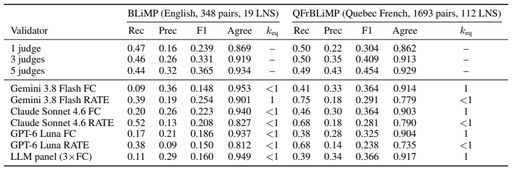
Table 1 : Finding the pairs whose intended label natives do not support (LNS). Every validator is scored against the held-out judges of the same resample (1,000 judge reshuffles). Rec/Prec/F1: LNS detection. Agree: agreement with the held-out majority on which sentence is better. keq: the largest human panel whose F1 the validator matches. FC: forced choice; RATE: 1–5 rating of each sentence on its own. QFrBLiMP is reported but not used for the pre-registered verdict, because its split-half reliability is below 0.5 (0.454).
Original paper · CC BY 4.0 · Guofang Tang · LLM Validation Makes Minimal-Pair Benchmarks Easier for Language Models · Original paper figure · Extracted the figure area from page 4 of the original PDF.Rating validators take the opposite trade: they recall more LNS pairs on BLiMP, 0.38 to 0.52, but their precision drops. The LLM panel flags 1.7% of BLiMP pairs, although 5.5% of them are LNS. On QFrBLiMP, the forced-choice validators recall more, at 0.38 to 0.46, but their agreement of 0.903 to 0.917 still falls short of the five-judge panel.
On BLiMP, six of the seven validators fall below a single judge in F1. The best, Gemini 3.8 Flash RATE, reaches an F1 of 0.254, which matches one judge but not three. On QFrBLiMP, the best validator is the LLM panel, with an F1 of 0.366, which also reaches one judge but not three. Five of the seven validators sit below the five-judge panel, with intervals excluding zero.
The VERIFY prompt, which shows the intended label, doesn't do better, with BLiMP F1 between 0.153 and 0.244.
The pre-registered BLiMP test asked whether the best validator falls below the three-judge panel with an interval excluding zero. The best validator's F1 minus the panel's is −0.077, with an interval of [−0.304, +0.150]. With only 19 LNS pairs the interval is wide and includes zero, so the verdict is a weak pass. QFrBLiMP is reported only as a descriptive result, because its split-half reliability of 0.454 sits below 0.5.
Do the flagged pairs make LMs look better?
Only pairs that humans support, with s above 0.5, enter the primary estimand. For each dataset and each LM, the gap is accuracy on flagged pairs minus accuracy on unflagged pairs.
Human-supported pairs that the primary filter flags are 18.9 points harder for LMs than the pairs it accepts. The 95% interval runs from −22.1 to −15.8, and the gap is negative for all 10 LMs. The gap holds on each dataset, with BLiMP at −15.7 and QFrBLiMP at −19.1. It also holds when only pairs with support of at least 0.75 count, at −16.4.
The other six validators show gaps from −18.2 to −32.1 points, with Holm-adjusted p below 0.001.
A human-flag control asks whether any judge's disagreement marks pairs that are equally hard for LMs. Human flags from one judge give −13.7 points, and from three judges they give −21.7 points.
Every LM scores higher on the LLM-filtered QFrBLiMP than on the human-filtered one, by 3.4 points on average. The order of the 10 LMs stays stable across no filter, human filter and LLM filter, with Kendall τ of at least 0.87. The authors argue the harm falls on absolute scores and on which failures stay visible, and not on the ranking.
Does a single judge's disagreement produce the same gap?
The post-hoc control asks whether plain human disagreement is enough to mark pairs that LMs find hard. Support for each pair comes from the held-out judges, so the flag and the outcome stay separate. Single-judge flags mark hard pairs at −13.7 points, and three-judge majority flags at −21.7 points. Human disagreement does separate hard pairs, but the LLM flags separate them further.
For all 7 validators, the gap is larger than the one-judge gap, with differences from −5.2 to −18.5 points. Every interval for these differences lies below zero. Rating validators flag 19.4–24.6% of supported pairs, against 11.4% for one judge. A larger flagged set would normally dilute the gap, yet the rating validators still show a larger one.
The forced-choice validators and the LLM panel flag 4.3–6.2% of pairs, close to the 5.9% flagged by three judges. Against that three-judge baseline, their gap is larger by −5.8 to −10.5 points, with 3 of 4 intervals below zero. Rating validators match the three-judge panel, with differences from −0.5 to +2.8 points.
VERIFY flags more pairs than the other prompts, and its gap sits close to that of one judge. Its differences from one judge run from −0.9 to −5.7 points, with intervals that include zero. Against three judges, the VERIFY gap is smaller, at +2.2 to +7.1 points. The authors read this as LLM errors lining up with LM errors more closely than one judge's disagreement does.
For forced choice, the alignment is closer than even the three-judge disagreement gives.
A frozen replication on BLiMP-NL
BLiMP-NL tests whether the downstream result holds in Dutch, with support taken from graded ratings instead of forced choices. Native speakers rated single sentences on a 7-point scale, so the authors could not use a share of forced choices. This support measure gives 38 LNS pairs, and the primary filter stays Gemini RATE, which the authors did not re-select.
The gap replicates: Gemini RATE flags 50 supported pairs, which LMs find 13.4 points harder than the pairs it accepts. All 10 LMs score lower on the flagged pairs, and 66 of the 70 LM-validator combinations are negative. Removing the flagged pairs lifts accuracy by 1.6 points over random removal, with interval [+0.7, +2.5]. The lift is smaller than in Phase 1 because this filter flags fewer pairs.
Five of those six stay significant after Holm correction, and the LLM panel is the exception. The LLM panel flags only 7 supported pairs, so its estimate is less stable. Length-normalised log-probabilities give −16.5, with interval [−24.1, −9.1].
Detection is weaker here, because forced-choice validators recall 0.15 to 0.43 of the LNS pairs. Gemini 3.8 Flash RATE reaches F1 0.388, against 0.430 for three raters. Because a rater judges one sentence rather than a pair, the authors treat this comparison as descriptive. LLM-filtered and human-filtered BLiMP-NL give the same mean accuracy, a difference of +0.1 points with interval [−0.7, +0.9].
Where the Limitations of LLM validation results stop
The evidence rests on three datasets, because only three public minimal-pair sets release individual judgments. BLiMP's validated subset has 19 LNS pairs, so its Phase 0 comparison carries wide intervals and only a weak pass. QFrBLiMP has more LNS pairs, but its split-half reliability of 0.454 kept it out of the pre-registered verdict.
Ten open LMs up to 9B parameters were scored by total log-probability, so larger or closed models were not tested. DeepSeek-7B is near chance on QFrBLiMP at 0.491 and shows the smallest gap. The validators are three API models, three prompt formats and one temperature, so other prompts may change detection. Chain-of-thought or in-context examples are also untested, and the models may change behind their APIs, so the paper releases all outputs.
The analysis is correlational, so it shows that LLM flags and LM errors coincide on human-supported pairs, not why.
Paper info
- Authors
- Guofang Tang
- Venue
- arXiv · Preprint
- First published
- 2026-11-10
- Added
- 2026-11-11
- Updated
- 2026-11-10
- Version
- v1
- arXiv
- 2611.13788
- Category
- cs.CL
- Original paper terms
- CC BY 4.0
- What we show
- Paper info, commentary and permitted figures from the original paper
AI commentary is a separate explanation from the original paper and may contain errors. The original paper and figures follow each source's terms of use and any rights noted separately.
Abstract
Minimal-pair benchmarks are only as good as their labels, and LLMs are an obvious substitute for costly human validation. We test it on BLiMP (English) and QFrBLiMP (Quebec French), the two public minimal-pair datasets releasing every forced-choice human judgment. Three LLMs validate by forced choice, by rating, and as a panel, scored against human panels of one, three and five judges in two pre-registered phases. On BLiMP, forced-choice validators agree with held-out human majorities more often than five-judge panels, yet catch far fewer pairs whose label humans reject than one judge does. By point estimate, no validator is worth more than one judge. The errors are not random. On both datasets, across 10 open LMs, human-supported pairs that the pre-registered LLM filter flags are 18.9 points harder than those it accepts, in all 70 LM-validator combinations, and harder than pairs a single human judge flags. Filtering thus removes items on which LMs fail but humans do not, raising accuracy more than random removal. A protocol frozen before any output replicates the gap and the lift on Dutch BLiMP-NL. LLM validation makes minimal-pair benchmarks easier for the models they are meant to test; we release code, validator outputs and item-level scores.
Quote from the paper
Guofang Tang (2026). LLM Validation Makes Minimal-Pair Benchmarks Easier for Language Models. arXiv:2611.13788v1. https://arxiv.org/abs/2611.13788v1
BibTeX
@misc{tang2026validation,
  title = {{LLM Validation Makes Minimal-Pair Benchmarks Easier for Language Models}},
  author = {Guofang Tang},
  year = {2026},
  eprint = {2611.13788},
  archivePrefix = {arXiv},
  url = {https://arxiv.org/abs/2611.13788v1}
}