Paper commentary
Self-supervised 6D Object Pose Estimation for Robot Manipulation
- Problem Learned 6D pose estimators need labelled real images, and labelling each object's full 6D pose by hand is slow and costly.
- Method A robot holding an RGB-D camera collects multi-view images, initializes and tracks object poses with PoseCNN and PoseRBPF, rejects failed estimates, and fine-tunes its networks on the self-labelled data.
- Results Mean segmentation F1 on 20 YCB objects rose from 60.8 with synthetic-only training to 88.7 with 100% real fine-tuning data.
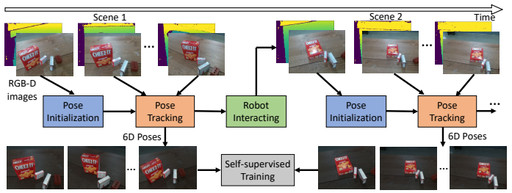
Fig. 2 : Overview of our self-supervised 6D object pose estimation system.
Original paper · CC BY 4.0 · Xinke Deng, Yu Xiang, Arsalan Mousavian, Clemens Eppner, Timothy Bretl, Dieter Fox · Self-supervised 6D Object Pose Estimation for Robot Manipulation · Original paper figure · Extracted the figure area from page 2 of the original PDF.Why pose labels are the bottleneck
Training a deep 6D pose estimator needs a large labelled set, and for real objects each training image has to carry the pose of every object in it. Synthetic images avoid that cost because the simulator supplies ground truth for free, but a network trained only on them can fail when a real object looks different from its model, for example through shiny surfaces or a mismatch in texture and lighting.
Earlier real-data efforts cut the labelling cost by moving a camera around a static scene, yet people still had to arrange the scene, record the sequences and initialize the tracker.
What was missing is a way to label 6D poses directly in real images without supervision, since two things are hard at once: estimating the pose accurately and judging automatically whether an estimate can be trusted. The study asks two questions: whether real images labelled this way improve segmentation and 6D pose estimation over networks trained on synthetic data alone, and whether the fine-tuned system makes model-based grasping more reliable.
A robot loop that labels and collects scenes
An RGB-D camera is mounted on the hand of a robot manipulator, so moving the arm moves the viewpoint of the camera. Four modules run in sequence: pose initialization from a single image, pose tracking across predefined views, robot interaction that pushes or grasps an object, and self-supervised training on the saved data.
Each cycle starts with pose initialization on one view, and the tracked poses from the arm's views are saved online as labelled RGB-D frames. After saving, the robot changes the arrangement by pushing or grasping an object, and the new scene is initialized and tracked again, so the arrangement keeps changing. The labels therefore come from the robot's own tracking and evaluation, and the paper contrasts this with the earlier setups that depended on people to arrange scenes.
Human help is still needed for presenting new subsets of the 20 YCB objects and for rearranging objects when initialization stalls for a while.
Estimating poses from one view
Detection uses PoseCNN, which labels each pixel with an object class and then applies Hough voting to find object centers and bounding boxes, so it does not depend on box-based top-down detectors. Its segmentation masks also supply the object point clouds used later in refinement, and the authors argue that its voted centers are more accurate than box centers.
Because objects occlude each other from a low view, the camera first moves to a viewpoint with a high elevation angle.
PoseRBPF is a Rao-Blackwellized particle filter with a learned auto-encoder, and each particle holds a 3D translation (u, v, z) together with a full distribution over SO(3). Particles are drawn around the detected center with Gaussian spread in image coordinates and with a uniform spread in depth around the observed depth. Each particle defines a region of interest that the auto-encoder encodes, and the code gives the particle's likelihood.
K further filtering steps on the same image then yield the expected rotation and translation.
A particle filter with a limited particle count and a discretized rotation is too coarse for an exact pose, so a continuous refinement fits 3D points from the depth image. The points are chosen with a mask that keeps only pixels labelled as the object by PoseCNN, that agree with the rendered mask, and whose depth matches the rendered depth within a margin m.
The mask is \[\Omega_{obj} = \hat{\Omega} \cap \bar{\Omega} \cap \Omega_D,\] where \(\Omega_D\) keeps pixels whose rendered and measured depths differ by less than m. Back-projecting these pixels through the inverse camera intrinsics gives the object point cloud. The pose is refined by minimizing the summed absolute signed distance of the points to the object SDF, plus a weighted penalty on how far the translation moves from the PoseRBPF estimate, with the weight λ set to 0.001.
Failed estimates are caught by rendering each object at its estimated pose and comparing the render with the real RGB-D image. Color is checked with the cosine similarity between the auto-encoder codes of the rendered and real regions of interest: \[s = \frac{\hat{c}\cdot c}{\lVert \hat{c}\rVert\,\lVert c\rVert}.\] Depth is checked with the quantity \[e = \sum_{(u,v)\in\Omega_{obj}} |\hat{D}(u,v)-D(u,v)|,\] which the text calls a mean depth error even though the expression is a sum over the object mask.
An estimate fails when s is below s* or e is above e*, and the object is then re-initialized, with s* set to 0.5 and e* to 0.03 m.
Keeping poses on track with kinematics
While the robot moves, the particles are propagated with the camera pose change given by forward kinematics, written as ΔR and Δt in SE(3). The translation particles move with the rotated previous translation plus Δt, with covariance Σt: \[P(t_k \mid t_{k-1}, \Delta t, \Delta R) = \mathcal{N}(\Delta R\, t_{k-1} + \Delta t, \Sigma_t).\] The rotation particles move by ΔR applied to the previous rotation, with covariance Σ_R: \[P(R_k \mid R_{k-1}, \Delta t, \Delta R) = \mathcal{N}(\Delta R\, R_{k-1}, \Sigma_R).\] Because the rotation is a discrete distribution over SO(3), the grid itself must shift, using the changes in pitch, yaw and roll, Δφ, Δθ and Δψ, followed by bilinear interpolation of the shifted grid.
Forward kinematics is imperfect because encoder noise and hand-eye calibration bias shift the camera estimate, so the propagated particles receive one filtering step on the current RGB-D frame for every object. Data is saved only when both pose evaluation metrics pass their thresholds, and the saved poses are then refined with the SDF-based step.
Changing scenes and choosing grasps
A push direction points either at the mass center of the remaining clutter or at the middle of the workspace, so objects stay within reach. Grasps are prepared offline, with 100 parallel-jaw grasps per object drawn from robust grasps.
At run time the precomputed grasps are moved from object coordinates into camera coordinates using the estimated pose. A grasp is accepted when it is kinematically feasible and collision-free, and the search uses an RRT* planner in MoveIt!. After grasping, the gripper rotates to reorient the object, and the object is placed at a random location in the workspace.
Curriculum fine-tuning from one object to clutter
At the start the segmentation network in PoseCNN and the auto-encoders in PoseRBPF are trained on synthetic data only, which leaves some textureless objects, such as a red foam brick, unsegmented. The authors bootstrap the system with curriculum learning that starts from scenes containing only one object.
When the network cannot segment the lone object, initialization falls back to a global search in which particles are sampled uniformly across the image. The single-object data fine-tunes the segmentation network, and the authors state that this also lets it segment objects in cluttered scenes. The next stage moves to cluttered scenes, where varied poses and occlusions fine-tune both the segmentation network and the auto-encoders.
Synthetic and real data are mixed during fine-tuning to keep the networks from overfitting.
Data collection and fine-tuning alternate, and the authors note that better networks make each later round of data collection more efficient.
Collected data and evaluation setup
Over around 12 robot hours the system collected 497 scenes, 6,541 RGB-D images and 22,851 object instances from the 20 YCB objects, all with accurate 6D poses. Human help was needed in two situations: when a new subset of the 20 YCB objects was presented, and when objects had to be rearranged because initialization stalled. For scale, the YCB-Video dataset has 92 scenes and the LabelFusion dataset has 138 scenes.
The training split has 265 scenes and 3,590 images, and the test split has 232 scenes and 2,951 images.
Segmentation is scored by the pixel-wise F1 score against ground truth labels. Pose is scored with ADD, the mean over model points of the distance between points transformed by the ground truth pose and by the estimated pose: \[\mathrm{ADD} = \frac{1}{m}\sum_{x\in M}\lVert (Rx+t)-(\tilde{R}x+\tilde{t})\rVert,\] where M is the set of model points and m is their number.
ADD-S takes, for each model point, the closest model point under the estimated pose: \[\mathrm{ADD\text{-}S} = \frac{1}{m}\sum_{x_1\in M}\min_{x_2\in M}\lVert (Rx_1+t)-(\tilde{R}x_2+\tilde{t})\rVert.\] Grasping is measured by success rate and by the time spent initializing and grasping each object.
The system runs on a 7-DoF Franka Panda with an Intel RealSense D415 camera on its parallel-jaw gripper, and the networks run on two NVIDIA Titan Xp GPUs. Particle sampling noise is 20 pixels for σu and σv and 0.1 m for σz, the refinement margin is 0.02 m, and tracking process noise is 0.015 m for Σt and 0.05 rad for ΣR.
Segmentation gains from real data
Synthetic-only training gives a mean F1 of 60.8 across 20 YCB objects on the test set, and fine-tuning with 20% real data raises the mean to 85.9. The authors summarize the first step, to 20% real data, as a 25 % increase in the overall F1 score, and describe improvement with more data as consistent.
Tuna fish can rises from 42.3 under synthetic training to 90.1 at 20% real data.
They also point to pudding box and power drill, whose real textures differ from the 3D models after product updates, and to large marker, which is small in the images. These explanations are the authors' reading of the per-object scores, and the paper does not test them separately.
Pose accuracy with and without refinement
PoseCNN regresses object distance and 3D rotation directly, whereas the pose initialization method uses the auto-encoders and a particle filter for translation and rotation. ADD and ADD-S are plotted on the test set against the amount of real fine-tuning data or the number of particles, in Fig. 6.
Both methods improve as more real training data is added, and the gap between synthetic-trained and fine-tuned models is clear. Depth is important for high accuracy, and the authors report that SDF-based refinement boosts accuracy. More particles improve the PoseRBPF estimate, but the improvement is smaller once refinement is applied.
RGB-based particle filtering with SDF refinement gives the best result, ahead of the RGB-D particle filter with refinement. The authors attribute this to the auto-encoders being trained only on RGB images, so RGB particles give more accurate rotations, and SDF refinement then corrects translation and adjusts rotation locally. Whether this ranking holds for other objects is not tested in the paper.
Fig. 7 shows a single case where synthetic networks fail in segmentation and pose estimation and the fine-tuned networks succeed.
Grasping in clutter
The pick-and-place task clears all objects from the clutter into a bin, with the camera around 0.5 m from the clutter and an initial elevation angle of 55°. Six cluttered environments were built, each with five YCB objects, giving 14 graspable objects and 30 grasping trials. Before each grasp, all objects are evaluated, and any object with a detected failure is re-initialized.
The comparison in this experiment is between these two training conditions.
The authors give the success-rate gain as 85.7 %, the reduction in initialization duration as 55.3 %, and the reduction in overall grasp duration as 27.3 %. A trial is labelled a failure when the pose of an object cannot be initialized within 45 s.
Limitations
Of the four failed grasps, three came from pose estimation errors and one from MoveIt! failing to produce a feasible trajectory. The grasping evaluation covers 30 trials and 14 graspable objects.
The segmentation and pose results come from the 20 YCB objects and the authors' own test split of 232 scenes. Initial networks trained only on synthetic data cannot segment some textureless objects, so the curriculum depends on single-object scenes to start. The authors name grasp selection and grasp execution as the next things to improve with self-supervised learning.
Paper info
- Authors
- Xinke Deng, Yu Xiang, Arsalan Mousavian, Clemens Eppner, Timothy Bretl, Dieter Fox
- Venue
- arXiv · Preprint
- First published
- 2019-9-23
- Added
- 2026-11-5
- Updated
- 2020-3-7
- Version
- v2
- arXiv
- 1909.10159
- Category
- cs.RO
- Original paper terms
- CC BY 4.0
- What we show
- Paper info, commentary and permitted figures from the original paper
AI commentary is a separate explanation from the original paper and may contain errors. The original paper and figures follow each source's terms of use and any rights noted separately.
Abstract
To teach robots skills, it is crucial to obtain data with supervision. Since annotating real world data is time-consuming and expensive, enabling robots to learn in a self-supervised way is important. In this work, we introduce a robot system for self-supervised 6D object pose estimation. Starting from modules trained in simulation, our system is able to label real world images with accurate 6D object poses for self-supervised learning. In addition, the robot interacts with objects in the environment to change the object configuration by grasping or pushing objects. In this way, our system is able to continuously collect data and improve its pose estimation modules. We show that the self-supervised learning improves object segmentation and 6D pose estimation performance, and consequently enables the system to grasp objects more reliably. A video showing the experiments can be found at https://youtu.be/W1Y0Mmh1Gd8.
Quote from the paper
Xinke Deng, Yu Xiang, Arsalan Mousavian, Clemens Eppner, Timothy Bretl, Dieter Fox (2019). Self-supervised 6D Object Pose Estimation for Robot Manipulation. arXiv:1909.10159v2. https://arxiv.org/abs/1909.10159v2
BibTeX
@misc{deng2019self,
  title = {{Self-supervised 6D Object Pose Estimation for Robot Manipulation}},
  author = {Xinke Deng and Yu Xiang and Arsalan Mousavian and Clemens Eppner and Timothy Bretl and Dieter Fox},
  year = {2019},
  eprint = {1909.10159},
  archivePrefix = {arXiv},
  url = {https://arxiv.org/abs/1909.10159v2}
}