Paper commentary
EO-Jev: Decision Model for Earth Observation
EO-Jev adapts a decision model into an Earth observation generalist
- Problem No general decision model had been tested on remote-sensing imagery. Generated text answers can't be thresholded or audited like probabilities, and the nearest prior work trained on single benchmarks.
- Method EO-Jev is d3-flash adapted with LoRA on public EO training splits. Instead of writing text, it scores each candidate answer in one forward pass, and replay keeps general decision skills.
- Results EO-Jev improves significantly over d3-flash on 26 of 30 settings and matches or exceeds specialist references on 20 of 28. It loses 1.8 points on general decision performance.
Why generated answers fit EO triage poorly
EO triage often means picking one outcome from a known set, attaching a confidence to it, and passing the answer on. Generated text fits this job poorly, because an autoregressive answer can't be thresholded, aggregated or audited the way a probability can. The paper's Figure 1 illustrates this idea, with the answer and its confidence shown side by side.
Yet no general decision model had been evaluated on remote-sensing data, and the public decision-model leaderboards hold no EO imagery. The nearest prior work, RSJEV, applies a one-pass readout to scene classification on UC Merced, AID and NWPU-RESISC45 using Qwen3.5-0.8B. RSJEV trains and evaluates separately on each benchmark, so its results aren't directly comparable with out-of-domain evaluations.
The authors address these with ten capability groups, out-of-domain evaluation, EO specialist baselines and calibration analysis. They start with a diagnostic study of d3-flash, an open 8.4B-parameter decision model derived from Qwen3.5-9B.
Reading option probabilities from one forward pass
d3-flash computes a probability for each candidate answer instead of writing text, so one forward pass can score a question. It is an 8.4B-parameter decision model derived from Qwen3.5-9B, and the paper counts 8.39B parameters with a 7.94B text tower. The language-modelling head is replaced by a 255 × 4096 linear readout applied to the last prompt token.
That readout produces a distribution over up to 255 answer codes, so each option gets a probability from the same pass.
To isolate what decision training adds, the authors run Qwen3.5-9B through the same runtime as a same-backbone control. Specialists don't get this treatment, because each one keeps its own chat template and only the question text is shared.
Each specialist is the open-weight EO model with the highest reported performance on its dataset, and it sees the same images, questions and lettered options. The authors score both the option probabilities and the generated answers, and they report whichever result is better. In option-probability mode, the specialist's answer is pre-filled up to the option, and each option's probability is read from the next-token distribution.
How LoRA and decision replay adapt d3-flash
EO-Jev keeps the decision interface of d3-flash, so the 255-code readout stays in place. Training attaches low-rank adapters to three parts of the network: the vision blocks, the vision merger and the text tower. The vision blocks receive a lower learning rate than the other adapted parts. During training, the frozen readout Wr turns the final hidden state h into option probabilities p.
Figure 2 labels the LoRA parameters as the only trainable part, so the rest of the network doesn't change.
Replay keeps general decision skills in place, because about a fifth of every batch comes from general decision data. Their targets are d3-flash's own probabilities, so replay pulls the model back toward its existing behaviour.
The training loss is L = KL(q ∥ p) + λ RPS(q, p), where q is the target distribution and p holds the predicted option probabilities. The KL divergence term matches the predicted distribution to the target distribution q. A ranked probability score is added only for ordinal questions, such as damage levels. Training runs for 20,000 steps before the LoRA adapters are merged into the BF16 weights.
At inference, a per-question threshold τq accepts a confident answer and defers the rest to an analyst.
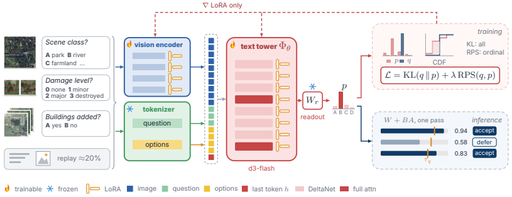
Figure 2 EO-Jev Architecture and Training.EO images (single images, pre/post pairs or time series) are paired with typed questions with predefined answers. General decision data is replayed in 20% of each batch. The vision encoder and text towerΦθ process the images and questions, respectively. A frozen readoutWr converts the final hidden state h into option probabilitiesp.Training:LoRA adapters in the vision encoder and text tower are optimized using KL divergence against target distributionsq, with an additional ranked probability score (RPS) on ordinal questions. Inference:merged adapters (W +BA) enable single-pass predictions at d3-flash cost. Answers are accepted when confidence exceeds a per-question thresholdτq and otherwise deferred to an analyst. Examples and probabilities are illustrative.
Original paper · CC BY 4.0 · Mohamed Atef Abouelhadid, Diaa Addeen Abuhani, Muhammad Akhtar Munir, Fahad Shahbaz Khan, Salman Khan · EO-Jev: Decision Model for Earth Observation · Original paper figure · Extracted the figure area from page 3 of the original PDF.Which settings count as in-domain
The evaluation builds 30 closed-form settings from 23 public benchmarks, spanning scene recognition, land cover, VQA, counting and more. The settings cover optical aerial and satellite imagery, since that is where the evaluation primarily focuses. Every setting is tied to a capability group, and the 30 settings fall into ten capability groups in Table 1.
Multiple-choice benchmarks are used natively, while yes/no questions become binary decisions and damage levels become ordered-level questions. Multi-select items are scored by exact-set match, and SAR inputs are excluded throughout.
The authors split the settings this way to measure gains inside the adaptation datasets and transfer to held-out ones. That split gives 18 in-domain settings and 12 out-of-domain settings.
For fMoW-WILDS, training and evaluation images are also separated in time and space. Training images predate 2013, while evaluation images date from 2016 onwards.
Accuracy is the main metric, with exact-set match, strict CircularEval on LHRS-Bench and correct abstention on VHM deceptive questions as exceptions. Calibration is measured by expected calibration error with 15 equal-width bins on the top answer's probability. The general Decision Index serves as a retention check on non-EO decision skills.
All models answer identical images, questions and candidate answers, which reduces differences caused by benchmark protocols.
What the general model already does on EO
d3-flash, with no EO training, does best on broad multiple-choice reasoning over EO imagery. On LHRS-Bench under strict CircularEval it reaches 77.5, while the best specialist reaches 60.0. On CHOICE it reaches 83.5, against 76.9 for the best specialist. Across the 28 settings that have a specialist, d3-flash only barely matches or beats the best open specialist in 7.
Where specialists were trained on the same benchmark, d3-flash falls behind, and AID shows the gap clearly. It reaches 78.1 on AID, while RSThinker reaches 98.5. On counting, the model scores 33.8 on DOTA-v2 and 64.2 on NWPU VHR-10. On CDVQA it answers buildings for 401 of 468 questions about which class changed most, whatever the image shows.
On xBD its damage accuracy is 41.1, where chance is 25.0. On out-of-domain VHM deceptive questions it abstains correctly 30.4% of the time, below the 33.9% of its Qwen3.5-9B backbone.
Against the Qwen3.5-9B backbone under the same answer-code readout, d3-flash scores higher in 23 of 30 settings. These gains are generally modest, so the authors read most of its EO perception as inherited from the backbone. Calibration is the clearer benefit, with lower ECE than the backbone in 24 of 30 settings. In earlier zero-shot runs, decision training cut the share of GEOBench-VLM answers that changed under option reordering from 40.9% to 13.5%.
A linear probe on d3-flash's decision state reaches 96.4 on AID, 94.3 on EuroSAT and 87.5 on NWPU-RESISC45. Its zero-shot answers on the same datasets reach 78.1, 56.8 and 73.5. That gap points to the readout rather than the representation as the bottleneck for these recognition tasks.
Did EO supervision help held-out datasets too
The authors split these settings by whether their datasets fed adaptation or stayed fully held out from it. Inside the adaptation datasets, EO-Jev's gains average 23.8 points, so the largest effect shows up where training data overlaps evaluation.
All 18 in-domain settings improve significantly, and the median gain is 24.6 points. On DisasterM3 single-choice, EO-Jev moves from 46.2 to 91.1, and on EuroSAT from 57.3 to 96.1. xBD damage grading rises from 41.1 to 65.1. The fMoW-WILDS country score climbs from 44.4 to 70.3, which the authors read as evidence against memorization. Its training images predate 2013, while its evaluation images date from 2016 onwards.
Eight of the 12 out-of-domain settings improve significantly, by 8.0 points on average across all 12. Scene datasets never used in training gain 6 to 11 points, with UC Merced rising by 11.0. GEOBench-VLM improves by 9.8 points, and NWPU VHR-10 counting gains 7.8 points. The authors explain this transfer by training on questions about absent objects drawn from other datasets.
Four out-of-domain settings don't show a significant improvement, with UrBench at +1.2 and absent-class questions at +4.7.
Against the specialists
Counting ties and wins together, EO-Jev reaches the best specialist's level on 20 of 28 settings. Of the 17 in-domain settings that have a specialist, EO-Jev matches or beats it on 14. NWPU VHR-10 counting is the exception, with a specialist lead of −7.8. The largest leads go to specialists that generalize poorly, such as TerraScope on DisasterM3 at +53.1.
Over GeoChrono, EO-Jev gains +23.5 on CDVQA and +21.7 on DVL-Bench.
Fifteen tasks clear specialist level by over 10%, five sit at it, and eight approach it. The eight approaching settings all fall within 2% of the specialist, except NWPU VHR-10 counting at 90%. No setting falls below 85%, the floor of the tiering.
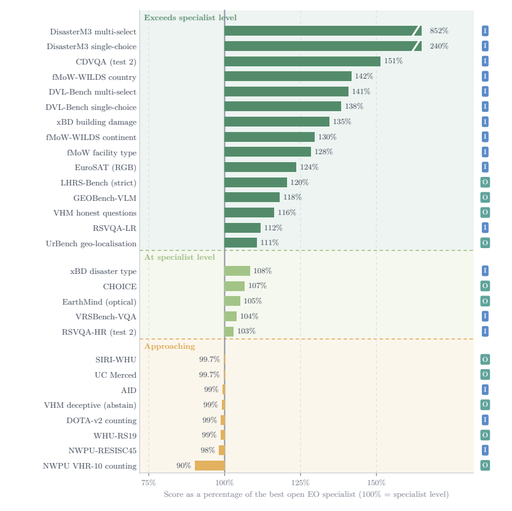
Figure 6 EO capability relative to specialist level.For each setting with a specialist reference, EO-Jev’s score as a percentage of the best open EO specialist’s. Settings are grouped into tiers: exceeds specialist level (above 110%), at specialist level (100–110%) and approaching (85–100%). No setting falls below 85%. Bars beyond 165% are clipped. Badges:I= in-domain,O= out-of-domain.
Original paper · CC BY 4.0The authors argue that the specialists' edge came from supervision rather than architecture. Once the general model gets comparable supervision, that edge largely disappears. They suggest a division of labor, with a calibrated decision model as the default interface for EO decisions. Specialists stay useful for perception the decision model hasn't learned, such as counting on unfamiliar imagery.
Uncertain cases can be routed to specialists or analysts instead of replacing either one.
Whether the confidence can be trusted
Every model answers the same questions in the ECE comparison, and multi-select options count as binary questions. The biggest drops appear where d3-flash was both inaccurate and over-confident. ECE on VHM deceptive questions drops from 0.254 to 0.062. On xBD damage grading it falls from 0.168 to 0.050, and on WHU-RS19 from 0.105 to 0.009.
On in-domain scene and VQA settings, EO-Jev's ECE is typically 0.01 to 0.03. Figure 4 plots each change as an arrow from d3-flash's ECE to EO-Jev's.
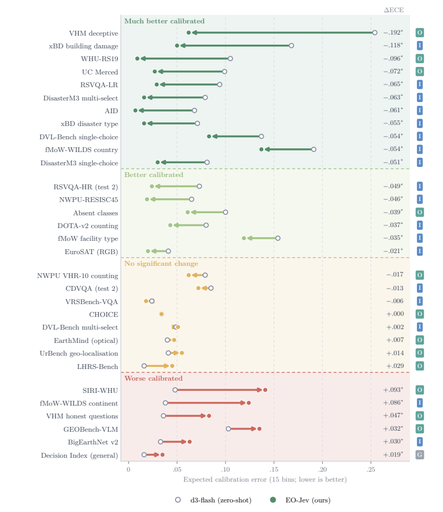
Figure 4 Calibration change from d3-flash to EO-Jev.Each arrow runs from d3-flash’s ECE (open circle) to EO-Jev’s (filled circle); lower is better. Rows are grouped by∆ECE=EO-Jev − d3-flash: much better calibrated (∆ECE ≤− 0.05), better calibrated, no significant change, and worse calibrated.∗: the paired 95% bootstrap interval (over images) excludes zero. Badges:I= in-domain,O= out-of-domain,G= general (non-EO) retention check. All EO rows in the bottom tier are over-confident; the Decision Index is slightly under-confident.
Original paper · CC BY 4.0The authors scored specialists on option probabilities, because their generated answers carry no confidence. EO-Jev has lower ECE than the best specialist on 21 of 28 settings. Specialist calibration looks competitive on scene classification, where RSThinker's ECE ranges from 0.004 to 0.052. On counting and multi-select tasks it is much worse, with RSThinker at 0.712 on NWPU VHR-10.
RSThinker reaches 0.356 on DOTA-v2, and TerraScope reaches 0.529 on DisasterM3 multi-select.
When EO-Jev is significantly less calibrated than d3-flash, its mean confidence sits above its accuracy. That gap reaches 12 to 14 percentage points on SIRI-WHU, GEOBench-VLM and fMoW-WILDS continent. It is 7.3 points on VHM honest questions and 6.2 points on BigEarthNet. The BigEarthNet and VHM honest cases link to a stronger tendency to answer yes on object-presence questions.
They didn't run that temperature check in this study.
Single-pass speed against generative specialists
With one question per call, EO-Jev is a median 3.2 times faster than the best specialist, with a range of 0.8 to 109 times. The specialist is faster on 7 of 28 rows in this single-question regime and ties on one. With batching the median rises to 6.4 times, with a range of 0.8 to 41 times. Batching narrows the set of rows where the specialist wins, which drops to only 3 rows.
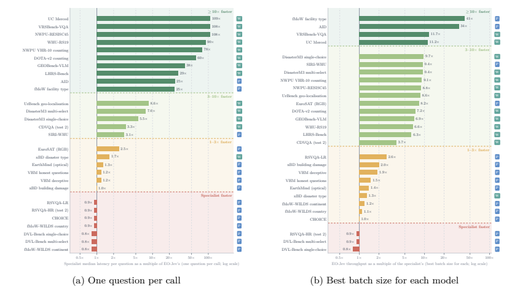
Figure 5 Inference cost against the specialists.(a) Specialist median latency per question as a multiple of EO-Jev’s, one question per call. (b) EO-Jev throughput as a multiple of the specialist’s, each at its best batch size. Bars are grouped by speed-up; red rows are those where the specialist is faster. Badges give the specialist’s best-accuracy mode (P: prompted, W: wrapped/generative). All models run on the same exclusive node (4×A100, BF16), on the same 160-question seeded sample per row, with image decoding inside the timed region. Medians: 3.2× in (a) and 6.4× in (b).
Original paper · CC BY 4.0The timing runs on one exclusive node with 4×A100-80GB GPUs in BF16, after a warm-up pass. The merged LoRA adds no cost at inference, so EO-Jev runs at the same speed as its backbone-based d3-flash.
Against prompted VLMs of similar size, such as RSVQA, DVL-Bench, fMoW-WILDS and CHOICE, EO-Jev costs about the same. Both run one forward pass, so the speed advantage comes from reading out a decision, not from a smaller model.
Limits that remain after EO adaptation
Counting is the one capability where a specialist still leads clearly. Zero-shot, d3-flash reaches only 33.8 on DOTA-v2 and 64.2 on NWPU VHR-10 counting. On in-domain DOTA-v2, EO-Jev reaches 47.7, within 0.6 points of RSThinker, yet absolute accuracy stays low for every model. The authors attribute counting limits partly to perception at the 1.6MP input budget, since tiling ultra-high-resolution scenes raised zero-shot counting by 5.0 points.
Adaptation slightly erodes option-order stability, with CHOICE down 1.5 points and LHRS-Bench strict accuracy down 5.2. The authors name option-permutation augmentation, plus keeping option-order tests as regression checks, as the obvious remedy. This study doesn't train with option-permutation augmentation, so that remedy remains untested here.
Zero-shot, orientation-estimation questions scored 30.5 against a 24% random baseline. Over-confidence concentrates on SIRI-WHU, GEOBench-VLM, fMoW-WILDS continent and VHM honest questions, which are mostly out-of-domain.
Adaptation costs 1.8 points on the general Decision Index, with EO-Jev scoring 91.9 against 93.7 for d3-flash. Adaptation also lowers accuracy on two reasoning benchmarks and raises calibration error on some settings. Whether confidence-based deferral holds up under distribution shift is still open, because the study doesn't evaluate it. The authors point to stronger quantitative and geometric perception as the next priority.
Paper info
- Authors
- Mohamed Atef Abouelhadid, Diaa Addeen Abuhani, Muhammad Akhtar Munir, Fahad Shahbaz Khan, Salman Khan
- Venue
- arXiv · Preprint
- First published
- 2026-11-2
- Added
- 2026-11-4
- Updated
- 2026-11-2
- Version
- v1
- arXiv
- 2611.03371
- Category
- cs.CV
- Original paper terms
- CC BY 4.0
- What we show
- Paper info, commentary and permitted figures from the original paper
AI commentary is a separate explanation from the original paper and may contain errors. The original paper and figures follow each source's terms of use and any rights noted separately.
Abstract
Earth observation (EO) workflows require selecting among known outcomes, estimating confidence, and processing large volumes of imagery. Generative vision-language models can address these tasks, but autoregressive decoding is computationally costly and their confidence estimates are unreliable. Decision models offer an alternative, returning probabilities over candidate answers in a single forward pass. However, their accuracy, calibration, and transfer across EO tasks remain insufficiently understood. We investigate these properties through a diagnostic study of d3-flash (8.4B parameters) across 30 settings from 23 public EO benchmarks. We find that compositional reasoning transfers well and calibration improves over its Qwen3.5-9B backbone on 24 settings, while counting, change quantification, damage grading, and absent-object recognition remain challenging. To address these limitations, we adapt d3-flash through low-rank fine-tuning on public EO training splits, producing EO-Jev. EO-Jev improves significantly over d3-flash on 26 of 30 settings and matches or exceeds specialist references on 20 of 28. It also achieves an average gain of 8.0 points across 12 held-out settings and lower expected calibration error than specialists on 21 of 28 settings. These improvements come at a modest cost of 1.8 points in general decision performance. Our results demonstrate the potential of adapting general decision models into competitive EO generalists while highlighting persistent challenges in quantitative perception, option-order consistency, and calibration under distribution shift.
Quote from the paper
Mohamed Atef Abouelhadid, Diaa Addeen Abuhani, Muhammad Akhtar Munir, Fahad Shahbaz Khan, Salman Khan (2026). EO-Jev: Decision Model for Earth Observation. arXiv:2611.03371v1. https://arxiv.org/abs/2611.03371v1
BibTeX
@misc{abouelhadid2026decision,
  title = {{EO-Jev: Decision Model for Earth Observation}},
  author = {Mohamed Atef Abouelhadid and Diaa Addeen Abuhani and Muhammad Akhtar Munir and Fahad Shahbaz Khan and Salman Khan},
  year = {2026},
  eprint = {2611.03371},
  archivePrefix = {arXiv},
  url = {https://arxiv.org/abs/2611.03371v1}
}