Paper commentary
Beyond Word Error Rate: A Failure Taxonomy of Streaming Dictation ASR
Failure taxonomy shows streaming dictation ASR systems fail in different ways
- Problem Word error rate gives one number and does not say which mistakes a dictation user has to fix. Systems with similar WER on quiet English can lose very different amounts of whispered speech.
- Method The authors sort every streamed error into four levels by a fixed rule: recognition, output formatting, language handling, and audio dropped before the model. Each error type has its own word-count rule, applied to a word-by-word comparison.
- Results Zoom Scribe and GPT-Live-Transcribe have nearly equal quiet-English WER, at 7.4% and 7.3%. On whispered English, Zoom reaches 34.7% WER while GPT-Live reaches 8.8%.
Why one WER number misleads
A single word error rate figure hides which mistakes a dictation user has to fix, because WER only counts errors. Dictation differs from that setting, because the transcript goes straight into the message as written.
WER also cannot say what kind of error a system makes. The same 9% could also mean one whole sentence missing from otherwise correct text.
Zoom Scribe and GPT-Live-Transcribe have almost the same WER on quiet English, at 7.4% and 7.3%. On whispered English, their WER is 34.7% and 8.8%, so one quiet-English WER number misses the difference. The study tests this across 107 EARS speakers, where the same four systems lost 7–31% of whispered words.
Four error levels and their rules
The failure taxonomy sorts every error into one of four levels by where in the pipeline it shows up. The four levels are recognition, output formatting, language handling and the level before the model. Language handling covers one language of a two-language message that is dropped, written in Latin letters or translated. The level before the model covers audio that the app never sends to the system.
The levels describe what the output shows, and they don't prove a cause. A hosted service may lose a missing word in its own speech detection, so the word still sits at the recognition level.
Each error type has its own rule, and a program applies that rule to the word-by-word comparison. A missing stretch needs 5 or more words in a row to be missing, and a cut-off ending needs the last 3 or more words missing. A failed clip has a WER of at least 50%, a lost clip has at least 90%, and a hard clip has a WER above 30%. Some rules rely on earlier judgements, and the paper lists those in Section 11.
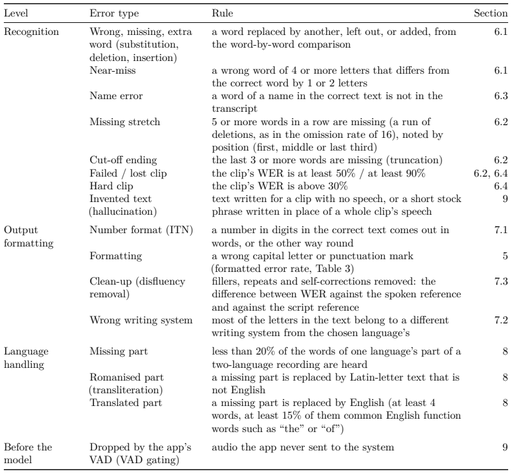
Table 1 :The failure taxonomy: error types grouped by the level they show up at, with the field’s usual term in brackets, the rule used to detect each, and the section that measures it. The 50% bar for a failed clip is where half of the message would have to be retyped; the 30% bar for a hard clip counts a clip that needs several corrections; the 20% bar keeps a part with a few misheard words from counting as missing.
Original paper · CC BY 4.0 · Harras Mansoor, Muhammad Wisal, Hassan Bhatti, Masood Shakir · Beyond Word Error Rate: A Failure Taxonomy of Streaming Dictation ASR · Original paper figure · Extracted the figure area from page 4 of the original PDF.The output formatting level holds number format, formatting, clean-up and wrong writing system errors. The language handling level uses a 20% bar: a part with less than 20% of its words heard counts as missing. A missing part replaced by Latin-letter text that isn't English counts as romanised, and one replaced by English counts as translated.
The before-the-model level holds audio dropped by the app's VAD, which the taxonomy calls VAD gating. Only the self-hosted models, Whisper and Qwen, are tested at this level, because their audio path is under the authors' control. Whisper Large V3 is self-hosted as Whisper SH, and Qwen3-ASR 1.7B runs as Qwen.
The streamed test set and its two references
The in-house English set has 106 scripted messages, read aloud by one member of the research team. The three conditions use different messages, so the authors compare systems within a condition rather than across conditions. The reader moved between US, South Asian, British and Irish English, often within a message.
Each English message has two correct texts, a script reference and a spoken reference. The script reference is the text the reader was given, which is what they meant to send.
Each clip gets a new session, and all systems are called from the same client machine.
Except where Section 9 applies, no VAD drops any audio, so every system receives every sample.
Whispered speech and missing words
Quiet-English WER doesn't predict how systems handle whispered speech, because the same WER can hide very different losses. Zoom Scribe and GPT-Live have nearly equal quiet-English WER, at 7.4% and 7.3%. On whispered English, Zoom reaches 34.7% WER while GPT-Live reaches 8.8%. The paired difference is 25.8 points, with a 95% CI from 10.3 to 51.7.
Almost all of that gap is missing words, so Zoom left out 28% of whispered words against 1% for GPT-Live. The English conditions are therefore compared separately rather than pooled into one average.
On quiet English, ten of the thirteen rows fall between 3.9% and 9.5%, so the ranking there tells little about whispered speech. Qwen, Zoom and both AssemblyAI models left out 26 to 32% of whispered words, while every other row left out at most 3%. Five or six of the 16 whispered clips failed outright for these four systems, and two to four were almost entirely lost.
The authors checked whether the server's own turn detection caused the loss, by forcing the last turn to end and then turning end-of-turn detection off. For AAI 3.6 the missing share went from 25.7% to 25.6% after forcing, and fell to 22.7% with detection off. The loss stays with the AssemblyAI models whatever their turn settings, so the authors count it as recognition inside the hosted service.
Qwen behaves differently, because the authors' own deployment runs its speech detection before the model. Relaxing that detection lowered Qwen's missing words from 32.2% to 5.7%. Its loss therefore sits in an audio path the authors control, at the level before the model. The relaxed setting didn't raise WER on quiet or fan-on English, so the tables keep the default.
The same four systems then get tested on 107 EARS speakers, which shows whether this pattern holds beyond one reader.
Replication across EARS speakers
EARS gives the authors a way to ask whether the whispered gap holds across voices rather than for one speaker. EARS has 107 speakers, each reading the same passage normally and in a whisper, using parts 1 to 4 from every speaker. That gives 428 normal and 428 whispered clips, and the Rainbow Passage is the text every speaker reads. Because the passage is the same for everyone, EARS varies the voice while keeping the text fixed, not the words.
Normal speech is easy for every system on EARS, with WER between 0.8 and 2.5%. Whispered, the same four systems that lost words on the in-house test lose them again, now 7 to 31% of words. AAI 3.6 and AAI 3.5 rise by about 7 points, Zoom rises by 24 points and Qwen by 31 points from normal speech.
Gemini, ElevenLabs, Meta, GPT-Live and RT Whisper change by less than one point when whispered. Whisper SH, which lost few words on the in-house whispered clips, loses 10.4% of its words as missing on EARS. Each AAI model loses 7.3% as missing on EARS, so the gap between Whisper SH and the AAI models is within chance. The in-house groups therefore don't split cleanly across speakers, so the system grouping depends on the speaker set.
No speaker reaches a whispered WER of 20% with Gemini, ElevenLabs, Meta, GPT-Live or RT Whisper. EARS uses one well-known passage, so this replication tests many voices on the same text rather than unseen text.
Two-language recordings and the language setting
Joining clips in two languages makes a dropped language easy to see, so the test checks whether each setting keeps both parts. The recordings join single-language clips from different speakers with a 300ms pause, so language, speaker and recording all change at one sentence boundary. The test doesn't separate a part lost in the system from a part that is hard on its own, although a screened subset gave the same conclusions.
With only English selected, Gemini, Deepgram and Whisper SH lose the non-English part in 86 to 99% of the 100 recordings. With both languages selected, the same three systems lose that part in 33 to 46% of recordings. The authors call this a filter, because the English-only setting removes the other language in more than half the EN+X recordings.
Qwen, Meta, AAI 3.6, AAI 3.5, GPT-Live and RT Whisper lose the part in 7 to 38% of recordings, which makes the English-only setting a preference for them.
Zoom lost a language in 62% of EN+X recordings and 85% of X+Y recordings, and it lost its Arabic, Hindi and Mandarin parts in every recording. Set to finalise at each 300ms pause, ElevenLabs lost far fewer languages, so the finalisation timing changes the outcome.
The whisper case study in Section 9 follows the language results, because the same app choices matter there as well.
Output formatting and the reference choice
Output formatting errors keep the words but change how they are written, such as the script or the digit form. Qwen, Meta and AAI 3.5 wrote most Urdu clips in Devanagari, the script of Hindi, and failed on 85 to 95% of them. Zoom has no Urdu option either, and it wrote 19 of 20 Urdu clips in Latin letters and failed on every one. Zoom has the highest Hindi WER of the eleven systems at 34.6%, but its text is in the right writing system.
Number form is a separate habit, and each system's ITN output stays visible because the scripts aren't converted before scoring. Qwen wrote 68% of the digit numbers as words, such as seven for 7, while Meta wrote 47% and GPT-Live 45%. These switches make up 16.1% of GPT-Live's English errors, against 4.8 to 6.1% for ElevenLabs, Zoom and Whisper SH.
The number itself was heard correctly, so these errors are about form, not recognition.
Gemini Smart lowers Gemini's quiet-English WER from 6.9% to 3.9% against the script, and ElevenLabs' no_verbatim setting cuts 12.8% to 5.1%. Against the spoken reference, Gemini Smart is the only row that does worse, by 0.8 points. Every verbatim system does better on quiet English against the spoken reference, by 2.2 to 4.0 points, because the reader's added words no longer count as extra.
The spoken reference was drafted from proposals that the verbatim systems favoured, so the reference could favour them.
The audio path before Whisper
The Whisper case study shows that the voice activity detector (VAD) setting changed the whispered result more than most choices between systems did. The authors ran nine ways of running Whisper, and setups 1 to 6 use Whisper Large V3 on two of their own deployments. Setups 7 to 9 use OpenAI's hosted Whisper, and OpenAI doesn't say which Whisper version it serves.
Because of that, setups 7 to 9 may differ in model version as well as in how they run. The setups differ in how the audio is cut into segments, which VAD is used, and whether the VAD drops audio before the model.
With its VAD on, the gated deployment reached an 80.7% whispered WER, and the VAD never sent 2 of the 16 whispered clips. With Silero dropping audio, that rose to 51.4%, and 44.6% of words were missing. So the loss is a missing-word problem, not a recognition problem in the model itself. The effect also holds across the 107 EARS speakers, where Silero dropping audio raised WER by 26.8 points.
TEN VAD behaved differently: when it dropped audio, its whispered WER stayed at 10.7%. Silero reached 51.4% in the same arrangement, so the two VADs gave very different results. TEN keeps whispered speech because it calls 79% of whispered 32ms windows speech, compared with 37% for Silero. Lowering Silero's threshold to 0.2 still left its whispered WER at 41.1%, while TEN stayed between 10.0% and 10.7%.
The VAD also affects silence, because dropping audio removes text written on silence. Whisper-1 wrote text on all 10 no-speech clips, mostly "you" and "Thank you for watching." On two short Spanish (Spain) clips, it replaced the whole speech with a stock phrase.
Its typical wait was 1,850ms, so the most accurate setup was also the slowest. RT Whisper was the most accurate on the other languages, at 14.0% on average, but it accepts only one language. Its typical wait was about twice that of the self-hosted deployment, at 735ms against 361ms. Cutting at pauses kept whispered words, since the self-hosted deployment misses 1.8% of whispered words.
Limitations of the speaker, corpus and hosted-service design
Most English results come from one read speaker, so differences between speakers aren't measured in the in-house data. The in-house English is 106 scripted messages, and the reader varied accent deliberately.
EARS reads one well-known passage, so every speaker reads the same text. EARS therefore tests many voices on the same text, not unseen text.
The 16 whispered messages make the intervals wide, with Qwen's 95% CI running from 15 to 58%. Names were labelled by a language model (Claude) under a written rule, and accents by a classifier checked against the reader's account.
Hosted services were tested in October 2026 from one client location, so results may shift as services change. The authors didn't test ElevenLabs' pause finalising on single-language audio, or Zoom settings beyond its sample app.
Paper info
- Authors
- Harras Mansoor, Muhammad Wisal, Hassan Bhatti, Masood Shakir
- Venue
- arXiv · Preprint
- First published
- 2026-11-12
- Added
- 2026-11-14
- Updated
- 2026-11-12
- Version
- v1
- arXiv
- 2611.16919
- Category
- cs.CL · cs.SD
- Original paper terms
- CC BY 4.0
- What we show
- Paper info, commentary and permitted figures from the original paper
AI commentary is a separate explanation from the original paper and may contain errors. The original paper and figures follow each source's terms of use and any rights noted separately.
Abstract
Speech recognition (ASR) systems are usually compared by word error rate (WER) on recorded files, after punctuation, capital letters and number format are removed. In dictation, the audio is streamed live and the text goes into the user's message as written, so what matters is which mistakes the user has to fix. The test set, streamed to eleven ASR systems, comprises 106 scripted English dictations from one speaker (read in a quiet room, with a fan on, and whispered), 20 clips in each of eleven other language and dialect sets, and 400 recordings that join clips in two languages. Every error was sorted by a fixed rule into four levels: recognition, output formatting, language handling and, for the self-hosted models, audio dropped before the model. Systems with similar WER failed in different ways. Zoom Scribe and OpenAI's GPT-Live-Transcribe have almost the same WER on quiet English (7.4% and 7.3%), but 34.7% and 8.8% on whispered English. Zoom and both AssemblyAI models left out 26-28% of whispered words, and still 21-26% with their end-of-turn detection relaxed or off; seven other systems left out at most 3%. Qwen3-ASR's 32% came from the speech detection in our own deployment (6% when relaxed). Across 107 EARS speakers, the same four systems lost 7-31% of whispered words, while six others lost under 2%. With only English selected, Gemini, Deepgram and our self-hosted Whisper lost the non-English part of a two-language recording in 86-99% of recordings, against 33-46% with both languages selected, while GPT-Live-Transcribe, OpenAI's realtime Whisper and Meta lost it in at most 20%. Running Whisper behind a Silero voice activity detector that drops audio judged to be silence raised whispered WER from 10.1% to 51.4%. Most English results come from one read speaker. The code, the recordings, both references and every transcript are released.
Quote from the paper
Harras Mansoor, Muhammad Wisal, Hassan Bhatti, Masood Shakir (2026). Beyond Word Error Rate: A Failure Taxonomy of Streaming Dictation ASR. arXiv:2611.16919v1. https://arxiv.org/abs/2611.16919v1
BibTeX
@misc{mansoor2026beyond,
  title = {{Beyond Word Error Rate: A Failure Taxonomy of Streaming Dictation ASR}},
  author = {Harras Mansoor and Muhammad Wisal and Hassan Bhatti and Masood Shakir},
  year = {2026},
  eprint = {2611.16919},
  archivePrefix = {arXiv},
  url = {https://arxiv.org/abs/2611.16919v1}
}