Paper commentary
Code-Grounded Agentic Explanations for Static Analysis Vulnerability Findings
Agent-written explanations make static analysis findings easier to act on
- Problem Developers often dismiss static analysis findings they cannot interpret. Letting a language model do the detection would remove the rule-based auditability that makes these tools trusted.
- Method SAFE is an IntelliJ plugin that keeps detection with the analyser and lets an LLM agent only explain. Before answering, the agent must read the rule that fired and the trace endpoints.
- Results In a 24-participant crossover study, correct remediation odds were 2.6 times higher with SAFE-Red than with SAFE-Blue. Trust did not change.
Why explanations stall triage
SAST tools are rule-based, reproducible and auditable, yet developers still underuse them. The paper names a major reason: the poor usability and quality of the explanations these tools provide. Some usability criteria call for warnings that expose the tool's internal reasoning, the consequence of an issue, and the underlying weakness. Large language models could close this explanation gap.
A model's stated reasoning is also weak evidence, since chain-of-thought explanations can be steered by input features the model never mentions. Accuracy dropped by as much as 36 % under such manipulations.
Commercial tools such as GitHub's Copilot Autofix for CodeQL alerts and Snyk's DeepCode AI Fix pair a model with an analyser. A developer must first judge whether a finding is real, and a suggested patch doesn't help with that judgement. That judgement needs an account of the analyser's reasoning rather than a suggested diff. The authors instead keep the SAST tool as detector and let the LLM explain its finding.
What developers said about the first prototype
20 students and professionals judged from screenshots whether each reported vulnerability was real, once per tool. Each tool was rated on a 6-point scale, and the authors used Wilcoxon signed-rank tests because the ratings were ordinal and the sample was small. The material came from the OWASP Benchmark, scanned with Semgrep, with two findings randomly drawn for each of five injection types.
Within that group the difference wasn't significant (p=.222), while the other ten reached only 0.30 with the prototype and 0.24 with Qodana. Order of exposure dominated the outcome, so H1 stayed unresolved and the survey setting left H2 unsupported. Satisfaction told a different story, since participants rated the prototype higher on every feedback item.
Its per-participant mean across explanation-quality items was 4.24, against 3.45 for Qodana, and 13 of the 20 participants preferred it.
Participants found the explanations too long, so they asked for the presence of a vulnerability to be stated directly. They wanted cause and mitigation only on demand, which the fixed structure didn't provide. The fixed structure sometimes made the model explain false positives as real vulnerabilities, contradicting the SAST tool's verdict.
Mitigation detail scored lowest at 3.85, and participants asked for corrected code examples.
A workshop with 19 practitioners from industry and research then found that scale was the dominant pain point. Participants wanted fixes and examples taken from their own project, because generic examples left the translation work to them. These two studies yielded five requirements that shaped the redesign.
Keeping detection with the analyser
SAFE keeps detection with an established SAST tool and gives the language model only the job of explaining that tool's verdict. The model is constrained to explain the existing verdict and isn't allowed to detect or patch anything itself. Because the verdict comes from the analyser, the results stay auditable and reproducible.
The requirements push the explanation toward that outside check by tying it to the rule and the reported data flow. The agent must look up the rule that fired and read the endpoints of the trace before it writes anything.
The authors expected this split to work because the first prototype failed on exactly this point. Its account of why the analyser objected therefore rested on the rule's message rather than on the conditions the rule checks. A single fixed prompt can't reach the rule definition or the rest of the repository, because the model only sees what the prompt holds.
How a finding becomes an explanation
SAFE reads findings either from the Qodana tool window or from a SARIF 2.1.0 file, so any SARIF-exporting tool can be explained. The plugin takes that trace and the rule as the analyser's own reasoning, so the model starts from them rather than reconstructing them. SAFE resolves the inspection identifier to a CWE entry using a curated mapping and a bundled MITRE catalogue, outside the LLM.
The trace steps are classified as source, propagator, call, sanitizer or sink, so each step stays interpretable in isolation.
The request then goes to the active explanation provider, which can be the SAFE Agent or a direct single-request provider. The agent's tools include lookup_sast_rule, get_code_structure, read_code and search_codebase, so the model can check the rule and read the code. The agent must look up the rule that fired and read the endpoints of the trace before it writes anything.
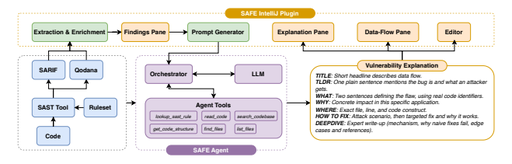
Fig. 1 : Architecture of the SAFE approach. A SAST tool applies its ruleset to the code and reports findings as SARIF or through Qodana. The SAFE plugin extracts and enriches them, lists them in its findings pane, and builds a prompt for the selected finding. In the SAFE Agent, an orchestrator relays that prompt to the language model and executes the tool calls the model issues against the project. The resulting struc- tured explanation is rendered in the explanation pane, the data-flow pane, and the editor.
Original paper · CC BY 4.0 · Oshando Johnson, Ranjith Krishnamurthy, Rohith Kumar Shanmuganathan, Goran Piskachev, Eric Bodden · Code-Grounded Agentic Explanations for Static Analysis Vulnerability Findings · Original paper figure · Extracted the figure area from page 9 of the original PDF.Every backend must return a fixed schema with title, TLDR, what, why, where, how to fix and an optional deep dive. Each trace hop also gets a step annotation, requested in the same structured response, so opening one costs no further LLM call. The plugin checks automatically that every required section is present before the explanation reaches the user.
Generated explanations are cached persistently, so reopening a project issues no new model calls.
The tiered layout shows the essentials first, while the analyser's verbatim rule identifier and message stay behind a disclosure.
Did the redesign help developers?
The design let each participant act as their own control and balanced tool order and snippet set across four groups. Both builds were assessed on the same findings from the Health-Doc-Exchange application.
Perceived usability rose from 77.3 with SAFE-Blue to 85.0 with SAFE-Red on the System Usability Scale. Among the explanation-quality items, actionability showed the widest gain, which fits the weakness both formative studies had flagged.
Proposals were rated correct roughly twice as often with SAFE-Red, and the two measures agreed. A rating alone could have been a nicer-looking explanation that just feels more useful, so the grading matters.
Triage accuracy and time per finding did not separate the builds, and the median was 3.5 minutes per finding. Five findings needed more time than a fifteen-minute block holds, so two or three decisions per participant were the expected outcome.
Trust was the one perception measure that stayed flat, even though the trace and annotations made findings easier to understand. Participants anchored their trust to their own review of the code, so the authors suggest grounding serves comprehension more than belief.
Limits of the crossover
SAFE-Red and SAFE-Blue differ in interface, tiering, content and backend at once, so the crossover can't isolate the agentic backend. The authors call this a construct-level choice, since a gain could come from the interface, the tiering, the backend, or any mix of them. Separating those parts would need a factorial ablation over two hybrid configurations, which the authors didn't engineer.
That ablation would have roughly doubled the sessions or the sample, so the authors rejected it on engineering and recruitment grounds.
The counterfactual interview question was asked in 13 of 24 sessions. Its answers pointed to the interface rather than the backend, but self-attribution of cause is weak evidence.
The redesign also changes all five requirements at once, so no single requirement's contribution can be reported. Incremental implementation would have allowed that, but R2 and R3 both depend on the agent's ability to consult the codebase. Segment-level agreement between the two coders reached 46.9 per cent on the four double-coded interviews.
Agreement was near zero on presentation codes, because such talk pervades the interviews and coders marked overlapping spans. The authors therefore treat the interview themes as an interpretive aid, not as a result on their own.
The interview coding covered 211 segments across all 24 interviews. The evaluation also rests on one unpublished Java application, Health-Doc-Exchange, with findings from five weakness families.
Paper info
- Authors
- Oshando Johnson, Ranjith Krishnamurthy, Rohith Kumar Shanmuganathan, Goran Piskachev, Eric Bodden
- Venue
- arXiv · Preprint
- First published
- 2026-11-9
- Added
- 2026-11-11
- Updated
- 2026-11-9
- Version
- v1
- arXiv
- 2611.13041
- Category
- cs.SE · cs.AI · cs.HC
- Original paper terms
- CC BY 4.0
- What we show
- Paper info, commentary and permitted figures from the original paper
AI commentary is a separate explanation from the original paper and may contain errors. The original paper and figures follow each source's terms of use and any rights noted separately.
Abstract
Static application security testing (SAST) tools surface vulnerabilities early and their verdicts are rule-based and auditable. Yet developers routinely dismiss findings they cannot interpret. Large language models can supply the missing explanation, but designs that also hand the model the detection give up the auditability that makes static analysis defensible. We keep detection with the analyser and give the model only the explaining. A preliminary user study with 20 participants and a workshop with 19 practitioners yielded five requirements. Guided by these we redesigned SAFE, an open-source IntelliJ IDEA plugin that explains findings from any analyser reporting in the Static Analysis Results Interchange Format. It tiers explanations by demand, ties them to the reported data flow, and replaces the single-prompt backend with an agent that must consult the repository and the rule that fired before answering. A within-subjects crossover experiment with 24 participants compared the redesign against its predecessor. Perceived usability rose from 77.3 to 85.0 on the System Usability Scale. Actionability gained most among the explanation-quality items, the aspect both earlier studies flagged as weakest, and the odds of a correct remediation were 2.6 times higher. Triage accuracy and time per finding were indistinguishable, which we read as uninformative rather than as equivalence. Trust was the one measure that did not move, and the closing interviews indicate that grounding made findings easier to understand rather than easier to believe. Participants also drew a boundary no requirement anticipated, wanting the tool to find and explain while they judge and apply.
Quote from the paper
Oshando Johnson, Ranjith Krishnamurthy, Rohith Kumar Shanmuganathan, Goran Piskachev, Eric Bodden (2026). Code-Grounded Agentic Explanations for Static Analysis Vulnerability Findings. arXiv:2611.13041v1. https://arxiv.org/abs/2611.13041v1
BibTeX
@misc{johnson2026code,
  title = {{Code-Grounded Agentic Explanations for Static Analysis Vulnerability Findings}},
  author = {Oshando Johnson and Ranjith Krishnamurthy and Rohith Kumar Shanmuganathan and Goran Piskachev and Eric Bodden},
  year = {2026},
  eprint = {2611.13041},
  archivePrefix = {arXiv},
  url = {https://arxiv.org/abs/2611.13041v1}
}