Paper commentary
Robust Flow Matching under Target Corruption and Label Noise
Residual-based weights make flow matching robust to corrupted data
- Problem Flow matching assumes clean targets and correct labels, but corruption in either degrades generation. Existing robust-learning methods were built for discriminative prediction, not for this regression.
- Method TRS weights each sample by its squared residual at late flow times, where clean and corrupted samples separate best. CCS instead compares the observed label's residual with alternative class fields.
- Results On CIFAR-10 with Gaussian corruption, FM-TRS reached FID 2.91, against 73.17 for OT-FM.
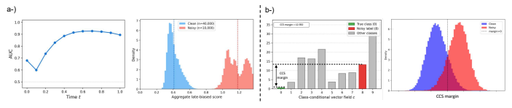
Figure 5 :Aggregated score separation under target corruption and label noise. Left:FM-TRS score distribution under target corruption. Aggregated residual scores separate clean and corrupted samples, with corrupted samples concentrated in the high-score region that receives lower weights. Right:FM-CCS score distribution under label noise. The comparative margin separates clean and label-flipped samples around zero: positive scores indicate that an alternative class-conditional VF explains the trajectory better than the observed label, while negative scores indicate that the observed label explains the trajectory better than the alternatives.
Original paper · CC BY 4.0 · Mert Can Kurucu, Erik Englesson, Hossein Azizpour · Robust Flow Matching under Target Corruption and Label Noise · Original paper figure · Extracted the figure area from page 26 of the original PDF.Why corruption breaks the regression
Training assumes that each target sample is clean and each conditioning label is correct. Two failures break that assumption: the target sample can be corrupted, or the label can name the wrong condition.
Generative performance can degrade substantially under either failure, as prior work on robust generative modeling observed. Most robust-learning methods, such as loss correction, sample selection and robust losses, were built for discriminative prediction or supervised regression. The paper fills that gap by writing out how each corruption enters the time-dependent regression that FM optimizes.
The authors regress the model onto the velocity target u(x0, x1) = x1 - x0 along the linear interpolation path. Target corruption changes the regression input and the regression target, because the corrupted endpoint shifts both the state and the velocity. Label noise leaves the path and the velocity target unchanged, so it changes only the condition argument of the vector field.
Under that assumption, the clean distribution remains identifiable from the observed distribution, so the residuals can separate clean from corrupted samples. The authors don't claim this residual pattern holds for every corruption.
How target corruption shifts the residual
A corrupted endpoint shifts the interpolation state by t times Delta_1 and the velocity target by Delta_1, where Delta_1 is the endpoint error. The residual therefore splits into the clean residual, a state-perturbation term, and a target-shift term of minus Delta_1. The state-perturbation term compares the velocity field at the shifted state with the field at the clean state.
Both extra terms vanish when Delta_1 is zero, and they grow with the size of the endpoint corruption.
The state term matters most at later times, because the displacement t times Delta_1 grows toward t equal to 1. The authors therefore expect intermediate-to-late times to separate clean from corrupted samples best. They attach a caveat: TRS fits corruption that forms a non-dominating component with residuals distinct from the clean majority.
Rare valid modes can be downweighted, and corrupted samples near the source can keep high weights.
TRS takes the squared norm of the noisy-target residual for each sampled tuple, which the training loop already computes. Times come from the late-biased density 2t on [0, 1], drawn as the square root of a uniform variable xi. Each sample keeps a stored score that an exponential moving average updates with decay beta. The average limits how far any single noisy residual evaluation can move the stored score.
The weight is a sigmoid centered at the (1 minus rho_x) quantile of the score buffer, so high-score samples get smaller weights.
During an initial warmup, the method keeps every weight at one while the scores accumulate. Reusing the sampled residual for scoring and for the loss avoids an extra forward pass. That reuse also adds a temporal factor 2t to the loss, because the late-biased sampling density is 2t.
How label noise routes the update
Under label noise, the path and velocity target stay clean, so the open question is which class-conditional field the update uses. The residual under the observed label splits into the clean residual plus the difference between the two fields at the same state and time. A large residual could come from that wrong label or from a hard but correctly labeled trajectory, so residual magnitude alone can't identify the bad label.
CCS computes, for each label c, the squared residual of the vector field under c at the same state, time and velocity target. It subtracts the smallest alternative residual from the residual under the observed label, which gives the instantaneous score s_y. A positive score means an alternative class-conditional field explains the trajectory better, which is evidence that the observed label may be corrupted.
To reduce variance, the authors average the score over a fixed deterministic set of probe times T_y, giving M_i. The weight is sigma(-M_i / tau_y), and its boundary sits at zero, so CCS doesn't need quantile centering.
Ordinary FM updates under label noise use the uniform time distribution, and the probe set is used only to refresh the CCS weights. An exact refresh costs O(N |T_y| C) sample-condition evaluations, where C is the number of labels. Proposition 3 in Appendix A gives a sufficient class-conditional margin condition for this zero-centered boundary to separate clean and corrupted labels.
That condition concerns the evaluated trajectories and probe times, so it doesn't require global separation of the conditional VFs.
Target corruption results
Under target corruption, FM-TRS came closer to clean generation than OT-FM on both the 2D spirals and CIFAR-10. Against FM-DeepGUM, the same TRS variant cut W2 and MMD by about 40% and 63%. Late-biased sampling helped further: at τ = 0.001, W2 fell to 0.532, compared with 0.621 under uniform time. The authors read this gap as evidence that FM-time structure matters for residual-based reweighting.
For CIFAR-10, the authors corrupted 20% of training images with Gaussian or salt-and-pepper noise. They built this experiment on the standard FM UNet setup from [3]. OT-FM's FID rose from the clean reference of 2.67 to 73.17 under Gaussian noise and to 64.73 under salt-and-pepper noise. FM-TRS brought these values to 2.91 and 3.61, close to the clean reference.
OT-FM (L1) lowered the Gaussian FID to 24.56, but OT-FM (Huber) stayed near OT-FM at 67.02. FM-DeepGUM was the strongest baseline, with FID 4.43 under Gaussian and 4.11 under salt-and-pepper noise. FM-TRS still beat it, with FID 2.91 against 4.43 and 3.61 against 4.11.
In Figure 3(a) and (b), OT-FM shows corruption artifacts that FM-TRS removes. The reported CIFAR-10 target corruption experiments use only a 20% corruption rate.
Label noise results on spirals and CIFAR-10
On segmented spirals, FM-CCS gives the best CW-W2 across all label-noise regimes. Against FM-DivideMix, the gains were about 51%, 64%, and 18%. The authors read this as evidence that comparing alternative class-conditional VFs beats generic noisy-label selection. With 20% target outliers and 20% or 40% label flips, the joint weights cut CW-W2 by about 88% and 86% relative to OT-FM.
The paper tested this joint case only in controlled 2D settings.
Under 20% symmetric noise, CW-FID went from 19.23 to 15.26 at τ = 0.01. The robust-loss and noisy-label baselines improved little over OT-FM in these settings. At the suitable temperature, FM-CCS had the lowest CW-FID in all three noise settings.
The trade-off is unconditional quality: at τ = 0.001, FM-CCS's FID was higher than OT-FM's despite better class alignment. The temperature therefore sets a balance between class alignment and unconditional image fidelity. Figure 3(c)–(d) shows OT-FM producing plausible images that often miss the requested class. FM-CCS produces more consistent class-conditional samples in the same comparison.
Larger label spaces and web labels
CCS is tested on CIFAR-100 with 100 classes under 40% symmetric label noise, using a model about 2.25 times larger than the CIFAR-10 model. Both FM-CCS temperatures improve CW-FID, CW-Coverage and classifier accuracy over OT-FM, at 1.44 to 1.48 times the runtime. With τy = 0.01, FM-CCS reaches a CW-FID of 87.34 and a CW-Coverage of 0.8342, against 0.8272 for OT-FM.
This is a single noise rate, 40% symmetric, so other rates weren't tested in this experiment. The paper also reports a complementary 1000-class experiment in Appendix D.3, which this section doesn't cover.
WebVision provides the real-world check, using the standard 50-class Mini WebVision setting. Models train on naturally noisy web labels and are evaluated against clean ImageNet images from the same classes.
Across the two settings, the gains from comparing labels hold at 100 classes and on noisy web labels.
Limitations of TRS, CCS and the tested settings
TRS relies on residuals that separate clean samples from corrupted ones at intermediate-to-late FM times. When corrupted samples are close to the source distribution or easy to transport, they yield small residuals and keep high weights.
Late-biased sampling also changes the temporal weighting of the optimization, because the method uses t drawn with density 2t. The paper says this effect may depend on the dataset, the model and the probability path, and it didn't test these dependencies in isolation.
CCS needs conditional losses that differ across labels, since its margin compares the correct label against every competing label. CCS is developed for discrete labels, so the paper doesn't cover continuous condition spaces. An exact refresh needs O(N|T_y|C) sample–condition evaluations, where C is the number of conditions, so the refresh cost grows with C.
Joint corruption was evaluated only in controlled 2D settings, and the paper leaves broader corruption models for future work. The authors didn't test severe class imbalance, and they didn't run matched comparisons with diffusion-based methods. Appendix H collects the operating conditions and limitations in more detail.
Paper info
- Authors
- Mert Can Kurucu, Erik Englesson, Hossein Azizpour
- Venue
- arXiv · Preprint
- First published
- 2026-11-9
- Added
- 2026-11-11
- Updated
- 2026-11-9
- Version
- v1
- arXiv
- 2611.13324
- Category
- cs.LG · cs.CV
- Original paper terms
- CC BY 4.0
- What we show
- Paper info, commentary and permitted figures from the original paper
AI commentary is a separate explanation from the original paper and may contain errors. The original paper and figures follow each source's terms of use and any rights noted separately.
Abstract
Flow Matching (FM) is a strong framework for generative modeling due to its stable training and efficient sampling. However, FM assumes clean target data and labels, an assumption often violated in practice. We formulate FM training as a time-dependent regression problem over conditional vector fields and analyze how the two corruption types affect the objective: i) target corruption adds a time-dependent residual term that grows with time, ii) label noise causes updates to the wrong class-conditional vector field. Based on this analysis, we propose to improve FM robustness by mapping corruption-specific residual scores to sample weights. For target corruption, we propose the Temporal Residual Score (TRS), which emphasizes residual magnitudes at intermediate-to-late FM times, where clean and corrupted samples are more separable. For label noise, we propose the Comparative Conditional Score (CCS), which compares the residual of the observed class-conditional vector field against alternative class-conditional vector fields for the same trajectory and velocity target. Experiments across controlled corruption settings and real-world noisy labels show that the proposed methods improve robustness over standard FM and robust-training baselines, supporting corruption-specific residual structure as a practical basis for robust FM.
Figures from the paper

Figure 2 :2D results.(a)-(c) Under target corruption, FM-TRS downweights the off-manifold outliers; (d)-(f) under label noise, FM-CCS reduces cross-class mixing and improves class-aligned spirals.
Original paper · CC BY 4.0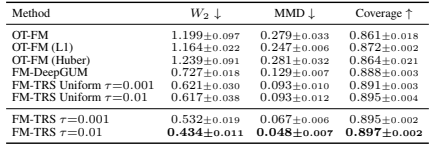
Table 1 :2D target corruption results for spirals.FM-TRS improves over robust-regression baselines under off-manifold target corruption. “Uniform” denotes TRS scoring with uniform rather than late-biased time sampling, and bold numbers indicate the best performance in each column.
Original paper · CC BY 4.0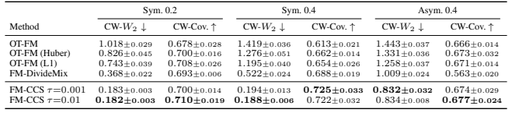
Table 2 :2D label-noise results on segmented spirals.CW- W2 and CW-Cov. are class-wise metrics averaged over classes, and bold numbers indicate the best performance in each column.
Original paper · CC BY 4.0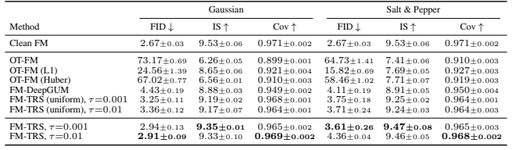
Table 3 :CIFAR-10 target corruption results.We corrupt training images with Gaussian or Salt- and-Pepper noise and evaluate against the clean test distribution. “Uniform” denotes TRS scoring with uniform rather than late-biased time sampling, and bold numbers indicate the best performance.
Original paper · CC BY 4.0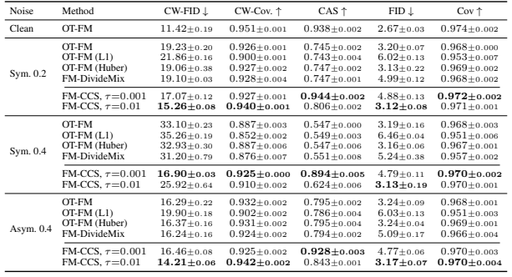
Table 4 :CIFAR-10 label-noise results.Sym. and Asym. denote symmetric and asymmetric label noise, with headers indicating noise rate. CW-FID and CW-Cov. are metrics averaged over classes.
Original paper · CC BY 4.0
Table 5 :CIFAR-100 under 40% symmetric label noise.Values are mean ± standard deviation. Runtime is in minutes.
Original paper · CC BY 4.0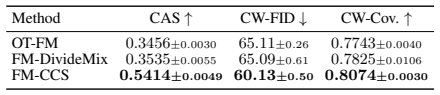
Table 6 :WebVision real-world noisy-label results.Models are trained on noisy WebVision labels and evaluated against clean ImageNet images restricted to the same 50 classes.
Original paper · CC BY 4.0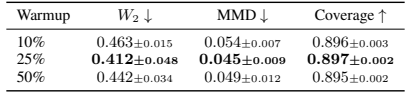
Table 7 :TRS warmup fraction(2D target corruption). Mean±std over 3 seeds.
Original paper · CC BY 4.0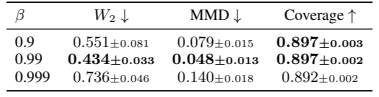
Table 8 :TRS EMA decay(2D target corruption). Mean±std over 3 seeds.
Original paper · CC BY 4.0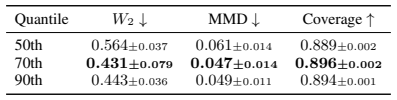
Table 9 :TRS quantile hyperparameter(2D target corruption). The percentile denotes the score- buffer quantile used as the transition center, not a known or estimated corruption rate. Mean ± std over 3 seeds.
Original paper · CC BY 4.0
Table 10 :Ablation of late-biased time sampling without reweightingon 2D target corruption. OT-FM with late-biased sampling alone improves only modestly over OT-FM, while FM-TRS yields substantially larger gains, showing that the benefit of TRS does not come from time bias alone.
Original paper · CC BY 4.0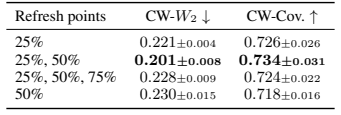
Table 11 :CCS refresh schedule(2D40%symmetric label noise). Mean±std over 3 seeds.
Original paper · CC BY 4.0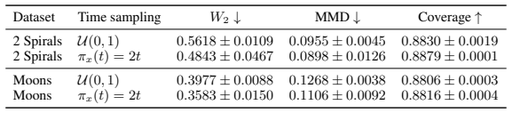
Table 12 :Time sampling on clean 2D data.Neither method uses sample reweighting. Values are mean±standard deviation.
Original paper · CC BY 4.0
Table 13 :Time sampling on clean CIFAR-10.Neither method uses sample reweighting. Mean ± standard deviation over three seeds.
Original paper · CC BY 4.0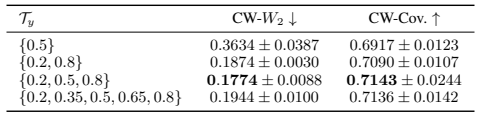
Table 14 :CCS probe-time ablationunder 40% symmetric label noise on the 2D benchmark. Values are mean±standard deviation.
Original paper · CC BY 4.0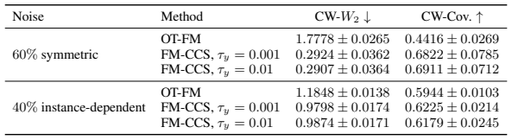
Table 15 :More challenging label noise on segmented spirals.Mean ± standard deviation over three seeds.
Original paper · CC BY 4.0
Table 16 :Simultaneous target and label corruption on segmented spirals.Mean ± standard deviation over three seeds.
Original paper · CC BY 4.0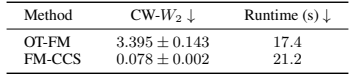
Table 17 :A 1000-class Gaussian-grid experimentunder40%symmetric label noise.
Original paper · CC BY 4.0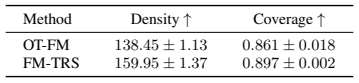
Table 18 :Additional density evaluation under 2D target corruption.Values are mean ± standard deviation.
Original paper · CC BY 4.0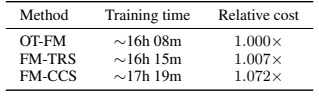
Table 19 :Measured training-time overhead on CIFAR-10 over the full 1000-epoch run.Relative cost is reported with respect to standard OT-FM under the same backbone and optimization setup.
Original paper · CC BY 4.0
Figure 4 :TRS score behavior across FM time.Residual-based separation between clean and corrupted samples becomes stronger at intermediate-to-late FM times. This supports the FM-TRS design: under target corruption, later points on the interpolation path expose the geometric effect of endpoint corruption more clearly, making residual-based reliability scoring more informative than at early times.
Original paper · CC BY 4.0Quote from the paper
Mert Can Kurucu, Erik Englesson, Hossein Azizpour (2026). Robust Flow Matching under Target Corruption and Label Noise. arXiv:2611.13324v1. https://arxiv.org/abs/2611.13324v1
BibTeX
@misc{kurucu2026robust,
  title = {{Robust Flow Matching under Target Corruption and Label Noise}},
  author = {Mert Can Kurucu and Erik Englesson and Hossein Azizpour},
  year = {2026},
  eprint = {2611.13324},
  archivePrefix = {arXiv},
  url = {https://arxiv.org/abs/2611.13324v1}
}