Paper commentary
Deep Learning-Enabled Semantic Communication Systems with Task-Unaware Transmitter and Dynamic Data
- Problem Semantic encoders are usually trained with the receiver's task known to both ends, which breaks down when the transmitter cannot see that task and the observed data drift away from the library data.
- Method Trains the encoder-decoder pair with a gradient fed back from the receiver so the transmitter can update its encoder without learning the task, then trains a CycleGAN-based converter at the transmitter alone while the trained encoder stays fixed.
- Results Reached 93% test accuracy on CIFAR-10 at CR 0.1 and 3dB SNR, against 91.8% for the JPEG2000-based method and 82.4% for the VAE-based method.
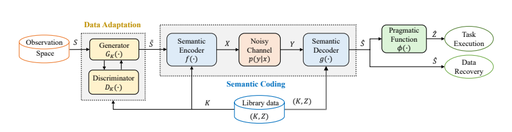
Fig. 1 : Illustration of the main parts in the proposed semantic communication system.
Original paper · CC BY 4.0 · Hongwei Zhang, Shuo Shao, Meixia Tao, Xiaoyan Bi, Khaled B. Letaief · Deep Learning-Enabled Semantic Communication Systems with Task-Unaware Transmitter and Dynamic Data · Original paper figure · Extracted the figure area from page 4 of the original PDF.Why the transmitter cannot train the task-specific encoder
Most deep learning semantic communication systems assume that the transmitter and receiver share a knowledge base of paired observable data and semantic information, and that this shared base is complete. In the setting studied here, semantic information is defined by the receiver's pragmatic task, so the transmitter cannot know which information matters.
Sending the receiver's local task-relevant labels back to the transmitter would cost communication time and could expose how the receiver uses the data.
A second difficulty is that the data observed later can follow a distribution different from the library, and a trained network then loses accuracy, much like over-fitting to the training samples. Retraining recovers performance but adds communication and computing cost, and the earlier transfer-learning method in the cited work still needs exchanges between transmitter and receiver to tune the coders.
The design therefore separates the problem into two stages: a preparation stage in which the receiver leads the coder training on library data, and a working stage in which the transmitter adapts new observations to the library form without changing the coder.
Receiver-leading training of the semantic coder
In each epoch the transmitter samples a batch of library data uniformly at random and encodes each sample as X, which it sends through the channel to the receiver. The semantic coder is shown in the figure below as the encoder at the transmitter and the decoder at the receiver, with the loss computed at the receiver.
The encoder gradient follows the chain rule and splits into a factor the receiver can compute and a factor only the transmitter can compute. The receiver evaluates the gradient of the loss with respect to the channel output, and the transmitter evaluates the Jacobian of its own output with respect to its encoder parameters, so the receiver sends the channel output Y and the gradient with respect to Y back to the transmitter.
\[ \nabla_{\theta_1}\mathcal{L} = \nabla_Y\mathcal{L}\cdot\nabla_{\theta_1}Y \]
The decoder gradient needs only the decoder output, so the receiver computes it locally as the gradient with respect to the reconstruction multiplied by the gradient of the reconstruction with respect to the decoder parameters. \[ \nabla_{\theta_2}\mathcal{L} = \nabla_{\hat K}\mathcal{L}\cdot\nabla_{\theta_2}\hat K \] Both sets of parameters are then updated with Adam, using the averaged gradients over the batch, as \[ \theta_{i,t+1}=\theta_{i,t}-\eta\frac{\rho_t}{\sqrt{\nu_t}+\epsilon} \] where ρt and νt are the first and second moments of the gradient and η is the learning rate.
The authors argue that the feedback pair does not reveal the pragmatic function, because the gradient alone does not determine how the transmitted data are used, and they cite prior work for a secrecy argument that holds when the transmitted data are much larger than the pragmatic output. The feedback is assumed to travel over a noiseless channel, since the receiver is treated as the party with more resources, and the pragmatic function is assumed to be known to the receiver in advance.
The loss has a binary structure, with one term for observable information and one for semantic information, and tasks are split into two categories, each with its own distortion measure.
Adapting new data with a CycleGAN converter
The data adaptation network is a converter that maps observed data toward the library form, and it is trained locally at the transmitter without any communication with the receiver. Unlike the transfer-learning method referenced earlier, which freezes part of the coder and retrains the rest, this design leaves the whole semantic coder unchanged and puts the adaptation in front of it.
The architecture has two generators and two discriminators, one pair for each direction between the library domain and the observed domain. The generator G_K converts observed data S into library-like data G_K(S), and its discriminator D_K tries to tell real library samples from converted ones. The second generator G_S and discriminator D_S handle the reverse mapping, and only G_K(S) is needed at inference time.
The total objective adds the two adversarial losses and a cycle-consistency term, and the cycle term applies an L1 penalty to both forward cycles. \[ \mathcal{L}_{\text{cycle}}=\mathbb{E}_{K}\big[\|G_K(G_S(K))-K\|_1\big]+\mathbb{E}_{S}\big[\|G_S(G_K(S))-S\|_1\big] \] The discriminators maximize the objective while the generators minimize it, which is the min-max problem over G_S, D_S, G_K and D_K, and the paper iterates this in batches of V samples per step.
The two adversarial terms are written in different forms in equations (11) and (12), so this article does not restate the discriminator term and relies on the combined objective.
The authors note that CGAN does not need labelled target data, while semi-supervised GAN suits settings with a few labels; the semi-supervised algorithm is omitted from the paper. The authors also argue that reusing the existing encoder and decoder avoids online retraining of the coders and the pragmatic function, which saves communication cost.
Measuring how similar two datasets are
The H∆H-divergence compares the library and observed distributions through the error of hypotheses that split the two domains, and the paper uses it as the measure of intrinsic difference. \[ d_{H\Delta H}=2\sup_{h,h'\in\mathcal{H}}\left|\mathbb{E}_{k\sim p_{lib}}\mathbf{1}[h(k)\neq h'(k)]-\mathbb{E}_{s\sim p_{pro}}\mathbf{1}[h(s)\neq h'(s)]\right| \] A small value means the pragmatic outputs of the two datasets nearly agree, so the gain from adaptation is expected to be small, and the authors use this to decide when to trigger adaptation.
Because H∆H-divergence is hard to evaluate directly, the paper approximates it with the proxy A-distance: samples from the two datasets get labels 0 and 1, a binary classifier is trained on them, and the proxy A-distance is computed from its error. \[ d_A = 2(1-2\epsilon) \] A smaller proxy A-distance means the two domains are more similar, and linear classifiers such as SVM or MLP are suggested for the separation.
Between USPS and MNIST the proxy A-distance is 0.5, and between SVHN and MNIST it is 1.48, so the authors rank USPS as the closer dataset.
Channel, benchmarks and network choices
Results are reported at two SNR values of the AWGN channel, 3dB and 10dB, which the authors take as low and high SNR regimes. The proposed encoder and decoder contain no activation functions, and a normalization layer at the encoder output enforces the transmit power constraint. The second benchmark is a VAE-based semantic communication system with a KL-divergence loss, which the authors chose because the VAE responds better to noise.
MNIST digit recognition and reconstruction
MNIST is split into 50,000 training images and 10,000 test images, and the pragmatic digit classifier at the receiver is trained in advance on the ground-truth labels. The proposed encoder and decoder each use one fully connected layer, while the VAE baseline uses two fully connected layers in each.
Under CR below 0.4 the proposed method reaches the highest digit accuracy among the compared schemes, and the VAE baseline is lowest at every compression rate. The authors attribute this to a loss that weights observable and pragmatic information by compression rate, so low compression favours the task. Above CR 0.2 the gap to JPEG2000 is minor, with the proposed method ahead for CR in [0.1, 0.4] and JPEG2000 slightly ahead for CR in [0.6, 0.9].
The authors explain that MNIST samples are simple enough to be coded at a very low rate with negligible loss, which leaves little room for joint source-channel coding to gain.
On PSNR the proposed method shows no advantage at either 3dB or 10dB SNR. The VAE method has the best PSNR at 10dB SNR, while JPEG2000 is best for CR in [0.2, 0.9] at 3dB and for CR in [0.6, 0.9] at 10dB. The PSNR of the proposed method rises with compression rate and approaches the best scheme, which the authors link to the loss shifting its focus back to reconstruction at higher rates.
The figure contrasts the three schemes on MNIST across compression rates, with test accuracy and PSNR as the two panels.
CIFAR-10 classification and reconstruction
CIFAR-10 has 60,000 RGB images of size 32×32 in 10 classes, split into 50,000 training images and 10,000 test images. At CR 0.1 and 3dB SNR the proposed method reaches 93% test accuracy, against 91.8% for the JPEG2000-based method and 82.4% for the VAE-based method. The authors attribute the difference to CIFAR-10 being harder to classify than digits, so a high accuracy at low rate needs either a near-faithful reconstruction or a task-aware encoder.
For PSNR the proposed method is best when CR is low, while the JPEG2000-based method is best at high CR. The advantage in PSNR is apparent for CR below 0.2 at 3dB. The authors link the weaker high-rate behaviour to the more complex coder networks, which they say are harder to train toward a good local optimum.
At CR 0.1 the recovered images from the proposed method keep the object outline clearly but show more blur than JPEG2000, while the VAE reconstructions show chromatic aberrations and the coarsest approximation of the objects.
PASCAL-VOC2012 segmentation
PASCAL-VOC2012 has 2,913 RGB images in 20 categories, and the experiment uses 10,582 training images and 1,449 test images. The proposed encoder is a five-layer CNN and the decoder is a deconvolution network, with each convolution kernel of size w by w, where w is set from the channel input size and the compression rate. \[ w=\left\lceil\frac{\log|\Gamma_X|}{5}\times\left(1-\sqrt{CR}\right)\right\rceil \]
The IoU compares the intersection and union of the segmented parts in the recovered and raw images. At 10dB SNR and low CR the proposed method has better IoU than the JPEG2000-based method, while at 3dB SNR it is slightly worse. Its IoU grows with compression rate, which the authors read as segmentation needing more information than classification.
On PSNR the JPEG2000-based method is best at 10dB SNR, and the gap closes as CR grows. At 3dB SNR and low CR the proposed method has the higher pixel-wise PSNR, which the authors attribute to joint source-channel coding beating separate coding for complex sources over poor channels.
The visual comparison fixes the coding rate of all three encoders at 1,895,064 bits, equal to an RGB image of 281×281 resolution. The proposed method keeps the outlines of different areas more clearly than JPEG2000, while JPEG2000 shows more colour artefacts, especially at CR 0.1.
Adapting SVHN and USPS to MNIST
MNIST is the library dataset, and two observed datasets are used: SVHN, a real-world house-number dataset with ten categories and 32×32 three-channel images, and USPS, with 7,291 training and 2,007 test images of 16×16 grayscale digits. Two benchmarks are compared: coding the observed images directly without adaptation, and retraining the whole semantic coder on the observed data, which is an ideal upper bound that the authors call impractical because of communication overhead.
With SVHN as the observed data, at CR 0.1 and 3dB SNR, the adapted method converges within about 80 epochs and its accuracy is close to the retrained ideal and far above the case without adaptation. With USPS as the observed data, the adapted method converges within 5 epochs, and the accuracy difference from the ideal case is under 10%. The authors note that the adapted method does better on USPS than on SVHN, which fits the closer proxy A-distance between USPS and MNIST.
Adapting STL10 to CIFAR-10
At CR 0.1 and 3dB SNR, the classification accuracy of the adapted method stays within 5% of retraining at fewer than 80 epochs. The final accuracy with adaptation is reported as 59.3% higher than the case without adaptation, and the paper does not say whether this gap is in percentage points or in relative terms. The accuracy against compression rate for this pair is shown in the second panel of the figure.
Limitations
The compression-rate range in which the proposed scheme dominates depends on the dataset and the pragmatic task, so no single threshold transfers. The feedback is assumed noiseless, and the pragmatic function is assumed known to the receiver in advance. The secrecy argument rests on a result cited from prior work and applies only when the transmitted data are much larger than the pragmatic output.
On MNIST the accuracy gain over JPEG2000 is minor above CR 0.2, and no PSNR advantage is shown at either SNR. Adaptation experiments pair datasets of the same category, such as USPS and MNIST, and the reported curves use CR 0.1 and 3dB SNR. The text does not report the number of runs behind each curve, so the spread across runs is not shown.
Paper info
- Authors
- Hongwei Zhang, Shuo Shao, Meixia Tao, Xiaoyan Bi, Khaled B. Letaief
- Venue
- arXiv · Preprint
- First published
- 2022-4-30
- Added
- 2026-11-6
- Updated
- 2022-10-18
- Version
- v3
- arXiv
- 2205.00271
- Category
- cs.IT · cs.LG · cs.NI
- Original paper terms
- CC BY 4.0
- What we show
- Paper info, commentary and permitted figures from the original paper
AI commentary is a separate explanation from the original paper and may contain errors. The original paper and figures follow each source's terms of use and any rights noted separately.
Abstract
Existing deep learning-enabled semantic communication systems often rely on shared background knowledge between the transmitter and receiver that includes empirical data and their associated semantic information. In practice, the semantic information is defined by the pragmatic task of the receiver and cannot be known to the transmitter. The actual observable data at the transmitter can also have non-identical distribution with the empirical data in the shared background knowledge library. To address these practical issues, this paper proposes a new neural network-based semantic communication system for image transmission, where the task is unaware at the transmitter and the data environment is dynamic. The system consists of two main parts, namely the semantic coding (SC) network and the data adaptation (DA) network. The SC network learns how to extract and transmit the semantic information using a receiver-leading training process. By using the domain adaptation technique from transfer learning, the DA network learns how to convert the data observed into a similar form of the empirical data that the SC network can process without retraining. Numerical experiments show that the proposed method can be adaptive to observable datasets while keeping high performance in terms of both data recovery and task execution.
Quote from the paper
Hongwei Zhang, Shuo Shao, Meixia Tao, Xiaoyan Bi, Khaled B. Letaief (2022). Deep Learning-Enabled Semantic Communication Systems with Task-Unaware Transmitter and Dynamic Data. arXiv:2205.00271v3. https://arxiv.org/abs/2205.00271v3
BibTeX
@misc{zhang2022deep,
  title = {{Deep Learning-Enabled Semantic Communication Systems with Task-Unaware Transmitter and Dynamic Data}},
  author = {Hongwei Zhang and Shuo Shao and Meixia Tao and Xiaoyan Bi and Khaled B. Letaief},
  year = {2022},
  eprint = {2205.00271},
  archivePrefix = {arXiv},
  url = {https://arxiv.org/abs/2205.00271v3}
}