Paper commentary
Kezek: Splitting Mono Two-Person Conversations into Per-Speaker Tracks for Full-Duplex Dialogue Data
Kezek splits mono two-person conversations into one clean track per speaker
- Problem Full-duplex dialogue models need one channel per speaker, but most conversation audio is a single mono mix. Cascades of diarization and separation drop quiet short replies, because diarization tends to filter out backchannels that overlap the other speaker.
- Method Kezek first decides once for the whole recording who speaks when and who is who, using a speaker fingerprint. A separator then follows that decision instead of judging each window, and its outputs always sum to the input.
- Results On Open Yap test, Kezek keeps 0.83 of short replies, against 0.69 for the pyannote and DialogueSidon pipeline. It also returns the whole recording and runs 4 to 5 times faster.
Why cascades lose dialogue cues
Full-duplex dialogue models learn turn-taking from conversations where each person has a separate channel. Such recordings are scarce, while most podcasts, interviews and call recordings exist only as one mono mix. The paper uses pyannote for diarization and DialogueSidon for restoration as its external baseline.
A cascade's average separation quality can look good while three failure modes still break dialogue data. Leakage makes a track carry the other person's voice, which teaches the model that its own channel holds both speakers. Lost short replies remove the backchannels that a full-duplex model needs to learn.
Backchannels are short and quiet, and they often overlap the other speaker. That is why diarization tends to drop them, even when the rest of the recording is handled well. Standard separation metrics don't capture these failures, so the authors report short-reply retention, leakage, channel swaps and coverage instead. A data tool also has to return the whole recording at its original timing and run fast enough for tens of thousands of hours.
Deciding once, then separating
Kezek stops asking a separator to judge, window by window, whether the target voice is present. Earlier single-model designs ended up either muting a speaker on real recordings or sliding into silence. Kezek splits the problem, so stage 1 decides activity and identity for the whole recording. Stage 2 then separates under that decision instead of making the call itself.
It finds the two voices once with the fingerprint, using 1.5s windows, a 0.25s hop and two groups. Two Transformer decoder layers compare each frame with both voices and output activity for A and for B. The identity of A and B comes from the recording-level voices, so the model needs no linking step. That removes the step where a linking error turns into a channel swap, which is the failure of window-based diarization.
PairNet thresholds activity at 0.3 and processes about 2400 hours of audio per GPU-hour.
Stage 2, the KezekTSE-L separator with 19.6M parameters, takes the mixture, the activity hints and the profiles of both speakers. Its projection adds half of the leftover residual to each track, so the two outputs sum exactly to the input. Because nothing in the input is lost, a separation error can only put material on the wrong track. The separator runs over the whole recording in 8s chunks with a 6s hop, so the decision covers the full length.
Stage 1: fingerprint and PairNet
The speaker fingerprint is a 10.1M-parameter embedding that reads raw 16kHz audio. It uses a convolutional front end with strides 5, 4, 4 and 4, one frame per 20ms and learned log compression. A Conformer with 6 layers and 256-d follows, then attentive statistics pooling produces a 192-d output. The fingerprint replaces ECAPA-TDNN and runs at 29539× real time against 6427× for ECAPA-TDNN.
Kezek trains it with AAM-softmax, margin 0.2 and scale 30, over 8961 people from Libri-Light, VoxPopuli and Open Yap train. That design forces the embedding to separate voices that differ only slightly. A triplet term sends the anchor and a confusable partner through the same recording chain, and the positive through a different one. The channel therefore can't serve as an identity cue.
Random all-pass cascades on 60% of crops were added because the raw-waveform network was otherwise sensitive to phase alone.
Its encoder is the fingerprint's raw-audio front end and Conformer, which yield a 128-d voice embedding and a speech/overlap estimate every 20ms. A log-mel branch with 80 bands and a 20ms hop is added to the encoder frames. Its projection starts at zero, so the branch can join a trained model without changing its output.
The voice term pulls the found voices toward the labelled ones. Frames of utterances shorter than 1s are weighted ×4, so short replies count more in training. Inference runs on 10s windows with 2s of context, and activity is thresholded at 0.3.
The first version, without the log-mel branch and fingerprint cosines, ran at about 15900 hours per GPU-hour. Stage 1 hands its activity hints to KezekTSE-L, which adds them at the bottleneck and applies the projection that makes the two outputs sum to the mixture. Stage 1 decides once, and the separator only follows that decision.
Why energy labels caused channel swaps
Open Yap ships energy-based activity per channel, and that signal marks a frame as speech whenever the headset channel has energy. A close-talk microphone picks up the other person, so the crosstalk on a headset channel can look like the speaker's own speech. Because of this, 29% of the frames labelled active contain none of the speaker's own words.
A first activity model trained on these energy labels swapped channels in 36 to 46% of conversations. The authors gave that model the reference activity instead of its own prediction, and the pipeline then had no swaps at all, with activity F1 at 0.993. The fix keeps the energy condition but adds a word condition: a frame is active only if it has energy and lies within ±0.15s of one of the speaker's own words.
The authors also close pauses shorter than 0.3s inside speech. Without that pause rule, 45% of the short replies would be fragments of ordinary turns.
Table 1 compares the energy VAD labels with the word-gated labels for the WavLM-based prototype on Open Yap val, 113 conversations. On clean audio, the share of conversations without swaps rises from 63.7% with energy labels to 97.3% with word-gated labels. Activity F1 moves from 0.877 to 0.952 on the same clean condition, so the label change carries most of the swap fix.
On recorded audio, the no-swap share goes from 54.0% to 96.5%, and short-reply retention goes from 0.711 to 0.862.
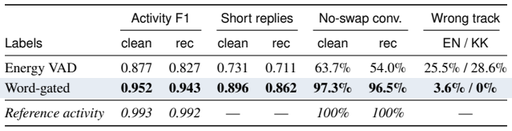
Table 1 .Effect of word-gated labels on the stage-1 activity model (prototype, WavLM features), Open Yap val, 113 conversations. Wrong track: share of replies assigned to the wrong person on real podcast dialogues, judged by speaker embedding against solo clips: 55 English replies from 10 podcasts and 14 Kazakh replies from 5 podcasts.
Original paper · CC BY 4.0Training the separator on overlaps
The separator learned solo speech from natural Open Yap windows but didn't learn to separate overlaps. Overlaps are short and rare in that data, so the separator got little signal to split them. The fix was a curriculum, not a bigger model trained on the same mixture.
Each 4s window holds one speaker solo for 2 to 4s and the other for 1 to 3s. The model then moves to Open Yap with synthetic overlaps built from Open Yap solos, natural windows and Libri-Light replay. Table 2 lists the steps of this path and the SI-SDRi each one reached.
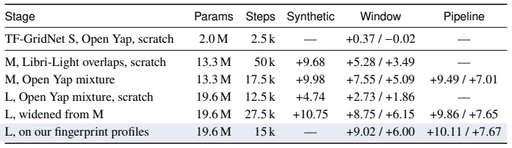
Table 2 .Separator training path. Window: SI-SDRi on Open Yap val overlap windows (clean / as recorded). Pipeline: overlap SI-SDRi of the whole pipeline on Open Yap val (clean / as recorded), each with the stage 1 of its time, so pipeline numbers compare only within a row’s neighbours. The Libri-Light row’s window numbers are zero-shot. All runs on one RTX PRO 6000, batch 16, 4s crops. Highlighted: the separator used inKezek.
Original paper · CC BY 4.0The widened large model scored +10.75dB on synthetic overlaps, and its pipeline overlap SI-SDRi was +9.86 dB clean and +7.65 dB as recorded.
The separator also gets activity hints during training, but they are corrupted on purpose. Edges shift by ±40ms, 10% of short segments are dropped, 3% false alarms appear and occasionally all hints are zero. This makes the separator tolerate stage 1 errors instead of trusting its hints.
Comparison with pyannote→DialogueSidon on short replies
The external baseline chains pyannote diarization with DialogueSidon, run unchanged from the DuplexChat code. Whatever this pipeline drops counts as lost, so the comparison measures coverage together with reply retention. Table 4 reports both systems on the same whole recordings, with Open Yap test scored against the reference channels.
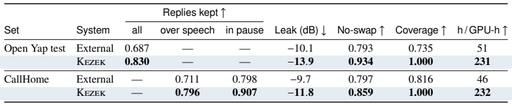
Table 4 .Kezekvs.pyannote →DialogueSidononthesamerecordings, wholerecordings. OpenYaptestisasrecorded. Replies: share of short replies (<1s) kept on the right track; on Open Yap scored against the reference channels over all replies, on CallHome scored by the annotation, separately over the other’s speech and in pauses. Leak: energy on a track during the other’s solo.
Original paper · CC BY 4.0 · Bagzhan Karl, Alizhan Karl · Kezek: Splitting Mono Two-Person Conversations into Per-Speaker Tracks for Full-Duplex Dialogue Data · Original paper figure · Extracted the figure area from page 7 of the original PDF.On Open Yap test, Kezek keeps 0.830 of short replies, while the external pipeline keeps 0.687 over all replies. On CallHome, which neither system was trained on, Kezek keeps 0.796 of replies over the other's speech. The external pipeline keeps 0.711 over speech on the same set. In pauses, Kezek keeps 0.907 of replies, against 0.798 for the external pipeline.
The gap in replies comes mostly from what the external pipeline drops, not from how it keeps the audio it returns. On the audio both systems return, reply retention is nearly the same, at 0.865 for the external pipeline and 0.859 for Kezek on Open Yap. The authors attribute the rest of the gap to leakage and swaps, since Kezek swaps channels less often.
Kezek returns the whole recording with coverage 1.000 on both sets, while the external pipeline returns 0.735 on Open Yap. Swaps also grow on telephone speech, with Kezek swapping in 14% of calls there against 7% on Open Yap. Kezek runs 4 to 5 times faster, at 231 hours of audio per GPU-hour against 51 for the external pipeline on Open Yap.
Speed is measured on one RTX PRO 6000 GPU, so the speed ratio reflects that single setup.
Stage 1 as a diarizer against pyannote community-1
Stage 1 alone can be scored as a two-speaker diarizer, using the standard diarization error rate with overlap included. The reference is the word-gated activity of each Open Yap channel, and for CallHome the annotated utterances. The comparison pits stage 1 against pyannote speaker-diarization-community-1, the diarization front end of the external pipeline.
Stage 1 also always finds exactly two speakers on Open Yap.
Its speaker confusion stays low on every set, at 0.5 to 2.0% against 3.0 to 4.4% for pyannote. Most of its error is false-alarm speech rather than confusion between speakers. The authors trace the false alarms to two choices: a low activity threshold of 0.3, and closing short pauses in the labels. Both choices were made on purpose, to keep short replies.
To see how much the threshold drives this error, the authors raised it to 0.7 for a sensitivity check only. At 0.7, DER falls to 14.8% on Open Yap as recorded and 23.1% on CallHome. Kezek keeps the threshold at 0.3, so the sensitivity result doesn't change the shipped system. Part of that residual is probably the reference itself, because utterance-level segments leave out annotated backchannels and laughter.
Table 7 holds the split into missed speech, false alarm and confusion, with the Jaccard error rate for each set.
What the own-components version gave up
Version 1 drops the frozen third-party parts that the prototype relied on, and it still runs faster than the prototype. Version 1 has 41M parameters, all trained by the authors, against about 140M for the prototype, of which 115M are frozen. Version 1 runs at 231 hours per GPU-hour, compared to 118 for the prototype.
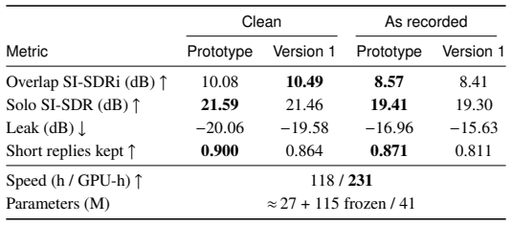
Table 5 .Version 1 (own components) vs. the prototype (frozen WavLM Base+ and ECAPA), Open Yap test, run once. Version 1 here uses the stage 1 that preceded the final one. Speed and parameters: prototype / version 1.
Original paper · CC BY 4.0The gap in replies comes from stage 1, so the authors compared the two stage 1 models under each recording condition. PairNet matches the prototype's activity F1 everywhere and keeps more replies in noise. Elsewhere, PairNet keeps 1.3 to 2 points fewer replies than the prototype. Over the other person's speech, PairNet scores 0.853 against 0.876 for the prototype, while in pauses it is slightly better at 0.911 against 0.904.
A log-mel branch and crops around real replies then raised that figure to 0.873. The final stage 1 therefore narrows the reply gap that version 1 first showed against the prototype.
Quiet replies under a louder voice
The analysis of quiet replies uses a stricter criterion than the energy test, and it asks whether a reply is present and audible. A reply counts as present when the projection of the track onto the reply's reference has a coefficient of at least 0.5, which is −6dB. Under this criterion the reference tracks score 1.00 and the unprocessed mixture scores 0.40 on replies over the other's speech.
The ideal ratio mask uses an STFT with a 512-sample window and the mixture phase, so it shows what a masking separator can recover at all.
For replies more than 10dB below the other voice, as recorded, the ideal mask keeps 0.743 of them, and Kezek keeps 0.171. Given labelled activity, the separator keeps only 0.286 of these replies, against 0.405 on clean audio. Some of the loss sits in stage 1, because the replies it misses are absent from its output altogether. Lowering the threshold to an activity of 0.15 recovers short bursts and adds only 0.007.
The separator loses many quiet replies even when it gets labelled activity, so stage 1 isn't the whole story.
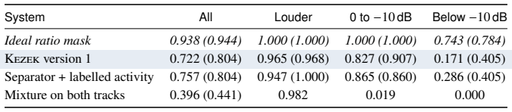
Table 9 .Replies over the other’s speech kept, by level relative to the other voice (20 Open Yap val conversations of 300s, as recorded; clean in brackets). A reply counts as kept only if it is present and audible (Section 3); only replies at least 6dB above the crosstalk in their own reference are scored.
Original paper · CC BY 4.0On all 113 validation conversations, this bin holds 151 replies instead of 35, and the separator keeps 0.371 of them. The ideal mask keeps 0.788 on the same larger set, so the gap remains there too. That result suggests the level of quiet replies in the training data isn't the bottleneck. Capacity and loss weights didn't move the pipeline either, so the remaining headroom is bounded rather than a capacity limit.
Phase sensitivity in the fingerprint
A raw-waveform fingerprint needs a phase check, because an all-pass filter changes only the phase of a signal. On the first raw-audio fingerprint, a telephone band cost 8.5% EER when applied with zero phase. With the phase response of an IIR filter, the same telephone band raised that EER to 14.1%. A pure all-pass filter alone raised the EER to 9.6%, against 7.5% for ECAPA-TDNN.
The authors added random all-pass cascades of one to four second-order sections, from 80 to 4000Hz, to 60% of crops.
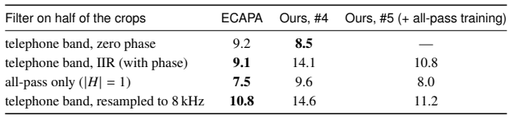
Table 12 .Phase sensitivity of the raw-audio fingerprint, EER on Open Yap val where half of the crops pass through the named filter. The all-pass filter changes only the phase.
Original paper · CC BY 4.0On telephone speech it reaches 10.3%, against 10.8% for ECAPA-TDNN. But it is coarser on clean conversational speech, at 9.5% against 7.5% for the convolutional front end. So the authors kept the convolutional front end and added all-pass augmentation.
The final fingerprint is a 10.1M-parameter embedding on raw 16kHz audio that replaces ECAPA-TDNN. It runs 4.6 times faster than ECAPA-TDNN, at 29539 times real time against 6427. On conversational Open Yap under the full chain, it reaches 13.9% EER, against 11.7% for ECAPA-TDNN. On hard Libri-Light pairs it reaches 6.8%, against 11.2% for ECAPA-TDNN.
Adding 1558 VoxPopuli speakers left the Open Yap number unchanged, so the number of voices isn't the cause.
Limitations: quiet replies, two speakers and English-only evaluation
Most short replies that Kezek still loses are quiet replies under a louder voice. Even with labelled activity, the separator keeps only 0.286 of those replies, so the gap isn't closed by stage 1 alone. Kezek handles exactly two speakers, offline, with no enrollment sample. It doesn't clean the audio the way DialogueSidon does, because it only splits the recording.
All training and quantitative evaluation so far uses English. The Kazakh check covers five podcasts and 14 judged replies, and the stage 1 activity model placed none of them on the wrong person. The authors call that sample far too small for a conclusion. Kazakh examples appear on the demo page for listening only.
Kezek only reassigns audio that is already in a recording and doesn't synthesise speech. Following the Open Yap data use agreement, the authors don't release Open Yap audio or derived tracks.
Paper info
- Authors
- Bagzhan Karl, Alizhan Karl
- Venue
- arXiv · Preprint
- First published
- 2026-11-12
- Added
- 2026-11-14
- Updated
- 2026-11-12
- Version
- v1
- arXiv
- 2611.16933
- Category
- eess.AS · cs.AI
- Original paper terms
- CC BY 4.0
- What we show
- Paper info, commentary and permitted figures from the original paper
AI commentary is a separate explanation from the original paper and may contain errors. The original paper and figures follow each source's terms of use and any rights noted separately.
Abstract
Full-duplex spoken dialogue models learn turn-taking, overlaps and backchannels from conversations recorded with one channel per speaker, but most available conversational audio is a single mono mix. We present Kezek, a model that turns a mono recording of exactly two people into one track per person with the original length and timing; overlaps and short replies ("yeah", "mm-hm") stay on the track of the person who said them. Kezek decides who speaks when and who is who once for the whole recording (stage 1: a two-voice activity model guided by a speaker fingerprint trained to be insensitive to phase), and a conditioned time-domain separator only carries out that decision (stage 2), with outputs that always sum to the input. Standard separation metrics miss the failures that matter for dialogue data, so we report short-reply retention, leakage onto the other person's solo, channel swaps and coverage. Against the open pipeline pyannote -> DialogueSidon on the same recordings, Kezek keeps more short replies (0.83 vs. 0.69 on Open Yap test; 0.80 vs. 0.71 over the other's speech on unseen telephone speech from CallHome English), mostly because it returns the whole recording while the external pipeline drops part of it (on the audio both return, reply retention is about the same: 0.859 vs. 0.865 on Open Yap); it also leaks less, swaps channels less often, and runs 4-5 times faster (about 230 hours of audio per GPU-hour). We also report negative results and an ideal-mask ceiling that locate the remaining gap: quiet replies under a louder voice. Code and weights are released under permissive licences.
Quote from the paper
Bagzhan Karl, Alizhan Karl (2026). Kezek: Splitting Mono Two-Person Conversations into Per-Speaker Tracks for Full-Duplex Dialogue Data. arXiv:2611.16933v1. https://arxiv.org/abs/2611.16933v1
BibTeX
@misc{karl2026kezek,
  title = {{Kezek: Splitting Mono Two-Person Conversations into Per-Speaker Tracks for Full-Duplex Dialogue Data}},
  author = {Bagzhan Karl and Alizhan Karl},
  year = {2026},
  eprint = {2611.16933},
  archivePrefix = {arXiv},
  url = {https://arxiv.org/abs/2611.16933v1}
}