Paper commentary
Consensus Capture in Reference-Based UAV Video Stabilization: A Benchmark on Dynamic Urban Scenes
Benchmark shows moving vehicles can pull drone video stabilization off the background
- Problem Stabilization pipelines are picked on benchmarks where only the camera moves. Vehicles moving together can pull the robust homography toward their motion, and inlier statistics do not flag this.
- Method The authors build a two-part benchmark that scores ten pipelines on static scenes and on dynamic urban hovers. It measures background alignment and how far each estimate follows a moving group.
- Results Unmasked ORB was captured on 28 of 304 real-time dynamic pairs. Masking removed capture for every pipeline and left the leading pipelines unchanged.
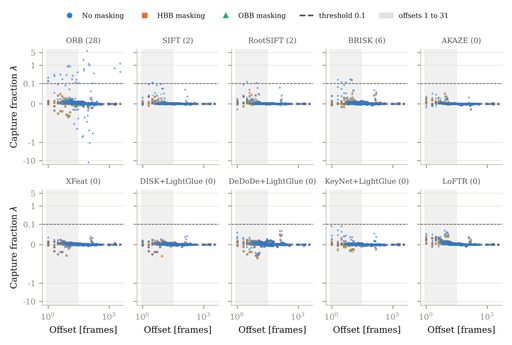
Figure 8 : The capture fraction λ (Eq. (18)) of every real-time measurement on a pair with a moving group, against the offset: one panel per pipeline, its title counting the captured measurements, and a marker per masking mode. The dashed line is the capture threshold of 0.1 and the shaded band the survey’s offsets of 1 to 31 frames. The axis is linear within the threshold and logarithmic beyond it, so a partial pull, a complete capture (λ≈ 1) and a breakdown far from zero are all visible. The offline regime is in Fig. C.1, the captured share per offset bin in Fig. C.2.
Original paper · CC BY 4.0 · Robert Fonod, Nikolas Geroliminis · Consensus Capture in Reference-Based UAV Video Stabilization: A Benchmark on Dynamic Urban Scenes · Original paper figure · Extracted the figure area from page 26 of the original PDF.Why moving vehicles mislead the registration
Reference-frame stabilization registers every frame of a hovering drone video directly onto one fixed reference frame, which keeps object positions comparable over a long hover. The pipelines behind it are picked on benchmarks where only the camera moves, so their scenes contain no independently moving content.
The authors call this failure consensus capture, and it matters for evaluation before it matters for method design. Figure 1 shows unmasked ORB at the real-time budget registering a frame ten frames after the reference frame of case S2. The estimate carries the platoon's motion across the whole crop, with a 10.0 px corner error against the reference estimator.
Inlier count, inlier ratio and reprojection error measure only the self-consistency of a fit, so a captured fit can look as sound as a correct one. On static scenes these statistics are already weak proxies for accuracy, but on dynamic scenes they become anti-informative. The authors note that no matching or registration benchmark combines independently moving content with reference geometry.
Capture matters most for microscopic analyses that read individual trajectories, such as car following, lane changes and surrogate safety measures. Reference-frame registration treats each frame on its own, so a captured estimate isn't tied to the estimates of neighboring frames. Its error follows the group's motion and remains only while the group holds the consensus.
Measuring capture without a true homography
The benchmark judges each estimate on the static background and separately on whether it follows the moving group. Real footage has no true homography, so the reference frame is compared directly with the warped current frame. The evaluation region starts from the pixels that receive real data under the warp, minus a two-pixel fringe of interpolated values.
It then removes the annotated objects of both frames with a dilation of τ pixels, and hand-drawn polygons over buildings, raised structures and tree canopy. A final erosion by Dρ keeps the region a margin away from the frame edge, the warped-data edge and the dilated objects.
Each term guards against a specific bias: without the object terms, a busier scene would score worse for every pipeline. The polygons are drawn once per case and don't depend on any pipeline. The current frame's mask is placed into reference coordinates by the reference estimator's Hek→ref, so a candidate can't shape its own region. Over this region the benchmark computes SSIM, ZNCC, MI and GOS, and agreement among them shows that no single measure's blind spot drives the result.
The largest set of boxes that moves together is the group, which a single wrong homography could fit. The capture fraction λ is the median share of the group's displacement that a candidate follows. The reference estimator's audited error amounts to 0.08 on the smallest group displacement, 5 px. Captured estimates are counted descriptively, with counts at λ ≥ 0.25, 0.5 and 1 beside the threshold.
The authors treat an outright failure as a miss rather than as an identity transform, because the identity looks plausible for a nearly stationary drone. For the reference-free measures, a failed pair receives the identity warp, the transform the pipeline actually delivered.
What decides accuracy on static scenes
On static scenes the compute budget sets accuracy more than any other setting in Part I. SIFT, RootSIFT, DISK and DeDoDe with LightGlue had saturated by half resolution. LoFTR has no feature budget and exhausted the 24 GB of the benchmark GPU at full resolution, so it is reported as N/A throughout Part I.
The matcher thresholds mattered far less than the budget, because the score surfaces are flat at the operating point. Tuning raised XFeat's mAA over its starting values by 0.0062, and every other pipeline gained at most 0.0011. Changing the estimator moved mAA by less than 0.0002 for every pipeline, so the data don't identify a preferred estimator.
Untuned values also held up on the evaluation scenes, where the order of pipelines barely changed.
AKAZE scored highest, at 0.9839 unmasked and 0.9845 under either mask. DISK with LightGlue and ORB followed at 0.972 and 0.970 unmasked, 0.012 and 0.014 behind. Under the mAA definition, a margin of 0.01 corresponds to 0.05 px of mean error.
Masking cost every pipeline less than 0.005 mAA on these static scenes, and it left the leading group where it was. The benchmark tested no scene with a moving object here, so these results describe the static case only.
Capture appears on real hovers
The authors ran nine hovers over Songdo intersections, and capture showed up on real footage before any masking was tested. At the offline budget capture was rarer, with unmasked ORB captured on 6 pairs in two cases.
One real-time pair shows the mechanism directly, with unmasked ORB reaching a capture fraction of 0.96. That estimate has a corner error of 10.0 px against the reference estimator. Across the captured estimates, the median corner error is 18.8 px, yet their inlier counts and ratios look typical.
Masking removed capture for every pipeline at both budgets, so the masked runs tell a different story. The leading pipelines, SIFT, RootSIFT and AKAZE, stayed where they were under masking. For real-time ORB, the masked run returns its feature budget to the ground, which matters for the comparison. Real-time ORB scored 0.679 mAA with masking, compared to 0.584 without.
HBBs and OBBs did not differ at these densities and orientations, since both withhold nearly the same pixels.
The primary masking contrast is therefore not claimed under the analysis plan. Per pipeline, ORB's real-time gain in eight of nine cases does not survive Holm's adjustment over the ten pipelines.
Where the Songdo results stop holding
The results rest on one recording day at one altitude band, so the capture findings hold only for that range of moving foreground. Each case is registered onto one reference frame, and the design doesn't estimate how often capture occurs across all frames a deployed pipeline might register onto.
Part II changes resolution and feature budget together, while Part I separates the two only on static scenes. The single homography model excludes buildings, raised structures and large tree canopy, but poles, signs and isolated street trees stay in the frame.
Paper info
- Authors
- Robert Fonod, Nikolas Geroliminis
- Venue
- arXiv · Preprint
- First published
- 2026-11-12
- Added
- 2026-11-14
- Updated
- 2026-11-12
- Version
- v1
- arXiv
- 2611.17190
- Category
- cs.CV
- Original paper terms
- CC BY 4.0
- What we show
- Paper info, commentary and permitted figures from the original paper
AI commentary is a separate explanation from the original paper and may contain errors. The original paper and figures follow each source's terms of use and any rights noted separately.
Abstract
Reference-frame stabilization registers every frame of a hovering-drone video onto one reference frame, keeping object positions comparable. The registration pipelines it relies on are selected on feature-matching benchmarks in which only the camera moves. Over a busy intersection, vehicles moving together supply mutually consistent correspondences that can draw the robust homography estimate toward their motion: consensus capture, which inlier statistics cannot flag. A two-part benchmark measures it and the object masking meant to prevent it. A static protocol scores ten pipelines under exactly known homographies on 4K aerial frames, tuned on a site-disjoint split at a matched resolution and feature budget. A dynamic protocol scores them at an offline and a real-time budget on hovers selected from the video alone to span the amount and coherence of moving foreground, plus a stationary control. It measures background alignment, object position error and the share of a moving group's displacement an estimate follows, against a pseudo-ground-truth reference audited with manually annotated ground control points, which also score every candidate. On static scenes, tuned AKAZE, RootSIFT, SIFT and BRISK lead, retuning the matcher thresholds raises the mean average accuracy (mAA) by at most 0.0062, and masking costs less than 0.005. Unmasked ORB is captured on 28 of 304 real-time dynamic pairs and on 6 offline; its real-time captured estimates have a median corner error of 18.8 px yet typical inlier counts and ratios. Masking removes capture for every pipeline and leaves the leading pipelines unchanged. Code, data and results are released.
Figures from the paper
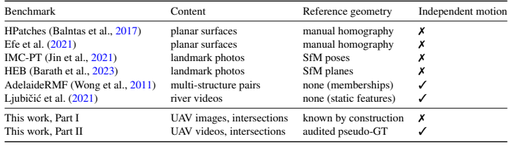
Table 1 : Benchmarks for feature matching, homography estimation and stabilization, and the property this work adds. “Independent motion” asks whether any part of the scene moves between the two views independently of the camera.
Original paper · CC BY 4.0
Figure 2 : Part I. A scene frame is warped by a known geometric and photometric perturbation, and the pipeline registers the warped copy back onto the original. The perturbation is the ground truth, so no separate reference estimate is involved. The object annotations enter twice and for different purposes: as the feature mask handed to the pipeline, and as the object boxes whose object-level errors are scored.
Original paper · CC BY 4.0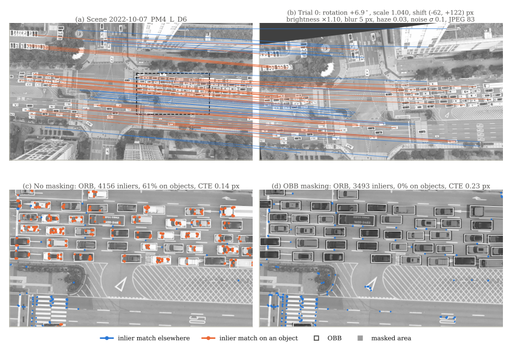
Figure 3 : One trial of the detector campaign, registered again with the campaign’s stored parameters and seed. (a) The evaluation scene with the most objects, every OBB outlined. (b) Its perturbed copy in trial 0, with the sampled parameters above it and a random sample of unmasked ORB’s inlier matches drawn between the two frames. (c, d) The dashed crop of (a) with every ORB inlier unmasked and underOBB masks, the masked area (each OBB scaled about its center by 1+ m, Table A.2) shaded; orange marks an inlier on an annotated object, blue one elsewhere. Nothing in the scene moves, so the inliers on vehicles are correct here; under masking ORB spends that share of its feature budget on the ground.
Original paper · CC BY 4.0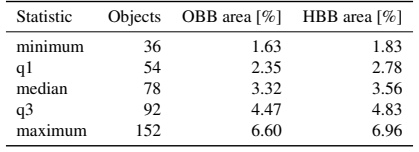
Table 3 : Object content of the 20 scenes the campaign ran on, as quantiles over scenes. Area is the fraction of the frame covered by the union of the boxes, for the oriented boxes and for the horizontal boxes they were converted from, before any mask margin; the difference between the two area columns is the additional area a horizontal mask suppresses.
Original paper · CC BY 4.0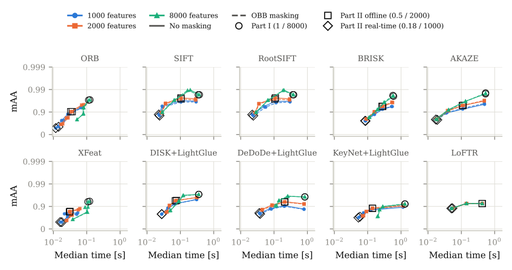
Figure 4 : Accuracy against compute on the tuning scenes, at the untuned starting thresholds. Each panel is one pipeline; a line joins the downsampling ratios 0.18, 0.30, 0.50 and 1.0 at one feature budget (color and marker), unmasked (solid) or under OBB masks (dashed), so a split between the two lines is a masking effect. A circle rings Part I’s operating point (1.0, 8000 features), a square Part II’s offline one (0.50, 2000 features) and a diamond its real-time one, the cheapest point of the grid (0.18, 1000 features). Time is the median registration time per frame pair; mAA is drawn on a logarithmic scale of 1−mAA , so the last hundredths before saturation stay visible. LoFTR has no point at full resolution, which exceeds the benchmark GPU’s memory.
Original paper · CC BY 4.0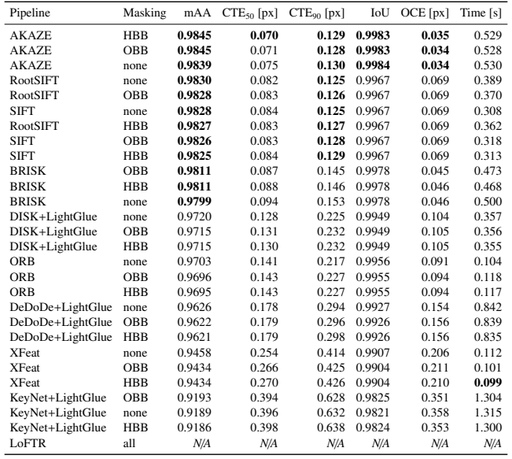
Table 4 : Part I (static benchmark): accuracy under known homographies and photometric degradation. mAA integrates HEA ε, the share of trials whose corner transfer error (CTE) stays withinε, overε∈ [0, 5] px, a failed estimate counting as a miss; IoU and OCE (object center error) compare each object’s box with its round trip through the known homography and the estimate. Bold marks the best value of each column and every value not distinguishable from it: a paired difference to the best, over the 13 sites, whose 95% cluster-bootstrap interval includes zero or whose estimate is below the equivalence margin (0.01 for mAA). HEA 1, HEA3 and HEA5 are at least 0.999 in every row. No configuration failed on any trial. N/A marks configurations that could not be run on the benchmark machine: memory was exhausted before any measurement was taken, so the run was aborted rather than averaged over the subset of the data that happened to fit.
Original paper · CC BY 4.0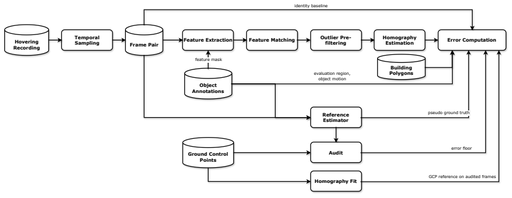
Figure 5 : Part II. Every candidate registers the same frame pairs under each masking mode in turn, and the reference estimator registers them once, under OBB masks. The reference estimator supplies pseudo-ground truth and its own error is measured against GCPs; that residual is the equivalence margin of the reference-relative pixel metrics. On the audited frames a homography fitted to the same points is an independent reference of its own, and the identity transform is scored on every pair as the unstabilized baseline. The object annotations enter as the feature mask and, placed by the reference estimator, as the evaluation region and as the object motion that the capture fraction is read against.
Original paper · CC BY 4.0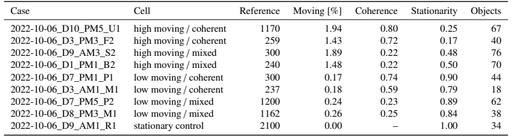
Table 5 : Part II: the cases, selected from 831 candidate reference frames in 370 hovers of 2022-10-06. Candidates are points every 900 frames inside each hover, clear of its first and last seconds, and a case’s reference frame is its selected point; a hover supplies at most one case. Each candidate is read on pairs of its reference frame with the frames 1, 2, 5, 11 and 22 frames later. Moving: the share of the frame covered by reference-frame objects displaced by more than 0.1 median object widths; Coherence: the share of that foreground moving with one of them (within 0.1 widths or 25% of its displacement, whichever is larger); Stationarity: the share of the found foreground that stayed in place; each averaged over the offsets. Cells split at the pool medians (moving 0.67%, coherence 0.42); coherence is undefined below 4 displaced objects, which left 72 candidates unclassified, and the control comes from the top decile of stationarity. Reference: the reference frame’s index in its recording; Objects: its detections. Every cell was filled.
Original paper · CC BY 4.0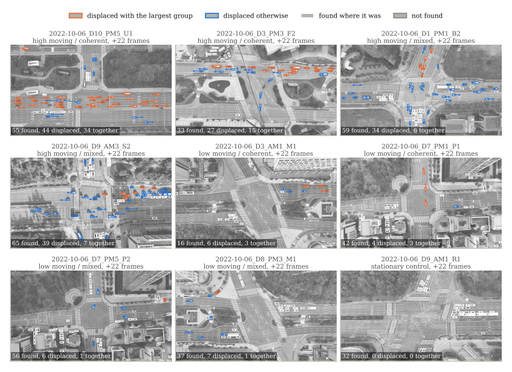
Figure 6 : The nine cases of Table 5 at their reference frames, in cell order. Every object annotated in the reference frame is outlined by itsOBB and colored by what it did 22 frames later, the longest offset the survey reads: displaced with the largest group that moved together, displaced otherwise, found where it was, or not found. Objects are found again as the survey finds them, with the reference estimator’s transform as the platform motion, as for the capture measure (Section 4.5); arrows are displacements at true scale, and each panel counts the objects found, displaced and moving together; the low-moving cases show few displaced objects by definition. Each panel is one pair, whereas the survey’s descriptors average five offsets and remove the platform motion by an affine fit to the background.
Original paper · CC BY 4.0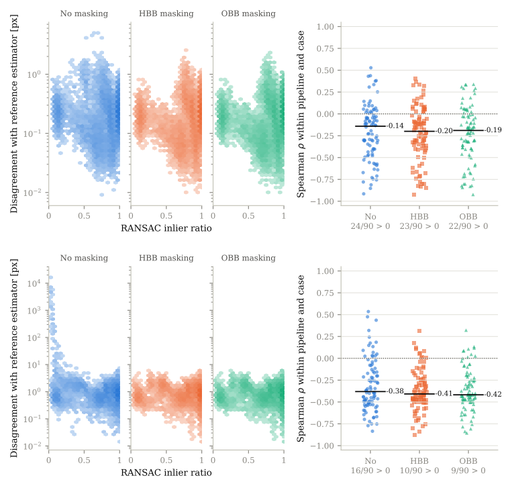
Figure 10 : Inlier ratio against the disagreement with the reference estimator, offline (top) and in real time (bottom). In each row, left, the density of frame pairs and pipelines, one panel per masking mode, darker where more of them fall, on a logarithmic scale of the count; right, the Spearman coefficient between the two within each pipeline and case, one point per group, with the median printed beside it and the number of positive coefficients under each masking mode. A negative coefficient means that a higher inlier ratio goes with a smaller error.
Original paper · CC BY 4.0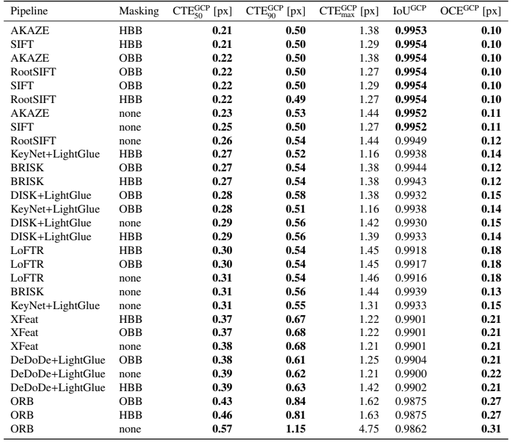
Table 10 : Part II (offline regime at downsample ratio 0.5 and 2000 features) candidates against the homography fitted to each audited frame’s ground control points, which involves no reference estimator: CTE is the corner transfer error, IoU and OCE compare the frame’s object boxes as placed by the candidate and by the fitted transform. CTE50 and CTE90 are per case and averaged over the cases; CTEmax is the largest over every audited frame. Every row is scored on 72 audited frames and 1064 ground control points. Bold marks the best value of each column and every value not distinguishable from it: a paired difference to the best, over the 9 cases, whose 95% cluster-bootstrap interval includes zero or whose estimate is below the equivalence margin (1.00 px, the GCP repeatability, for the pixel columns, none for IoU). With 9 cases the smallest attainable sign-flippis 0.0039.
Original paper · CC BY 4.0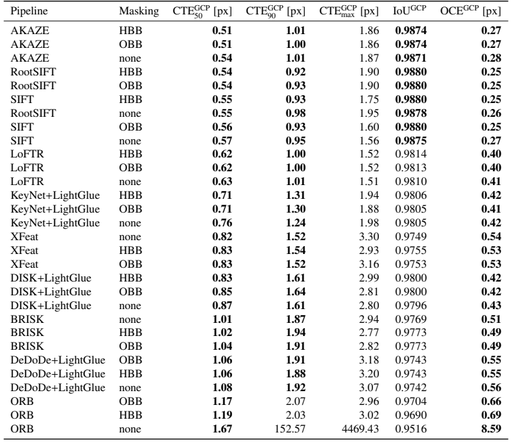
Table 11 : Part II (real-time regime at downsample ratio 0.18 and 1000 features) candidates against the homography fitted to each audited frame’s ground control points, which involves no reference estimator: CTE is the corner transfer error, IoU and OCE compare the frame’s object boxes as placed by the candidate and by the fitted transform. CTE50 and CTE90 are per case and averaged over the cases; CTEmax is the largest over every audited frame. Every row is scored on 72 audited frames and 1064 ground control points. Bold marks the best value of each column and every value not distinguishable from it: a paired difference to the best, over the 9 cases, whose 95% cluster-bootstrap interval includes zero or whose estimate is below the equivalence margin (1.00 px, the GCP repeatability, for the pixel columns, none for IoU). With 9 cases the smallest attainable sign-flippis 0.0039.
Original paper · CC BY 4.0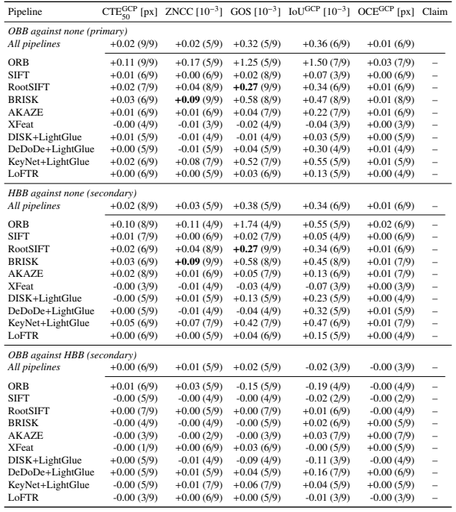
Table 12 : Part II (offline regime at downsample ratio 0.5 and 2000 features): the planned masking contrasts over 9 cases. Each cell is the Hodges–Lehmann estimate of the per-case paired benefit of the first mode over the second (positive favors the first; pixels for CTE and OCE) and the number of cases in which it is positive. CTE, IoU and OCE are against the ground control points on the audited frames, ZNCC and GOS over every pair. A contrast is read over all pipelines (Holm across the outcomes), then per pipeline (Holm across the pipelines). Bold: a benefit with a 95% cluster-bootstrap interval above zero, an estimate reaching the margin (the GCP repeatability, 1.00 px for CTE and OCE) and a Holm-adjusted p≤ 0.05; underlined: the same in favor of the second mode at the unadjusted p. The smallest attainable p is 0.0039. The primary contrast (OBB against none, all pipelines) is claimed when an outcome is bold and none is underlined. Intervals andp-values:offline_masking_contrasts.csv.
Original paper · CC BY 4.0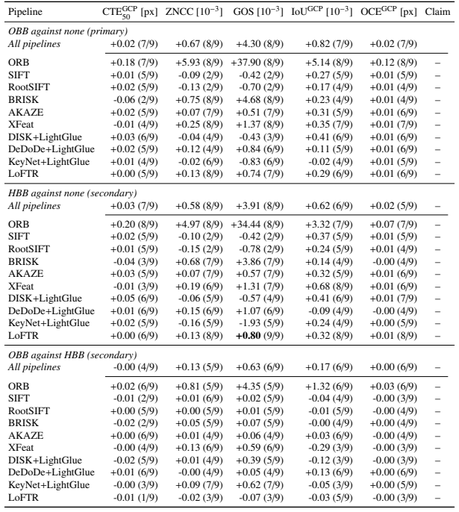
Table 13 : Part II (real-time regime at downsample ratio 0.18 and 1000 features): the planned masking contrasts over 9 cases. Each cell is the Hodges–Lehmann estimate of the per-case paired benefit of the first mode over the second (positive favors the first; pixels for CTE and OCE) and the number of cases in which it is positive. CTE, IoU and OCE are against the ground control points on the audited frames, ZNCC and GOS over every pair. A contrast is read over all pipelines (Holm across the outcomes), then per pipeline (Holm across the pipelines). Bold: a benefit with a 95% cluster-bootstrap interval above zero, an estimate reaching the margin (the GCP repeatability, 1.00 px for CTE and OCE) and a Holm-adjusted p≤ 0.05; underlined: the same in favor of the second mode at the unadjusted p. The smallest attainable p is 0.0039. The primary contrast (OBB against none, all pipelines) is claimed when an outcome is bold and none is underlined. Intervals andp-values:realtime_masking_contrasts.csv.
Original paper · CC BY 4.0Quote from the paper
Robert Fonod, Nikolas Geroliminis (2026). Consensus Capture in Reference-Based UAV Video Stabilization: A Benchmark on Dynamic Urban Scenes. arXiv:2611.17190v1. https://arxiv.org/abs/2611.17190v1
BibTeX
@misc{fonod2026consensus,
  title = {{Consensus Capture in Reference-Based UAV Video Stabilization: A Benchmark on Dynamic Urban Scenes}},
  author = {Robert Fonod and Nikolas Geroliminis},
  year = {2026},
  eprint = {2611.17190},
  archivePrefix = {arXiv},
  url = {https://arxiv.org/abs/2611.17190v1}
}