Paper commentary
Robotic Reward Models in the Foundation-Model Era
Survey sorts robotic reward models by the question each one answers
- Problem Robotic reward models give one name to scores that answer different questions. Frame-order agreement cannot show whether a reward tracks task fulfillment, and policy gains mix the evaluator with the learner.
- Method The authors sort 114 methods into five families by what their outputs answer. They then build RRM-Bench-1K, 1,117 real-robot videos with task-state labels, and four contrast suites that separate credit from its cues.
- Results Across 27 evaluators, the strongest final scores rank whole executions well enough for selection. Dense credit follows an execution's progression more closely than its task state.
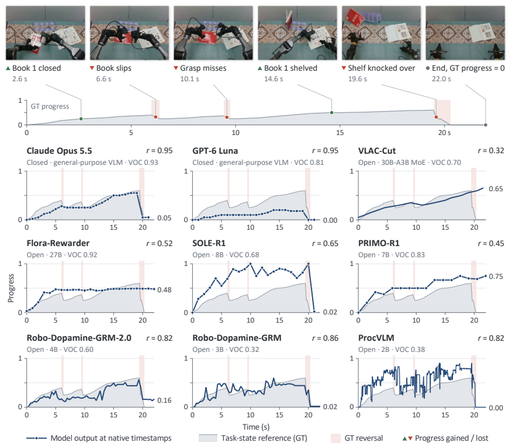
Fig. 9 . Reward profiles of nine evaluators on one execution of put the books back. The task-state reference (GT, gray) drops to zero when the robot knocks the shelf over at 19.6 s; red bands mark its reversals, andris each model’s Pearson correlation with it.
Original paper · CC BY 4.0 · Guoqiang Liang, Yiqi Lin, Shangchen Zhou, Wenzheng Zeng, Yanzhe Chen, Zechen Bai, Mike Zheng Shou · Robotic Reward Models in the Foundation-Model Era · Original paper figure · Extracted the figure area from page 14 of the original PDF.Why agreement with frame order isn't enough
Robotic reward models (RRMs) replace hand-written, per-task reward terms with one task-conditioned evaluator built on a foundation model. The first difficulty is that one name covers outputs with different meanings: a success probability, a preference, an expected return, or a structured diagnosis. Ranking candidates, steering a policy during training, and choosing when to stop each load the same score in a different way.
The common check is agreement with frame order on successful demonstrations. Any score that rises over time passes that check, so it can't reveal whether the score follows task fulfillment when progress stalls or reverses. Policy results don't settle the question either, because they mix the evaluator with the learning algorithm and the control system.
On a real robot, Tian et al. [19] found learned rewards that over-reward unsafe behavior and behavior that only looks like the task, which human evaluators reject.
Four cases make a reward credit the wrong thing: motion without its effect, a wrong destination or another broken constraint, a condition achieved and later lost, and a missing decisive view. Test sets drawn from natural runs hold few instances of the first three cases and leave the fourth unlabeled.
Five families by native output
Those three readings differ, so a score that looks alike can carry different meanings once it becomes a control signal. The five families are Outcome, Absolute Progress, Relative, Temporal Value, and Hybrid, and the survey lists 114 methods across them.
Relative models return comparisons rather than an absolute score, so the sign of the output carries the meaning. Robo-Dopamine's GRM takes a before state and a after state and returns a signed hop H between -1 and 1. Chaining hops gives progress, and removing the green block gives a hop of -0.50. A direct comparator's sign registers a local change, including a regression, which an absolute score may hide.
Pairwise comparators can also compare transitions, such as TimeRewarder's signed temporal distance between frames.
The sign matters because a lost achievement has to register as a drop, and a comparator shows that only if its output can go negative. Evaluators built on a single absolute scale, by contrast, read elapsed time as progress unless the tests decouple the two.
How RRM-Bench-1K builds its executions and suites
RRM-Bench-1K starts from 1,117 videos of learned policies run on a real robot. The authors keep each run whole, so failures, partial completions, retries and recoveries stay in the record. Task-state labels mark which conditions hold at each moment of an execution. When an achieved condition is lost, those labels withdraw its credit.
In suites A to C the counterpart is a hard negative, while in suite D it is a reduced view.
Its critical evidence is the terminal stain state, and the expected behavior is to credit the effect instead of the motion. Credit must be retracted after that reversal, so an evaluator that keeps it accumulates history.
Suite D removes the decisive view and expects the evaluator to abstain or widen its uncertainty. Cases A and B test proxy validity, C tests temporal validity, and D tests evidence validity. Natural executions rarely produce cases A to C on their own, so the authors build each suite from real executions.
Endpoint ranking versus dense credit
The unified protocol ran 27 evaluators on four contrast suites and scored endpoint judgment, dense credit, and evidence use apart. Keeping the three capabilities separate matters because a single leaderboard would merge them into one number.
Dense credit is the harder test, and the normalized-time control shows why chronology alone isn't enough. Its τa and falling F1 are zero, so a high VOC can coexist with no response to task-state falls.
Losses of an achieved condition are rare among the falls, yet they draw a clearer response than other falls. Robometer and Robo-Dopamine-GRM-2.0-8B-Preview recall more than half of the lost achievements, exceeding the overall fall-prediction rate the most. VLAC-Cut leads the single-view specialized evaluators in falling F1, but it recalls few lost achievements.
Outputs also lean toward elapsed time, so credit can follow the clock rather than the task state.
Whether evaluators notice missing evidence
Hiding the decisive view lowers Macro-F1 for nearly every evaluator in Table 3, so removing evidence hurts most scores. No evaluated interface can report insufficient evidence, which means an evaluator with no decisive view still returns a number. Most Pair-queried evaluators still report progress on views with no task evidence, staying close to the always-rising predictor.
Sequence-queried VLMs behave differently, holding their output nearly constant on those same views. The paper counts that constant output as error, because a direction test against the hidden task state penalizes it.
Extra cameras help evaluators that have separate camera slots, because the other views recover what the primary view hides. With the video's camera in the primary slot and the execution's other cameras in the rest, all four Robo-Dopamine checkpoints and SOLE-R1 gain. Flora-Rewarder, which receives views tiled in one frame, doesn't gain from the extra cameras.
The query form changes results as well, because the query is part of the evaluator. The authors read this as Pair queries exposing local change, real or spurious, while Sequence queries smooth it over the video.
What bounds these scores and suites
Natural runs rarely produce the cases of suites A to C, so the suites had to be built on purpose. Their results describe behavior on these constructed contrasts, not on the mix of executions a deployed robot produces.
The unified study covers 27 evaluators under one protocol, so its scores describe those evaluators under those conditions. The benchmark videos come from a real robot, with 1,117 closed-loop executions across five embodiments. The query form changes results, because Pair and Sequence queries trade falling recall for falling precision across the seven VLMs.
Extra cameras helped the evaluators with separate camera slots, but Flora-Rewarder, given tiled views, didn't gain. WARP-RM and RARM haven't been tested against what the camera shows, so their calibration claims stay untested on this evidence.
The paper leaves open whether a protocol can keep the falling recall of Pair queries while adding the falling precision of Sequence queries. Because nine in ten transitions rise, the always-rising predictor can beat half of the single-view specialized evaluators on Macro-F1.
Paper info
- Authors
- Guoqiang Liang, Yiqi Lin, Shangchen Zhou, Wenzheng Zeng, Yanzhe Chen, Zechen Bai, Mike Zheng Shou
- Venue
- arXiv · Preprint
- First published
- 2026-11-16
- Added
- 2026-11-17
- Updated
- 2026-11-16
- Version
- v1
- arXiv
- 2611.20741
- Category
- cs.RO · cs.CV
- Original paper terms
- CC BY 4.0
- What we show
- Paper info, commentary and permitted figures from the original paper
AI commentary is a separate explanation from the original paper and may contain errors. The original paper and figures follow each source's terms of use and any rights noted separately.
Abstract
Robotic reward models (RRMs) use foundation models to replace per-task reward engineering with reusable, task-conditioned evaluation. Yet under one name, their outputs answer different questions, from whether a task succeeded to which execution is better. This survey organizes 114 methods into five semantic families by the question their native outputs answer: Outcome, Absolute Progress, Relative, Temporal Value, and Hybrid. Within this taxonomy, we review how model design determines what an evaluator can judge, how raw experience becomes supervision, and how existing evaluation practice tests the result. The review exposes a gap: agreement with demonstration order and downstream policy gains do not show whether a reward tracks task fulfillment. We therefore introduce RRM-Bench-1K, 1,117 real-robot videos of closed-loop executions with task-state and camera-evidence labels, and four contrast suites that separate the credited condition from its usual cues. A unified study of 27 evaluators shows that the strongest final scores rank whole executions well enough for selection and filtering. Dense credit, however, follows the progression of an execution more closely than its task state, and no evaluator signals when the decisive view is missing. How much fidelity a reward model needs therefore depends on the decision it drives. We outline directions from real-failure supervision to metrics that separate task state from chronology, and open-source RRM-Hub, a toolbox in which 14 existing RRMs can be readily applied and new evaluators tested on the same capabilities.
Figures from the paper
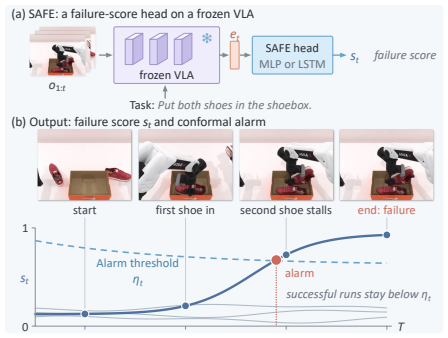
Fig. 3 . SAFE [34], a representative Outcome model. (a) A light head on a frozen VLA maps its featurese t to a running failure scores t. (b)s t rises as the second shoe stalls and crosses the conformal thresholdη t, which raises the alarm before the execution fails.
Original paper · CC BY 4.0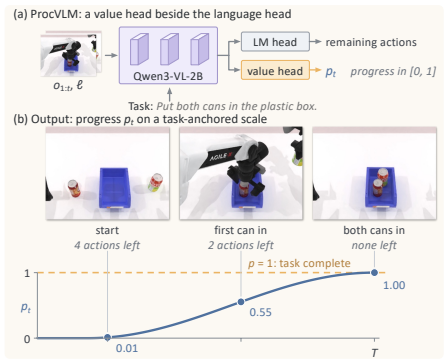
Fig. 4 . ProcVLM [56], a representative Absolute Progress model. (a) Given observationso 1:t and instructionℓ, the language-model head first generates the remaining actions, and the value head then reads this generated procedure to output progressp t ∈[0,1]. (b)p t rises as fewer actions remain and reaches the anchorp= 1when both cans are in the box.
Original paper · CC BY 4.0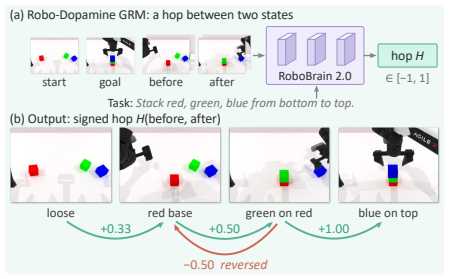
Fig. 5 . The Robo-Dopamine GRM [9], a representative Relative model. (a) Given start and goal states, the GRM compares a before and an after state and returns a signed hopH∈[−1,1]. (b) Hops are scaled to the distance that remains or to the progress made, so chained hops keep progress in[0,1]; removing the green block gives−0.50.
Original paper · CC BY 4.0Quote from the paper
Guoqiang Liang, Yiqi Lin, Shangchen Zhou, Wenzheng Zeng, Yanzhe Chen, Zechen Bai, Mike Zheng Shou (2026). Robotic Reward Models in the Foundation-Model Era. arXiv:2611.20741v1. https://arxiv.org/abs/2611.20741v1
BibTeX
@misc{liang2026robotic,
  title = {{Robotic Reward Models in the Foundation-Model Era}},
  author = {Guoqiang Liang and Yiqi Lin and Shangchen Zhou and Wenzheng Zeng and Yanzhe Chen and Zechen Bai and Mike Zheng Shou},
  year = {2026},
  eprint = {2611.20741},
  archivePrefix = {arXiv},
  url = {https://arxiv.org/abs/2611.20741v1}
}