Paper commentary
How Much of Your VLA Is kNN
Nearest-neighbor lookup of demonstrations matches many VLAs on LIBERO
- Problem VLAs now score above 95 percent on LIBERO, but it is unclear how much of that needs generalization beyond the training demonstrations. A high score alone does not show that a policy goes past what it was shown.
- Method The k-NN policy stores each demonstration frame with its following action chunk. At run time it blends the chunks of the nearest entries, using at most one entry per demonstration, so no training is needed.
- Results The multimodal k-NN variant reaches 91.7 percent success on LIBERO without policy training. Under LIBERO-Plus perturbations it has the smallest drop of all evaluated policies, 9.3 points.
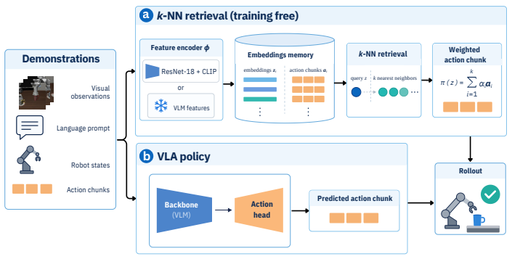
Figure 1 : Overview of our evaluation pipeline. Both are evaluated with the same rollout protocol. (a) ak-NN retrieves neighboring demonstration embeddings and combines their associated action chunks; (b) the VLA predicts an action chunk directly through its backbone and action head.
Original paper · CC BY 4.0 · Denis Grachev, Damien LaRocque, Omar Moured · How Much of Your VLA Is kNN · Original paper figure · Extracted the figure area from page 2 of the original PDF.Why a near-saturated benchmark is hard to read
Several recent VLAs report success rates around or above 97 % on LIBERO, so further gains are hard to read as better generalization. LIBERO has 130 language-conditioned Franka tasks spread across five suites, and each task comes with 50 demonstrations. VLAs are usually fine-tuned on these demonstrations and tested from a fixed set of initial states, so a high score doesn't by itself show that a policy goes beyond the demonstrations.
Perturbation studies complicate that reading. LIBERO-Plus reports that models above 95 % on standard LIBERO can fall sharply under controlled changes to viewpoint, robot state, language, appearance and layout. The question the authors ask is how much of that success a plain lookup over the demonstrations can already explain.
A lookup over demonstrations as the policy
The core idea is to skip policy training and treat the demonstrations as a memory. Each demonstration frame is stored with the action chunk that follows it, and at run time the current observation is matched against that memory. The point is to measure how far such a lookup gets without learning an action policy.
Each entry stores an observation, the action chunk of horizon H that starts at that frame, and the index of its source trajectory. The distance between a query q and an entry i is a weighted sum of per-modality distances, \( d(q, i) = \sum_r \frac{w_r}{s_r} d_r(q, i) \). Here w_r sets how much a modality counts and s_r rescales it, so modalities with different numerical ranges can be combined.
The policy keeps the k nearest entries but at most one entry from each demonstration, so a single trajectory can't dominate the prediction. Closer neighbors get larger weights through a softmax over negative distances, \( \alpha_i = \exp(-d(q,i)/\tau) / \sum_{j} \exp(-d(q,j)/\tau) \), where τ is the temperature. The predicted chunk is the weighted sum of the neighbors' action chunks, \( \pi(q) = \sum_i \alpha_i a_{t_i:t_i+H} \).
Because the weights sum to one, the output is a blend of the stored chunks rather than a new action.
Judging a retrieval key without rollouts
LAC asks whether frames that look alike in a representation also lead to similar future action chunks. For a held-out query q, LAC@k compares the action distances to its k nearest neighbors with those to all same-task memory entries. The numerator averages the squared action distance over the k nearest neighbors, and the denominator averages it over the same-task set C(q).
LAC@k subtracts that ratio from 1, so a value near 1 means the neighbors act much more alike than a typical same-task match. Figure 2 illustrates the ratio with LAC values of about 0.9 for one retrieval example and about 0.1 for another. The authors report LAC@8, which uses eight neighbors, averaged over held-out queries.
LAC is designed as an offline metric, so it scores a retrieval representation without running any rollouts. Excluding the fine-tuned VLM backbones, LAC tracks closed-loop retrieval success with a Pearson r of 0.78. Its Spearman ρ of 0.61 is weaker, so LAC doesn't reliably rank keys of similar quality. Appendix E's Fig. 10 plots LAC against closed-loop success for each key, which is where this comparison appears.
The fine-tuned π0 backbone gets an LAC of 0.55, against 0.76 to 0.88 for all other keys, so the score flags that degraded representation.
The authors train a linear projection of the standardized ResNet features with a differentiable surrogate of LAC. This projection lifts the plain k-NN lookup from 88.7 % to 93.0 % on LIBERO. On LIBERO-Plus, the LAC key scores 81.7 %, just below the multimodal variant's 82.4 %.
How the k-NN policy compares with nine VLAs
The k-NN policy is a training-free lookup, so the question is whether it holds up against the VLAs on LIBERO and under LIBERO-Plus. The ResNet variant encodes each camera view with a frozen ImageNet-pretrained ResNet-18, using a 4×4 spatial feature grid from layer 3. Its retrieval distance uses only the image features and is restricted to demonstrations of the instructed task.
The multimodal variant instead retrieves from all demonstrations with the full distance, which adds robot state, language, episode time and observation history.
On LIBERO, the multimodal variant reaches 91.7 % and the ResNet variant 88.7 %, while the LAC key variant reaches 93.0 %. The authors read this as retrieval from demonstrations alone recovering a large share of the benchmark score without learning a control policy. Although π0.5 scores highest on both benchmarks, the k-NN policies match π0-FAST on LIBERO and beat SmolVLA and π0.
On LIBERO-Plus, the multimodal variant scores 82.4 % and the LAC key variant 81.7 %, against 75.5 % for the ResNet variant. Under perturbation, the multimodal variant beats 7 of the 9 VLAs and has the smallest drop of all evaluated policies, 9.3 %pt.
The 420 LIBERO-Plus variants hold 60 variants per perturbation category, and they are shared across all policies and kept out of training and tuning. VLA-JEPA, Evo-1 and X-VLA exceed 94 % on LIBERO, yet their LIBERO-Plus success falls below that of the training-free ResNet variant. Strong LIBERO scores don't carry over to these perturbations.
The paper evaluates each public checkpoint as released, so these numbers reflect those checkpoints rather than the original publications.
Which parts of the k-NN policy carry the score
The authors ablate the multimodal k-NN variant one component at a time, starting from its 91.7 % LIBERO success. Each ablation changes a single element, so the size of the drop shows how much that element contributes. Cutting the demonstration memory to 10 % pulls success down from 91.7 % to 77.4 %. Replacing the image features with raw pixels lowers success to 57.2 %.
The multimodal variant uses k = 13 neighbors, drawn from all demonstrations under the full distance. Retrieval also keeps at most one entry per demonstration, so a single trajectory can't dominate the neighbor set.
The remaining refinements contribute less, according to the authors. Full ablations and hyperparameter studies sit in Appendix A, which this section doesn't reproduce.
Does fine-tuning make the backbone a better key?
To test the backbones, the authors swap the ResNet-18 features for the hidden states of image tokens from one VLM layer. These hidden states are pooled to a 2×2 grid per camera and standardized per dimension. The chosen layer maximizes the R² of the lookup's action predictions on held-out demonstrations. This design keeps the comparison fair, because the lookup itself stays identical and only the key changes.
Table 2 reports the lookup success for each VLA's backbone before and after LIBERO fine-tuning, next to the full VLA. On LIBERO-Plus, it improves for 7 of the 8 fine-tuned VLAs, by 5 to 37 points. GR00T freezes its VLM, so its before and after values are identical. For these VLAs the drop from LIBERO to LIBERO-Plus also shrinks, from 20.9 to 34.7 points before fine-tuning to 10.4 to 21.0 points after.
The exception is π0, whose retrieval falls from 86.9 % to 17.9 % on LIBERO after fine-tuning. So fine-tuning usually helps the key, but it can also break it.
For some models, the fine-tuned backbone alone beats the full VLA. This happens for 2 of 9 models on LIBERO and for 4 of 9 on LIBERO-Plus, by up to 48 points. The authors read this as the action head not exploiting all the action-relevant information held in the backbone. The t-SNE maps in Fig. 3 add a geometric view of the same change. After fine-tuning, the Evo-1 keys form trajectories that follow task progress.
Across all backbones, the progress gap decreases for 7 of the 8 fine-tuned VLAs.
Local structure and action agreement
Fine-tuning changes how same-task frames cluster in the retrieval keys, and the t-SNE maps show this for four VLAs and ResNet-18. All maps use the same 4,150 demonstration frames from LIBERO, so the keys can be compared directly. The median progress gap to the nearest same-task frame from another demonstration falls from 0.031 to 0.022 for Evo-1.
Across all backbones, this gap decreases for 7 of the 8 fine-tuned VLAs, while the change stays small for π0.5 and MolmoAct2.
Its nearest neighbors still come from the same task, but its progress gap grows from 0.028 to 0.052. The authors link this gap increase to the collapse of π0's retrieval performance.
The action-space analysis asks whether VLA actions stay close to the demonstrations during LIBERO rollouts. Each VLA's action chunk is compared with the ResNet k-NN prediction, which is the weighted mean of the chunks of its k = 8 nearest same-task demonstration frames. Held-out ground-truth chunks reach R² = 0.78 against this prediction.
The median squared error to the nearest training chunk is 0.62 to 0.99 times the ground-truth reference.
GR00T N1.7 is evaluated on LIBERO-Spatial only, and X-VLA is excluded because it predicts absolute poses. The conclusion covers LIBERO only, so it doesn't establish the same closeness on other benchmarks.
Limits of the retrieval-based conclusions
The conclusions are confined to LIBERO and related benchmarks, which the authors flag as a limit on what the results show. Sparser demonstrations are one of the settings the authors list as future work.
LIBERO-Plus perturbations largely keep the underlying task and solution trajectories intact.
Retrieval can't extrapolate beyond the support of its memory, which is the central boundary of the k-NN approach. Because of this, the strong LIBERO performance of k-NN policies shouldn't be read as evidence that they generalize broadly across robotic problems. The authors didn't test novel object placements or behavior outside the demonstrated support; they list these as future work.
Paper info
- Authors
- Denis Grachev, Damien LaRocque, Omar Moured
- Venue
- arXiv · Preprint
- First published
- 2026-11-9
- Added
- 2026-11-11
- Updated
- 2026-11-9
- Version
- v1
- arXiv
- 2611.13160
- Category
- cs.RO · cs.AI · cs.LG
- Original paper terms
- CC BY 4.0
- What we show
- Paper info, commentary and permitted figures from the original paper
AI commentary is a separate explanation from the original paper and may contain errors. The original paper and figures follow each source's terms of use and any rights noted separately.
Abstract
Vision-language-action (VLA) models now exceed 95% success on the LIBERO simulation benchmark, yet it remains unclear how much of this performance requires generalization beyond the training demonstrations. In this work, we show that retrieving nearby demonstrations and reusing their action chunks achieves a success rate of 91.7 % on LIBERO without policy training. Under LIBERO-Plus perturbations, retrieval shows the smallest drop of all evaluated policies. Across nine publicly available VLAs, fine-tuning mostly makes the vision-language backbone a better retrieval key, and the actions of the VLAs remain close to the demonstrations. In addition, we introduce Local Action Consistency (LAC), an offline metric that measures whether nearby observations in representation space are also associated with similar future actions. We show that LAC tracks the success rate of retrieval and can guide the training of a retrieval key. Our evaluation and source code are available at https://github.com/sereact/lerobot_knn.
Figures from the paper
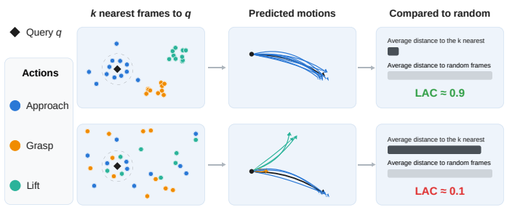
Figure 2 : Local Action Consistency (LAC) is the ratio between the average action distance of the retrievedknearest neighbors and the average action distance over the same-task set.
Original paper · CC BY 4.0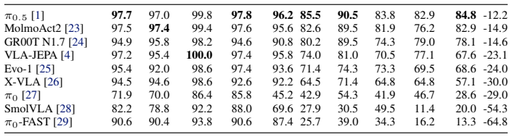
Table 1 : Success rate (%) on LIBERO (official protocol, 2000 episodes) and on the same 420 LIBERO-Plus variants. VLAs are ordered by average on LIBERO-Plus.∆is the difference be- tween the average success rates on LIBERO-Plus and LIBERO, computed before rounding. The k-NN rows are training-free, except for the LAC key.
Original paper · CC BY 4.0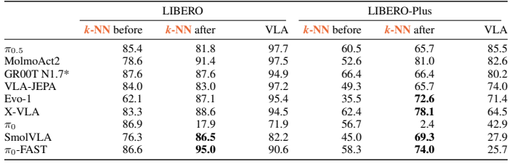
Table 2 : Lookup success using each VLA’s VLM backbone before and after LIBERO fine-tuning, compared with the full VLA.Boldindicates cases where retrieval on the fine-tuned backbone out- performs the corresponding VLA. ∗GR00T freezes its VLM, so before=after.
Original paper · CC BY 4.0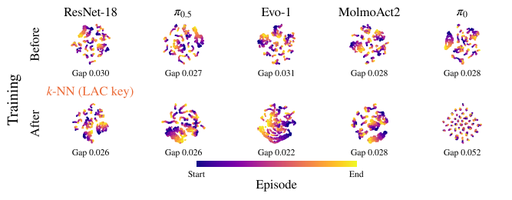
Figure 3 : t-SNE maps of retrieval keys for the same 4,150 demonstration frames from LIBERO. Top: before LIBERO fine-tuning (ImageNet ResNet-18 for the first column). Bottom: after fine- tuning (LAC-trained key for the first column). Colors indicate normalized episode progress. Below each map: median progress gap to the nearest frame from another demonstration of the same task.
Original paper · CC BY 4.0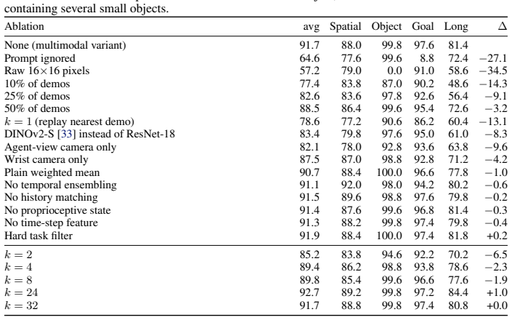
Table 4 : Evaluated VLA checkpoints, hosted on the Hugging Face Hub. Revisions are abbreviated commit hashes. GR00T N1.7 uses one checkpoint per LIBERO suite. Model Repository Revision
Original paper · CC BY 4.0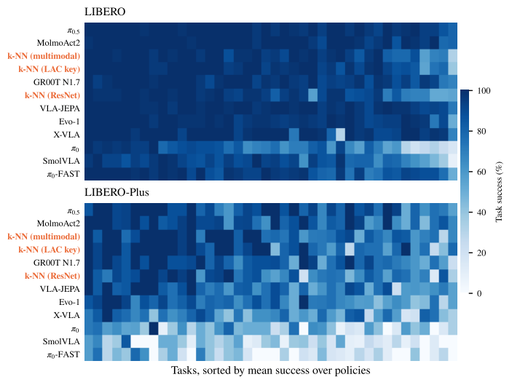
Figure 6 : Success of every policy on each of the 40 tasks, tasks sorted from easiest to hardest (mean over policies).
Original paper · CC BY 4.0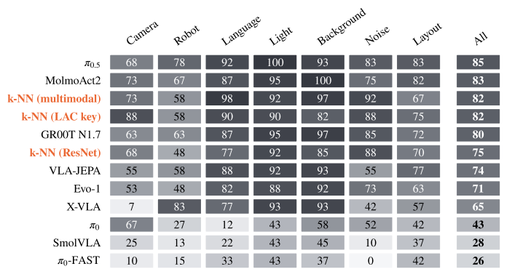
Figure 7 : Success rate(%)of each policy on LIBERO-Plus tasks, per type of perturbation.
Original paper · CC BY 4.0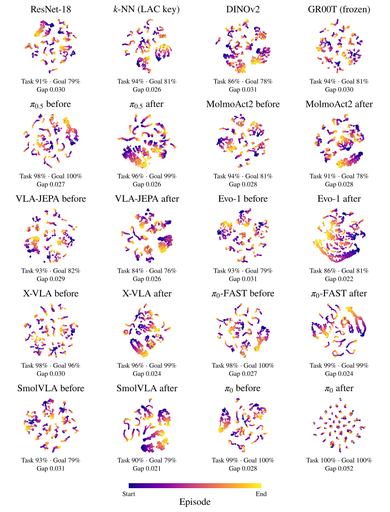
Figure 8 : t-SNE visualization of each retrieval space, colored by progress through the episode. Below each map: Task, the fraction of nearest neighbors from another demonstration that belong to the same task; Goal, the same fraction within LIBERO-Goal; Gap, the median progress difference to the nearest frame from another demonstration of the same task. GR00T freezes its VLM, so its representation is unchanged by policy fine-tuning.
Original paper · CC BY 4.0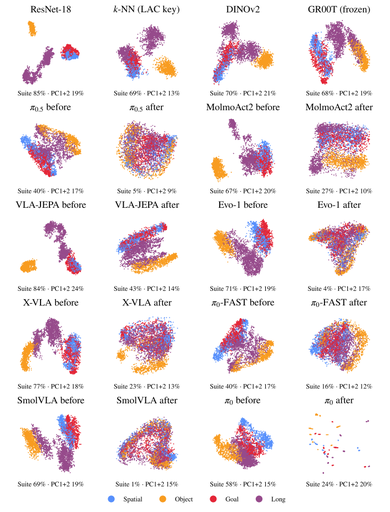
Figure 9 : First two principal components of each retrieval key, colored by LIBERO suite. Below each map: Suite, the fraction of the variance of the two components explained by the suite; PC1+2, the fraction of the total variance captured by the two components.
Original paper · CC BY 4.0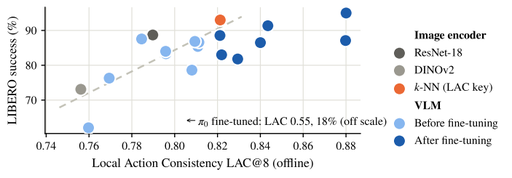
Figure 10 : Offline LAC versus closed-loop retrieval success. Each point is a visual representation used as the key of theResNet k-NN variant. The x-axis reportsLAC@8on held-out demonstrations, and the y-axis the LIBERO success rate. The dashed line is fitted on all keys except the fine-tuned VLM backbones, which were trained on the held-out demonstrations.
Original paper · CC BY 4.0Quote from the paper
Denis Grachev, Damien LaRocque, Omar Moured (2026). How Much of Your VLA Is kNN. arXiv:2611.13160v1. https://arxiv.org/abs/2611.13160v1
BibTeX
@misc{grachev2026much,
  title = {{How Much of Your VLA Is kNN}},
  author = {Denis Grachev and Damien LaRocque and Omar Moured},
  year = {2026},
  eprint = {2611.13160},
  archivePrefix = {arXiv},
  url = {https://arxiv.org/abs/2611.13160v1}
}