Paper commentary
Visible Tails: Characterizing Adaptation to Unknown Moments in Heavy-Tailed Bandits
Visibility condition lets heavy-tailed bandits adapt to unknown moments at constant cost
- Problem Bandit learners without moment parameters cannot tell a poor arm from one whose big rewards have not yet appeared. Adapting to unknown moments at constant cost was an open problem.
- Method The authors add a variance-core visibility condition, which bounds hidden mean by the spread still seen. They build VT-UCB, a quantile-trimmed UCB index that knows the visibility constants.
- Results The authors show a class of optimal-arm laws admits free adaptation exactly when it fits inside one visibility class. VT-UCB gets logarithmic regret whenever the optimal arm is visible and rewards have finite mean.
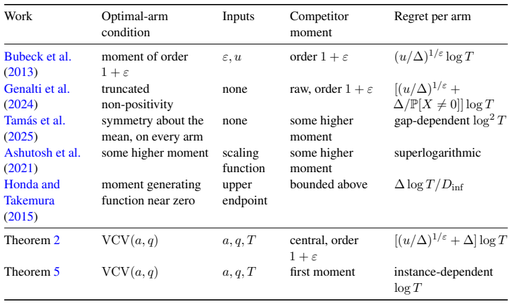
Table 1 : Expected-regret guarantees for heavy-tailed stochastic bandits, organized by the
Original paper · CC BY 4.0 · Tuan Ngoc Do, Hai Duc Nguyen · Visible Tails: Characterizing Adaptation to Unknown Moments in Heavy-Tailed Bandits · Original paper figure · Extracted the figure area from page 4 of the original PDF.Where adaptation gets stuck
A learner can't tell a poor arm from a hidden-upside arm because the rewards that carry the mean may not have appeared yet. Those parameters are the moment order 1+ε and the moment bound u, and the learner needs both to set the index width.
Symmetry supports a second adaptive guarantee, due to Tamás et al. (2025). These two assumptions are incomparable and both exclude Pareto rewards, so Genalti and Metelli (2025) posed an open problem: find one assumption covering every law where adaptation costs nothing extra.
Formally, a law has variance-core visibility, VCV(a, q), when the centered mean omitted by any reward set E of omitted probability 0 < p ≤ q is bounded by a √p v_E.
Visibility as the condition on the optimal arm
The key idea is to ask whether the mean hidden in any rare omitted event stays within a constant multiple of the spread the learner still sees. A reward set E leaves out probability p, and bE is the centered mean that E omits. The quantity vE equals (1-p) Var[X|E], which measures the spread of the retained rewards. A law is in VCV(a, q) when bE is at most a times the square root of p vE, for every set with 0 < p ≤ q.
The condition is a bias-variance balance: the unseen mean must be small compared with the standard error of the retained sample.
The same quantity vE governs both directions of the proof. The variance of that competitor is exactly what the benchmark charges, so the upper and lower bounds share one quantity.
Theorem 2 states that a class D containing all point masses admits free adaptation to RcenT exactly when D is contained in some VCV(a, q). The raw-moment analogue in Proposition 4 uses threshold visibility at the origin, and that class contains every truncated non-positive law.
A Bernoulli(p) law with p at most q lies outside VCV(a, q) for every a. The reason is that a deterministic competitor is charged its exploration allowance alone, so no finite a can cover it.
How VT-UCB builds its index
The trimming count is set to ℓ equal to the ceiling of 24 log T, so the trimming grows only logarithmically with the horizon. The pilot size is m equal to 2 times the ceiling of 16 log T plus 1, and the warm-up n0 equals the ceiling of 2ℓ divided by q. The warm-up keeps 2r at or below q, so the trimmed fraction stays inside the range that visibility covers.
Each arm is pulled m times, and those pilot observations serve only to form its median Zi, so the pilot never mixes with the index data.
Fresh observations then decide the index: at fresh sample size n, the set Si keeps the n minus ℓ observations with smallest distance to Zi. Ties are broken by observation index, which keeps the selected set deterministic. The trimmed mean averages the retained observations, and the retained second moment is their mean squared deviation from Zi.
The width combines the retained variance and the largest retained deviation, as the square root of 2 times the retained variance times ℓ over n, plus 9ℓ times the largest deviation over n. Centered VT-UCB pulls the arm maximizing Ui equal to the trimmed mean plus 3(1 + a) times the width, with fixed arm order breaking ties.
The term 3 times the width covers sampling error, while the term 3a times the width covers the mean removed by trimming. Visibility bounds that removed mean by a multiple of the width, which is why the index can stay optimistic.
This event fails with probability at most 7K over T cubed across all arms and sample sizes.
The frontier and the cost of unknown visibility
Theorem 2 says a class of optimal-arm laws admits free adaptation to the centered benchmark exactly when it sits inside some VCV(a, q), provided the class contains every point mass. Sufficiency is constructive, because VT-UCB attains the explicit constant C_K = 25[200(1+a)]^((1+ε0)/ε0) + 37 + 50/q + 8K. The algorithm takes the inputs (a, q) and the horizon, so it needs the visibility constants in advance.
The proof of necessity runs through a conditioning argument: the conditioned law and the original law differ in one arm, at KL divergence d = -log(1-p) per pull.
Corollary 3 shows that a uniform guarantee needs the visibility level as prior knowledge. Any strategy adapting over VCV_ε0(a, q) has two-arm constant C at least 1 - log(1-q), which is at least 12q. Because of this bound, the 50/q term in C_K has the right order in q. So no single strategy adapts over the union of all visibility classes, since that union is not covered by any one (a, q).
The lower bound in Corollary 3 comes from a proof that uses the class of laws with an omitted atom at zero, where the conditional mean is negative.
The raw-moment version in Proposition 4 replaces the variance core by threshold visibility at the origin. Its two-arm constant permits the same pair (c, q) = (√(128C), min{1/2, 1/(4C)}) as the centered case. The raw VT-UCB constant is C°_K = 25[40(1+c)]^((1+ε0)/ε0) + 2 + 50/q + K, with raw inputs (c, q) in place of (a, q).
A two-point family Π_p separates raw adaptation from centered adaptation. At thresholds between its atoms, Π_p lies in VT(1, 1/2) uniformly, so raw visibility holds. Retaining only the lower atom gives v_E = 0 and b_E = 1-p > 0, which breaks the centered condition for every uniform (a, q). VT-UCB's pilot median Z_i gives the trimming center, and the pilot size m is set by log T.
Logarithmic regret from a first moment
VT-UCB reaches logarithmic regret when every arm has only a finite first moment, provided the optimal arm is visible. The index is Ui = bµi + 3(1 +a)bwi, and the term 3bwi covers sampling error while 3abwi covers the mean removed by trimming. Raw VT-UCB drops the pilot stage, fixes every Zi at zero, and uses the raw inputs (c, q) in place of (a, q).
Theorem 5 bounds the regret contribution of a suboptimal arm with a central moment of order 1 +ε by its own pair (ε, u). The bound takes the infimum over all admissible 0 < ε ≤ 1 and u > 0, so the arm-wise guarantee needs no common exponent floor. The optimal arm needs no higher moment, only visibility. The concentration event fails with probability at most 7K/T^3 across all arms and sample sizes.
Population quantiles M− and M+ bracket the empirical threshold, Bν measures how far trimming can inflate the estimated mean, and Wν bounds the width. Binomial bounds place the empirical threshold between M−(r) and M+(r), and Bernstein bounds at M− and M+ control optimism and competitors.
Corollary 6 gives a sharper rate for polynomial tails: if P[|X−µi| > t] ≤ A_i t^(−α_i) with 1 < α_i < 2, the regret exponent is −1/(α_i − 1). The parameters A_i and α_i stay unknown to the learner, and the bound covers Pareto endpoints with infinite α_i-th moment. The exponential gap law in the next section shows that the coefficient of this logarithmic rate can still grow quickly in the inverse gap.
An exponential gap law: how large the coefficient gets inside one visibility class
The authors build an explicit law with A=e/10 to show how large the coefficient must be inside one visibility class. The optimal arm's law is P_Δ = L(x_Δ − ξ) with x_Δ = 2A − Δ, while the second arm has mean −Δ. The variable ξ puts mass 9/10 at zero and has survival probability A/[y(log y)^2] for y ≥ e, so E[ξ] = 2A but E[ξ^{1+ε}] = ∞ for every ε > 0.
Both arms lie in the fixed class VCV(0,1/4), so the difficulty lies entirely inside one visibility class.
Theorem 7 bounds the lim sup of regret over log T from above by C_0 Δ^{−1} e^{A/Δ} for centered VT-UCB with (a, q) = (0, 1/4). The converse rests on the maximizer of f(λ) = E_{P_Δ}[log(1 − λX)], so d_Δ = f(λ_Δ) is the information each pull carries.
The upper prefactor is 48Ae^{κ+1} and the lower prefactor is Ae, with κ = 133 + 18√2. The learner's resolution point A/Δ + κ + 1 and the converse's A/Δ + 1 differ only by a constant, which exponentiates into the gap.
All of these laws stay in the single class VCV(0,1/4), so the coefficient grows within one visibility class. The Pareto and symmetric examples of Section 6 do not enter this construction, which keeps the atom at zero as the only hidden mass.
Translation experiment: centered versus raw VT-UCB under a common shift
The translation check asks whether centering keeps regret constant when every reward is shifted by the same amount. Figure 2 and Table 2 compare raw VT-UCB with centered VT-UCB on N(3+h,1) and N(2.7+h,1) at T=20,000. Both methods use (a, q) = (√(3/2), 1/4), so the only change between them is the centering step.
Centering reserves 319 pilot observations per arm, which the centered learner uses to estimate each arm's center. The practical setting uses ℓ=20 and 160 fresh observations, and the paper says it lies outside the range of the theorem.
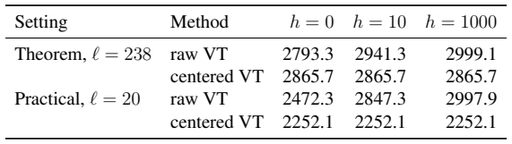
Table 2 : Mean pseudo-regret over 200 replications at T= 20,000 . The largest 95 percent
Original paper · CC BY 4.0Under theorem tuning, raw VT-UCB scores 2793.3 at zero shift, 2941.3 at shift 10, and 2999.1 at shift 1000. Centered VT-UCB stays at 2865.7 for every shift, so its regret does not move with the common reward offset. Raw VT-UCB has the lower regret at zero shift, 2793.3 against 2865.7, but its regret rises as the shift grows.
Under practical tuning with ℓ=20, raw VT-UCB rises from 2472.3 at zero shift to 2847.3 at shift 10 and 2997.9 at shift 1000. Centered VT-UCB stays at 2252.1 for all three shifts in the same setting.
Limitations and open questions
The gap-law limit is stated as a lim sup with universal constants C0 and Δ0 that the excerpt never gives numerically. The prefactors 48Aeκ+1 and Ae differ from each other, so the upper and lower bounds match only in order, not in constant. The paper also doesn't measure this ratio on any simulation, so the gap between the two constants stays a proof artifact.
The translation runs stay in the pre-logarithmic regime, where certified widths exceed the gap, so they can't measure the logarithmic rate. The experiment uses one pair of Gaussian arms at horizon 20,000, so it doesn't test the gap law or the heavy-tailed classes. The practical setting with ℓ = 20 is uncertified, so its numbers don't carry the theorem's guarantee.
The paper doesn't test unknown visibility levels, which it lists among its open questions.
The Pareto visibility constants are law dependent, because the threshold depends on the slowly varying factor of the tail. The worked Pareto constants at α = 3/2 come from one scale and one parameter choice, so they don't yield a universal bound. The uniform inputs (34√2, 1/2313) for α in [3/2, 2) cover a range of exponents, but the paper doesn't tighten them.
Paper info
- Authors
- Tuan Ngoc Do, Hai Duc Nguyen
- Venue
- arXiv · Preprint
- First published
- 2026-11-9
- Added
- 2026-11-10
- Updated
- 2026-11-9
- Version
- v1
- arXiv
- 2611.12140
- Category
- cs.LG · cs.AI
- Original paper terms
- CC BY 4.0
- What we show
- Paper info, commentary and permitted figures from the original paper
AI commentary is a separate explanation from the original paper and may contain errors. The original paper and figures follow each source's terms of use and any rights noted separately.
Abstract
Heavy-tailed bandit learners without moment parameters face an obstruction: the rewards that carry an arm's mean can stay unseen. We address the remaining part of a COLT open problem by characterizing the optimal-arm laws that permit adaptation to unknown moments at constant-factor cost. The condition, variance-core visibility, is one-sided and translation-invariant: the mean hidden in any rare event is at most a constant multiple of the standard error of the rewards that remain. A quantile-trimmed UCB index that knows the visibility constants attains the central-moment benchmark on this class, and no single strategy adapts across all visibility levels. The same index achieves logarithmic expected regret on every instance with a visible optimal arm and finite-mean rewards. On an explicit family with no higher moment, gap $Δ$ and constant $A$, its logarithmic coefficient and the information lower bound are of order $Δ^{-1}e^{A/Δ}$, exponential in the inverse gap within one visibility class.
Quote from the paper
Tuan Ngoc Do, Hai Duc Nguyen (2026). Visible Tails: Characterizing Adaptation to Unknown Moments in Heavy-Tailed Bandits. arXiv:2611.12140v1. https://arxiv.org/abs/2611.12140v1
BibTeX
@misc{do2026visible,
  title = {{Visible Tails: Characterizing Adaptation to Unknown Moments in Heavy-Tailed Bandits}},
  author = {Tuan Ngoc Do and Hai Duc Nguyen},
  year = {2026},
  eprint = {2611.12140},
  archivePrefix = {arXiv},
  url = {https://arxiv.org/abs/2611.12140v1}
}