Paper commentary
Moving Generality from Model to Modeler: LLM Agents for PHM on a Deployment-Style Benchmark
LLM agents that build PHM predictors generalize better than AutoML and published methods
- Problem Fixed-split PHM benchmarks don't show whether a predictor works on machines it has never seen. Reported accuracies also depend on each paper's own evaluation conventions, such as capped remaining-life labels.
- Method NextUnit-Bench tests the builder instead of a fixed model. Coding agents develop predictors on labelled units within two hours, then their sealed programs are scored on hidden units.
- Results The strongest frontier agent scored 43.0, against 11.6 for AutoGluon and 13.5 for FLAML. The ranking held across complete re-runs.
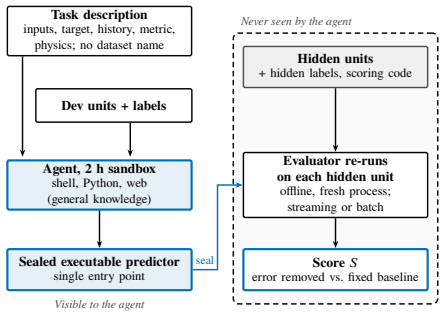
Fig. 1 . Deployment-style evaluation. The agent sees the task description and the development units, works for two hours in a sandbox, and delivers a sealed, executable predictor. The evaluator runs it offline on each hidden unit; the hidden units, their labels, the scoring code, and the score itself remain invisible to the agent.
Original paper · CC BY 4.0 · Zhenling Chen, Zhiguo Zeng, Anne Barros · Moving Generality from Model to Modeler: LLM Agents for PHM on a Deployment-Style Benchmark · Original paper figure · Extracted the figure area from page 3 of the original PDF.Why fixed splits miss the deployment question
A PHM model only proves its worth once it meets a machine nobody tested it on, such as the next bearing or an engine that hasn't failed yet. Evaluation conventions also shift reported numbers, since C-MAPSS remaining-life results are customarily reported against capped labels.
To test this, they run agents on 24 public PHM datasets and compare them with faithful implementations of published methods and with AutoML.
How the deployment-style benchmark runs
The key idea is to test the builder instead of a fixed model: the agent develops on labelled units, and the evaluator scores its sealed program on units it has never seen. The agent gets a task description covering inputs, target, history, metric and physical information, but not the dataset name, together with development units that carry labels.
It has two hours of wall-clock time, may use the internet for general knowledge, and must deliver a predictor with a single entry point.
Each dataset is split by physical unit, so that every test unit stays out of development, and the 24 datasets yield 58 folds. For datasets without independent units, such as CWRU, SEU or the UCI hydraulic rig, the held-out part is whole operating conditions instead. Official splits are kept where they exist.
The score \( S = 100 \max(0, 1-E/B) \) gives the share of the baseline's loss that a method removes, with E the method's loss and B the baseline's loss. A failure scores zero, and a constant prediction scores 3.9, so S is best read as a comparison between methods. Scores are averaged over the folds of each dataset, then over the 24 datasets with equal weight.
Frontier agents against AutoML
Frontier agents cut the baseline's error by roughly a third to almost half. GPT-6 Astra led with a score of 43.0, compared to 30.8 for GPT-6 Luna, the weakest of the four frontier agents. The ranking held across complete re-runs under identical conditions, where no agent's average moved by more than 1.2 points. Dropping the datasets with a shortcut, or keeping only those with independent units, leaves the order unchanged.
AutoGluon and FLAML, given the baseline's inputs and a two-hour search target, reached 11.6 and 13.5. Adding a bank of generic signal features lifted both to 18.7, and AutoGluon overran the two-hour target in nearly every fit. Generic features close the gap on easy problems, taking CWRU above 90, but not on the hydraulic rig, the IMS bearings, Paderborn or SEU, where AutoML stays below 15.
The authors read the difference as judgment about the machine at hand, not as a better search.
The authors also tried general time-series foundation models, MOMENT and Chronos-2, fine-tuned on every fold with one fixed pipeline. The authors note that tuning each model to its dataset might lift them, but that tuning is the work of a modeler.
Published methods under two protocols
The authors had the same agent implement 20 published methods on four datasets, once under each paper's protocol and once under deployment. An LLM judge rated all 30 implementations as faithful, yet only 6 of them beat the agent's own design on the same fold. On average the published methods fell short on C-MAPSS, N-CMAPSS and Paderborn, and drew level on Tennessee Eastman.
C-MAPSS papers cap a test engine's remaining life at 125 cycles before computing the error, while the benchmark scores each engine at its last observed cycle. Under that cap, three of four implementations came close to the published errors, at 13.7 to 18.7 cycles.
The authors could not obtain the papers' own splits, so the reading itself remains unchecked.
Where the advantage sits: in a plan, not in the code
The key idea is that the advantage is a design fitted to one machine's data, so the authors wrote it down as a plan with no code and no fitted numbers. A plan has seven short sections, stays within 900 Chinese characters, about 500 English words, and is written by a separate Astra session from the delivered code. A second agent implements that plan read-only, without knowing whose plan it is.
The authors cross the strongest and the weakest frontier agents in both directions, so plans move across the widest gap.
Given Luna's plans, Astra falls to Luna's level, often to identical predictions. Astra with no plan in the same harness scored 44.2, compared to 43.0 in its main run.
Plans made without seeing the data added only about a point and a half over Luna's own work, while plans written on the data added 6 to 13 points. Lightened plans, stripped of neural networks and heavy packages, gave Astra 42.6, compared to 44.2 with no plan. Only 6 of Astra's 58 original designs used a neural network at all.
Why local agents can't use the same plans
Local models are where PHM agents would matter most, but Qwen3.6-35B-A3B scored 14.3 in its main run and failed on 17 of 58 runs, mostly by running out of time. Gemma 4 delivered on 56 of 58 runs, but its predictors were weak, with a score of 16.5. Both local models sit far below the weakest frontier agent, whose score is 30.8.
Handed Astra's plans, Qwen delivered a working predictor on 32% of runs, compared to 57% without a plan. Its score fell from 12.6, the mean of its four plan-free runs, to 9.3. Plan load mattered more than authorship: Astra's plans sat in the heaviest third, 64 of 116, compared to 12 of Luna's. In that heaviest third Qwen delivered on only one run in five, and even the lightened plans left it at 31% with a score of 9.6.
Where Qwen did deliver, its scores differed by about one point with and without Astra's plans. They offer a lens, not a proof: \( \bar{S} = \Phi\left(\frac{\theta - c}{\sigma}\right) Q \), where θ is capability, c the design's demand, σ the shared spread, Φ the standard normal distribution function and Q what a completed design is worth.
Two runs of the same Qwen configuration differed by 7.5 points, more than any lever the authors pulled. Of 100 failed runs read in full, half were slow but progressing, and a third were stuck in loops over an empty output from the evaluator.
Limitations
Most configurations ran once; aggregate results held across complete re-runs, but single datasets did not. Faithfulness of the published-method implementations rests on a single LLM judge. The reasoning of two agents can't be inspected, so memorization of the public datasets can't be ruled out.
Plan transfer was tested only between GPT-6 Astra and GPT-6 Luna, not between frontier models from different developers. A new machine type with no labels at all, the cold start, remains open.
Paper info
- Authors
- Zhenling Chen, Zhiguo Zeng, Anne Barros
- Venue
- arXiv · Preprint
- First published
- 2026-11-18
- Added
- 2026-11-20
- Updated
- 2026-11-18
- Version
- v1
- arXiv
- 2611.25252
- Category
- cs.LG
- Original paper terms
- CC BY 4.0
- What we show
- Paper info, commentary and permitted figures from the original paper
AI commentary is a separate explanation from the original paper and may contain errors. The original paper and figures follow each source's terms of use and any rights noted separately.
Abstract
Coding agents built on large language models (LLMs) now help develop many models published as general solutions. Should generality instead reside in the agent that builds a model for each new task? We examine this question in prognostics and health management (PHM), where every model must work on unseen equipment. Our deployment-style benchmark, NextUnit-Bench, covers 24 public datasets split into 58 folds that hold out units or operating conditions; each agent has two hours to deliver an executable predictor, then run on the hidden units. First, frontier agents outperform AutoML, which reaches less than half the best agent's score, and faithful implementations of published methods on four datasets, of which only 6 of 30 beat the strongest agent's own design; published accuracies, where reproducible, rest on the papers' own conventions, and a single convention, capping the remaining life of test engines, can halve the reported error. Second, the agents' advantage is a design made on each machine's data; once made, a plain-text plan of a few hundred words carries most of the gap between two frontier agents, and given a weaker agent's plan, the strongest agent falls to that agent's level, often to identical predictions. Before touching the data, however, it matters little whose plan an agent carries out, and domain toolkits appear to help neither: what sets the strongest apart is how much it learns from the data. Third, such designs reach only implementers that can execute them: given the strongest agent's designs, a locally deployable open-weight model delivers half as often, even when they are lightened, and scores no higher than without them. Generality, we argue, is not disappearing but moving, from the model to the modeler.
Quote from the paper
Zhenling Chen, Zhiguo Zeng, Anne Barros (2026). Moving Generality from Model to Modeler: LLM Agents for PHM on a Deployment-Style Benchmark. arXiv:2611.25252v1. https://arxiv.org/abs/2611.25252v1
BibTeX
@misc{chen2026moving,
  title = {{Moving Generality from Model to Modeler: LLM Agents for PHM on a Deployment-Style Benchmark}},
  author = {Zhenling Chen and Zhiguo Zeng and Anne Barros},
  year = {2026},
  eprint = {2611.25252},
  archivePrefix = {arXiv},
  url = {https://arxiv.org/abs/2611.25252v1}
}