Paper commentary
Generalizable AI-Generated Image Detection with Embedding-Space Explanations
FOX locks a DINOv3 detector and explains its verdicts without changing it
- Problem Explainable detectors train classification and language generation together, so the language objective reshapes the visual features and can weaken the verdict. Fully re-synthesized images also leave no boundary to localize.
- Method FOX first trains a DINOv3 detector and then locks it. A joint-embedding predictor maps the locked visual evidence into a frozen text encoder's space, and a small VLM verbalizes that guidance into an explanation on demand.
- Results FOX scored 97.4 mean AUC across 14 unseen generators and 69.8 BERTScore on XPlainVerse, with the verdict fixed before explanation training.
Why bare verdicts and joint training fall short
A bare real-versus-fake score tells a journalist or moderator little, because they also need to know why an image was flagged. Even localization is hard: with no pasted patch or boundary to inspect, forensic localization of fully re-synthesized images is close to chance, and humans do little better. Existing detectors mostly rely on low-level generator traces or on semantic features from pretrained encoders, and they are usually validated in-domain.
Adapting a backbone on the detection data tends to memorize generator-specific fingerprints, which transfer poorly to new generators. Explainable MLLM detectors take another route: they fine-tune billions of parameters for a problem that is mostly about vision, and they show weaker detection. Training one multimodal model for both classification and language generation also exposes the visual representation to the language objective, so the two goals compete.
DINOv3 has recently generalized well across generators, which suggests a pure vision encoder may serve forensic perception better than a general MLLM vision tower. Yet explainable detection still couples authenticity prediction and explanation in one pipeline, even though the two run on different convergence timescales. That tension leads to the paper's question: can the strongest detector be fixed first and then used to help explain its verdict?
Lock the verdict, then explain it
FOX changes the order of training: it finishes and locks the detector first, then lets an explainer read the detector's representation. The VLM never decides authenticity; it only verbalizes an explanation from the input image, the fixed verdict, and detector-derived evidence. Stage 1 trains the X-Encoder LoRA and the Classifier with cross-entropy on authenticity labels alone, with no captions or explanation losses.
The authors borrow the Joint Embedding Predictive Architecture idea, which predicts the embedding of a target instead of reconstructing its exact tokens. For explanations, the predictor targets what the forensic evidence describes, so paraphrases with different wording stay near each other in the target space. The Y-Encoder is a frozen E5-large-v2 model, so its targets are fixed points that cannot drift toward the predictor.
This removes target co-collapse, where predictor and target encoder jointly converge to a constant. The Stage 2 InfoNCE term adds a further penalty on a constant predictor, because it contrasts each prediction against other explanations in the batch. The authors also argue that pretrained text embeddings are strongly anisotropic, so relative comparisons against in-batch negatives carry more signal than absolute similarity targets.
Because the verdict is part of the prompt, the decoder explains a decision that already exists rather than making one. The authors designed the split so that explanation training has no path to the detector's weights, which is why they expected the verdict to stay intact.
How the five components pass information
The X-Encoder is DINOv3 ViT-L/16 at 384×384 resolution, adapted through a rank-32 LoRA in its fused query-key-value projections. It reads the last four transformer blocks, and each block contributes its mean-pooled patch tokens, the [cls] token, and four register tokens. Those four block vectors stack into the features sx in R^(4×6144), which both the Classifier and the Predictor read.
The released DINOv3 weights stay frozen, and after Stage 1 the LoRA parameters are locked, so the same representation feeds both heads.
Its global-token output gives two authenticity logits, and the verdict is the larger one, with index 0 meaning real and index 1 meaning generated. The Predictor follows the same trunk shape with independently parameterized weights, so it doesn't share parameters with the Classifier. Its global-token output is projected to an L2-normalized vector ŝy in the semantic embedding space, and it is trained from scratch in Stage 2.
The Y-Encoder is a frozen E5-large-v2 model with 335M parameters, and it embeds both whole explanations and their sentences. Its embeddings are precomputed as training targets, so the Y-Encoder isn't loaded at inference. Normalization turns the slots into four query vectors q1 to q4, each with unit L2 norm.
The Y-Decoder is Qwen2.5-VL-3B-Instruct, with a frozen vision encoder and a rank-16 LoRA on its attention and MLP projections. A residual cross-attention adapter projects the decoder's visual tokens and the four queries to a shared width. Its output projection starts at zero, so the decoder behaves unchanged until adapter training begins.
At test time the verdict needs only one X-Encoder pass, with no language-model decoding, and the decoder verbalizes it on demand.
Three stages, each locked before the next
Training in FOX runs in three sequential stages, and each stage keeps the parameters that earlier stages produced fixed. Stage 1 jointly trains the X-Encoder LoRA and the Classifier with cross-entropy on authenticity labels alone. Stage 1 uses no captions, text encoders or explanation losses, so the verdict is shaped by the label signal only.
Checkpoints are selected by AUC on Chameleon, an external validation set disjoint from XPV training. The selected encoder and classifier are then locked, which fixes the verdict function for every later stage.
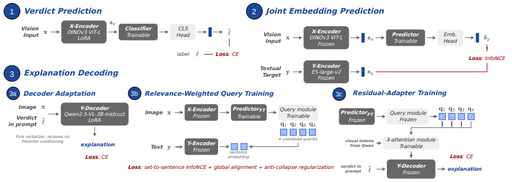
Figure 2 .Training of FOX.Detection and explanation are optimized separately. Stage 1 adapts theX-Encoderthrough LoRA jointly with theClassifierunder cross-entropy; Stage 2 trains thePredictorwith InfoNCE against the frozenY-Encoder. Stage 3 trains a LoRA on the decoder (3a), the query module together with thePredictor(3b), and the residual adapter (3c).
Original paper · CC BY 4.0 · Nikos Giakoumoglou, Paschalis Giakoumoglou, Tania Stathaki, Symeon Papadopoulos · Generalizable AI-Generated Image Detection with Embedding-Space Explanations · Original paper figure · Extracted the figure area from page 4 of the original PDF.Stage 2 trains the Predictor from scratch with the X-Encoder locked and the Y-Encoder frozen. The Predictor is trained with InfoNCE at temperature 0.05, aligning each predicted embedding with the target of its own explanation. The other explanations in the batch serve as negatives, so the loss is relative rather than absolute. Because the Y-Encoder is frozen, its targets cannot drift toward the Predictor, so the constant-collapse solution is unavailable.
The authors rely on prior work showing that pretrained text embeddings are anisotropic, so unrelated texts still reach high cosine similarity. Under that geometry, relative comparisons against in-batch negatives stay discriminative while absolute similarity targets carry little signal.
Stage 3 trains the explanation pathway in three steps, and the Y-Decoder is the only module it adapts. Stage 3a trains a language-side LoRA on the Y-Decoder with next-token cross-entropy on the reference explanation tokens. Stage 3b attaches a cross-attention module with four learned query slots to the trained Predictor and fine-tunes both jointly.
Sentences that the frozen unconditioned decoder assigns higher negative log-likelihood receive greater weight, so query learning focuses on evidence the decoder does not explain well. Stage 3c trains only the residual cross-attention adapter, with PredictorFT, the query module and the decoder all locked.
Each stage's freezing rule protects the verdict, because the Predictor is optimized only after the Classifier is locked. The authors list the Stage 1 to Stage 3 optimizer settings in Appendix C rather than in the main text. FOX trains 89.26M parameters in total, and 28.35M of them define the verdict. The Predictor's objective is contrastive, which the authors contrast with direct cosine regression in the ablation.
Table F.3 reports a BERTScore of 72.1 for InfoNCE against 65.6 for cosine regression. Checkpoint selection on the external validation set is what the authors treat as the unresolved choice in backbone adaptation.
Why DINOv3 and external validation
The backbone study freezes each encoder, reads its last four blocks, and trains the same readout to detect five unseen GenImage generators. DINOv3 scored 98.8 mean AUC, compared to 94.7 for DINOv2 and 88.1 for CLIP, the best language-supervised model in the table. DINOv3 wins on every column, with 99.3 on SD1.5 and 96.9 on MJv4 as its lowest value.
MAE, I-JEPA and V-JEPA 2 score lower, at 84.7, 71.9 and 69.1 mean AUC. The authors read this as showing that removing language supervision alone is not enough, because the discriminating property is view consistency.
The adaptation study compares frozen DINOv3 features, end-of-epoch LoRA, LoRA chosen on XPV, and LoRA chosen on Chameleon. XPV validation AUC is nearly saturated across these strategies, at 99.4 for frozen features and 99.9 for LoRA, so it can't separate them. Choosing the LoRA checkpoint on Chameleon gives 97.2 on Chameleon and 99.7 on GenImage.
End-of-epoch LoRA reaches 83.6 on Chameleon and 97.6 on GenImage, so external selection gains on both. Selecting on XPV instead gives 95.0 on GenImage, which is below both alternatives.
Table 4 and the backbone comparison in Table 3 together support DINOv3 as the encoder and external validation as the selection rule. Frozen DINOv3 reaches 98.8 on GenImage, so LoRA on the external split is what lifts Chameleon from 79.9 to 97.2. The paper does not claim that pure-vision pretraining is superior in general, only that DINOv3 transfers best under this readout.
Detection across 14 unseen generators
FOX reaches a mean AUC of 97.4 across 14 generators it never saw during training. The 14 generators span Stable Diffusion, Midjourney, DALL-E, GPT-based, and other families, and Table 1 reports each one separately. The baselines include DeFake, PatchCraft, RINE, SPAI, and B-Free, which were run from public checkpoints under the same protocol.
The authors also retrained SPAI, RINE, B-Free and DINO-MAC on XPlainVerse, using the same external Chameleon validation protocol as FOX. Those XPV-retrained variants reach at most 93.7 mean AUC, with DINO-MAC the strongest of them.
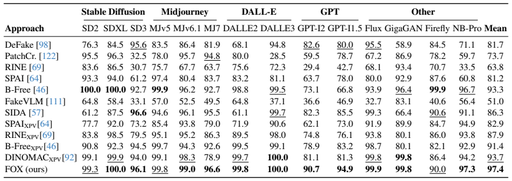
Table 1 .Detection performance on unseen generators.AUC (×100) on 14 unseen generators. Best per column inbold, second best underlined, with ties bolded jointly. The XPV ows indicate retraining on XPlainVerse.
Original paper · CC BY 4.0The gap is not uniform: B-Free scores 100.0 on SD2, compared to 99.3 for FOX. So the transfer is strong on average but uneven across generator families.
The backbone study explains why the detector is DINOv3 rather than another encoder. Table 3 shows DINOv3 at 98.8 mean AUC on five GenImage generators, against 94.7 for DINOv2 and 88.1 for CLIP. Checkpoint selection on the external Chameleon set produced this frozen-then-locked detector.
Explanation quality on XPlainVerse and LOKI
FOX is scored against reference explanations with ROUGE-L, CSS, and BERTScore F1, and the comparison covers SIDA and FakeVLM. On XPlainVerse, FOX reaches 69.8 BERTScore F1, compared to 57.0 for FakeVLM and 52.3 for SIDA. Its ROUGE-L of 27.5 and CSS of 62.2 are the highest of the three methods on both measures. The metrics are computed against the reference explanation, so higher values mean closer agreement with that reference text.
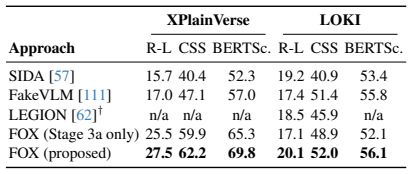
Table 2 .Explanation performance comparison.ROUGE-L (R- L), CSS [62], and BERTScore F1 [119] (×100). †No public LE- GION detection checkpoint is available, entries are from [62].
Original paper · CC BY 4.0LOKI lies outside the XPlainVerse training distribution, so it tests whether the explanations transfer to an independent set. FOX reaches 56.1 BERTScore F1 on LOKI, compared to 55.8 for FakeVLM and 53.4 for SIDA. On LOKI, FOX also leads FakeVLM on ROUGE-L with 20.1 versus 17.4 and on CSS with 52.0 versus 51.4.
The Stage 3a-only decoder, which receives no query guidance, scores 65.3 on XPlainVerse and 52.1 on LOKI. The gain appears on both sets, which means the guidance helps beyond the XPlainVerse distribution it was trained on. LEGION's entries come from another paper, since no public LEGION detection checkpoint is available.
Decoupling and query design ablations
Decoupling is tested against a single end-to-end pipeline that trains detection and explanation together. The end-to-end pipeline reaches 93.4 AUC and 68.9 BERTScore F1, while the decoupled detector and explainer reach 97.4 and 72.1. Shared trunks expose a checkpoint trade-off, because early stopping gives 96.9 AUC with 68.9 BERTScore F1.
Late stopping gives 94.5 AUC with 69.5 BERTScore F1, so neither shared-trunk run matches the decoupled version on both metrics. The authors tie this to the two objectives competing inside one trunk, a conflict that disjoint trunks avoid.
The query ablation crosses sentence weighting, global retention, and collapse resistance, as Table 6 lists. Without retention or collapse resistance, NLL weighting reaches 68.5 BERTScore F1 with a query cosine similarity of 99.9. Adding collapse resistance pulls that cosine down to 35.7 and lifts BERTScore F1 to 69.3. NLL weighting with both retention and collapse resistance reaches 72.1 BERTScore F1 and a cosine similarity of 31.1.
Uniform weighting with the same two terms gives 70.2 and a cosine of 68.4, so NLL weighting yields more distinct queries.
Under Stage 3a only, PaliGemma-2-3B scores 66.3 and InternVL2.5-4B scores 66.2 as explanation backbones. Qwen2.5-VL-3B reaches 69.1, and the authors select it as the backbone for the rest of the study. Adding a query-free adapter lifts Qwen2.5-VL-3B to 69.3, while the four-query conditioning lifts it to 72.1. The authors read the small gain from the query-free adapter as isolating the benefit of the predicted forensic representation.
With one slot, BERTScore F1 is 69.3, and with two slots it rises to 69.9. Eight slots reach 70.1, while four slots reach the best score of 72.1. Shuffling four queries across images drops the score to 68.9, below the unshuffled four-slot result. Shuffling whole query sets keeps class information and query count, so the drop reflects lost image-specific evidence.
Why InfoNCE and Stage 2 pretraining
Stage 2 trains the Predictor with InfoNCE rather than regressing directly onto the text embeddings. Direct cosine regression replaces the InfoNCE objective in the same stage and reaches 65.6 BERTScore F1. InfoNCE reaches 72.1 under the same protocol, so the contrastive objective adds about 6.5 points of explanation quality. The authors justify this with the anisotropy of pretrained text embeddings, where unrelated pairs still show high cosine similarity.
Absolute similarity targets carry little signal in that geometry, whereas relative comparisons against in-batch negatives stay discriminative. Direct regression is therefore a simple alignment baseline, while contrastive prediction keeps the relative structure of the explanation space.
The second test asks whether Stage 3b needs the Stage 2 Predictor as its starting point. Both variants undergo the same Stage 3b query training and Stage 3c adapter training. Initializing the Predictor randomly instead of with Stage 2 pretraining lowers BERTScore F1 to 68.3. Stage 2 pretraining reaches 72.1 under the same setup, so removing it costs explanation quality.
The authors keep Stage 2 pretraining because the semantic representation it learns gives query training a useful initialization.
The authors read the detection side of this design as separate from the explanation objective. Their detection comparison concerns what generalizes under a matched readout, not the choice of objective inside Stage 2. Within the explanation pathway, the Predictor's semantic pretraining and its InfoNCE objective both matter for the query stage.
What the limitations leave open
The authors' own caveats begin with the claim that an embedding is not an explanation. Because Y-Decoder receives the image and the locked verdict, the predicted queries act as forensic guidance for post-hoc verbalization. They are not presented as a complete account of the decision. Explanation quality is scored against automatically constructed references with similarity metrics.
Those metrics measure agreement with a reference, so they don't establish factual correctness or causal faithfulness. Although LOKI tests transfer beyond XPV, the authors say human evaluation remains necessary.
FOX produces a whole-image verdict and doesn't localize manipulated regions. That gap leaves possible provenance and dataset biases open, despite the strong cross-generator transfer.
The failure cases in the appendix cluster where generative artifacts meet ordinary photographic artifacts. FOX predicts real for two fakes by anchoring on plausible but incorrect cues, such as bumpy frosting and muddy wheels.
The design's checkpoint selection depends on a labeled external validation distribution. The authors report this requirement as a design cost. XPV validation AUC is nearly saturated across adaptation strategies, so internal validation can't pick checkpoints reliably. Locking the detector guarantees that explanation gradients cannot alter its verdict.
Paper info
- Authors
- Nikos Giakoumoglou, Paschalis Giakoumoglou, Tania Stathaki, Symeon Papadopoulos
- Venue
- arXiv · Preprint
- First published
- 2026-11-3
- Added
- 2026-11-5
- Updated
- 2026-11-3
- Version
- v1
- arXiv
- 2611.04111
- Category
- cs.CV · cs.AI · cs.MM
- Original paper terms
- CC BY 4.0
- What we show
- Paper info, commentary and permitted figures from the original paper
AI commentary is a separate explanation from the original paper and may contain errors. The original paper and figures follow each source's terms of use and any rights noted separately.
Abstract
AI-generated images have reached unprecedented realism, while instruction-driven AI editors re-synthesize images for local changes, leaving no splice boundary to localize. Most detectors are black boxes with unverifiable verdicts and generalize poorly because adapting a backbone on the detection distribution memorizes generator-specific fingerprints that quickly become obsolete. Specialist detectors built on pure-vision representations, particularly DINOv3, generalize well across generators, but explainable methods forgo this advantage: jointly training one multimodal model for classification and language generation subjects its visual representation to the language objective. We therefore require that explanation training cannot alter the verdict. We introduce FOX, which first builds and locks a specialist DINOv3 detector, then uses its representation to guide a lightweight VLM toward forensic explanation. A joint-embedding predictor maps locked visual evidence into a frozen text encoder's semantic space, producing guidance that the VLM verbalizes on demand. FOX achieves 97.4 mean AUC across 14 unseen generators, 69.8 BERTScore on XPlainVerse, and 56.1 on LOKI.
Quote from the paper
Nikos Giakoumoglou, Paschalis Giakoumoglou, Tania Stathaki, Symeon Papadopoulos (2026). Generalizable AI-Generated Image Detection with Embedding-Space Explanations. arXiv:2611.04111v1. https://arxiv.org/abs/2611.04111v1
BibTeX
@misc{giakoumoglou2026generalizable,
  title = {{Generalizable AI-Generated Image Detection with Embedding-Space Explanations}},
  author = {Nikos Giakoumoglou and Paschalis Giakoumoglou and Tania Stathaki and Symeon Papadopoulos},
  year = {2026},
  eprint = {2611.04111},
  archivePrefix = {arXiv},
  url = {https://arxiv.org/abs/2611.04111v1}
}