Paper commentary
Measure Before You Repair: An Explainable Agent for Blind Restoration of Multi-Artifact 3-D MRI
Dx-Rx agent measures MRI artifacts before repairing whole 3-D volumes
- Problem Most MRI restoration methods fix one known artifact, but a scan can carry an unknown mix of artifacts. Fixed repair orders also can't reorder steps when one repair interferes with another.
- Method Dx-Rx is an agent in which a multimodal language model measures each suspected artifact before repairing it. It checks each repair, can return to an earlier version and change the order, and writes a report.
- Results On 148 simulated 3-D T1-weighted volumes, Dx-Rx with GPT-6.1 Terra removed a mean 64.5 % of artifact error, nearly matching the 64.6 % of the oracle pipeline.
Why fixed rules struggle with mixed artifacts
Running every repair on every volume is the obvious shortcut, but it isn't safe. On the authors' test set, this apply-all approach made 11 volumes worse.
An expert rule-based pipeline avoids that harm by running a repair only when its detector flags the artifact. Because of that, the pipeline can't reorder repairs when one interferes with another. The rule-based pipeline made no volume worse on the test set.
Agents built on large language models can reason and call tools in a loop, so they offer a different route. AgenticIR reschedules its restoration steps with a language model and judges quality with a vision-language model. Yet AgentMRI and MRI-AgentNet only look at the image through a vision-language model. Earlier MRI agents restore 2-D slices rather than whole 3-D volumes.
The authors' Dx-Rx takes the agent route and adds measurement before each repair.
Measuring each artifact before repairing it
The key idea is to measure each suspected artifact before repairing anything, and to measure again after each repair. The agent gets one 3-D T1-weighted volume of 192×240×240 at 1 mm and nothing else, with no clean scan, no labels and no file name. The MLLM acts only through eleven tools and finish, and each tool takes a version handle, with v0 as the input.
Its system prompt states the task, the A–P phase encoding and that motion can't be repaired, and it gives no repair order.
The noise tool estimates σ in flat tissue, and the spike tool looks for isolated bright points in k-space. The ghosting tool looks for faint copies of the head along A–P, and the bias tool fits an N4 field over the brain, found with HD-BET. The motion tool has no repair of its own, and the agent compares its value with 0.033, at or above which a rescan is advised.
That threshold equals an error of 3.3 % of white matter.
Four restoration tools each write a new version: despike, deghost, denoise and debias. Despike removes spikes in k-space, and deghost puts back the signal that ghosting moved along A–P. Debias divides out the N4 field, and each repair runs its diagnostic tool again on the new version.
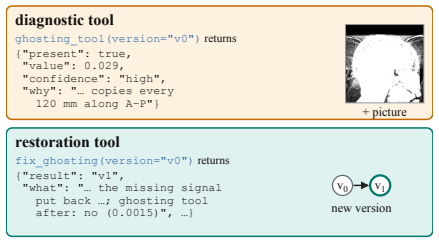
Fig. 2 . What the agent receives from a tool (t0100, GPT-6.1 Terra, shortened). A diagnostic tool returns whether its artifact is present, a value, a confidence, a reason and a picture of its evidence. A restora- tion tool returns the new version and its diagnostic tool’s new answer.
Original paper · CC BY 4.0The MLLM runs a diagnose-restore loop inspired by ReAct, in which it reasons, calls tools, reads their text and pictures, and decides again. It can also return to an earlier version and try another order, a move the authors compare with how AgenticIR reschedules after reflection.
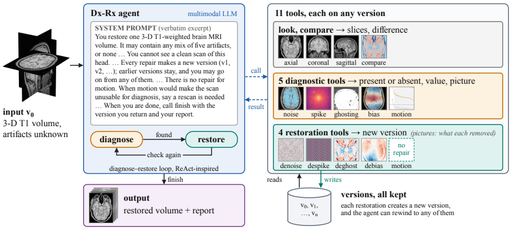
Fig. 1 . Dx-Rx. The MLLM receives one 3-D volume with unknown artifacts and a system prompt (excerpt, verbatim) and works in a diagnose–restore loop inspired by ReAct [4]: it calls tools on any version and reads their results (text and pictures) before deciding again.
Original paper · CC BY 4.0 · Necati Sefercioglu, Mehmet Ozan Unal, Metin Ertas, Altan Cakir, Isa Yildirim · Measure Before You Repair: An Explainable Agent for Blind Restoration of Multi-Artifact 3-D MRI · Original paper figure · Extracted the figure area from page 2 of the original PDF.How the report is written and checked
The agent ends by calling finish, which returns one version together with a report. The report uses radiology headings, running from examination to limits. Each artifact gets a finding that opens with present, absent or uncertain, followed by its evidence. The repair list gives the repairs in the order they ran, each with its reason.
Prior work reports that a model's explanation may diverge from its actual behaviour. For a clinical setting, the authors want reports to avoid claims the measurements can't back. The check runs deterministically against the run log. First, the repairs the report lists must match the returned version's history. Second, every number in the text must have been returned by a tool.
Third, the written findings must agree with the agent's own yes/no answers.
A report that passes all three checks is called faithful. Sonnet 5.5 wrote the most faithful reports of all five MLLMs, at 147 of 148 reports. In the Fig. 3 run, the report explains why the agent went back to the input and changed the repair order.
Simulated test volumes and the error score
The authors used public IXI T1-weighted scans from three hospitals at 1.5 T and 3 T. They computed brain masks with HD-BET, removed coil shading with N4, resampled to 1 mm and scaled each volume so that white matter equals 1. Artifacts were then added to each whole volume as one 3-D acquisition, in physical order. The order is bias field, rigid motion, ghosting and spikes, and then Rician noise, with the magnitude taken last.
Ghosting and spikes were produced with TorchIO, keeping the image complex until the magnitude is taken.
For motion, 30 MR-ART subjects were each scanned still once and moving twice, and radiologists graded the 60 moving scans as good (10), medium (17) or bad (33). The authors measured how much each moving scan's image entropy rose over the same subject's still scan, and then applied their own motion to the still scans at many strengths. At 0.033, the chance of an unusable grade equaled that of a usable one, which is why the rescan line sits there.
Ghosting and spikes have no clinical grade, so they use the same damage scale, and noise follows clinical noise grades.
Three other disjoint IXI sets calibrated the levels, set the tool thresholds and developed the agent. Writing x for the input, y for the output and r for the clean volume, the score is \( 1 - \lVert y - r \rVert / \lVert x - r \rVert \), computed inside the brain mask. PSNR and SSIM inside the brain, the number of volumes made worse and the count of correct diagnoses are reported alongside it.
Each method ran once after the agent was frozen, and no method saw file names or labels.
Four questions organize the comparisons, and each compared method differs in what it can do. The oracle pipeline runs the same repairs on the true artifacts, which shows how far the restoration tools can go. Per-volume differences are tested with the Wilcoxon signed-rank test, zero differences dropped, and Holm's adjustment across models.
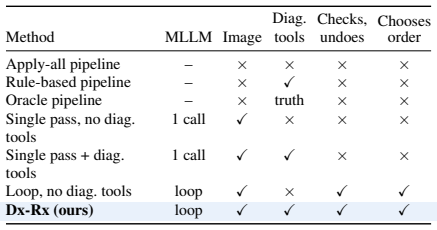
Table 1 . Compared methods and their components.
Original paper · CC BY 4.0Fixed rules versus measured repair
Running all four repairs on every volume made 11 volumes worse, but gating each repair by its diagnostic tool removed that harm. Dx-Rx needed no hand-set order or gating rule, so the authors take the gain as evidence that an agent can replace those rules. The agent checks each repair by running its diagnostic tool again on the new version.
Given the true artifacts, the oracle pipeline removed 64.6 % using the same fixed repair order. Dx-Rx with GPT-6.1 Terra removed 64.5 % without being told the artifacts, nearly matching the oracle. No MLLM differed significantly from the oracle pipeline, with p ≥ 0.06. So the restoration tools, not the diagnosis, set the ceiling, and even a perfect diagnosis leaves part of the error in place.
The paired comparisons use the Wilcoxon signed-rank test per volume, with Holm's adjustment across the models.
With all five MLLMs, Dx-Rx made no volume worse than its input. Compared volume by volume with the rule-based pipeline, each MLLM gave the same result on most volumes, at least 112 of 138. With GPT-6.1 Terra, Dx-Rx was the only MLLM never worse than the rule-based pipeline, and it was better on 8 volumes. So the gain on this test set comes without a safety cost to individual volumes.
In one test run, Dx-Rx repaired ghosting before the spike and removed 96.5 % of the error. The fixed order removed 47.7 % on the same volume, because it repairs the spike before ghosting. Its report explains why it changed course, which the fixed rules cannot do.
What each part of the agent adds
The first variant is a single MLLM pass that sees the three planes once and names repairs for the fixed order. Looking at the image alone, the single pass removed at most 19.7 % of the error. It removed 19.7 ± 25.8 with Claude Haiku 5.5. With Qwen 3.8-27B it removed only 3.3 ± 13.0.
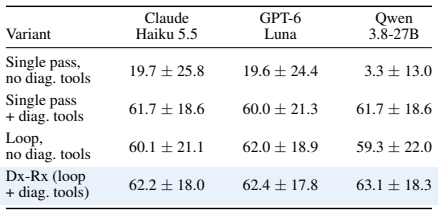
Table 3 . Q3: What each component adds. Each value is the error removed (%), as in Table 2.
Original paper · CC BY 4.0Adding the five diagnostic answers to the single pass lifted it to 61.7 with Claude Haiku 5.5. With GPT-6 Luna it reached 60.0. The diagnostic tools therefore carry most of the gain over the image-only pass. Full Dx-Rx scored 62.2 with Claude Haiku 5.5, 62.4 with GPT-6 Luna and 63.1 with Qwen 3.8-27B. Each of these sat above the single pass with diagnostic tools, but the gap wasn't significant (p ≥ 0.07).
Without diagnostic tools, the loop scored 60.1 with Claude Haiku 5.5, 62.0 with GPT-6 Luna and 59.3 with Qwen 3.8-27B. Each of these stayed below Dx-Rx with the same MLLM. The gap was significant for Claude Haiku 5.5 and Qwen 3.8-27B, but not for GPT-6 Luna. The loop adds feedback, because the agent sees each repair's result, can check it and goes back to change the order.
In 18 test runs, the agent repaired ghosting before the spike, and these runs beat the oracle 16 times.
After ghosting stayed, it returned to the input and repaired ghosting first, removing 96.5 % of the error against 47.7 %.
Reordering repairs in practice
The fixed order runs spike, ghosting, noise and bias, and the rule-based pipeline keeps that order. Dx-Rx sets no order by hand, so it can return to any earlier version and try another sequence. The agent keeps every version, so a failed attempt doesn't block a later one.
In 18 test runs, Dx-Rx repaired ghosting first instead of the spike. These ghosting-first runs beat the oracle pipeline 16 times and were never worse. Test volume t0122 has spike and ghosting, so it shows this switch clearly. The agent first repaired the spike, then ghosting, but ghosting remained after two more tries. The spike-first route removed 47.7 % of the error, while the ghosting-first route removed 96.5 %.
The ghosting-first run cut the estimated ghost RMS from 0.0314 to 0.0009.
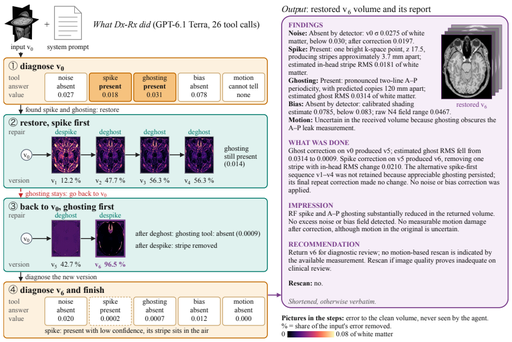
Fig. 3 . One test volume (t0122: spike and ghosting) from input to output, GPT-6.1 Terra
Original paper · CC BY 4.0The report records why the agent dropped the spike-first sequence. Every number in that report must match a value that a tool returned.
Does a larger MLLM help?
GPT-6.1 Terra, the larger model in the GPT-6 family, removed 64.5 % of the error, close to the oracle pipeline's 64.6 %. Against its smaller sibling GPT-6 Luna, which removed 62.4 %, the gain was significant at p = 0.02. Compared to the rule-based pipeline, GPT-6.1 Terra had 8 volumes with more error removed and 0 with less. That edge over the rule-based pipeline was significant at p = 0.04 after Holm's adjustment.
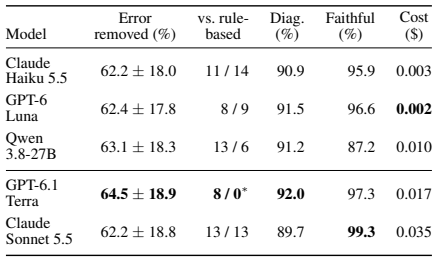
Table 4 . Q4: Dx-Rx with smaller and larger MLLMs. Error re- moved is as in Table 2. Vs. rule-based counts volumes with more / less error removed than the rule-based pipeline ( ∗significant after Holm’s adjustment). Diag. and Faithful are the shares of correct di- agnoses and of faithful reports. Cost is the mean per volume.
Original paper · CC BY 4.0In the Claude 5.5 family, Sonnet 5.5 removed 62.2 %, the same as Haiku 5.5 (p = 0.85). Sonnet 5.5 nevertheless wrote the most faithful reports of the five MLLMs, 147 of 148. Against the rule-based pipeline, Sonnet 5.5 had 13 volumes with more error removed and 13 with less.
The authors argue that a hospital can run an open-weights model on site, keeping scans in-house for privacy.
With GPT-6.1 Terra, Dx-Rx didn't differ significantly from the oracle pipeline, with p at least 0.06 for every MLLM. The tools set the ceiling, so a larger model narrows the gap but can't pass the oracle's result. They didn't test any model beyond the five listed, so a larger open-weights model remains untested.
Limitations
Dx-Rx doesn't repair motion, so the volume keeps its simulated motion and only the rescan advice addresses it. The 0.033 rescan line rests on 30 MR-ART subjects, so it inherits the sample that the radiologists graded. Ghosting and spikes have no clinical grade, so they borrow the motion damage scale.
All scores come from artifacts simulated on IXI volumes, not from real corrupted scans. The three levels of each artifact were calibrated to real scans, which the authors describe as mild, moderate and borderline. Only T1-weighted IXI scans from three hospitals were tested, at 1.5 T and 3 T. The faithfulness check tests consistency with the run log, so it doesn't establish clinical correctness.
The error metric scores only the 138 volumes with a repairable artifact. The other 10 volumes, 5 clean and 5 motion-only, don't enter the error-removed mean. Each method ran once after the agent was frozen, so every result comes from a single run. Four disjoint sets of IXI subjects were used, with 10 volumes for calibration, 10 for tool tuning and 60 for development.
They tested only one open-weights model, Qwen 3.8-27B, so the open-model result rests on one model. The oracle pipeline uses the true artifacts, so it marks the ceiling that the restoration tools can reach.
Paper info
- Authors
- Necati Sefercioglu, Mehmet Ozan Unal, Metin Ertas, Altan Cakir, Isa Yildirim
- Venue
- arXiv · Preprint
- First published
- 2026-11-2
- Added
- 2026-11-5
- Updated
- 2026-11-2
- Version
- v1
- arXiv
- 2611.03996
- Category
- eess.IV · cs.AI
- Original paper terms
- CC BY 4.0
- What we show
- Paper info, commentary and permitted figures from the original paper
AI commentary is a separate explanation from the original paper and may contain errors. The original paper and figures follow each source's terms of use and any rights noted separately.
Abstract
A brain MRI scan can carry an unknown mix of artifacts, so restoration has to be blind, yet most deep-learning methods are built to correct one known artifact. We present Dx-Rx, an agent in which a multimodal large language model (MLLM) measures suspected artifacts before it repairs them. To our knowledge, it is the first agent to restore whole 3-D MRI volumes, whereas earlier MRI agents restore 2-D slices. In a loop, it looks at slices of the 3-D volume, calls five diagnostic tools (noise, spike, ghosting, bias field, motion) and four restoration tools in any order it chooses, checks each repair, can return to any earlier version to change the order, and ends with a radiology-style report of its diagnostic reasons, the repairs it applied and their results. We simulated up to five artifacts on 148 whole 3-D T1-weighted volumes, at levels calibrated to radiologists' grades of real scans. An MLLM that only looked at the image, as earlier MRI agents do, removed at most 19.7 % of the artifact error. With the best of five MLLMs, Dx-Rx removed a mean 64.5 %, nearly matching the 64.6 % of the same tools given the ground-truth artifacts, which are never known for a clinical scan. With all five models, it made no volume worse and was on par with or better than an expert rule-based pipeline built from the same tools (62.3 %). Code and demo are public at https://itu-biai.github.io/measure-before-you-repair.
Quote from the paper
Necati Sefercioglu, Mehmet Ozan Unal, Metin Ertas, Altan Cakir, Isa Yildirim (2026). Measure Before You Repair: An Explainable Agent for Blind Restoration of Multi-Artifact 3-D MRI. arXiv:2611.03996v1. https://arxiv.org/abs/2611.03996v1
BibTeX
@misc{sefercioglu2026measure,
  title = {{Measure Before You Repair: An Explainable Agent for Blind Restoration of Multi-Artifact 3-D MRI}},
  author = {Necati Sefercioglu and Mehmet Ozan Unal and Metin Ertas and Altan Cakir and Isa Yildirim},
  year = {2026},
  eprint = {2611.03996},
  archivePrefix = {arXiv},
  url = {https://arxiv.org/abs/2611.03996v1}
}