Paper commentary
Adapting Frozen Promptable Segmenters to User-Defined Taxonomies via Few-Shot Proposal Learning
SnapHead learns project-specific class boundaries on top of a frozen SAM2.1 segmenter
- Problem Promptable segmenters like SAM 3 fix class boundaries to their training vocabulary, so they miss the finer cuts each annotation project needs. Between look-alike objects such as cell lines, that generic vocabulary gives near-chance class assignments.
- Method SNAP keeps SAM2.1 frozen and fits SnapHead, a small logistic regression classifier, to each project's labels. It classifies every mask proposal from one SAM2.1 pass and refits in seconds after each labeled image.
- Results With 20 labeled images, SNAP beats a SAM 3 oracle tuned on evaluation labels on five microscopy projects, scoring 0.484 against 0.441 F1.
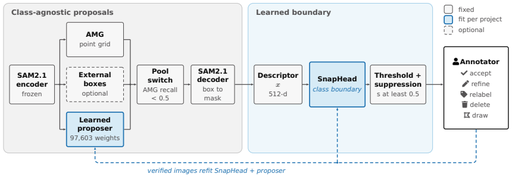
Figure 2 . Overview of SNAP. Gray blocks are frozen, blue blocks are fit to the labeled images L, and the dashed block is an optional proposal source. Every proposal passes through one frozen SAM2.1 decoder, and each newly labeled image refits SnapHead and the learned proposer.
Original paper · CC BY 4.0 · Khayrul Islam, Christopher Frederic Miller · Adapting Frozen Promptable Segmenters to User-Defined Taxonomies via Few-Shot Proposal Learning · Original paper figure · Extracted the figure area from page 4 of the original PDF.Why the class is the costly part
Prompt-driven segmenters such as SAM, SAM2 and SAM 3 have made masks cheap. Tools fill the class in one of two ways: the annotator names each object, so cost grows with the object count, or the model's training vocabulary supplies it, which caps the classes.
The trouble is that a project's class line rarely matches the one a model learned. People versus cars is a cut SAM 3 already makes, while sedans versus trucks, or one sedan model versus another, is finer than anything it was trained to separate. The authors' central observation is that a project usually brings a new boundary between objects a model has already seen, not new objects.
The problem shows up even when the correct masks are given and only the class is scored.
Projects can already get their own boundary, but each option costs something. The missing piece is an instance-level boundary learned from a few labeled images, quick enough to refit after every image.
A frozen segmenter with a learned class line
The key idea is to freeze the segmenter and learn only the piece that changes between projects, the class boundary. SNAP does this on one frozen SAM2.1 pass per image: class-agnostic proposers produce candidate masks, and a small head, SnapHead, gives each candidate a class or rejects it.
Every candidate is described by one 512-dimensional vector, built from the same SAM2.1 pass that produced its mask. The descriptor is \(x=[\bar{\phi}(m);\,o(b(m))]\in\mathbb{R}^{512}\), where \(\bar{\phi}(m)\) averages the stride-16 encoder embedding over the mask and \(o(b(m))\) is the object pointer for the tight box \(b(m)\). Each half is ℓ2-normalized, and the authors report that the pair beats either half alone from two labeled images on.
The labels supply the training examples: a proposal overlapping an object of class c at IoU 0.5 or more becomes a class-c example. A proposal overlapping every object below 0.1 becomes a background example, and the ambiguous proposals in between are dropped. SnapHead is a multinomial logistic regression on standardized descriptors, with class weights inversely proportional to example counts so rare classes count as much as common ones.
Being linear on a fixed 512-d input, it fits in seconds, which lets it refit after every labeled image.
Proposals at or above one threshold for every class are kept, and duplicates are removed by greedy suppression at mask IoU τ_nms.
Finding the candidates and choosing whose boundary wins
The grid needs no labels, so SAM2's automatic mask generator works from the first image. To recover those objects, SNAP fits a second proposer on the annotator's own masks. This learned proposer follows CenterNet and reads features the encoder already computes, normalized per image. It predicts a centre heatmap and a log-size map, with a loss that combines a focal term and a size term averaged over the object centre cells.
The top K heatmap peaks become boxes, and each box prompts the decoder the way an annotator's box would.
The proposer weights total 97,603, as shown in the overview of SNAP.
The switch measures the grid's recall on the object masks of all labeled images, called G pool. It adds the learned proposer to the pool only when that recall falls below τ r.
Where a cut already lies in SAM 3's vocabulary, SAM 3's own class is hard to beat. So when SAM 3 is available, the labels choose one class at a time. On the labeled data, SNAP picks SAM 3's phrasing and confidence threshold by macro-F1, and scores SnapHead by five-fold cross-validation grouped by image. No choice reads an evaluation label.
Class assignment with the masks given
To isolate the class from localization, every method receives the same ground-truth instance masks and only the assigned class is scored. Cohen's κ is used because it stays at zero for chance whatever the class balance.
On the eight LIVECell cell lines, SAM 3 scored κ 0.038 and SnapHead scored 0.754 at N=60. The authors explain this by SAM 3 scoring each phrase on its own, so its classes never compete for a mask, while SnapHead fits one softmax over all classes.
To test whether the words are the problem, the authors split LIVECell-A172 cells into area terciles and named them two ways. With small, medium and large, SAM 3 reaches κ 0.125, and with type A, type B and type C it falls from there to −0.007, while SnapHead scores 0.722 under both namings. SnapHead rises with each labeled image instead: 0.068 at N=1, 0.554 at N=5 and 0.722 at N=60.
Finer cuts on the same objects
A finer class cut should hurt a generic model, while SnapHead only needs more labels, and the authors test this on three label ladders. Every method classifies the same mask, which SAM2 decodes from the dataset's box. SnapHead sees twenty labeled images per finest class.
On aircraft, SAM 3 stays near chance at every cut, with κ at most 0.045. On ships, SnapHead reaches 0.761 at ship versus dock, compared to 0.753 for SAM 3, so the two are level at the coarsest cut. SnapHead leads once the cut moves to category, at 0.607 against 0.375, and to hull type, at 0.245 against 0.152. PanNuke is the reverse case, since its five nucleus types are in SAM 3's vocabulary and SAM 3 leads at the finest cut, as it does on COCO and LVIS.
Finding the cells as well as naming them
The authors measured the proposal stage on LIVECell-A172 to see whether it or the class stage limits the result.
At N=20, instance F1 reaches 0.481 with AMG.
The gain of 0.043 has a 95% CI of [0.031, 0.056] from a paired bootstrap over evaluation images. An annotator with no labels gets the blind row at 0.106.
Pricing predictions by annotator action
F1 says how good a set of predictions is, but not how much work it leaves the annotator. The authors therefore charge each prediction the action a simulated annotator takes on it, in the spirit of Fluid Annotation. A matched prediction of the right class is an accept if its IoU reaches τacc, and a refine otherwise. A wrong-class match is a relabel, an unmatched prediction is a delete, and every object left unmatched is a draw.
Each check action costs w_check, and the draw costs one unit, so the annotator's effort is priced in draws. The defaults are w_check 0.1 and w_refine 0.5, and E is reported over the whole cited range.
At these defaults, SNAP's pooled effort is 0.807 at N=5 and 0.784 at N=20, compared to 1 for drawing every object by hand. Most of what remains is drawing, since the pooled drawn fraction is 0.670 of that 0.784 effort. SnapHead's drawn fraction is 0.578, compared to 0.858 for SAM 3 with class names on the same microscopy projects.
The optional per-class dial sets each class's threshold on cross-validated curves to minimize total effort. Each curve includes the option of dropping a class entirely, so the optimum never adds cost over drawing. On its tuning evidence the dial keeps total cost at or below drawing every object by hand, which is A(t) ≤ n_gt c_draw. The bound holds on 231 of 231 tuning curves and on 221 of 231 held-out splits, which is 95.7%.
Replaying the loop with 36 rounds of five images on four projects, effort fell below manual from the second round on.
Limitations
Where a cut already sits in SAM 3's vocabulary, SnapHead alone trails SAM 3 with class names on the microscopy classes, 0.114 compared to 0.629.
The full comparison in Table 2 covers only the five microscopy projects.
The Cellpose variant isn't independent of the benchmark, since its training data include LIVECell and BBBC038, so its F1 of 0.544 carries a caveat. The effort weights come from timed studies rather than from measurements on this annotator. On the aerial projects Mask R-CNN can't run on large tiles, so those fragile projects lack that baseline.
Paper info
- Authors
- Khayrul Islam, Christopher Frederic Miller
- Venue
- arXiv · Preprint
- First published
- 2026-11-6
- Added
- 2026-11-10
- Updated
- 2026-11-6
- Version
- v1
- arXiv
- 2611.10092
- Category
- cs.CV
- Original paper terms
- CC BY 4.0
- What we show
- Paper info, commentary and permitted figures from the original paper
AI commentary is a separate explanation from the original paper and may contain errors. The original paper and figures follow each source's terms of use and any rights noted separately.
Abstract
Promptable segmenters of the SAM family turn a click or a phrase into an instance mask, so the costly part of a label is now its class. However, each annotation project draws its own class boundary, often through objects these models already know: people from cars, sedans from trucks, one sedan model from another. A generic model's boundary is fixed by its training vocabulary. We present SNAP, an annotation pipeline that learns the project's boundary from the labels the annotator draws anyway. On one frozen SAM2.1 pass per image, we fit a per-project head, SnapHead, that classifies every proposal and refits in seconds after each labeled image. Where SAM 3 is available, the same labels decide class by class whether to keep its boundary or ours. Given the true masks of eight look-alike cell lines, SAM 3 assigns classes at Cohen's kappa = 0.038 and SnapHead at 0.754 (60 labeled images), and when only the class names change, SAM 3 falls to chance and SnapHead's score is unchanged. End to end, with 20 labeled images, SNAP beats a SAM 3 oracle tuned on the evaluation labels on five microscopy projects (0.484 against 0.441 F1), and run unchanged on five held-out datasets, it beats SAM 3 as shipped on four. Our results suggest that frozen foundation features already encode the class boundaries a generic vocabulary misses, and that a project's own labels are enough to read them out.
Figures from the paper

Figure 3 . Class assignment on one LIVECell image of SH-SY5Y cells (densest third,112of190cells). Every panel draws the same ground-truth masks; color shows the assigned line. Titles give the count right in this crop and the accuracy over all35,458evaluation cells.
Original paper · CC BY 4.0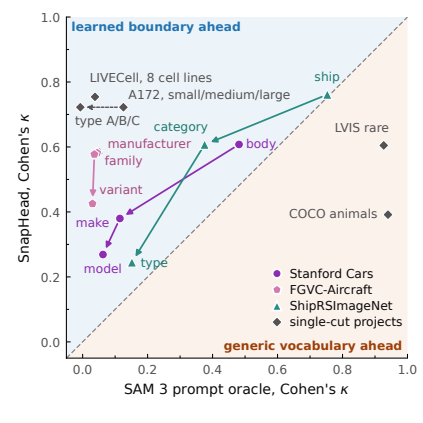
Figure 4 . Comparison with SAM 3 on the label ladders and class- assignment projects. Each point is one cut; above the diagonal, the learned boundary wins. Colored markers follow the three ladders, coarse to fine; SnapHead sees20labeled images per finest class. Gray diamonds are the single-cut projects of Tab. 1 atN=60. The dashed arrow renames the A172 size classes: SAM 3 moves, ours stays.
Original paper · CC BY 4.0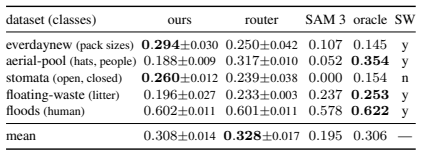
Table 3 . Transfer to five randomly drawn RF100-VL datasets at N=20. Instance F1 at box IoU0.5, mean±sd over three seeds; SAM 3 is deterministic.ours: SnapHead. SAM 3: class names, default threshold.oracle: best phrasing and threshold on evalua- tion labels.router: Sec. 3.3. SW: the automatic switch (Sec. 3.2) is within seed noise of the better fixed proposer. Last row: mean; sd over seeds.
Original paper · CC BY 4.0Quote from the paper
Khayrul Islam, Christopher Frederic Miller (2026). Adapting Frozen Promptable Segmenters to User-Defined Taxonomies via Few-Shot Proposal Learning. arXiv:2611.10092v1. https://arxiv.org/abs/2611.10092v1
BibTeX
@misc{islam2026adapting,
  title = {{Adapting Frozen Promptable Segmenters to User-Defined Taxonomies via Few-Shot Proposal Learning}},
  author = {Khayrul Islam and Christopher Frederic Miller},
  year = {2026},
  eprint = {2611.10092},
  archivePrefix = {arXiv},
  url = {https://arxiv.org/abs/2611.10092v1}
}