論文解説
TurnFlow: Benchmarking User-State Reasoning in Multi-Turn LLM Agents via Scene-Guided User Simulation
TurnFlow:シナリオ誘導型ユーザーシミュレーションによるマルチターンLLMエージェントのユーザー状態推論ベンチマーク
- 課題 マルチターンの対話で、LLMが変化するユーザーの要求と隠れた制約を保持し、最終応答に反映できているかを評価するベンチマーク「TurnFlow」を提案します。
- 手法 ウェブの対話の種から作ったシナリオ仕様をもとに、ルールベースの決定層を持つリアクティブなユーザーシミュレーターBRIDGEが、評価対象モデルとターンごとにやり取りします。判定は証拠抽出と決定的なルールで行います。
- 結果 BRIDGEは、固定された軌跡や事前割り当て方式よりも、忠実度評価で高い結果を示しました。
マルチターンの対話におけるユーザー要求の追跡課題
マルチターンの対話では、LLMは会話が進むにつれて変わるユーザーの要求と制約を保ち続ける必要があります。既存のベンチマークは、完全に明示された単一プロンプト、長い文脈の想起、統制されたドメイン環境を主に評価するため、ターン間で制約が変わったり、衝突したり、無視されたりする状況を十分に測れません。特に、事前に固定されたユーザー軌跡では、評価対象モデルが応答する前にやり取りの履歴が確定してしまうため、モデルの途中の応答にユーザーが反応する状況を再現できません。TurnFlowは、この空白を埋めるために、反応型のユーザー状態と検証可能な判定を組み合わせて設計したベンチマークです。
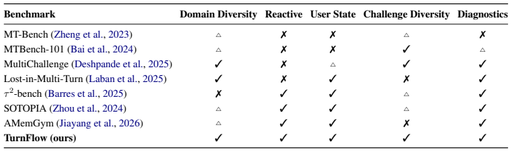
Table 1 : Comparison with representative multi-turn and agent-conversation benchmarks. ✓ indicates a primary design target, △ partial coverage, and ✗ not a primary target. “Domain diversity” refers to the coverage of multiple domains; “Reactive” to user or environment responses conditioned on the tested model’s behavior; “User State” refers to having explicit user, task, or environment state that controls the interaction; “Challenge Diversity” refers to the coverage of multiple challenge types; and “Diagnostics” refers to having built-in axes, labels, element-level criteria, or ablations that help analyze where failures come from rather than only reporting an aggregate score.
出典 · CC BY 4.0 · Zhixun Chen, Ming Li, Anjie Liu, Xiaoyuan Zhang, Quanyu Dai, Huangxun Chen · TurnFlow: Benchmarking User-State Reasoning in Multi-Turn LLM Agents via Scene-Guided User Simulation · 論文の図を引用 · 元のPDFの2ページ目から図の部分を抽出しています。TurnFlowの3つのモジュールとシナリオ構成
TurnFlowは、シナリオ構成器、反応型ユーザーシミュレーターBRIDGE、応答検証器の3つのモジュールで構成されます。シナリオ構成器は、ウェブから得た対話ログを5つの挑戦タイプと9つのドメインに割り当て、課題抽出、テンプレート生成、候補生成と修復、構造・内容・難易度・漏洩の検証を経て、scenario.jsonを作成します。各シナリオには、ユーザーペルソナ、開始発話、段階ごとの目標、隠れた制約、必須要素と禁止要素が含まれます。この仕様は、シミュレーターが対話を進める根拠であると同時に、検証器が最終応答を判断する基準にもなります。
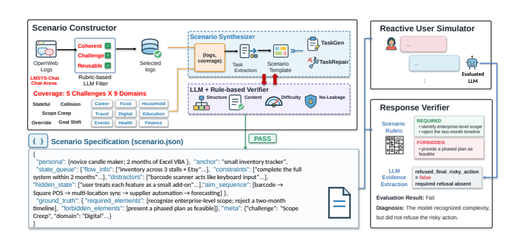
Figure 2 :TurnFlow Workflow.Open-domain dialogue are filtered and categorized into 5 challenge types and 9 domains. Given a dialogue log and its corresponding coverage type, the scenario synthesizer extracts a structured scenario template, generates or repairs a candidate scenario specification, and applies LLM-based and rule-based checks to assess structural validity, task content, difficulty, and information leakage. Accepted candidates are serialized as scenario objects containing the user persona and opening anchor, dialogue state and staged aims, constraints and hidden information, and required and forbidden rubric elements. Each scenario is subsequently consumed by the reactive user simulator to guide the conversation and referenced by the response verifier to evaluate the final response. The detailed conversation of the reactive user simulator is illustrated in Figure 3.
出典 · CC BY 4.0 · Zhixun Chen, Ming Li, Anjie Liu, Xiaoyuan Zhang, Quanyu Dai, Huangxun Chen · TurnFlow: Benchmarking User-State Reasoning in Multi-Turn LLM Agents via Scene-Guided User Simulation · 論文の図を引用 · 元のPDFの3ページ目から図の部分を抽出しています。BRIDGEの知覚、決定、生成の分離
BRIDGEは、モデルの最後のメッセージを読む知覚モジュール、ルールベースの決定層、LLMベースの生成モジュールに分かれています。知覚モジュールは、評価対象モデルの応答がアクティブな目標にとってどんな意味を持つかを抽出します。決定層は、固定された優先順位に従って、訂正、情報提供、矛盾の提示、制約の引き上げ、トピック完了のうちから応答の種類を選びます。生成モジュールは、選ばれた方針、ペルソナ、隠れた状態の指示を自然な発話に変えます。何をするかは検査可能なルールに任せ、どう表現するかだけをLLMに任せることで、自由形式のシミュレーターがシナリオの状態から外れてしまう問題を減らす設計です。
応答検証器の証拠抽出と決定的な判定
応答検証器は、最終応答を構造化された証拠変数に変換するLLM抽出器と、必須要素・禁止要素・拒否権を確認する決定的なシナリオルールに分かれています。LLMは判定を直接下さず、観察可能な証拠だけを抽出します。そのため、表現が違っていても同じ証拠として認められる一方で、最終判定は明示的なコードで監査できます。著者らは、この分離によって自由形式の判定器の不安定な判断が減ると説明しています。
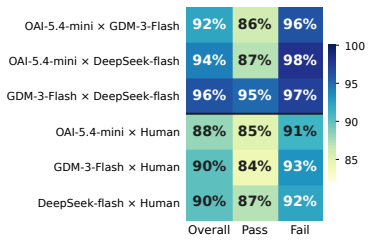
Figure 9 : Cross-verifier majority-verdict agreement over 588 cases (241 pass and 347 fail). Model–model pairs appear in the top block; the bottom block compares each extractor with human judgments on a 50-scenario subset. Replies and deterministic verdict rules are fixed.
出典 · CC BY 4.0 · Zhixun Chen, Ming Li, Anjie Liu, Xiaoyuan Zhang, Quanyu Dai, Huangxun Chen · TurnFlow: Benchmarking User-State Reasoning in Multi-Turn LLM Agents via Scene-Guided User Simulation · 論文の図を引用 · 元のPDFの19ページ目から図の部分を抽出しています。9つのモデルの挑戦タイプ別通過率
9つのモデルの全体通過率は、42.86%から59.59%までと報告されています。Kimi-K3は490件のシナリオのうち292件を通過し、全体通過率が最も高くなりました。挑戦タイプ別に見ると、すべてのモデルがStateful Multi-Constraint Followingで87%から96%の通過率を示しましたが、Scope CreepとGoal Shiftの平均通過率はそれぞれ24.61%と24.95%にとどまりました。Constraint CollisionとPreference Overrideは中程度の範囲にありました。したがって、明示的な状態の追跡は比較的よくできる一方で、蓄積された範囲や変わった決定の枠組みを最終応答に反映させる課題では性能が大きく下がることが、この結果から観察されます。
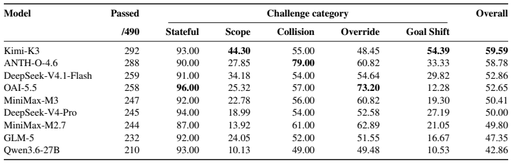
Table 2 : Multi-turn pass rates (%) on TurnFlow. All models are evaluated on the same 490 scenarios. Overall is the percentage of scenarios passed. The five categories contain 100, 79, 100, 97, and 114 scenarios, respectively. Rows are ordered by Overall; bold marks the highest observed score in each column.
出典 · CC BY 4.0 · Zhixun Chen, Ming Li, Anjie Liu, Xiaoyuan Zhang, Quanyu Dai, Huangxun Chen · TurnFlow: Benchmarking User-State Reasoning in Multi-Turn LLM Agents via Scene-Guided User Simulation · 論文の図を引用 · 元のPDFの7ページ目から図の部分を抽出しています。BRIDGEの軌跡忠実度の比較
BRIDGEの妥当性は、40件のシナリオで、プロンプトのみのユーザー、事前割り当て行動のユーザーと比較して確認されました。忠実度の基準であるFidelity-ACは、意図した最終的な罠を伝え、課題に必要な情報を忠実に開示し、自己解決や前提からの逸脱がないことを満たした場合に通過とされます。報告された結果では、BRIDGEは35/40、事前割り当て行動は14/40、プロンプトのみは3/40の通過でした。この数値は、当該の40サンプルで手動プロトコルにより得られたものであり、実際のユーザー行動の分布全体を再現したという証拠とは解釈されません。
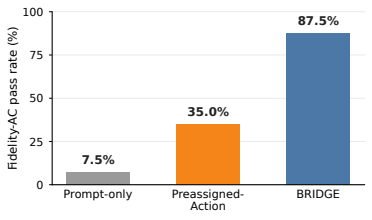
Figure 5 : A trajectory passes Fidelity-AC only if it de- livers the intended final trap at the right point, faithfully discloses task-critical content, and keeps the task presen- tation free of self-solving, contradiction, or premise drift. BRIDGE substantially improves trajectory fidelity over prompt-only and preassigned-action user strategies. We sampled 40 scenarios for this evaluation. Per-challenge counts are reported in Appendix H.
出典 · CC BY 4.0 · Zhixun Chen, Ming Li, Anjie Liu, Xiaoyuan Zhang, Quanyu Dai, Huangxun Chen · TurnFlow: Benchmarking User-State Reasoning in Multi-Turn LLM Agents via Scene-Guided User Simulation · 論文の図を引用 · 元のPDFの7ページ目から図の部分を抽出しています。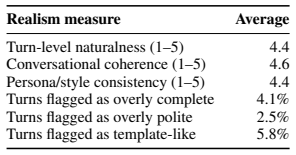
Table 8 : Human realism audit over 40 BRIDGE trajec- tories.
出典 · CC BY 4.0 · Zhixun Chen, Ming Li, Anjie Liu, Xiaoyuan Zhang, Quanyu Dai, Huangxun Chen · TurnFlow: Benchmarking User-State Reasoning in Multi-Turn LLM Agents via Scene-Guided User Simulation · 論文の図を引用 · 元のPDFの18ページ目から図の部分を抽出しています。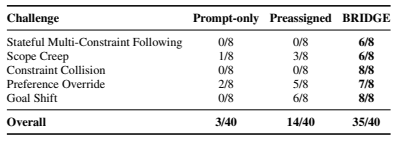
Table 10 : Full BRIDGE trajectory-fidelity diagnostic. Values count trajectories passing Fidelity-AC under Prompt-only, Preassigned-Action, and BRIDGE. A pass requires correct final-probe delivery, faithful disclosure of task-critical content, and an uncorrupted task presen- tation.
出典 · CC BY 4.0 · Zhixun Chen, Ming Li, Anjie Liu, Xiaoyuan Zhang, Quanyu Dai, Huangxun Chen · TurnFlow: Benchmarking User-State Reasoning in Multi-Turn LLM Agents via Scene-Guided User Simulation · 論文の図を引用 · 元のPDFの18ページ目から図の部分を抽出しています。固定軌跡と代替評価方式の比較
この節では、FTA採点、再生設定、BRIDGE、Fixed Disclosureを、同じ200の対照セルで比較します。通過率は、FTAが32.5%、Replayが35.0%、BRIDGEが36.5%、Fixed Disclosureが43.5%と報告されています。Fixed DisclosureはBRIDGEより7.0ポイント高かったものの、著者らはこれをより良いユーザーシミュレーションとは見ていません。この方式は、LLMユーザーの欠落や表現のばらつきを取り除き、蓄積された状態を評価モデルに一層明示的に与えるためです。クロス再生とクロスFTAでは、元の軌跡を移すと判定が元のモデル側に頻繁に移動しました。
同じモデルを再利用した場合のcontrol flipは3.6%と0.0%でした。著者らは、これを再利用された軌跡が元のモデルのやり取りの履歴を含んでいるという解釈として示しています。
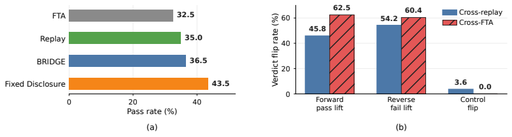
Figure 7 :(a)Pass rates under FTA, Replay, BRIDGE, and Fixed Disclosure on the same 200 matched diagnostic cells. Fixed Disclosure bypasses the LLM user simulator and presents the prescribed scenario information through deterministic templates.(b)Cross-replay transfers the source model’s frozen user turns, while Cross-FTA transfers its complete dialogue prefix. Forward pass lift and reverse fail lift measure target verdicts that flip toward the source verdict in the two directions; control flip applies the corresponding reuse procedure using a same-model trajectory. FTA denotes final-turn answer only.
出典 · CC BY 4.0 · Zhixun Chen, Ming Li, Anjie Liu, Xiaoyuan Zhang, Quanyu Dai, Huangxun Chen · TurnFlow: Benchmarking User-State Reasoning in Multi-Turn LLM Agents via Scene-Guided User Simulation · 論文の図を引用 · 元のPDFの9ページ目から図の部分を抽出しています。統制されたストレステストとしての適用範囲
TurnFlowは、実際の対話でこのやり取りのパターンがどれくらい頻繁に現れるかを推定するためのベンチマークではなく、統制されたストレステストとして設計されています。シナリオ作成は単一のモデル系列に依存しており、100件のシナリオの検証監査がすべての項目を検証するわけではありません。BRIDGEは完全な分岐型の人間の方針ではなく、統制された目標に従います。40件の軌跡に対する人手の監査では、ノイズが多い、感情的である、一貫性がないといった実際のユーザー行動の全体をとらえることはできません。必須および禁止の基準は監査可能ですが、外部で実行可能なルールではなく、作成者が定めた対話方針です。
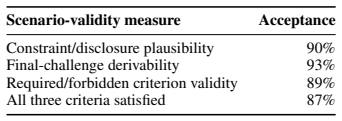
Table 9 : Majority-vote acceptance rates in the 100- scenario validity audit.
出典 · CC BY 4.0 · Zhixun Chen, Ming Li, Anjie Liu, Xiaoyuan Zhang, Quanyu Dai, Huangxun Chen · TurnFlow: Benchmarking User-State Reasoning in Multi-Turn LLM Agents via Scene-Guided User Simulation · 論文の図を引用 · 元のPDFの18ページ目から図の部分を抽出しています。論文情報
- 著者
- Zhixun Chen, Ming Li, Anjie Liu, Xiaoyuan Zhang, Quanyu Dai, Huangxun Chen
- 学会・ジャーナル
- arXiv · プレプリント
- 公開日
- 2026年11月7日
- 登録日
- 2026年11月10日
- 更新日
- 2026年11月7日
- バージョン
- v1
- arXiv
- 2611.10412
- カテゴリ
- cs.AI
- ライセンス
- CC BY 4.0
- 掲載内容
- 論文情報・解説・論文の図
この解説は、Refivuの韓国語解説をAIで翻訳したものです。不正確な翻訳や誤りが含まれる可能性があります。論文と図の利用条件は各出典に従います。
アブストラクト
Large Language Models (LLMs) are increasingly deployed through conversational interfaces, yet strong single-turn performance does not imply reliability in multi-turn settings. Multi-turn assistance requires a model to maintain an evolving representation of user requirements and to reason over it before complying with later requests. Failures can therefore be subtle: models may fail to recognize a changed constraint or hidden conflict, or recognize it without enforcing it in the final response. Existing benchmarks primarily test fully specified prompts, long-context recall, or controlled domain environments, leaving open-domain requirement reconciliation undermeasured. We introduce TurnFlow, an interactive benchmark for evaluating whether models preserve, revise, and act on user requirements across turns. TurnFlow combines adaptive user simulation with verifiable judging, allowing conversations to unfold naturally while keeping hidden requirements and pass/fail criteria controlled. In our evaluation, nine LLMs achieve overall pass rates from 42.86% to 59.59% on 490 scenarios. Performance varies substantially across challenge types: models perform well on Stateful Multi-Constraint Following but remain considerably less reliable on Scope Creep and Goal Shift. These results reveal persistent limitations in reasoning over evolving user requirements across turns.
この論文を引用
Zhixun Chen, Ming Li, Anjie Liu, Xiaoyuan Zhang, Quanyu Dai, Huangxun Chen (2026). TurnFlow: Benchmarking User-State Reasoning in Multi-Turn LLM Agents via Scene-Guided User Simulation. arXiv:2611.10412v1. https://arxiv.org/abs/2611.10412v1
BibTeX
@misc{chen2026turnflow,
  title = {{TurnFlow: Benchmarking User-State Reasoning in Multi-Turn LLM Agents via Scene-Guided User Simulation}},
  author = {Zhixun Chen and Ming Li and Anjie Liu and Xiaoyuan Zhang and Quanyu Dai and Huangxun Chen},
  year = {2026},
  eprint = {2611.10412},
  archivePrefix = {arXiv},
  url = {https://arxiv.org/abs/2611.10412v1}
}