論文解説
Point-NeRF: Point-based Neural Radiance Fields
Point-NeRF:点ベースのニューラル放射場
- 課題 NeRF系の手法は、シーンごとにグローバルなMLPを学習するため、再構成に時間がかかるという課題があります。Point-NeRFは、この問題を点ベースの表現で緩和することをめざします。
- 手法 Point-NeRFは、MVSベースのネットワークで初期点群と点ごとの特徴量を生成し、シーンごとに点の枝刈りと成長を行います。
- 結果 DTUとNeRF Syntheticの実験では、Point-NeRFは短いファインチューニングで既存手法と同程度の画質を達成したと報告しています。ただし、比較条件と反復回数によって結果は変わります。
NeRF系再構成の時間の問題
NeRFは高品質なnovel view synthesisを示しますが、シーンごとにグローバルなMLPを長時間学習する必要があります。論文では、この遅いシーンごとのフィッティングと、空き領域での不要なサンプリングが再構成時間を長くしていると指摘されています。Point-NeRFは、この問題を3Dニューラル点群と点ごとの特徴量でvolumetric radiance fieldを表す方法で扱います。論文は、1つのシーンの点フィールドをネットワークの順伝播で先に得て、その後の短いシーンごとの最適化で画質を高める流れを提案しています。
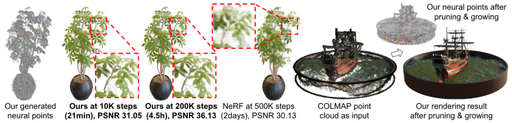
Figure 1 . Point-NeRF uses neural 3D points to efficiently represent and render a continuous radiance volume. The point-based radiance field can be predicted via network forward inference from multi-view images. It can then be optimized per scene to achieve reconstruction quality that surpasses NeRF [35] in tens of minutes. Point-NeRF can also leverage off-the-shelf reconstruction methods like COLMAP [44] and is able to perform point pruning and growing that automatically fix the holes and outliers that are common in these approaches.
出典 · CC0 1.0 · Qiangeng Xu, Zexiang Xu, Julien Philip, Sai Bi, Zhixin Shu, Kalyan Sunkavalli, Ulrich Neumann · Point-NeRF: Point-based Neural Radiance Fields · 論文の図を引用 · 元のPDFの1ページ目から図の部分を抽出しています。点ごとのニューラル特徴量と点ベースの放射場
Point-NeRFは、各点iが位置p_i、ニューラル特徴量f_i、信頼度γ_iを持つ点群Pを使います。任意の3D位置xでは、半径R内のK個の近傍点を問い合わせ、各点の特徴量を相対位置x−p_iを入力とするMLP Fで変換します。その後、逆距離加重平均で特徴量を集約してf_xを作り、MLP Rが視点方向dとともに放射輝度を回帰します。密度は点ごとのMLP Tがσ_iを予測し、同じ方式の加重集約によりσを得ます。このとき各点の信頼度γ_iが密度への寄与に直接掛けられるため、信頼度は点の密度への寄与を調整します。
MVSベースの初期点フィールド生成
初期点フィールドは、複数視点の画像からMVSNet系のcost volume 3D CNNで深度確率ボリュームを推定し、深度マップを3Dに逆投影して得ます。点の信頼度γ_iは、深度確率ボリュームを点の位置でtrilinearにサンプリングした値で決まります。点ごとの特徴量は、別の2D CNNであるVGG系のG_fが入力画像から抽出した複数解像度の特徴を点に対応づけて得ます。論文では、この生成過程全体をレンダリング損失でエンドツーエンドに学習し、シーンごとの最適化の前の初期放射場が妥当な重みから始まるようにしたと説明されています。
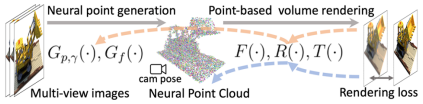
Figure 3 . The dash lines indicate gradient updates for radiance field initialization and per-scene optimization.
出典 · CC0 1.0 · Qiangeng Xu, Zexiang Xu, Julien Philip, Sai Bi, Zhixin Shu, Kalyan Sunkavalli, Ulrich Neumann · Point-NeRF: Point-based Neural Radiance Fields · 論文の図を引用 · 元のPDFの4ページ目から図の部分を抽出しています。
Table 5 . Comparisons between using the extracted image features to initialize the point features (our full model) or using the random initialized features.
出典 · CC0 1.0 · Qiangeng Xu, Zexiang Xu, Julien Philip, Sai Bi, Zhixin Shu, Kalyan Sunkavalli, Ulrich Neumann · Point-NeRF: Point-based Neural Radiance Fields · 論文の図を引用 · 元のPDFの12ページ目から図の部分を抽出しています。点の枝刈りと成長
シーンごとの最適化の段階で、著者らは既存の点位置を直接最適化すると学習が不安定になり、大きな穴を埋められないと述べています。そのため、点位置ではなく点の信頼度と特徴量を最適化する方法を選びました。枝刈りでは、γ_i < 0.1の点を10K反復ごとに削除し、スパース性損失L_sparseで信頼度を0または1に近づけます。成長では、ray marchingで不透明度α_jが最大となるshading位置x_jgを探し、α_jg > T_opacityかつ最も近い既存点までの距離ϵ_jg > T_distであれば新しい点を生成します。この手順により、表面付近にあるものの既存点から遠い空き領域が埋められます。
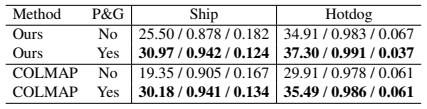
Table 4 . The quantitative results (PSNR / SSIM / LPIPSVgg ) of the Ship and Hotdog scene with or without point pruning and growing (P&G). The improvements are significant when using either our generated points or the point cloud generated by COLMAP [44].
出典 · CC0 1.0 · Qiangeng Xu, Zexiang Xu, Julien Philip, Sai Bi, Zhixin Shu, Kalyan Sunkavalli, Ulrich Neumann · Point-NeRF: Point-based Neural Radiance Fields · 論文の図を引用 · 元のPDFの8ページ目から図の部分を抽出しています。DTUとNeRF Syntheticでの検証
DTUのテストセットでは、著者らはネットワークによる直接推論とシーンごとのファインチューニングを比較しています。10K反復のファインチューニングでは、PSNRは30.12、SSIMは0.957、LPIPS(VGG)は0.117と報告されています。この結果をIBRNetの10K結果と比べると、SSIMとLPIPSでは上回っています。ただし著者らは、PSNRではIBRNetの方が高いことも併せて述べています。NeRF Syntheticでは、20K反復がNeRFの200K結果と同程度に達し、200K反復の結果はPSNR 33.31、SSIM 0.978、LPIPS(VGG) 0.049と報告されています。
これらの数値は、論文の表における該当条件に限って解釈すべきです。

Table 1 . Comparisons of our Point-NeRF with radiance-based models [29, 32, 53] and a point-based rendering model [2] on the DTU dataset [18] with the novel view synthesis setting introduced in [8]. The subscripts indicate the number of iterations during optimization.
出典 · CC0 1.0 · Qiangeng Xu, Zexiang Xu, Julien Philip, Sai Bi, Zhixin Shu, Kalyan Sunkavalli, Ulrich Neumann · Point-NeRF: Point-based Neural Radiance Fields · 論文の図を引用 · 元のPDFの7ページ目から図の部分を抽出しています。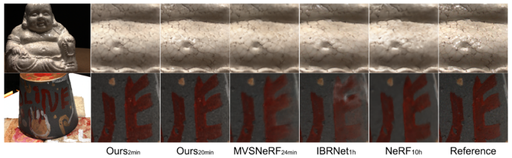
Figure 6 . Qualitative comparisons of per-scene optimization on the DTU dataset [18]. Our Point-NeRF can recover texture details and geometrical structures more accurately than other methods. Point-NeRF also demonstrates superior efficiency. Within two mins, our model trained for 1K steps is already on par with the state-of-the-art methods such as MVSNeRF [8] and IBRNet [53]
出典 · CC0 1.0 · Qiangeng Xu, Zexiang Xu, Julien Philip, Sai Bi, Zhixin Shu, Kalyan Sunkavalli, Ulrich Neumann · Point-NeRF: Point-based Neural Radiance Fields · 論文の図を引用 · 元のPDFの9ページ目から図の部分を抽出しています。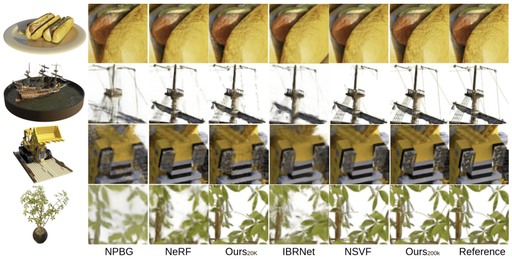
Figure 7 . Qualitative comparisons on the NeRF Synthetic dataset [35]. The subscripts indicate the number of iterations. Our Point-NeRF can capture fine details and thin structures (see the rope on row 2). Point-NeRF also demonstrates superior efficiency. Our model trained for 20K steps already on par with NeRF with 30× faster training time.
出典 · CC0 1.0 · Qiangeng Xu, Zexiang Xu, Julien Philip, Sai Bi, Zhixin Shu, Kalyan Sunkavalli, Ulrich Neumann · Point-NeRF: Point-based Neural Radiance Fields · 論文の図を引用 · 元のPDFの9ページ目から図の部分を抽出しています。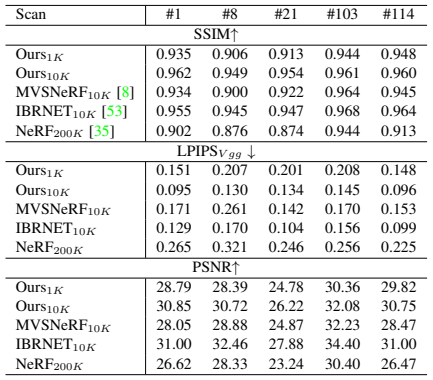
Table 6 . Quantity comparison on five sample scenes in the DTU testing set with the view synthesis setting introduced in [8]. The subscripts indicate the number of iterations during optimization.
出典 · CC0 1.0 · Qiangeng Xu, Zexiang Xu, Julien Philip, Sai Bi, Zhixin Shu, Kalyan Sunkavalli, Ulrich Neumann · Point-NeRF: Point-based Neural Radiance Fields · 論文の図を引用 · 元のPDFの12ページ目から図の部分を抽出しています。適用範囲と限界
Point-NeRFはローカルな放射輝度表現であるため、背景用NeRFのような追加の構成要素がなければ、unbounded sceneの背景は扱えないと論文に明記されています。ScanNetの実験では、著者らは深度画像で点群を初期化したと述べ、これはNSVFが同じ設定を使っていたためだと説明しています。また、MVSNetの点は背景の外れ値を減らすため、データセットごとのフィルタリングを経ます。レンダリング速度そのものは本研究の主な最適化対象ではありません。論文は、NeRFより高速である理由を、空き領域のサンプリングを省略したことによる結果として説明しています。

Table 8 . Quantity comparison on two scenes in the ScanNet dataset [11] selected in NSVF [29]. RMSE is the Root Mean Square Error. Our method Point-NeRF outperforms all state-of-the-art methods in all metrics by substantial margins. We also report the (original/calibrated) SSIM. Our original SSIM uses the Skimage library with dynamic max signal value while several current papers use SSIM with as 1, therefore we also calibrate to their settings. Besides, per other authors’ requests, we also add our method starting with the mesh instead of depth images, and report its results after 100K steps. Since the mesh of Scene 101 is extremely incomplete, we can observe tremendous quality loss.
出典 · CC0 1.0 · Qiangeng Xu, Zexiang Xu, Julien Philip, Sai Bi, Zhixin Shu, Kalyan Sunkavalli, Ulrich Neumann · Point-NeRF: Point-based Neural Radiance Fields · 論文の図を引用 · 元のPDFの13ページ目から図の部分を抽出しています。
Table 10 . We use MVSNet [59] to reconstruct the points and filter them by using background color, then initialize neural points and optimized our Point-NeRF model for 200 thousand iterations.
出典 · CC0 1.0 · Qiangeng Xu, Zexiang Xu, Julien Philip, Sai Bi, Zhixin Shu, Kalyan Sunkavalli, Ulrich Neumann · Point-NeRF: Point-based Neural Radiance Fields · 論文の図を引用 · 元のPDFの17ページ目から図の部分を抽出しています。論文情報
- 著者
- Qiangeng Xu, Zexiang Xu, Julien Philip, Sai Bi, Zhixin Shu, Kalyan Sunkavalli, Ulrich Neumann
- 学会・ジャーナル
- arXiv · プレプリント
- 公開日
- 2022年1月21日
- 登録日
- 2026年11月5日
- 更新日
- 2023年3月15日
- バージョン
- v7
- arXiv
- 2201.08845
- カテゴリ
- cs.CV
- ライセンス
- CC0 1.0
- 掲載内容
- 論文情報・解説・論文の図
この解説は、Refivuの韓国語解説をAIで翻訳したものです。不正確な翻訳や誤りが含まれる可能性があります。論文と図の利用条件は各出典に従います。
アブストラクト
Volumetric neural rendering methods like NeRF generate high-quality view synthesis results but are optimized per-scene leading to prohibitive reconstruction time. On the other hand, deep multi-view stereo methods can quickly reconstruct scene geometry via direct network inference. Point-NeRF combines the advantages of these two approaches by using neural 3D point clouds, with associated neural features, to model a radiance field. Point-NeRF can be rendered efficiently by aggregating neural point features near scene surfaces, in a ray marching-based rendering pipeline. Moreover, Point-NeRF can be initialized via direct inference of a pre-trained deep network to produce a neural point cloud; this point cloud can be finetuned to surpass the visual quality of NeRF with 30X faster training time. Point-NeRF can be combined with other 3D reconstruction methods and handles the errors and outliers in such methods via a novel pruning and growing mechanism. The experiments on the DTU, the NeRF Synthetics , the ScanNet and the Tanks and Temples datasets demonstrate Point-NeRF can surpass the existing methods and achieve the state-of-the-art results.
この論文を引用
Qiangeng Xu, Zexiang Xu, Julien Philip, Sai Bi, Zhixin Shu, Kalyan Sunkavalli, Ulrich Neumann (2022). Point-NeRF: Point-based Neural Radiance Fields. arXiv:2201.08845v7. https://arxiv.org/abs/2201.08845v7
BibTeX
@misc{xu2022point,
  title = {{Point-NeRF: Point-based Neural Radiance Fields}},
  author = {Qiangeng Xu and Zexiang Xu and Julien Philip and Sai Bi and Zhixin Shu and Kalyan Sunkavalli and Ulrich Neumann},
  year = {2022},
  eprint = {2201.08845},
  archivePrefix = {arXiv},
  url = {https://arxiv.org/abs/2201.08845v7}
}