論文解説
Explicitly capturing demonstrator multi-modality for distillation into diffusion policies
拡散ポリシーへの蒸留に向けたデモンストレーターのマルチモダリティの明示的な捕捉
- 課題 標準的なsliding window方式のデータ収集では、観測ごとに行動が1つしか記録されず、専門家の多峰性の分布を拡散ポリシーが再現しにくくなります。
- 手法 同じ観測で専門家をk回問い合わせるvineサンプリングをBCのデータ収集に適用し、観測ごとに複数の行動を記録します。
- 結果 合成タスクではkが大きくなるほどポリシー誤差と多様性が改善しました。truck unloadingでは、vineポリシーがsliding windowより、ポリシー誤差とSD比率が良く、探索とexpert iterationの性能も高くなりました。
標準的なデータ収集がマルチモーダルを取りこぼす理由
拡散ポリシーを行動複製(BC)で学習するとき、専門家の多峰性の行動分布がポリシーに十分伝わらないという問題を扱います。標準的なsliding window方式では、エピソードの各時点について観測履歴と予測区間の行動を1組にします。同じ観測に対して実際に記録される行動は1つだけです。連続的で高次元の観測では、別のエピソードが正確に同じ観測履歴を再現することはないため、専門家がその状態で別の行動を取れたという反事実の情報がデータセットに残りません。このとき拡散モデルは学習データを記憶している領域で動作し、観測ごとに1つのモードだけを再現しやすくなります。論文では、これが低いポリシーの多様性の原因だとされています。
この研究は、この曖昧さをデータの側から解決しようとしています。つまり、同じ観測で専門家に何度も問い合わせて観測ごとの行動数kを増やすと、学習データが専門家の条件付き分布をよりよく表すのかを問います。
観測ごとの行動数kを増やす合成分析
まず合成タスクで、観測ごとの行動数kが学習されたポリシーにどう影響するかを切り分けて調べます。合成タスクは16次元の観測と行動を持ち、観測の情報次元zに応じて、主要な行動座標yが4つの有効なモードのいずれかに入る必要があります。データセットは、観測数nと観測ごとの行動数kの積n·kを1000に固定し、kを1、10、100と変えます。
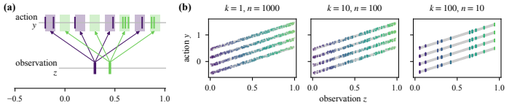
Fig. 3 : (a) Coordinate y of the synthetic task at two observations, with k = 5 actions sampled at each; arrows run from each observation to its four valid modes. (b) Visualization of synthetic datasets with fixed total dataset size n · k = 1000, but varied numbers of observations n, and actions per observations k; gray diagonals show the valid modes of the task. At fixed dataset size, more actions per condition comes at the cost of sparsity in z.
出典 · CC BY 4.0 · Shao Yuan Chew Chia, Rebecca H. Jiang, Abhinav Agarwal, Andreas Hofmann, Leslie Pack Kaelbling, Russ Tedrake · Explicitly capturing demonstrator multi-modality for distillation into diffusion policies · 論文の図を引用 · 元のPDFの4ページ目から図の部分を抽出しています。分布の次元での比較では、データ収集のサンプリング誤差が鍵になります。式(1)では、ポリシー誤差W1(πθ, πE)が、メモイゼーション誤差W1(πθ, P̂k)とデータ収集のサンプリング誤差W1(P̂k, πE)の和によって上から抑えられることが示されています。著者らは、メモイゼーションの項が小さいとき、ポリシー誤差はデータ収集のサンプリング誤差をどれだけ減らせるかに大きく左右されると解釈しています。実験では、kが大きくなるほどデータ収集のサンプリング誤差が減り、ポリシー誤差も一緒に減りました。メモイゼーション誤差はすべてのkで小さいままでした。
vineサンプリングのデータ収集手順
合成分析を実際のロボットBCに移すため、著者らはSchulmanらのvine手順をデータ収集のプロトコルに置き換えています。元のvine手順は、ポリシーのロールアウトを分岐させてポリシー勾配法の利得を推定するために使われます。一方この研究では、デモンストレーターの分岐した行動をBCの学習データとして使います。デモンストレーターは通常どおり計画を定期的に更新しながら状態を訪れ、各時点で確率pで現在の状態から専門家をk回問い合わせます。状態が行動決定過程によって変わる場合は、問い合わせの間に環境をリセットします。
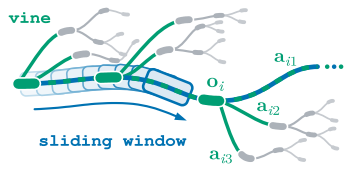
Fig. 2 : The choices that a demonstrator has the capac- ity to take branch along an episode. Sliding window datasets record one action per observation history, while vine datasets record several counterfactual actions at a random subset of observation histories. Gray actions are recorded in neither dataset.
出典 · CC BY 4.0 · Shao Yuan Chew Chia, Rebecca H. Jiang, Abhinav Agarwal, Andreas Hofmann, Leslie Pack Kaelbling, Russ Tedrake · Explicitly capturing demonstrator multi-modality for distillation into diffusion policies · 論文の図を引用 · 元のPDFの2ページ目から図の部分を抽出しています。データセットに入るのは、こうして選ばれた状態だけです。各状態はちょうどk個の行動を持ちます。したがって、vineサンプリングは1つの軌跡に沿ってp倍の条件を作り、その条件で専門家の代替行動を記録します。可能な代替行動をすべて分岐させる代わりに1つの軌跡を維持する設計は、状態分布が時間軸上で偏るのを避けるための選択だと説明されています。
truck unloadingにおけるvineと、ベースラインの比較
truck unloadingの実験は、平面ロボットがトラックから4つの箱をコンベアへ移す2Dシミュレーションのタスクです。2つのデータセットは同じ2,000個の問題インスタンスから収集されます。sliding windowはk=1、vineはp=0.1とk=10に設定しています。2つの方式は期待される学習サンプル数が同じになるように合わせ、どちらのデータセットも370,000個の学習サンプルに切り詰めました。ポリシーは100,000学習ステップのあいだ学習されました。
結果の比較では、vineポリシーはsliding windowポリシーより、ポリシー誤差とSD比率が良いと報告されています。この結果は、このタスクとこの設定で得られたものであり、他のロボットタスクやデータセットに一般化できる結果ではありません。また、処理量はピース数/時間で測定されました。
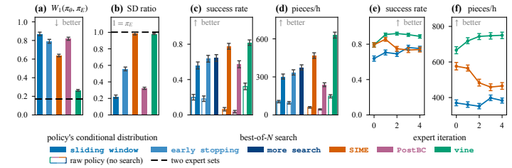
Fig. 5 : Truck unloading experiment. (a), (b) Policy error W1(πθ, πE) and SD ratio per method at held-out conditions. (c), (d) Success rate and throughput, in best-of- N search; N= 10 for solid bars except more search where N= 100 . (e), (f) The same two metrics over expert iteration for the sliding window , SIME, andvinemethods. Plotted values are means and error bars are 95% intervals.
出典 · CC BY 4.0 · Shao Yuan Chew Chia, Rebecca H. Jiang, Abhinav Agarwal, Andreas Hofmann, Leslie Pack Kaelbling, Russ Tedrake · Explicitly capturing demonstrator multi-modality for distillation into diffusion policies · 論文の図を引用 · 元のPDFの7ページ目から図の部分を抽出しています。探索とexpert iterationでの効果とベースライン
ポリシーの多様性の実際の効果は、best-of-N探索とexpert iterationで確認されます。論文では、best-of-NをN=10で評価しており、more searchベースラインだけがN=100を使っています。expert iterationは、sliding window、vine、SIMEのポリシーを初期値として比較されます。vineポリシーは探索で高い成功率と処理量を示し、expert iterationでも改善しましたが、後半の反復では成功率がわずかに下がりました。
ベースラインも一緒に比較されています。early stoppingは多様性を保つために20kチェックポイントを使いますが、学習が減るため、vineより適合度が低くなりました。SIMEは推論時にノイズを加えて多様性を高め、PostBCはアンサンブルに基づくガウスノイズを学習行動に加えます。著者らは、この結果を根拠に、データセットにデモンストレーターのマルチモーダルを記録する方が、学習後のポリシーに多様性を後から加えるよりも効果的だと解釈しています。
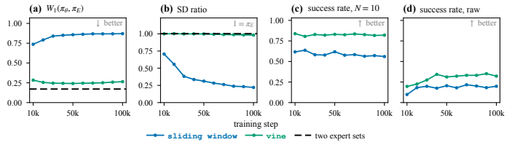
Fig. 9 : The sliding window and vine policies against training step. (a) Policy error and (b) SD ratio at the states of fig. 5. (c) Success rate under best-of-10 and (d) of the raw policy, on the 600 test instances. Reference lines in (a) and (b) are two independent sets of expert re-queries (black dashed).
出典 · CC BY 4.0 · Shao Yuan Chew Chia, Rebecca H. Jiang, Abhinav Agarwal, Andreas Hofmann, Leslie Pack Kaelbling, Russ Tedrake · Explicitly capturing demonstrator multi-modality for distillation into diffusion policies · 論文の図を引用 · 元のPDFの17ページ目から図の部分を抽出しています。コストと適用範囲の限界
vineサンプリングは、同じ数の学習サンプルを得るために、sliding windowよりもデモンストレーターへの問い合わせが多く必要です。sliding windowは実行されたエピソードのすべての時点を学習サンプルにしますが、vineは同じ問い合わせを、エピソードの完了と、サンプルごとの追加の問い合わせに使います。トラックの荷下ろしのデモンストレーターは、pickとplaceのたびに計画を立てるため、論文では、vineデータセットの収集コストは同じ規模のsliding windowデータセットの約30倍だと報告しています。
また、pとkの最適値は調べられておらず、best-of-N探索に最適なkが元のポリシーのロールアウトにも最適だという保証はありません。評価はシミュレーションのみで行われました。合成分析で見られた大きなkの利点は、データがまばらな領域に限ったものだと解釈されており、大規模ロボット基盤モデルがその領域にあるかどうかは今後の課題として残されています。
論文情報
- 著者
- Shao Yuan Chew Chia, Rebecca H. Jiang, Abhinav Agarwal, Andreas Hofmann, Leslie Pack Kaelbling, Russ Tedrake
- 学会・ジャーナル
- arXiv · プレプリント
- 公開日
- 2026年11月7日
- 登録日
- 2026年11月10日
- 更新日
- 2026年11月7日
- バージョン
- v1
- arXiv
- 2611.10949
- カテゴリ
- cs.RO
- ライセンス
- CC BY 4.0
- 掲載内容
- 論文情報・解説・論文の図
この解説は、Refivuの韓国語解説をAIで翻訳したものです。不正確な翻訳や誤りが含まれる可能性があります。論文と図の利用条件は各出典に従います。
アブストラクト
The diversity of a distilled diffusion policy's outputs matters beyond how it impacts the policy's success rate. In particular, downstream applications like test-time search and policy improvement require exploration. Thus, we want to distill multi-modal demonstrators into diffusion policies which reproduce their conditional action distributions. Standard data collection for behavior cloning applies a sliding window to demonstration episodes, which pairs unique observation histories with actions. These datasets can be fit by a policy that is either multi-modal, or unimodal with high Lipschitz constant to capture a diversity of actions seen at nearby observation samples. Prior work finds that diffusion policies trained on sparse data learn the latter, memorizing one action per observation. We adapt vine sampling to behavior cloning data collection to resolve this ambiguity: at some states the demonstrator visits, query it $k$ times from exactly the same observation. On a synthetic task, we study how the number of actions per observation, $k$, affects the learned policy, and find that larger $k$ yields a policy that better matches the demonstrator's conditional distribution, including its multi-modality and diversity. On a 2D truck unloading task, vine sampling likewise leads to a policy closer to the demonstrator and substantially improves both best-of-$N$ and expert iteration performance.
この論文を引用
Shao Yuan Chew Chia, Rebecca H. Jiang, Abhinav Agarwal, Andreas Hofmann, Leslie Pack Kaelbling, Russ Tedrake (2026). Explicitly capturing demonstrator multi-modality for distillation into diffusion policies. arXiv:2611.10949v1. https://arxiv.org/abs/2611.10949v1
BibTeX
@misc{chia2026explicitly,
  title = {{Explicitly capturing demonstrator multi-modality for distillation into diffusion policies}},
  author = {Shao Yuan Chew Chia and Rebecca H. Jiang and Abhinav Agarwal and Andreas Hofmann and Leslie Pack Kaelbling and Russ Tedrake},
  year = {2026},
  eprint = {2611.10949},
  archivePrefix = {arXiv},
  url = {https://arxiv.org/abs/2611.10949v1}
}