論文解説
Halting in Recurrent Sequence Models
再帰型シーケンスモデルにおける停止(halting)
- 課題 反復コピー課題で、再帰型モデルがEOSをいつ出力するかを、隠れ状態がどのように決めているのかはまだ明らかになっていません。
- 手法 反復回数だけが異なる2つの軌跡の差をRNNとSSMで追い、状態変換や位相回転によって停止時点に介入します。
- 結果 RNNではアフィン状態変換T_128により、新しいシーケンスで完全シーケンス精度0.944を達成し、コピーの停止を1回分早めました。SSMでは、平面ごとの独立回転によって停止の挙動のほとんどがなくなりました。
EOS停止問題
再帰型シーケンスモデルは出力の終わりをEOSトークンで知らせる必要がありますが、学習中のEOSは他のトークンと同じ語彙の項目にすぎず、専用の損失項も報酬もありません。この論文は、このような条件ではモデルがいつEOSを出力するのかがまだよく理解されていないと指摘しています。そのうえで、反復コピー課題を最小限の設定として、停止時点の内部メカニズムを調べています。モデルはシーケンスSを指示されたK回繰り返してからEOSを出力するように学習され、同じSを使いながら反復回数の指示だけを変えた2つの軌跡について、隠れ状態の差が停止時点までどのように伝わるかが中心的な問いです。
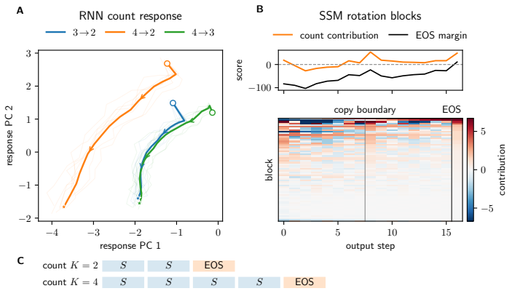
Figure 1 : The count instruction changes the EOS time while the stored sequence remains fixed.A, RNN trajectory differences on held-out sequences projected onto two principal components obtained from separate sequences. Open circles mark the state after the count instruction, stars mark the earlier target EOS, and arrows follow the autonomous recurrence.B, mean contributions of the 64 SSM rotation blocks to the limiting EOS comparison for count change 4→2 . Between copy boundaries the contributions have mixed signs. At the target EOS, most contributions have the same sign and the EOS margin crosses zero.C, repeat-copy examples ending after two or four copies of S. RNN seed 5, the model with the median energy in the two plotted components, and SSM seed 1 are shown.
出典 · CC BY 4.0 · Simon Dräger · Halting in Recurrent Sequence Models · 論文の図を引用 · 元のPDFの2ページ目から図の部分を抽出しています。tanh RNNにおける状態差の伝播
EOSマージン m_t は、EOSのスコアから他のトークンのスコアの最大値を引いた値で、正のときにEOSが出力されます。入力が終わると入力は0になり、再帰は自律的に動くため、停止時点は隠れ状態そのものが運ばなければなりません。RNNでは、2つの軌跡の差 Δ_JK,t が Δ_JK,t+1 = D_JK,t+1 W_h Δ_JK,t として伝播します。ここでDは、tanhの割線 s(a,b) を対角に並べた行列です。つまり、W_hで混ぜたあとに各隠れユニットを現在の状態に応じて (0,1] の範囲に縮める2段階が繰り返されます。著者らは、Table 1で割線をidentity、ランダム置換、時間シフトなどに置き換えたところ、ユニットの同一性と時間順序の影響が最も大きいと報告しています。
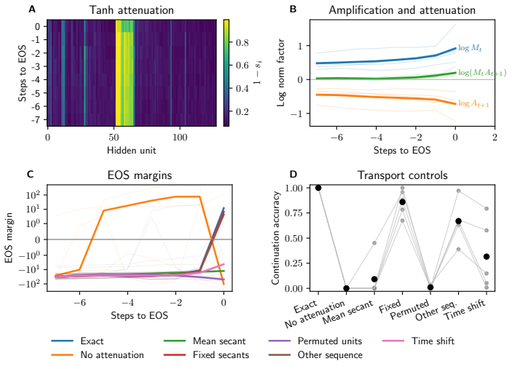
Figure 2 : Transport of the RNN trajectory difference.A, mean tanh secants for model seed 5 and count change 4→2 , with hidden units ordered by the step of strongest attenuation on separate sequences.B, multiplication by Wh expands the trajectory difference before tanh attenuates it. Faint lines denote model means and solid lines denote the cohort mean.C, EOS margins along the two trajectories.D, continuation accuracy under the exact secants and their controlled replacements.
出典 · CC BY 4.0 · Simon Dräger · Halting in Recurrent Sequence Models · 論文の図を引用 · 元のPDFの5ページ目から図の部分を抽出しています。コピー境界で残りの回数を減らす
RNNの状態は (n,p) で索引でき、nは残りのコピー回数、pはコピー内の位置です。異なる反復指示を受けた場合でも、同じ (n,p) と S を持つ状態は近くに集まります。著者らは、1回のコピーの位置平均からサイクルの中心を作り、これらの中心がPCAの2軸上で残りのステップ数 τ に従って並ぶと記録しています。次に、コピー境界で残りのコピーを1つ減らすアフィン状態変換 T_k を、別のシーケンスで学習しました。この変換を適用すると、元のRNNは1回のコピー分早くEOSを出力し、それより前のトークンはそのまま保たれます。
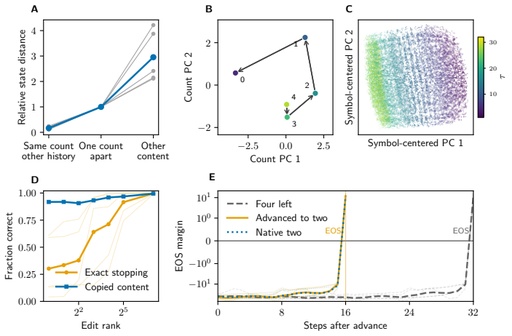
Figure 3 : RNN states indexed by the number of output steps remaining.A, distances between states that share (n, p)and S under different count instructions, between states one copy apart, and between states storing other content, each relative to the distance between states one copy apart. Gray lines denote models and the blue line denotes their mean.B, cycle centers projected onto two principal components obtained from separate sequences. Arrows follow one complete copy.C, evaluation states of model seed 3, the model with the median R2, after subtracting the fitting-set mean state of each emitted symbol, projected onto the first two principal components of the fitting states and colored by τ.D, stopping and content accuracy after the affine state transformation of Equation (7) as a function of its rank.E, EOS margins after the native recurrence advances a state by two copies.
出典 · CC BY 4.0 · Simon Dräger · Halting in Recurrent Sequence Models · 論文の図を引用 · 元のPDFの7ページ目から図の部分を抽出しています。線形SSMの回転平面と位相の整列
線形SSMは、A_q = ρ_q Rot(ω_q) の形の64個の2×2回転ブロックで構成されます。自律出力のu段階後、平面qの寄与はρ_q^uと回転角φ + uω_qで表され、出力行列がこれらの寄与を合計してEOS比較Δgを作ります。コピーの間は平面の寄与が打ち消し合い、停止時点の近くでは揃ってEOS比較を大きくします。平面ごとに位相だけを独立に回転させると、振幅とコピー内容は保たれますが、停止の挙動はほとんど消えます。すべての平面を同じ角度で回転させると相対位相は保たれるため、停止は0.268から0.316のロールアウトで残ります。
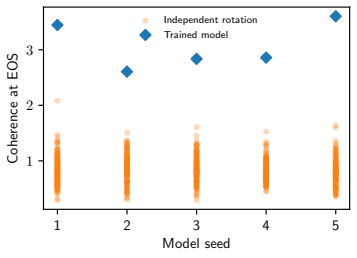
Figure 4 : Coherence of the rotation-plane contributions at EOS in each SSM, compared with independent amplitude-preserving rotations of the planes. Stopping and content accuracy under these rotations are given in Table 2.
出典 · CC BY 4.0 · Simon Dräger · Halting in Recurrent Sequence Models · 論文の図を引用 · 元のPDFの9ページ目から図の部分を抽出しています。介入実験の結果
RNNでは、Table 1の複数の割線置き換えを評価しました。割線をidentityにすると連続精度は0.000、正確な割線では1.000でした。同じ条件で、目標状態を混ぜたり平均状態に置き換えたりした対照条件は、完全出力をほとんど作れませんでした。SSMでは、固定方向 (r−3)ξ を3つのコピー状態の最初の出力状態に加える実験を行いました。r=1,2,4,5 の目標に合わせた方向は、4つのモデルで完全シーケンス精度の基準を満たしました。ただし、r=6では失敗しました。
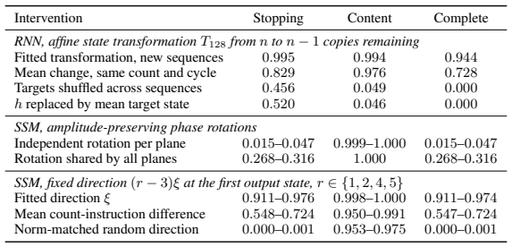
Table 2 : Interventions on the stopping mechanism, evaluated on held-out sequences. All accuracies are computed over every rollout. RNN entries are means over the five models, and SSM entries are ranges across the five models. The fixed-direction rows pool the targets r= 1,2,4,5 , starting from a rollout of three copies. Since the SSM rotations preserve almost all of the copied content, their complete-sequence accuracy rounds to the same range as their stopping accuracy.
出典 · CC BY 4.0 · Simon Dräger · Halting in Recurrent Sequence Models · 論文の図を引用 · 元のPDFの8ページ目から図の部分を抽出しています。限界
Lは固定されているため、(n,p) と残りのステップ数 τ=nL−p の間には全単射が存在します。そのため、この実験だけではネットワークが2つの軸を別々に表現しているかどうかは区別できません。分析は小さなtanh RNNと線形SSMに限られ、gated RNNと非線形SSMで同じ伝播の形が現れるかは確認していません。
論文情報
- 著者
- Simon Dräger
- 学会・ジャーナル
- arXiv · プレプリント
- 公開日
- 2026年11月16日
- 登録日
- 2026年11月17日
- 更新日
- 2026年11月16日
- バージョン
- v1
- arXiv
- 2611.20377
- カテゴリ
- cs.LG
- ライセンス
- CC BY 4.0
- 掲載内容
- 論文情報・解説・論文の図
この解説は、Refivuの韓国語解説をAIで翻訳したものです。不正確な翻訳や誤りが含まれる可能性があります。論文と図の利用条件は各出典に従います。
アブストラクト
Recurrent sequence models, such as recurrent neural networks (RNNs) and state space models (SSMs), are often trained to emit an end-of-sequence (EOS) token when their output sequence is complete. During training, EOS is treated as another token without a special loss term or incentive. Although this training paradigm is widely used, it is not understood how models decide to output EOS. We study a minimal version of the EOS halting problem in which networks are trained to emit a given input sequence an instructed number of times, followed by EOS. We train tanh RNNs and linear SSMs on this task, finding that the RNNs encode the number of tokens left to copy in a linear subspace, of which two principal components capture most of the variation. Hidden states with the same remaining count converge to a shared representation regardless of their instructed repeat count. By modulating the hidden state using an affine transformation at the boundary between copied sequences, we shift the RNN's state to the representation shared by states with one fewer copy remaining. The unchanged network emits EOS one copy earlier while reproducing the shortened target sequence in 94.4% of new sequences, revealing that this representation causally determines the stopping time. In the SSMs, the difference between trajectories with different repeat counts is separated across two-dimensional rotation planes whose contributions to the EOS comparison cancel during copying and align near the stopping time. Rotating the planes independently removes most of the intended stopping while preserving the copied content, which shows that the stopping time depends on the planes' relative phases. These results identify two candidate primitives of EOS halting in recurrent models: a shared encoding of the number of remaining tokens in tanh RNNs and phase alignment across fixed rotations in linear SSMs.
この論文を引用
Simon Dräger (2026). Halting in Recurrent Sequence Models. arXiv:2611.20377v1. https://arxiv.org/abs/2611.20377v1
BibTeX
@misc{drger2026halting,
  title = {{Halting in Recurrent Sequence Models}},
  author = {Simon Dräger},
  year = {2026},
  eprint = {2611.20377},
  archivePrefix = {arXiv},
  url = {https://arxiv.org/abs/2611.20377v1}
}