論文解説
CoRA-Bench: Evaluating Evidence Preservation by Context Selectors Under Token Budgets
CoRA-Bench:トークン予算下での文脈選択器による根拠保存の評価
- 課題 長い入力を削る文脈選択器が、質問に必要な根拠をどの程度残すのか、また、その残り方がリーダーの精度と同じ順位になるのかを、共通のトークン予算で比べます。
- 手法 CoRA-Benchでは、同じトークン予算内で6つの選択器が作った最終的な文脈について、データセットごとに根拠の回収率を測定します。同じ文脈を固定したリーダーに入れて、精度も測定します。
- 結果 BABILongのBM25、NoLiMaの密検索、LongMemEvalのDense+Rerankのように、根拠保存での優位はデータセットと予算によって変わります。リーダー精度の順位も、根拠回収率の順位と常に一致するわけではありません。
長い入力で根拠を失う問題
長い入力をモデルに渡すとき、入力長を減らすために文脈選択器を使うと、質問への回答に必要な根拠も一緒に取り除かれることがあります。この論文は、この問題を共通のトークン予算の下で比較できるよう、CoRA-Benchを提案しています。比較対象は、ヘッド・テール切り取り、BM25、密検索、密な再ランキング、LLMLingua-2、Provenceで、データセットはBABILong、LOONG、NoLiMaのカスタム診断、LongMemEvalです。中心となる問いは、選ばれた文脈がどの程度根拠を保存するか、そして同じ文脈を読んだリーダーの精度順位が根拠回収率の順位と一致するかです。
予算内での選択と評価の流れ
評価では、クエリq、元の文脈C、予算B、選択器Smを用意し、C′ = Sm(q, C; B)を作ります。その後、最終出力C′のトークン数がB以下になるように構成します。トークン数の計算にはcl100k_baseを使い、32K、64K、128Kの予算は、クエリと指示文のオーバーヘッドを除いた選択文脈に適用されます。BM25、密検索、密な再ランキングでは、512トークンのチャンクと64トークンの重なりを使います。重なる原文トークンの区間を統合した後、ランキングの先頭部分を予算内で選び、元の順序に戻します。再ランキングでは、候補プールが尽きると予算を使い切れないことがあります。根拠回収率、トークン保持率、リーダースコアは、いずれも同じ最終出力から計算されます。
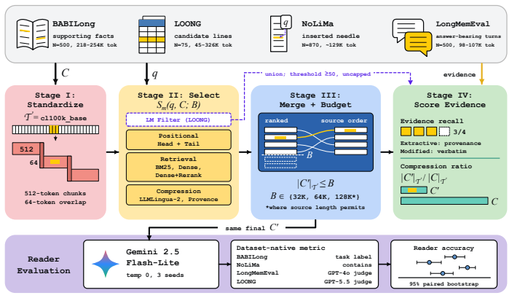
Figure 1 : CoRA-Bench: shared token budgets and dataset-specific evidence scoring across four retrieval regimes. Evidence and reader evaluation use the same final context, with overlapping retrieval spans merged; reader inference is repeated with 3 seeds. The LM-filter bypass denotes Threshold ≥50 , uncapped; its ranked, capped arms follow budget enforcement without a score threshold.
出典 · CC BY 4.0 · Huzaifa Pardawala, Siddhant Sukhani, Sudheer Chava, Agam Shah · CoRA-Bench: Evaluating Evidence Preservation by Context Selectors Under Token Budgets · 論文の図を引用 · 元のPDFの2ページ目から図の部分を抽出しています。データセットごとの根拠の定義とリーダー評価
根拠の定義はデータセットごとに異なります。BABILongでは、出現位置を考慮した正解の支持事実の回収率を測定します。LOONGでは、独立したレビューによる支持区間がない場合に、自動で特定した候補行の残存を測定します。この候補行は、人手で注釈された正解の根拠ではありません。NoLiMaでは挿入された針のverbatim残存を、LongMemEvalでは注釈された正解ターンの回収を測定します。このリーダー構成の結果は、その設定に限定して読む必要があります。
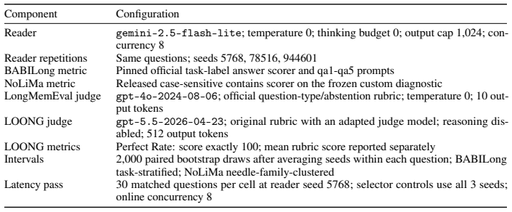
Table 4 : Reader and evaluation settings. The same questions are evaluated at 3 seeds; dataset-native scoring rules are retained, with an adapted judge model for LOONG.
出典 · CC BY 4.0 · Huzaifa Pardawala, Siddhant Sukhani, Sudheer Chava, Agam Shah · CoRA-Bench: Evaluating Evidence Preservation by Context Selectors Under Token Budgets · 論文の図を引用 · 元のPDFの9ページ目から図の部分を抽出しています。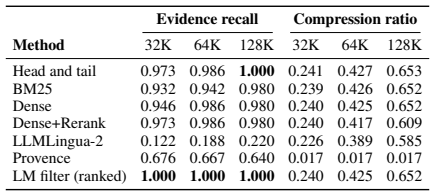
Table 11 : LOONG macro automatically matched candidate-line survival and macro compression ratio. Evidence denominators are 74/69/50; reader and token denominators are 75/70/51 at 32K/64K/128K. LM filter (ranked) applies no score threshold. Threshold ≥50 , uncapped is reported separately: survival 0.932 (n= 74) and compression ratio 0.037 (n= 75).
出典 · CC BY 4.0 · Huzaifa Pardawala, Siddhant Sukhani, Sudheer Chava, Agam Shah · CoRA-Bench: Evaluating Evidence Preservation by Context Selectors Under Token Budgets · 論文の図を引用 · 元のPDFの14ページ目から図の部分を抽出しています。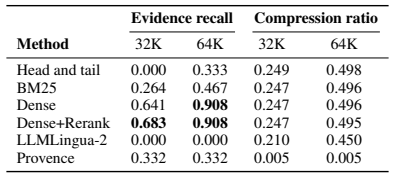
Table 12 : Custom NoLiMa normalized verbatim needle survival and macro compression ratio over 870 repeated observations.
出典 · CC BY 4.0 · Huzaifa Pardawala, Siddhant Sukhani, Sudheer Chava, Agam Shah · CoRA-Bench: Evaluating Evidence Preservation by Context Selectors Under Token Budgets · 論文の図を引用 · 元のPDFの14ページ目から図の部分を抽出しています。根拠保存の順位の変化とリーダー精度
BABILongでは、BM25が32K、64K、128Kの予算でそれぞれ支持事実の回収率0.838、0.868、0.921を示し、この設定では根拠回収率が最も高くなりました。NoLiMaのカスタム診断の64K予算では、密検索と密な再ランキングがそれぞれ0.908の針回収率となり、BM25は0.467でした。LongMemEvalでは、Dense+Rerankが32Kと64Kで正解ターンを0.979と0.991保存しました。リーダー精度では、BABILongの32KでBM25は46.20%、Full contextは31.13%でした。したがって、根拠回収率の順位とリーダー精度の順位はデータセットごとに一致せず、両方の指標を併せて報告すべきだと解釈できます。
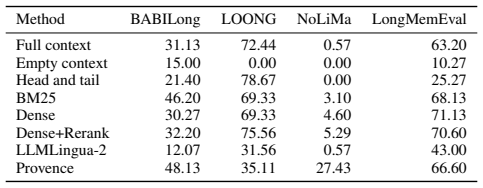
Table 2 : Reader accuracy (%) at a 32K context budget under overlap-union packing, averaged over seeds 5768, 78516, and 944601. LOONG uses Perfect Rate; NoLiMa is the custom diagnostic. Full and empty controls use all questions without a context budget. Confidence intervals and all budgets are reported in Appendix B.
出典 · CC BY 4.0 · Huzaifa Pardawala, Siddhant Sukhani, Sudheer Chava, Agam Shah · CoRA-Bench: Evaluating Evidence Preservation by Context Selectors Under Token Budgets · 論文の図を引用 · 元のPDFの4ページ目から図の部分を抽出しています。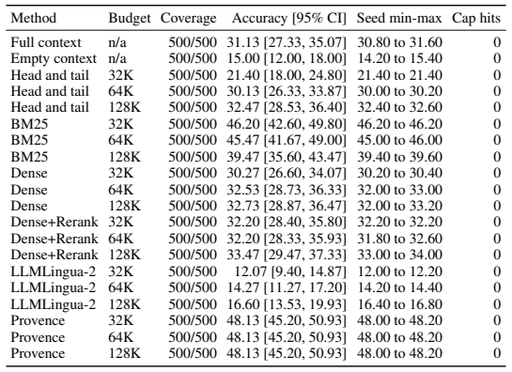
Table 5 : BABILong: reader evaluation under overlap-union packing. Accuracy is a percentage; brackets are 95% paired-bootstrap intervals after averaging three reader runs within each question (BABILong: task-stratified; NoLiMa: needle-family-clustered). The seed range is descriptive, not a confidence interval. Coverage counts questions scored at all three seeds; cap hits count outputs reaching the output-token limit.
出典 · CC BY 4.0 · Huzaifa Pardawala, Siddhant Sukhani, Sudheer Chava, Agam Shah · CoRA-Bench: Evaluating Evidence Preservation by Context Selectors Under Token Budgets · 論文の図を引用 · 元のPDFの11ページ目から図の部分を抽出しています。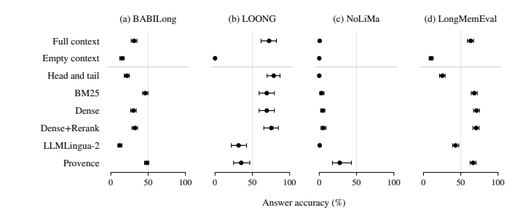
Figure 2 : Reader accuracy at 32K with Gemini 2.5 Flash-Lite, averaged over seeds 5768, 78516, and 944601. Points show mean accuracy. Horizontal bars are 95% paired-bootstrap intervals after averaging reader runs within question. BABILong is task-stratified and NoLiMa is needle-family- clustered. Full/empty controls have no budget cap. LOONG reports Perfect Rate; other panels report their dataset-specific answer metrics. Evidence and token-retention measurements in Figure 3 use these same emitted contexts.
出典 · CC BY 4.0 · Huzaifa Pardawala, Siddhant Sukhani, Sudheer Chava, Agam Shah · CoRA-Bench: Evaluating Evidence Preservation by Context Selectors Under Token Budgets · 論文の図を引用 · 元のPDFの11ページ目から図の部分を抽出しています。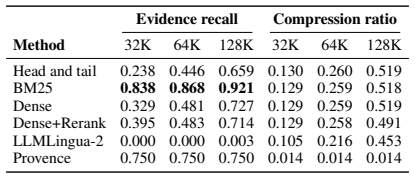
Table 10 : BABILong macro supporting-fact recall and macro compression ratio. Each cell uses the same 500 examples, all longer than 128K tokens.
出典 · CC BY 4.0 · Huzaifa Pardawala, Siddhant Sukhani, Sudheer Chava, Agam Shah · CoRA-Bench: Evaluating Evidence Preservation by Context Selectors Under Token Budgets · 論文の図を引用 · 元のPDFの14ページ目から図の部分を抽出しています。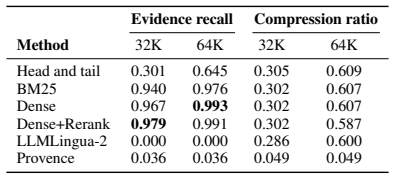
Table 13 : LongMemEval macro answer-bearing turn recall over 470 answerable examples and macro compression ratio over all 500 examples, including 30 abstentions. All methods have complete coverage.
出典 · CC BY 4.0 · Huzaifa Pardawala, Siddhant Sukhani, Sudheer Chava, Agam Shah · CoRA-Bench: Evaluating Evidence Preservation by Context Selectors Under Token Budgets · 論文の図を引用 · 元のPDFの15ページ目から図の部分を抽出しています。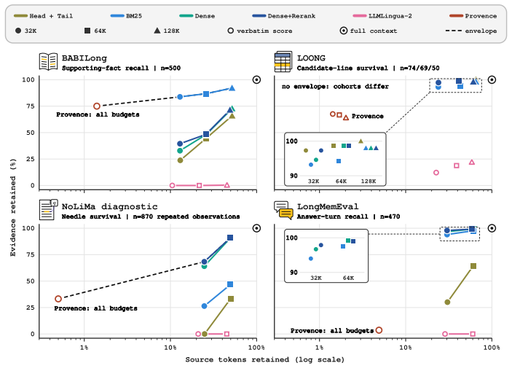
Figure 3 : Evidence recall versus retained source tokens across four datasets. Both axes show percentages, with a logarithmic token axis. Marker shapes indicate token budgets with hollow markers denoting verbatim evidence scoring and ringed markers denoting full context. Dashed lines show nondominated envelopes for fixed-cohort datasets. LOONG uses different cohorts across budgets (74/69/50 evidence-evaluable examples). Insets enlarge clustered results, with horizontally offset markers for clarity. Provence is shown once where results coincide across budgets. LM-filter results are excluded. All values are point estimates without confidence intervals.
出典 · CC BY 4.0 · Huzaifa Pardawala, Siddhant Sukhani, Sudheer Chava, Agam Shah · CoRA-Bench: Evaluating Evidence Preservation by Context Selectors Under Token Budgets · 論文の図を引用 · 元のPDFの16ページ目から図の部分を抽出しています。適用範囲と限界
結果は、評価したコホート、パッキング方針、Gemini 2.5 Flash-Liteリーダーという条件付きのものです。3つのシードは、このリーダー構成のばらつきを示すにとどまります。LOONGの候補行は自動で特定されるため、verbatimでの採点は意味的な保存を過小評価する可能性があります。NoLiMaは著者らによるカスタム診断であり、LongMemEvalは静的な選択を評価しています。共有トークン予算は実際のモデルコストとは異なり、記録された選択の計算時間はエンドツーエンドの遅延ではありません。論文では、この比較においてLOONGのコホートが予算ごとに異なり、予算間の差にはコホートの変化も反映されていると述べられています。
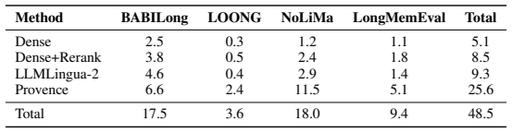
Table 3 : Historical per-method selection compute under chunk-concatenation packing, in L4 instance wall-clock hours (recorded via time.perf_counter around each selector’s main compute block; this is instance wall time, not measured GPU utilization). CPU-only baselines and API-based LM filtering are excluded. LM-filter API costs are reported separately in the text.
出典 · CC BY 4.0 · Huzaifa Pardawala, Siddhant Sukhani, Sudheer Chava, Agam Shah · CoRA-Bench: Evaluating Evidence Preservation by Context Selectors Under Token Budgets · 論文の図を引用 · 元のPDFの8ページ目から図の部分を抽出しています。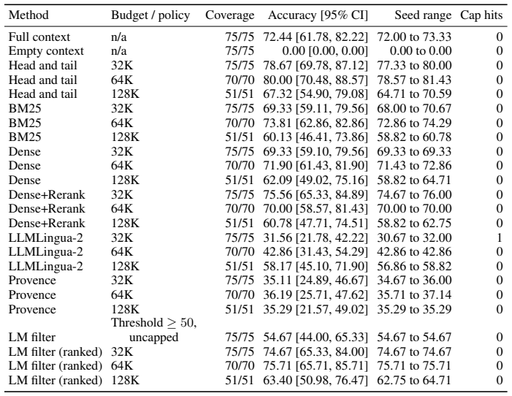
Table 6 : LOONG: reader evaluation under overlap-union packing. The LM-filter threshold arm keeps scores ≥50 without a cap; its ranked arms use no score threshold. Accuracy is LOONG Perfect Rate with the adapted GPT-5.5 judge; eligible cohorts are 75/70/51 at 32K/64K/128K; brackets are 95% paired-bootstrap intervals after averaging three reader runs within each question (BABILong: task-stratified; NoLiMa: needle-family-clustered). The seed range is descriptive, not a confidence interval. Coverage counts questions scored at all three seeds; cap hits count outputs reaching the output-token limit.
出典 · CC BY 4.0 · Huzaifa Pardawala, Siddhant Sukhani, Sudheer Chava, Agam Shah · CoRA-Bench: Evaluating Evidence Preservation by Context Selectors Under Token Budgets · 論文の図を引用 · 元のPDFの12ページ目から図の部分を抽出しています。論文情報
- 著者
- Huzaifa Pardawala, Siddhant Sukhani, Sudheer Chava, Agam Shah
- 学会・ジャーナル
- arXiv · プレプリント
- 公開日
- 2026年11月6日
- 登録日
- 2026年11月10日
- 更新日
- 2026年11月6日
- バージョン
- v1
- arXiv
- 2611.10238
- カテゴリ
- cs.AI · cs.CL
- ライセンス
- CC BY 4.0
- 掲載内容
- 論文情報・解説・論文の図
この解説は、Refivuの韓国語解説をAIで翻訳したものです。不正確な翻訳や誤りが含まれる可能性があります。論文と図の利用条件は各出典に従います。
アブストラクト
Context selection can reduce input length during long-input inference but can remove evidence required to answer a query. We introduce CoRA-Bench, a benchmark for evaluating evidence preservation under shared token budgets. We compare head and tail truncation, BM25, dense retrieval, dense retrieval with reranking, LLMLingua-2, and Provence across BABILong, LOONG Financial Spotlight, a custom NoLiMa diagnostic, and LongMemEval. Evidence-preservation results reveal task-dependent tradeoffs: BM25 achieves 0.921 supporting-fact recall on BABILong at 128K, dense retrieval and dense reranking each achieve 0.908 needle recall on NoLiMa at 64K, and dense retrieval achieves 0.993 answer-bearing-turn recall on LongMemEval at 64K. Evidence, token retention, and complementary reader evaluations use the same selected contexts. Reader evaluations use dataset-native answer metrics and three runs on the same questions, with paired bootstrap confidence intervals. At a 32K budget, BM25 achieves 46.20% BABILong answer accuracy and dense retrieval achieves 71.13% LongMemEval accuracy. The results show that method rankings vary across evidence types and between evidence recall and downstream accuracy.
この論文を引用
Huzaifa Pardawala, Siddhant Sukhani, Sudheer Chava, Agam Shah (2026). CoRA-Bench: Evaluating Evidence Preservation by Context Selectors Under Token Budgets. arXiv:2611.10238v1. https://arxiv.org/abs/2611.10238v1
BibTeX
@misc{pardawala2026cora,
  title = {{CoRA-Bench: Evaluating Evidence Preservation by Context Selectors Under Token Budgets}},
  author = {Huzaifa Pardawala and Siddhant Sukhani and Sudheer Chava and Agam Shah},
  year = {2026},
  eprint = {2611.10238},
  archivePrefix = {arXiv},
  url = {https://arxiv.org/abs/2611.10238v1}
}