論文解説
HARP-Bench: Benchmarking Robot Manipulation Around Active Humans
HARP-Bench:能動的な人の周辺でのロボット操作ベンチマーク
- 課題 人が作業空間をロボットと共有すると、課題の目標、使える物体、安全に動ける範囲が変わります。それでも既存のベンチマークは、この変化をほとんど評価していません。
- 手法 HARP-Benchは、Cueing、Contribution、Interruption、Co-presenceの4つの条件をアバターによる事象として実装しています。閉ループ評価と実演データの生成の両方に対応しています。
- 結果 学習ポリシーの成功率は最大0.19にとどまりました。成功率が高くても安全指標が一貫して良くなるわけではありませんでした。人の存在を含むデータで学習すると、シミュレーションと実機のContribution変形で一部改善が見られました。
既存のベンチマークが扱えなかった人の存在する状況
ほとんどのロボット操作ベンチマークは、ロボットだけが能動的に作業空間を変える状況を想定しています。この場合、課題の意味は言語指示と物体の状態によってほぼ固定されます。しかし人が同じ作業空間を共有すると、人の行動によってロボットの目標が明らかになったり、課題の一部が完了したり、物体の使用可否が変わったり、ロボットの安全な移動範囲が制限されたりすることがあります。HARP-Benchは、この変化を背景の変動ではなく、操作問題の一部として扱います。既存の高水準の人間相互作用ベンチマークは、計画や技能のレベルで抽象化しています。一方、低水準のHRC研究は、規模と視覚的な豊かさが不足しているという限界があります。
そのため、視覚観測と言語指示を受け取る自律操作ポリシーを、人が存在する作業空間で評価できるスケーラブルなシミュレーションベンチマークが必要です。
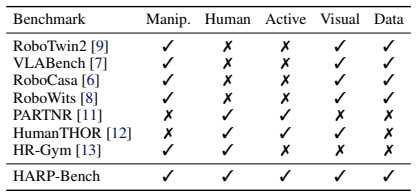
Table 1 :Comparison with related benchmarks.Manip. denotes low-level manipulation; Human denotes active humans in the workspace; Active denotes human activity during policy rollout; Visual denotes VLA-style visual observations; Data denotes demonstration or dataset generation support.
出典 · CC0 1.0 · Qinhong Zhou, Riley Zong, Chunru Lin, Diyi Hu, Shivraj Singh Bhatti, Hongxin Zhang, Lin Qiu, Hanqing Zeng, Chuang Gan · HARP-Bench: Benchmarking Robot Manipulation Around Active Humans · 論文の図を引用 · 元のPDFの4ページ目から図の部分を抽出しています。4つの人の存在条件とアバターによる事象
HARP-Benchは、人の活動をCueing、Contribution、Interruption、Co-presenceの4つの条件に分けます。Cueingは、人の行動がロボットの目指すべき目標を示す条件です。Contributionは、人が課題の一部を完了し、ロボットが残りの下流タスクを考慮しなければならない条件です。Interruptionは、人が物体の使用可否や実行タイミングを一時的に変える条件です。Co-presenceは、ロボットの元の目標は維持されるものの、周囲の人の動きが動作上の制約を加える条件です。人はアニメーションのアバターとして実装され、事象はロボットの実行中に発生します。
ただし、ロボット側の操作は物理ベースで実行され、人側の事象は制御された反復評価のためにスクリプトで決められます。この設計により、同じ課題設定を評価にも実演データの生成にも使えます。
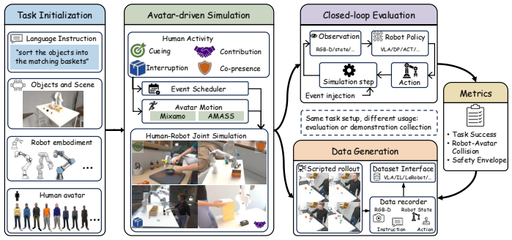
Figure 2 :Overview of the HARP-Bench pipeline.Each task initializes a scene with objects, a robot embodiment, and avatar-driven human activity. The same task setup supports two usage modes: closed-loop evaluation, where avatar events occur during execution and metrics are com- puted, and data generation, where scripted rollouts are recorded for robot learning.
出典 · CC0 1.0 · Qinhong Zhou, Riley Zong, Chunru Lin, Diyi Hu, Shivraj Singh Bhatti, Hongxin Zhang, Lin Qiu, Hanqing Zeng, Chuang Gan · HARP-Bench: Benchmarking Robot Manipulation Around Active Humans · 論文の図を引用 · 元のPDFの5ページ目から図の部分を抽出しています。安全指標とデータ生成の経路
評価では、課題の成功は物体の配置や姿勢などの課題ごとの完了基準で判断し、ロボットとアバターが衝突した場合、そのエピソードは失敗として扱われます。安全指標としては、衝突が起きたエピソードの割合であるCollision、エピソードごとの最小ロボット-アバター距離の平均であるMin. Dist.、そして距離が0.10 m未満のタイムステップの割合であるViolat.を使います。この0.10 mのしきい値は、ISO/TS 15066の速度および分離監視の原則に着想を得た評価上の慣行です。規格が定める保護距離や実際の安全遵守を証明するものではありません。データ生成の経路は同じ初期化とアバターのシミュレーションを使いますが、スクリプトによるロールアウトを記録して、VLAと模倣学習用の軌道を作ります。
シミュレーションの性能と成功率と安全性の関係
専門家ベースラインは、課題がベンチマークのプロトコルで実行可能であることを示しています。完全な状態情報を持つ専門家の平均成功率は0.99で、人の意図情報がない専門家は0.48でした。学習ポリシーのうち、π0が全体平均成功率0.19で最も高く、ACTは0.10、Diffusion Policyは0.09、SmolVLAは0.06でした。しかし安全指標では、4つの学習ポリシーのなかでACTが最も良い値を示しました。ACTのViolat.は0.080、Min. Dist.は0.133 m、Collisionは0.102でした。これは、成功率が高くても安全指標が一貫して良くなるわけではないことを示しています。
失敗分析では、学習ポリシーの失敗のうち60–66%がmanipulation/recoveryのカテゴリで、collisionは22–27%でした。
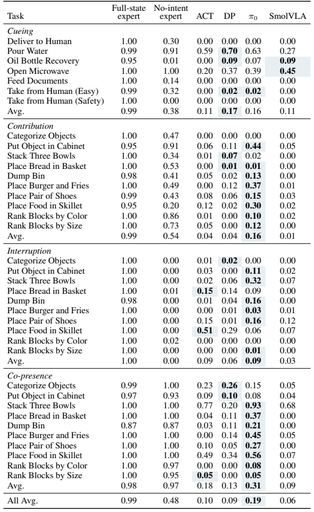
Table 2 :Task-level policy evaluation on HARP-Bench.We report collision-free success for each of the 37 tasks and averages over each condition and all tasks. Best nonzero values among the four learned policies in each row are highlighted, including ties.
出典 · CC0 1.0 · Qinhong Zhou, Riley Zong, Chunru Lin, Diyi Hu, Shivraj Singh Bhatti, Hongxin Zhang, Lin Qiu, Hanqing Zeng, Chuang Gan · HARP-Bench: Benchmarking Robot Manipulation Around Active Humans · 論文の図を引用 · 元のPDFの7ページ目から図の部分を抽出しています。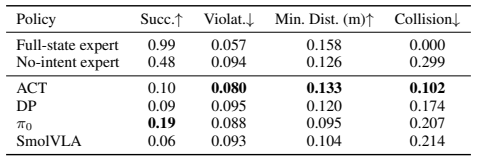
Table 3 :Task success and safety of policies.Results cover the 37 benchmark tasks. Success re- quires task completion without robot-avatar collision. Violat. is the mean fraction of timesteps with robot-avatar distance below 0.10 m; Min. Dist. is the mean episode minimum distance in meters; Collision is the fraction of episodes with robot-avatar contact. Bold marks the best value among the four learned policies in each column.
出典 · CC0 1.0 · Qinhong Zhou, Riley Zong, Chunru Lin, Diyi Hu, Shivraj Singh Bhatti, Hongxin Zhang, Lin Qiu, Hanqing Zeng, Chuang Gan · HARP-Bench: Benchmarking Robot Manipulation Around Active Humans · 論文の図を引用 · 元のPDFの8ページ目から図の部分を抽出しています。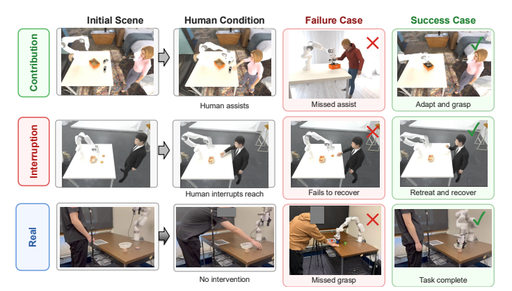
Figure 3 :Case studies in simulation and real-world experiments.Representative rollouts illus- trate missed human contributions, recovery failures after human intervention, and successful execu- tion with human-present training data.
出典 · CC0 1.0 · Qinhong Zhou, Riley Zong, Chunru Lin, Diyi Hu, Shivraj Singh Bhatti, Hongxin Zhang, Lin Qiu, Hanqing Zeng, Chuang Gan · HARP-Bench: Benchmarking Robot Manipulation Around Active Humans · 論文の図を引用 · 元のPDFの8ページ目から図の部分を抽出しています。人の存在を含む変形データの効果
人の存在を含む変形データの効果は、ACTを課題ごとに学習した設定で確認されました。この設定では、課題ごとに300件の実演を使い、課題設定あたり合計7,500件の実演で学習しました。比較の基準は、対応する人不在の課題におけるBase-only学習です。その結果、人の存在条件の平均成功率は0.10から0.15に向上し、Base条件は0.42から0.41とほぼ同じに保たれました。これは、対応する人の存在データが相互作用によって生じる変化の処理に役立つ可能性があることを示しています。

Table 4 :Effect of human-present data with per-task ACT training.Unlike Table 2, ACT is trained separately for each task, using 300 demonstrations per task (7,500 total per setting). Re- sults are averaged within each human-present condition; Human Avg. summarizes these conditions. Parentheses show absolute gains over Base-only training.
出典 · CC0 1.0 · Qinhong Zhou, Riley Zong, Chunru Lin, Diyi Hu, Shivraj Singh Bhatti, Hongxin Zhang, Lin Qiu, Hanqing Zeng, Chuang Gan · HARP-Bench: Benchmarking Robot Manipulation Around Active Humans · 論文の図を引用 · 元のPDFの8ページ目から図の部分を抽出しています。実機のxArm設定への転移結果
実際のxArmの卓上設定では、dump bin課題群のContributionとInterruption変形のみを評価しました。ACTポリシーは課題ごとに30回の試行で評価され、学習データの量と学習ステップ数は揃えました。基本の学習ポリシーは、ロボット単独の課題で0.40の成功率でしたが、Contributionでは0.13、Interruptionでは0.00に下がりました。HARP-Benchの人の存在データで学習すると、Contribution変形の成功率は0.13から0.33に向上しました。一方、Interruptionポリシーは実機の中断課題を完了できませんでした。この結果は、人が課題の一部を完了する転移には役立つ可能性がある一方で、物体の競合と人の動作タイミングは依然として難しいことを示しています。
Co-presenceはこの実機設定では評価されていません。

Table 5 :Real-world evaluation on the xArm dump-bin task family.ACT success over 30 trials per evaluated setting, with matched training data sizes and steps.
出典 · CC0 1.0 · Qinhong Zhou, Riley Zong, Chunru Lin, Diyi Hu, Shivraj Singh Bhatti, Hongxin Zhang, Lin Qiu, Hanqing Zeng, Chuang Gan · HARP-Bench: Benchmarking Robot Manipulation Around Active Humans · 論文の図を引用 · 元のPDFの9ページ目から図の部分を抽出しています。範囲と限界
著者らは、スクリプト化されたアバター事象は再現性のある評価を可能にする一方で、継続的な人とロボットの適応や、人の行動の全体的なばらつきは捉えていないと説明しています。課題集合は卓上操作に集中しており、移動操作や長期協働はまだ含まれていません。シミュレーションの安全指標は、実際の展開における安全性を証明するものではありません。評価シードはロールアウト条件のばらつきを扱いますが、独立に学習されたポリシー間のばらつきは測定していません。
論文情報
- 著者
- Qinhong Zhou, Riley Zong, Chunru Lin, Diyi Hu, Shivraj Singh Bhatti, Hongxin Zhang, Lin Qiu, Hanqing Zeng, Chuang Gan
- 学会・ジャーナル
- arXiv · プレプリント
- 公開日
- 2026年11月8日
- 登録日
- 2026年11月10日
- 更新日
- 2026年11月8日
- バージョン
- v1
- arXiv
- 2611.11123
- カテゴリ
- cs.RO · cs.CV
- ライセンス
- CC0 1.0
- 掲載内容
- 論文情報・解説・論文の図
この解説は、Refivuの韓国語解説をAIで翻訳したものです。不正確な翻訳や誤りが含まれる可能性があります。論文と図の利用条件は各出典に従います。
アブストラクト
Recent robot manipulation benchmarks have enabled systematic evaluation of general-purpose robot policies across diverse objects, scenes, instructions, and embodiments. However, most existing benchmarks still assume that the robot is the only active agent and that task semantics are determined primarily by the instruction and object state. This assumption overlooks a common source of real-world variation: humans actively sharing the workspace. In such settings, humans may reveal an implicit goal, complete part of the task, temporarily change object availability, or constrain safe robot motion while working nearby. We introduce HARP-Bench, a benchmark for evaluating robot manipulation policies in workspaces shared with active humans. HARP-Bench treats human activity as part of the manipulation problem, rather than as background scene variation. It organizes human-present manipulation into four conditions: Cueing, Contribution, Interruption, and Co-presence. These conditions are instantiated through everyday manipulation tasks, including paired human-present variants for controlled comparison with standard manipulation. HARP-Bench also provides a demonstration-generation pipeline for dynamic human-present settings. We evaluate VLA models, imitation-learning methods, and heuristic policies on HARP-Bench. Human-present variations challenge current policies, and higher task success does not consistently improve safety. Quantitative failure analysis identifies manipulation and recovery as the dominant remaining challenges. Training with HARP-Bench demonstrations improves human-present performance in simulation. A real-world study on one task family shows improved performance under human contribution, but not interruption, providing initial evidence of the data's utility and identifying limits of transfer. Code is available at https://github.com/UMass-Embodied-AGI/harp.
この論文を引用
Qinhong Zhou, Riley Zong, Chunru Lin, Diyi Hu, Shivraj Singh Bhatti, Hongxin Zhang, Lin Qiu, Hanqing Zeng, Chuang Gan (2026). HARP-Bench: Benchmarking Robot Manipulation Around Active Humans. arXiv:2611.11123v1. https://arxiv.org/abs/2611.11123v1
BibTeX
@misc{zhou2026harp,
  title = {{HARP-Bench: Benchmarking Robot Manipulation Around Active Humans}},
  author = {Qinhong Zhou and Riley Zong and Chunru Lin and Diyi Hu and Shivraj Singh Bhatti and Hongxin Zhang and Lin Qiu and Hanqing Zeng and Chuang Gan},
  year = {2026},
  eprint = {2611.11123},
  archivePrefix = {arXiv},
  url = {https://arxiv.org/abs/2611.11123v1}
}