論文解説
SAE-Audit: Clinical-Trial Prediction via Inference-Time Optimization of Black-Box LLMs Audited by Sparse Autoencoder Evidence
過去の試験データで概念の証拠を作り、LLMの臨床試験予測を推論時に修正する
- 課題 LLMは臨床試験が完了するか途中で終了するかの予測が不安定で、根拠の説明も回答の経緯を正しく示さないことがあります。従来の批評と修正の方法は、モデル自身の批評しか使えないため、外部の情報は加わりませんでした。
- 手法 SAE-Auditは、オープンモデルのSAEから過去の試験と結果が関連する概念を選び、その向きと強さを証拠として渡します。LLMは重みを変えずに、証拠を読んで回答を修正します。
- 結果 deepseek-v4-flashのbalanced accuracyは、五つの臨床試験予測タスクで9.6から12.0ポイント向上しました。学習なしで、LLM単独より高い精度を示しました。
臨床試験の予測でLLMが頼りにならない理由
臨床試験は、開始前に登録されたプロトコルだけを手がかりに、完了するか途中で終了するかを予測しなければなりません。LLMは長い自由記述のプロトコルを流暢に読めますが、結果を直接尋ねると答えの精度が安定しません。TrialPanoramaの試験完了タスクでは、GPT-4oのbalanced accuracyが59.3、o3-miniが51.0で、50が偶然の水準です。本研究で扱うdeepseek-v4-flashとGPT-5.6-terraも61と63にとどまり、予測が十分に当たっているとは言えません。
LLMは流暢な根拠を添えますが、その根拠は回答の経緯を正しく表さず、事実を誤って示すこともあります。既存の推論時改善として、批評と修正を繰り返す方法があります。ただし、批評がモデル自身や別のLLMによるものなら、モデルの外からの情報は加わりません。そこで、過去の試験の結果と結びついた外部の証拠を、どのように作ればよいかが問題になります。
SAE特徴を検証済みの臨床概念に変える
本研究の要点は、小型のオープンモデルの内部表現から、過去の試験で結果と関連する概念を取り出し、それを証拠としてブラックボックスLLMに渡すことです。ただし、個々の特徴には人が読める意味がないため、名前を付けて検証する二つの段階を置きます。図1は、SAE概念辞書の構築から、概念プローブ、SAE-Auditによる推論時最適化までの全体の流れを示しています。
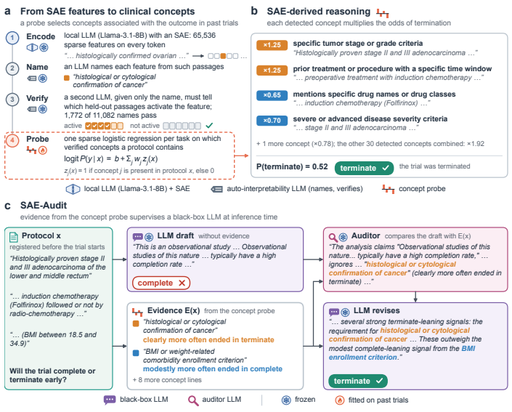
Figure 1 :Overview of SAE-Audit, with SAE concept dictionary build-up, SAE probes module which can serve as both a direct reasoner and predictor, and SAE-Audit that takes evidence from SAE probes for inference-time optimization on LLMs.a, A frozen SAE on Llama-3.1-8B-Instruct is turned into a vocabulary of clinical concepts, and one sparse probe per task is fitted on which concepts past protocols contain.b, SAE-derived reasoning: the probe’s prediction is an exact product of factors, one per detected concept, each tied to the passage of the protocol on which the concept is most active.c, SAE-Audit in the draft-first setting with the auditor: the concepts detected by the probe are written as evidence E(x); the auditor checks the LLM’s draft against the evidence, and the LLM revises its answer, here fromcomplete(wrong) toterminate(correct).
出典 · CC BY 4.0 · Junbo Shen · SAE-Audit: Clinical-Trial Prediction via Inference-Time Optimization of Black-Box LLMs Audited by Sparse Autoencoder Evidence · 論文の図を引用 · 元のPDFの2ページ目から図の部分を抽出しています。名前は、特徴が活性化した文章とそうでない文章を見せたうえで、deepseek-v4-flashに短い名前として付けさせます。次に、別のLLMは名前だけを受け取り、保留された文章のうち特徴が活性化する文章を選びます。この選択の結果がMatthews correlationで0.7以上だった特徴だけを、概念として採用します。11,082の名前付き特徴のうち、この検証を通ったのは1,772の特徴でした。名前が検証されているため、後で証拠に載る各行は、テキストに照らして確かめられる単位になります。
概念プローブと証拠の作り方
次に、タスクごとに、検証済み概念の有無を説明変数とするL1正則化ロジスティック回帰を、過去の試験で学習します。L1正則化は不要な概念の重みを0にするため、重みがゼロでない概念の集合Sだけが予測と説明に使われ、試験完了タスクではその数が162になります。さらに、各概念について、その概念を含む学習試験の結果率から全体の結果率を引いた値を効果の大きさとして測ります。この効果の大きさは、保留した学習試験の上で推定されます。
証拠E(x)は、新しいプロトコルに含まれる概念のうち、結果と最も強く関連するものを行として並べたものです。各行は、概念の名前、その概念が向く結果、効果の大きさの三つからなり、大きさは固定の尺度か率で書かれます。加えて、似た概念の組み合わせをもつ過去の試験がどう終わったかを示す行も付きます。証拠の作成にLLMを呼び出さないため、この段階の計算は概念プローブだけで済みます。
草稿を証拠と照らして修正する
証拠はLLMの重みを変えず、プロンプトを通じてLLMに渡されます。draft-firstの設定では、まずLLMが自分で答えを出し、その草稿を証拠と照らして修正します。もう一つのevidence-firstの設定では、LLMは証拠を読んでから一回の呼び出しで答えます。Self-Refineは自分の批評を使いますが、本研究はその批評を証拠E(x)に置き換え、草稿を過去の試験で測った関連と照らします。
auditorは、同じLLMに別の指示を与えて、草稿と証拠の概念を結びつける役割を担います。auditorの各指摘は、証拠の概念を名指しし、その向きと強さを変えず、対応する本文を引用しなければなりません。auditorは結果そのものを予測してはいけないため、判断の材料は証拠に限られます。図1cの例では、草稿が観察研究は完了しやすいと述べ、auditorが終了と関連する概念を指摘したあと、LLMが回答をterminateに修正します。
LLM単独との比較と対照実験
deepseek-v4-flashで五つのタスクを評価すると、SAE-Auditはすべてのタスクでbalanced accuracyを上げました。同じ試験完了で、SAE概念プローブ単独の65.2を上回ったことは、証拠が予測器の結果を超えたことを意味します。LLM単独は、平均で概念プローブより8.8ポイント低く、その差を証拠が埋めている形です。
証拠の向きを反転させると、LLMの精度は試験完了で18.2ポイント下がり、LLM単独の水準を下回りました。つまり、LLMは証拠の向きに従っており、改善には証拠が正しいことが必要だと読めます。概念プローブの予測ラベルと確率だけを渡した場合は65.7で、プローブ自身の65.2とほぼ同じ、証拠を渡した71.2には届きませんでした。
Self-RefineやBiomniとの比較
このため、概念の名前だけでは効かず、過去の試験で測った関連の向きと大きさが必要だと考えられます。
LLM + SAE-Auditは71.2を約6,900トークンで達成し、トークン量はBiomniの二十分の一です。
別のLLMへの転移と学習試験数の影響
GPT-5.6-terraに同じ250件の試験完了プロトコルで証拠を渡すと、balanced accuracyは62.9から70.8になりました。GPT-5.6-terraは証拠を選んで使い、修正のときに回答を変えたのは18%で、deepseek-v4-flashの41%より少なくなりました。反転した証拠では、GPT-5.6-terraは改善せず、deepseek-v4-flashは8.1ポイント下がりました。
学習試験を750件に減らすと、概念プローブは59.1となり、LLM単独の61.0を下回りました。一方、同じ750件から証拠を再計算したSAE-Auditは63.6で、LLM単独とプローブの両方を上回りました。
概念プローブの説明の忠実さ
概念プローブは式(1)が対数オッズの線形和なので、各概念の寄与を取り出して予測の説明にできます。説明には、寄与が大きい上位五つの概念と、残りの概念をまとめた寄与が含まれます。忠実さは、引用した段落を消したときと、その段落だけを残したときの予測変化を、無作為な段落の変化と比べて測ります。
試験完了では、引用を消したときの予測確率の変化が無作為な段落を消したときの2.6倍となり、LLMの1.4倍と1.2倍より大きくなりました。ただし、サンプルサイズでは三つの方法の比がいずれも1.8から1.9で、概念プローブが特に忠実とは言えません。引用の接地性では、概念プローブの引用はすべて原文どおりで、LLMの引用の16–19%は原文に見つかりませんでした。また、概念プローブは説明のためのトークンを生成せず、LLMは一説明あたり640から1,090トークンを生成します。
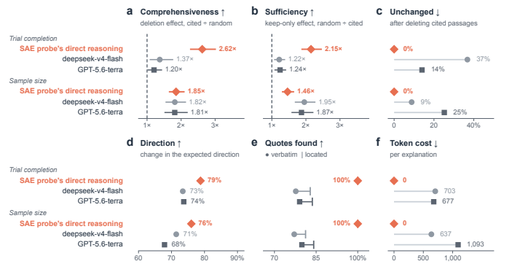
Figure 3 :SAE probes module’s direct reasoning is faithful, fully grounded in the protocol, and cost-friendlySAE probes module in SAE-Audit can give direct reasoning, comparable or better than LLM explanations, on 250 test protocols per task.a, Change in the prediction after deleting the cited passages, divided by the change after deleting as many random passages, with 95% bootstrap intervals; 1× is no better than random passages.b, Change after keeping only random passages, divided by the change after keeping only the cited passages.c, Protocols on which deleting the cited passages leaves the prediction unchanged.d, Protocols on which deleting the cited passages changes the prediction in the expected direction.e, Quotations found in the protocol word for word (verbatim) or with small differences in wording (located).f, Token cost: tokens generated per explanation. SAE probes module’s direct reasoning requires no additional LLM.
出典 · CC BY 4.0 · Junbo Shen · SAE-Audit: Clinical-Trial Prediction via Inference-Time Optimization of Black-Box LLMs Audited by Sparse Autoencoder Evidence · 論文の図を引用 · 元のPDFの7ページ目から図の部分を抽出しています。SAE基底が説明可能な概念名を生む理由
この結果は、SAEの特徴が専門家の注釈に近いことを示す一つの証拠です。
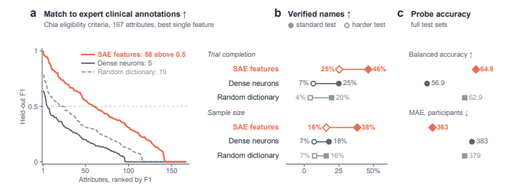
Figure 4 :SAE features match expert clinical annotations and receive verifiable concept names far more often than dense neurons or random dictionary. a, Held-out F1 of the best single feature of each basis for each of 167 clinical attributes, such as pregnancy or allergy, that experts annotated in the eligibility criteria of the Chia corpus, ranked.b, Percentage of concept names, written by an LLM, with which a second LLM identifies the passages where the feature is active (MCC ≥0.7 ), for the features that each probe selects. In the standard test, these are the passages on which the feature is most active. In the harder test, they also include passages on which it is only weakly active.c, Accuracy of probes of different types of features on full test set.
出典 · CC BY 4.0 · Junbo Shen · SAE-Audit: Clinical-Trial Prediction via Inference-Time Optimization of Black-Box LLMs Audited by Sparse Autoencoder Evidence · 論文の図を引用 · 元のPDFの9ページ目から図の部分を抽出しています。概念名の検証では、試験完了でSAE特徴の46%が標準テストを通り、ニューロンは25%、ランダム辞書は20%にとどまりました。より厳しいテストでは、SAEは25%が通り、ニューロンは7%、ランダム辞書は4%でした。予測精度では、SAE基底のプローブが高密度ニューロンのプローブより7.9ポイント高く、ランダム辞書とは同等以上でした。つまり、SAE基底は精度を落とさず、名前を付けやすい表現を与えると考えられます。
限界
LLMの実験は、各タスク250件のランダムな試験プロトコルで行い、全テストセットは使っていません。TrialBenchのテストセットは1,000試験のサンプルなので、信頼区間は広くなります。監査の設定は各タスクで最も適したものを示しており、単一の設定をすべてのタスクに使うと平均で9.1ポイントの改善になります。
結果は一つのSAE、一つの層、一つの8Bモデルに基づいています。概念プローブが捉えるのは登録された試験での関連であり、試験結果の原因ではありません。概念名の検証は適格基準の文章だけで行っており、臨床での有用性は前向きに評価されていません。
論文情報
- 著者
- Junbo Shen
- 学会・ジャーナル
- arXiv · プレプリント
- 公開日
- 2026年11月22日
- 登録日
- 2026年11月24日
- 更新日
- 2026年11月22日
- バージョン
- v1
- arXiv
- 2611.29368
- カテゴリ
- cs.AI · cs.CL · cs.LG
- ライセンス
- CC BY 4.0
- 掲載内容
- 論文情報・解説・論文の図
この解説は、Refivuの韓国語解説をAIで翻訳したものです。不正確な翻訳や誤りが含まれる可能性があります。論文と図の利用条件は各出典に従います。
アブストラクト
Clinical trials are costly and often take years to complete, making early outcome prediction valuable for trial planning. Large language models (LLMs) are increasingly used to forecast clinical-trial outcomes, yet their predictions remain unreliable and their rationales may not faithfully reflect the evidence underlying their answers. On tasks such as predicting whether a registered clinical trial will complete or terminate early, frontier LLMs perform only modestly above chance in our experiments. We introduce SAE-Audit, which optimizes a black-box LLM at inference time with evidence obtained from a deployable open model. A frozen sparse autoencoder (SAE) on Llama-3.1-8B-Instruct is converted into a vocabulary of clinical concepts. Sparse probes fitted on past trials determine which concepts are associated with the outcome. For a new protocol, the concepts detected by the probe are written as evidence, each with the direction and strength of its association with the outcome, and the LLM being audited optimizes its answer in the light of this evidence. Without additional training, SAE-Audit raises balanced accuracy of deepseek-v4-flash by 9.6--12.0 points on five clinical-trial prediction tasks and raises GPT-5.6-terra by 8.0 points on trial completion, exceeding other agentic inference-time optimization methods by a large margin. As an auxiliary, SAE probes module within SAE-Audit is itself accurate and auditable, providing natural-language explanations directly derived from verified concept contributions and protocol evidence, without requiring additional LLMs at inference time. SAE-Audit provides verifiable, concept-level evidence for more accurate and auditable clinical-trial prediction. It can also be embedded into biomedical AI agents such as Biomni to optimize their performance.
論文の図
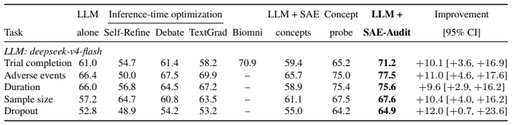
Table 1 :SAE-Audit improves a black-box LLM on clinical trial prediction tasks.Balanced accuracy (×100) on 250 random test protocols per task; gains are paired differences between LLM + SAE-Audit and the LLM alone with 95% bootstrap intervals. Self-Refine, debate, TextGrad, and LLM + SAE concepts (LLM directly given the names of the detected SAE concepts) are inference-time optimization baselines (Fig. 2a). Biomni is a general-purpose biomedical AI agent, evaluated on trial completion with a single run per protocol (Appendix G).Concept Probeis the SAE probe that supplies the evidence (full test sets in Table 2), and can also give direct predictions via the probe. SAE-Audit is draft-first for trial completion, sample size tasks and evidence-first for the other tasks (Appendix A.4).
出典 · CC BY 4.0 · Junbo Shen · SAE-Audit: Clinical-Trial Prediction via Inference-Time Optimization of Black-Box LLMs Audited by Sparse Autoencoder Evidence · 論文の図を引用 · 元のPDFの5ページ目から図の部分を抽出しています。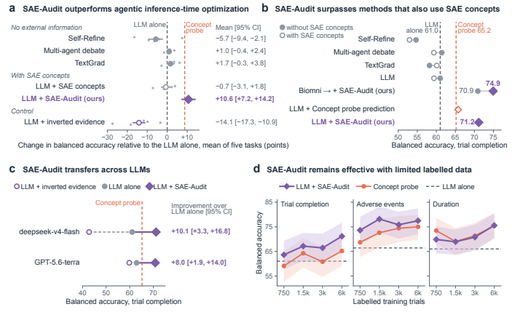
Figure 2 :SAE-Audit outperforms agentic inference-time optimization methods, surpasses them even when they use SAE concepts, transfers across LLMs and remains effective with limited labelled data.Balanced accuracy on 250 test protocols per task, with deepseek-v4-flash unless stated otherwise; intervals and bands are 95% bootstrap intervals.a, Change relative to the LLM alone, averaged over five tasks (dots: single tasks).b, Trial completion, without and with SAE concepts, and Biomni without and with SAE-Audit.c, Trial completion with two LLMs.d, Concept probe and evidence computed from 750 to 6,000 labelled training trials.
出典 · CC BY 4.0 · Junbo Shen · SAE-Audit: Clinical-Trial Prediction via Inference-Time Optimization of Black-Box LLMs Audited by Sparse Autoencoder Evidence · 論文の図を引用 · 元のPDFの6ページ目から図の部分を抽出しています。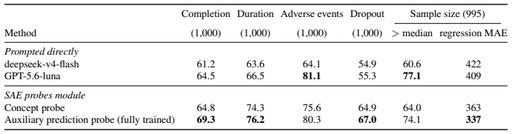
Table 2 :Predictive accuracy on test sets via only the SAE probes module in SAE-Audit.Balanced accuracy (×100) for 5 classification tasks; sample size is also scored as mean absolute error (MAE) in participants as regression-style tasks. The concept probe uses binary indicators of verified concepts and supplies the explanations and the SAE-Audit evidence.
出典 · CC BY 4.0 · Junbo Shen · SAE-Audit: Clinical-Trial Prediction via Inference-Time Optimization of Black-Box LLMs Audited by Sparse Autoencoder Evidence · 論文の図を引用 · 元のPDFの9ページ目から図の部分を抽出しています。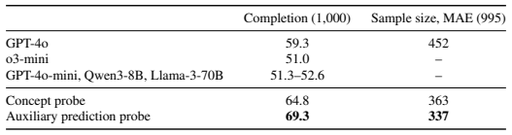
Table 5 :Published results of prompted LLMson the same test sets [ 1], next to the two SAE probes of Table 2. Balanced accuracy (×100) on trial completion and mean absolute error in participants on sample size.
出典 · CC BY 4.0 · Junbo Shen · SAE-Audit: Clinical-Trial Prediction via Inference-Time Optimization of Black-Box LLMs Audited by Sparse Autoencoder Evidence · 論文の図を引用 · 元のPDFの16ページ目から図の部分を抽出しています。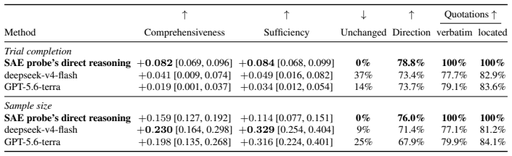
Table 6 :Faithfulness and grounding of direct SAE-derived explanations against LLM-generated explanations for the final predictions(250 test protocols per task): the probe’s SAE-derived reasoning against the rationales of two LLMs. Comprehensiveness and sufficiency are the changes in a method’s own prediction when the passages it cites are deleted, or are the only passages kept; both are given as the paired difference to a matched random set of passages with 95% bootstrap intervals.Unchanged: the fraction of predictions that remain unchanged after removing cited passages. Direction: the percentage of protocols on which deleting the cited passages changes the prediction in the expected direction, among those on which it changes.Verbatim / located: the fractions of cited quotations that exactly match or can be found in the original protocol.
出典 · CC BY 4.0 · Junbo Shen · SAE-Audit: Clinical-Trial Prediction via Inference-Time Optimization of Black-Box LLMs Audited by Sparse Autoencoder Evidence · 論文の図を引用 · 元のPDFの17ページ目から図の部分を抽出しています。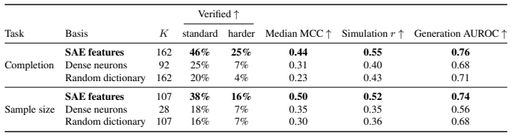
Table 8 :Interpretability comparison against different types of embeddings.The same probe selects K features from each basis, and an LLM writes a concept name for each feature.Verified: percentage of concept names with which a second LLM identifies the passages where the feature is active (MCC ≥0.7 ), tested on the passages on which the feature is most active (standardtest) or on a set that also includes passages on which it is only weakly active (hardertest).Median MCC: median MCC of the harder test.Simulation r: correlation between the activations an LLM predicts from the concept name and the true activations.Generation AUROC: AUROC of the feature’s activation on passages an LLM writes for its own concept name versus for other concept names.
出典 · CC BY 4.0 · Junbo Shen · SAE-Audit: Clinical-Trial Prediction via Inference-Time Optimization of Black-Box LLMs Audited by Sparse Autoencoder Evidence · 論文の図を引用 · 元のPDFの19ページ目から図の部分を抽出しています。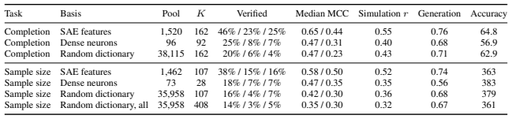
Table 9 :Comparison of bases, additional columns.Pool: features present in 1–50% of training protocols.Verified: percentage of selected features whose concept name reaches an MCC of at least 0.7 in the standard test / at least 0.9 in the standard test / at least 0.7 in the harder test.Median MCC: standard test / harder test.Accuracy: balanced accuracy on the full test set (completion) or MAE (sample size).
出典 · CC BY 4.0 · Junbo Shen · SAE-Audit: Clinical-Trial Prediction via Inference-Time Optimization of Black-Box LLMs Audited by Sparse Autoencoder Evidence · 論文の図を引用 · 元のPDFの19ページ目から図の部分を抽出しています。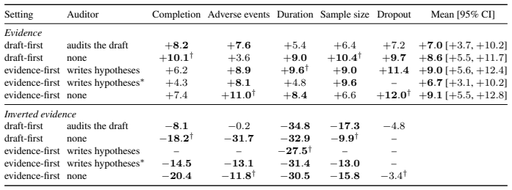
Table 10 :Both settings of the audit, with and without the auditor, improve the LLM on every task.Change in balanced accuracy (points) relative to the LLM alone, for deepseek-v4-flash on the 250 test protocols of each task. Bold: the 95% interval excludes zero. The first row is the setting of
出典 · CC BY 4.0 · Junbo Shen · SAE-Audit: Clinical-Trial Prediction via Inference-Time Optimization of Black-Box LLMs Audited by Sparse Autoencoder Evidence · 論文の図を引用 · 元のPDFの21ページ目から図の部分を抽出しています。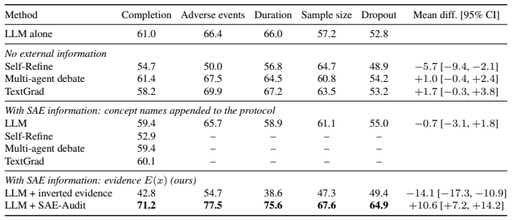
Table 12 :Inference-time refinement baselines, without and with SAE information, do not close the gap to SAE-Audit.Balanced accuracy ( ×100) of deepseek-v4-flash on the 250 evaluation proto- cols of each task, inference-time refinement baselines showing almost no improvements compared to direct LLM answers; the difference to the direct LLM answers averaged over the five tasks with a 95% bootstrap interval. Fig. 2a,b plots these values. After being given the concept names of the protocol via our SAE, baselines still fail to improve the LLM.Concept names: the names and descriptions of the SAE concepts detected in the protocol, without their directions and strengths.
出典 · CC BY 4.0 · Junbo Shen · SAE-Audit: Clinical-Trial Prediction via Inference-Time Optimization of Black-Box LLMs Audited by Sparse Autoencoder Evidence · 論文の図を引用 · 元のPDFの23ページ目から図の部分を抽出しています。この論文を引用
Junbo Shen (2026). SAE-Audit: Clinical-Trial Prediction via Inference-Time Optimization of Black-Box LLMs Audited by Sparse Autoencoder Evidence. arXiv:2611.29368v1. https://arxiv.org/abs/2611.29368v1
BibTeX
@misc{shen2026audit,
  title = {{SAE-Audit: Clinical-Trial Prediction via Inference-Time Optimization of Black-Box LLMs Audited by Sparse Autoencoder Evidence}},
  author = {Junbo Shen},
  year = {2026},
  eprint = {2611.29368},
  archivePrefix = {arXiv},
  url = {https://arxiv.org/abs/2611.29368v1}
}