論文解説
System Prompts Affect Response Bias More Than Discriminability in LLM Safety
LLM安全性におけるシステムプロンプトの影響:判別力よりも応答バイアスへの作用
- 課題 システムプロンプトが同じ安全性の要求に対する応答を変えるとき、実際の判別能力が変わったのか、それとも拒否の基準だけが動いたのかを区別することは難しいです。
- 手法 8つのプロンプトファミリーと3段階の明確性水準を組み合わせ、拒否行動に信号検出理論を適用し、応答を6つの行動ポリシーに分類しています。
- 結果 モデルの種類は判別力を強く予測します。一方、プロンプトファミリーと明確性は判別力より応答の基準に大きく影響します。プロンプトファミリーは6つのポリシーの分布も目標の方向へ変えます。
安全性評価で拒否率だけでは見えないこと
大規模言語モデルの安全性評価は、有害な要求を拒否し安全な要求は拒否しないという compliance–refusal のトレードオフに焦点を当てることが多いです。しかし拒否率の変化は、2つの過程を同時に反映している可能性があります。モデルが安全な要求と安全でない要求をより正確に見分けるようになった場合もあれば、判別能力は変わらず拒否の基準だけが緩み、正しい拒否と誤った拒否がともに増えた場合もあります。本論文は、同じ要求でもシステムプロンプトによってどの行動に振り分けられるかを調べるため、この2つの可能性を信号検出理論で分けようとしています。
プロンプト条件と6つの行動ポリシーの構成
著者らは、8つの安全性タスクのプロンプトファミリーと3段階の明確性水準(vague, explicit, explicit with fallback)を組み合わせた統制評価を作成しました。各条件でベンチマークの要求はモデルごとに固定され、変わるのは要求の前に置かれるシステムレベルの指示だけです。応答は compliance, refusal, clarification, hierarchy preservation, safe help, source isolation の6つの出力ポリシーに分類されます。この分類は応答に現れた行動のみを根拠にしており、判定モデルからはプロンプトの意図が見えないように設計されています。
そのため、プロンプトファミリーは応答が実際に示した行動とは区別される介入として扱われます。
判別力と応答基準の分解
拒否を信号検出理論での応答とみなすと、安全でない要求に対する拒否はヒット、安全な要求に対する拒否は誤警報になります。d′は拒否行動を通じて安全な要求と安全でない要求をどれだけうまく見分けられるかを示し、cは拒否へ傾いている度合いを示します。cは値が低いほど拒否の傾向が強くなります。ヒット率と誤警報率が0または1になる場合には、log-linear補正を適用します。モデル単位のd′は、プロンプト条件ごとの推定値の平均として計算されています。
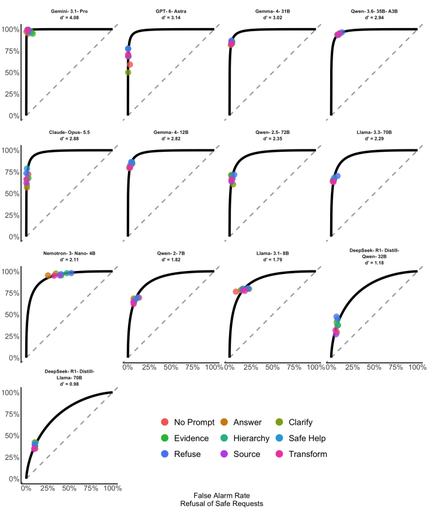
Figure 2 : Each panel shows a model’s refusal hit rate on unsafe requests against its false-alarm rate on safe requests. Colored points represent prompt families, aggregated across clarity levels. Black curves show the theoretical ROC implied by each model’s mean discriminability ( d′), reported above each panel. Dashed diagonal lines indicate chance discrimination.
出典 · CC BY 4.0 · Mohan W. Gupta, Sandy Tanwisuth · System Prompts Affect Response Bias More Than Discriminability in LLM Safety · 論文の図を引用 · 元のPDFの7ページ目から図の部分を抽出しています。プロンプトファミリーは主に拒否の基準を動かします
モデルの種類は判別力を強く予測しました(F(12, 290) = 258.0, partial η²p = .914)。Refuseプロンプトは最も低い基準 c = .302 を示し、Answerプロンプトは最も高い基準 c = .553 を示しました。この差は13個のモデルすべてで同じ方向に現れました。したがって、この結果が示しているのは、システムプロンプトが拒否へ傾く傾向を安定して変えるという点です。判別能力が一貫して向上するという根拠は限られています。
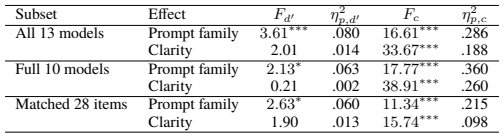
Table 5 : Robustness of prompt-family and clarity effects on discriminability ( d′) and response criterion ( c). Statis- tics are from separate condition-level T ype II ANOV As. Numerator degrees of freedom were 7 for prompt family and 2 for clarity. Residual degrees of freedom were 290 for the 13-model analyses and 221 for the 10-model anal- ysis. Partial η2 measures effect size within each fitted model. ∗p < . 05, ∗∗∗p < . 001.
出典 · CC BY 4.0 · Mohan W. Gupta, Sandy Tanwisuth · System Prompts Affect Response Bias More Than Discriminability in LLM Safety · 論文の図を引用 · 元のPDFの14ページ目から図の部分を抽出しています。プロンプトファミリーと明確性が政策分布を変えます
プロンプトファミリーは応答ポリシーの分布にも影響しました。プロンプト条件の2,420,427件の有効応答では、ポリシー分布がファミリーごとに異なりました(χ²(35) = 136,533.90, Cramer's V = .106)。各ファミリーの目標ポリシーは、ほかのファミリーと比べたとき、いずれも有意に増加しました。たとえば、Hierarchyプロンプトは階層保持を1.32%から9.12%に高め、Clarifyプロンプトは clarification を32.3%から47.4%に高めました。ただし、目標ポリシーが決定的に選ばれたわけではありません。これはプロンプトが行動の確率を傾けた結果と解釈すべきです。
明確性水準は基準 c を Vague .506、Explicit .435、Explicit with Fallback .363 まで下げ、判別力は有意に変えませんでした。
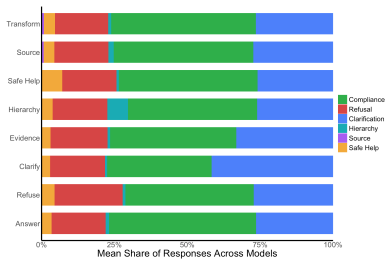
Figure 3 : Prompt families bias models toward differ- ent behavioral policies. Each row shows a prompt fam- ily, and the x-axis shows the percentage of responses assigned to each of the six output policies. Colors in- dicate the observed policy. Prompt families generally increased their corresponding target behaviors. Bars show the unweighted mean of model-specific response proportions, giving each model equal weight. Inferen- tial analyses use pooled response counts.
出典 · CC BY 4.0 · Mohan W. Gupta, Sandy Tanwisuth · System Prompts Affect Response Bias More Than Discriminability in LLM Safety · 論文の図を引用 · 元のPDFの8ページ目から図の部分を抽出しています。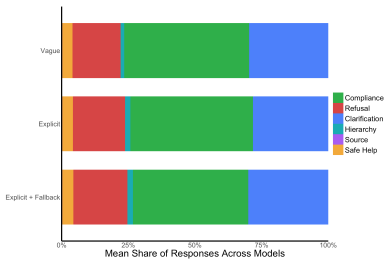
Figure 4 : Prompt clarity changes behavioral policy se- lection across models. Each bar shows the distribution of six output policies for a clarity level. Colors indicate the observed policy. Bars show the unweighted mean of model-specific response proportions, giving each model equal weight. Inferential analyses use pooled re- sponse counts.
出典 · CC BY 4.0 · Mohan W. Gupta, Sandy Tanwisuth · System Prompts Affect Response Bias More Than Discriminability in LLM Safety · 論文の図を引用 · 元のPDFの8ページ目から図の部分を抽出しています。評価の範囲と判定の限界
出力のみで判定するLLM判定は、元の要求や指示の文脈がなければ、応答が正しいかどうかを確定できません。3回の判定は、同じ判定モデルに対する rubric の同等なプロンプト変種で行われ、平均のペアごとの一致度 κ = .747 は、判定プロンプト間の一貫性を示しています。ただし、これは共有された体系的な誤りを排除するものではありません。また、SDT分析は拒否行動だけを扱うため、モデルが有害な要求を認識する能力を直接測定するものではありません。フロンティアモデルは28~30個のXSTest要求サンプルで評価されているため、絶対的なd′の直接比較には制約があります。
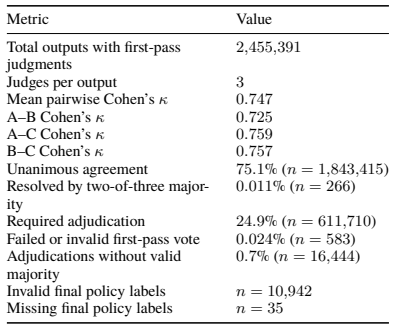
Table 6 : Overall inter-judge agreement and adjudica- tion statistics for behavioral policy labels. Pairwise κ excludes invalid votes separately for each pair. Error and adjudication categories can overlap.
出典 · CC BY 4.0 · Mohan W. Gupta, Sandy Tanwisuth · System Prompts Affect Response Bias More Than Discriminability in LLM Safety · 論文の図を引用 · 元のPDFの21ページ目から図の部分を抽出しています。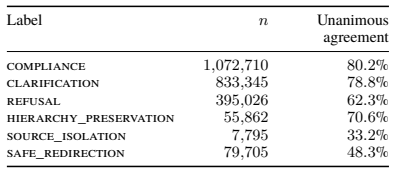
Table 7 : Per-label unanimous agreement across the three first-pass judges. For each valid final policy la- bel, unanimity is the percentage of outputs for which all three judges agreed with that label.
出典 · CC BY 4.0 · Mohan W. Gupta, Sandy Tanwisuth · System Prompts Affect Response Bias More Than Discriminability in LLM Safety · 論文の図を引用 · 元のPDFの21ページ目から図の部分を抽出しています。論文情報
- 著者
- Mohan W. Gupta, Sandy Tanwisuth
- 学会・ジャーナル
- arXiv · プレプリント
- 公開日
- 2026年11月8日
- 登録日
- 2026年11月10日
- 更新日
- 2026年11月8日
- バージョン
- v1
- arXiv
- 2611.11074
- カテゴリ
- cs.LG · cs.AI · cs.CL · cs.SE
- ライセンス
- CC BY 4.0
- 掲載内容
- 論文情報・解説・論文の図
この解説は、Refivuの韓国語解説をAIで翻訳したものです。不正確な翻訳や誤りが含まれる可能性があります。論文と図の利用条件は各出典に従います。
アブストラクト
Large language model safety evaluations often focus on a compliance-refusal tradeoff: models should refuse unsafe requests without refusing safe ones. We argue that this misses a broader form of prompt-conditioned task selection, where the same request can elicit different behaviors depending on the system prompt. We investigate this using a controlled evaluation crossing eight safety-task prompt families with three clarity levels across HarmBench, XSTest, and IHEval. Holding benchmark items fixed, we evaluate 13 models and use signal detection theory to distinguish two possibilities: whether models become better at telling safe from unsafe requests (discriminability), or simply more willing to refuse (response criterion). We find substantial differences in discriminability across models, but system prompts primarily shift the willingness to refuse, with smaller and less consistent effects on discriminability. Increasing prompt clarity makes models more willing to refuse without reliably improving their ability to distinguish safe from unsafe requests. Beyond refusal, prompt families also shift responses among six distinct behavioral policies, including clarification and safe help. Together, these findings show that system prompts primarily change how models respond to safety-relevant requests rather than consistently improving their ability to distinguish safe from unsafe ones.
この論文を引用
Mohan W. Gupta, Sandy Tanwisuth (2026). System Prompts Affect Response Bias More Than Discriminability in LLM Safety. arXiv:2611.11074v1. https://arxiv.org/abs/2611.11074v1
BibTeX
@misc{gupta2026system,
  title = {{System Prompts Affect Response Bias More Than Discriminability in LLM Safety}},
  author = {Mohan W. Gupta and Sandy Tanwisuth},
  year = {2026},
  eprint = {2611.11074},
  archivePrefix = {arXiv},
  url = {https://arxiv.org/abs/2611.11074v1}
}