論文解説
Empowering Masked Diffusion Models to Self-Correct with Leave-One-Out Transformers
Leave-One-Out TransformerによるMasked Diffusionモデルの自己修正能力の強化
- 課題 標準的なマスク拡散言語モデルは、一度埋めたトークンを後から修正できず、見えているトークンには学習信号が与えられません。
- 手法 各位置を残りの文脈だけから予測するLeave-One-Out Transformerを作り、全位置に掛かるLOOT目的関数で学習します。
- 結果 OWTでBlocked Gibbsによる修正を行うと、NFE 256でMAUVE 0.408を記録し、NFE 2048のReMDM(0.348)を上回りました。
標準MDMの2つの限界
マスク拡散言語モデル(MDM)は、トークンを一度復元すると、その値を後から修正できません。そのため、初期の誤りは後段の生成過程へ伝わります。学習でも損失はマスクされた位置にだけ掛かるため、見えているトークンは直接の監督を受けません。この論文は、この2つの限界を同時に扱えるかを問います。
2つの限界を同時に解くことが難しい理由は、標準MDMが双方向Transformerを使うからです。見えている位置にも損失を掛けると、モデルは正解を文脈から予測せず、入力をそのままコピーできてしまいます。著者らは、位置iの予測が入力xiに依存しないようにすることで、この問題を避けようとしています。
リーブワンアウト性質と目的関数
リーブワンアウト(LOO)性質は、denoiserの位置i予測がx−iだけに依存するという条件です。この性質があれば、位置iをマスクしても見えたままにしても、予測は同じになります。著者らは、この不変性を使い、位置ごとのマスキング事象をRao-Blackwellizationで周辺化して、全位置を足し合わせたLOOT目的関数 L_LOOT(θ)=E[α′t Σ_{i=1}^N log pθ(xi|x[Mt])] を得ています。この式は、性質が成り立つdenoiserではMDMのNELBOと同じ期待値を持ち、全位置に損失が掛かります。
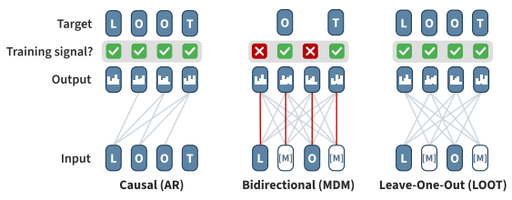
Figure 1 : Dependencies of output tokens on input tokens in causal, bidirectional, and leave-one-out models. Unlike standard bidirectional MDMs, the output of LOOTat index i does not depend on the input at indexi, enabling loss optimization even on unmasked tokens.
出典 · CC BY 4.0 · Sofian Zalouk, Vincent Counathe, Paul Jünger, Daniel Cao, Daniel Zlotnick, Kilian Q. Weinberger, Christopher De Sa · Empowering Masked Diffusion Models to Self-Correct with Leave-One-Out Transformers · 論文の図を引用 · 元のPDFの2ページ目から図の部分を抽出しています。標準の重みα′t/(1−αt)は、αtが1に近づくと発散します。一方、LOOTの重みはα′tだけを使います。log-linearスケジュールαt=1−tでは α′t=−1 なので、重みは定数になります。この設定はLOO性質が成り立つ場合の条件付きの結果であり、性質のないモデルに同じ式をそのまま当てはめた結果ではありません。
3つのストリームとスライディングウィンドウによる統合
LOOTは、順方向ストリームf、逆方向ストリームb、出力ストリームoを持ちます。順方向はi以下の位置を、逆方向はi以上の位置を見ます。出力ストリームは各レイヤーでf<iとb>iを統合し、xiを除いた条件付き分布を作ります。出力ストリームは[MASK]の埋め込みで初期化し、LOO性質を保ちます。
実装では、順方向と逆方向のキーと値を連結したテンソルに、長さN−1のウィンドウによるスライディングウィンドウ・アテンションを適用します。これにより、レイヤーごとに2回のFlashAttention呼び出しで統合を処理できます。パラメータは、アテンションの射影とMLPを3つのストリームで共有するため、DiTと同じ学習パラメータ数を保ちます。順伝播のコストは、N=1024で標準MDMの2.24倍です。
言語モデリングのperplexity
LM1B(N=128)では、LOOTはMDLMより0.78低いperplexityを記録しました。dense-supervisionのベースラインであるPGMとは、評価シードによる変動の範囲で同程度でした。OWT(N=1024)では、LOOTは26.83を記録し、MDLMは25.20、PGMは26.57でした。したがって、OWTの長いシーケンスでは、標準のMDLMとの差が残ります。
シーケンス長のアブレーション実験では、LOOT構造にMDLMの損失を使うと、N=128で2.2、N=1024で4.4のperplexityの不利が見られました。同じ構造にLOOTの損失を使うと、perplexityはそれぞれ2.9と2.8改善しました。この結果は、損失の改善だけでは長いシーケンスの差をすべて解消できなかったことを示しています。
自己修正サンプリングとMAUVE
OWTでのサンプリング評価では、LOOT-Blocked-Gibbsは、NFE 256でMAUVE 0.408を記録しました。同じ指標でReMDMは、NFE 2048で0.348でした。エントロピーをそろえた条件では、LOOTは8倍少ないNFEで、より高いMAUVEを得ました。推論FLOPsは3.5倍少なかったです。
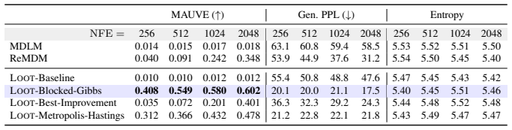
Table 2 :Unconditional generation quality on OpenWebText.We compare LOOTsampling methods against MDLM and ReMDM across different numbers of function evaluations (NFEs). LOOT-Blocked-Gibbs achieves better generation quality than ReMDM with 8× fewer NFEs (256 vs. 2048) at matched entropy.
出典 · CC BY 4.0 · Sofian Zalouk, Vincent Counathe, Paul Jünger, Daniel Cao, Daniel Zlotnick, Kilian Q. Weinberger, Christopher De Sa · Empowering Masked Diffusion Models to Self-Correct with Leave-One-Out Transformers · 論文の図を引用 · 元のPDFの8ページ目から図の部分を抽出しています。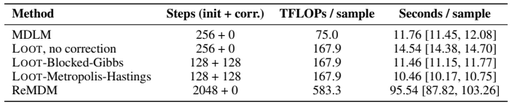
Table 9 : Inference cost per generated sequence at N= 1024 (NVIDIA A6000, bf16). FLOPs are counted matmul and attention FLOPs; seconds are measured end-to-end, with 95% intervals over 3 runs.
出典 · CC BY 4.0 · Sofian Zalouk, Vincent Counathe, Paul Jünger, Daniel Cao, Daniel Zlotnick, Kilian Q. Weinberger, Christopher De Sa · Empowering Masked Diffusion Models to Self-Correct with Leave-One-Out Transformers · 論文の図を引用 · 元のPDFの26ページ目から図の部分を抽出しています。修正を行わずMDMと同じ方法でサンプリングしたLOOT-Baselineは、NFE 256でMAUVE 0.010でした。この値は、MDLMの0.014より低いです。したがって、MAUVEの向上は、LOOモデルにBlocked GibbsまたはMetropolis-Hastingsの修正を適用したときに見られました。反対に、Best-ImprovementはNFE 256で0.035にとどまり、サンプリングアルゴリズムの選択が結果を大きく左右しました。
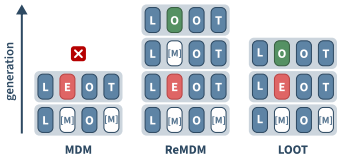
Figure 4 : LOOTenables efficient self-correction.
出典 · CC BY 4.0 · Sofian Zalouk, Vincent Counathe, Paul Jünger, Daniel Cao, Daniel Zlotnick, Kilian Q. Weinberger, Christopher De Sa · Empowering Masked Diffusion Models to Self-Correct with Leave-One-Out Transformers · 論文の図を引用 · 元のPDFの6ページ目から図の部分を抽出しています。残された課題
LOOTは、長いシーケンス長では標準の双方向MDMとの尤度差が残っています。順伝播あたりのFLOPsは約2.2倍です。修正戦略の間の差が大きいため、生成品質はサンプリングアルゴリズムに強く依存します。著者らは、長さによる尤度差の原因、より効果的な自己修正手法、そして学習と推論を組み合わせるハイブリッドな手法を、今後の課題として挙げています。
論文情報
- 著者
- Sofian Zalouk, Vincent Counathe, Paul Jünger, Daniel Cao, Daniel Zlotnick, Kilian Q. Weinberger, Christopher De Sa
- 学会・ジャーナル
- arXiv · プレプリント
- 公開日
- 2026年11月14日
- 登録日
- 2026年11月17日
- 更新日
- 2026年11月14日
- バージョン
- v1
- arXiv
- 2611.19127
- カテゴリ
- cs.LG · cs.CL
- ライセンス
- CC BY 4.0
- 掲載内容
- 論文情報・解説・論文の図
この解説は、Refivuの韓国語解説をAIで翻訳したものです。不正確な翻訳や誤りが含まれる可能性があります。論文と図の利用条件は各出典に従います。
アブストラクト
Masked diffusion models (MDMs) have emerged as a promising paradigm for language modeling, enabling parallel token generation with competitive performance. Yet standard MDMs suffer from two fundamental limitations: (1) inability to revise tokens, and (2) sparse training signal. We revisit hollow transformers, which address both limitations by predicting each token from its surrounding context, independently of the input at that position. We introduce the Leave-One-Out Transformer (LOOT), a more efficient and expressive architecture that advances hollow transformers through two complementary advances. First, we redesign the merging mechanism to enable frequent interaction between left and right contexts, substantially improving predictive performance over prior hollow transformers. Second, we derive a lower-variance estimator of the MDM NELBO that supervises all tokens and improves validation perplexity. Together, these advances yield a competitive standalone diffusion language model capable of effective self-correction during inference. On LM1B, LOOT matches the strongest dense-supervision MDM baseline in validation perplexity. On OpenWebText, LOOT achieves higher MAUVE and better generation quality-diversity tradeoffs than prior remasking methods, using $8\times$ fewer forward evaluations and $3.5\times$ fewer inference FLOPs.
この論文を引用
Sofian Zalouk, Vincent Counathe, Paul Jünger, Daniel Cao, Daniel Zlotnick, Kilian Q. Weinberger, Christopher De Sa (2026). Empowering Masked Diffusion Models to Self-Correct with Leave-One-Out Transformers. arXiv:2611.19127v1. https://arxiv.org/abs/2611.19127v1
BibTeX
@misc{zalouk2026empowering,
  title = {{Empowering Masked Diffusion Models to Self-Correct with Leave-One-Out Transformers}},
  author = {Sofian Zalouk and Vincent Counathe and Paul Jünger and Daniel Cao and Daniel Zlotnick and Kilian Q. Weinberger and Christopher De Sa},
  year = {2026},
  eprint = {2611.19127},
  archivePrefix = {arXiv},
  url = {https://arxiv.org/abs/2611.19127v1}
}