論文解説
Shortcut Learning in Feature-Based Algorithm Selection
特徴量ベースのアルゴリズム選択におけるShortcut Learning
- 課題 目的関数の値を正規化しても、比較ベースのアルゴリズムを使う特徴量ベースのアルゴリズム選択には、Shortcut Learningが残る可能性があります。
- 手法 目的関数の値に狭義単調増加変換をランダムに適用したテストインスタンスでアルゴリズムを再実行し、予測のR2の低下を測定します。
正規化だけでは不十分な理由
自動アルゴリズム選択(AAS)と自動アルゴリズム構成(AAC)は、目的関数の特徴量を入力として受け取り、アルゴリズムを選んだり性能を予測したりします。入力の特徴量が実際のアルゴリズム性能と無関係な情報に依存していると、学習時の分布では精度が高くても、分布が変わると性能が大きく下がることがあります。この現象をShortcut Learningと呼びます。
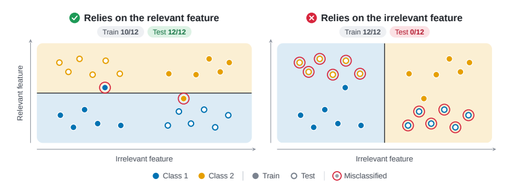
Figure 2 : A model that relies on an irrelevant feature fails on out-of-distribution test data. The horizontal axis is the irrelevant feature, and the vertical axis is the relevant feature. Filled markers are training data, and hollow markers are test data. In the training data, both features correlate with the class. In the test data, the irrelevant feature’s correlation is reversed. The background color shows the decision boundary of each model. The left model misclassifies two training points but correctly classifies all test points. The right model classifies all training points correctly but misclassifies every test point.
出典 · CC BY 4.0 · Shuhei Tanaka, Shoichiro Tanaka, Toshiharu Hatanaka · Shortcut Learning in Feature-Based Algorithm Selection · 論文の図を引用 · 元のPDFの2ページ目から図の部分を抽出しています。既存研究では、目的関数の値を正のアフィン変換で正規化することで、この問題を軽減してきました。しかし、CMA-ESのように値の順序だけを使う比較ベースのアルゴリズムは、狭義単調増加変換を受けても探索の振る舞いが変わりません。正規化は正のアフィン変換に対してのみ不変なので、この場合は狭義単調増加変換によって生じる特徴量の変化を防げません。
Rubber Ruler Testの手順
Rubber Ruler Testでは、まず学習インスタンスで予測器を学習させます。その後、テストインスタンスの目的関数の値にだけ、ランダムな狭義単調増加変換を適用します。変換関数は0と1で値が固定され、区間ごとにスプラインで定められるψです。これは正規化後の値に適用されます。変換したテストインスタンスでアルゴリズムを再実行し、特徴量を計算し直してから、学習済みの予測器のR2を測定します。
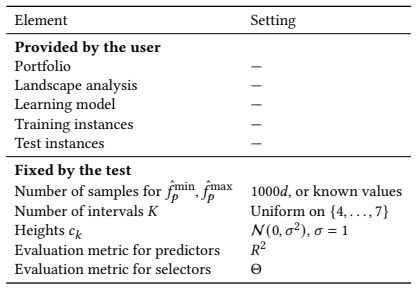
Table 1 : Elements that the user provides (upper part) and that the Rubber Ruler Test fixes (lower part).
出典 · CC BY 4.0 · Shuhei Tanaka, Shoichiro Tanaka, Toshiharu Hatanaka · Shortcut Learning in Feature-Based Algorithm Selection · 論文の図を引用 · 元のPDFの4ページ目から図の部分を抽出しています。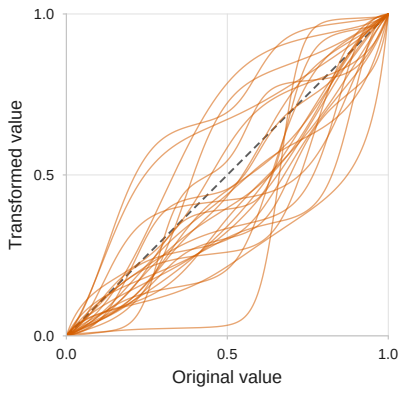
Figure 8 : Functions 𝜓 drawn from Dspline warp normalized objective values nonlinearly but keep their order. The dashed line is the identity.
出典 · CC BY 4.0 · Shuhei Tanaka, Shoichiro Tanaka, Toshiharu Hatanaka · Shortcut Learning in Feature-Based Algorithm Selection · 論文の図を引用 · 元のPDFの10ページ目から図の部分を抽出しています。値ベースの特徴量はmin-max正規化を経るため、正のアフィン変換に対してのみ不変です。順位ベースの特徴量は順位が変わらないので、狭義単調増加変換に対しても不変です。したがって、比較ベースのアルゴリズムで変換後に性能が下がった場合、その低下はShortcut Learningを表していると解釈します。
G1回帰で見られたShortcut Learning
G1の回帰タスクでは、ELAの全特徴量を使った予測器の変換前のR2は0.85でした。不変な特徴量のみを使ったベースラインは0.45です。変換後、全特徴量の予測器のR2は0.23に下がり、ベースラインは0.45のままでした。変換後の二つの予測器の差は有意でした。
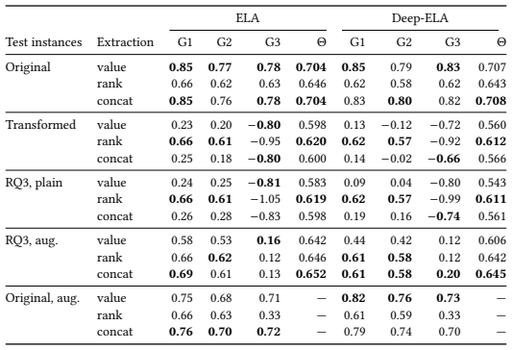
Table 7 : All results of RQ2 and RQ3. 𝑅2 (G1–G3, regression) and Θ (mixed portfolio, selection) are medians over 11 model seeds. Original: original test instances. Transformed: test instances transformed byDspline (RQ2). RQ3: test instances transformed by the four distributions that data augmentation does not use, without ( plain) and with ( aug.) data augmentation; Original, aug.: original test instances with data augmentation ( Θ: Table 13). Bold marks the best feature extraction in each column of each block. The Oracle reaches Θ = 0.756 on the original and 0.753 on the transformed test instances.
出典 · CC BY 4.0 · Shuhei Tanaka, Shoichiro Tanaka, Toshiharu Hatanaka · Shortcut Learning in Feature-Based Algorithm Selection · 論文の図を引用 · 元のPDFの14ページ目から図の部分を抽出しています。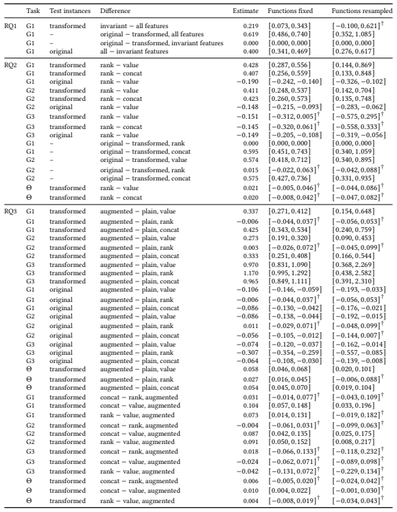
Table 10 : Bootstrap 95% intervals of the differences with ELA. Estimate: the difference of the levels in the main paper. Functions fixed: resampling model seeds, 𝜔, and the test instances of each function. Functions resampled: resampling the 24 functions as well.†: the interval includes zero.
出典 · CC BY 4.0 · Shuhei Tanaka, Shoichiro Tanaka, Toshiharu Hatanaka · Shortcut Learning in Feature-Based Algorithm Selection · 論文の図を引用 · 元のPDFの18ページ目から図の部分を抽出しています。G1アルゴリズムは順位だけを使うため、Jは変換によって変わりません。したがって、この低下は、変換によって変化する非不変な特徴量に予測器が依存していたことの証拠と読み取れます。著者らは、この結果が正規化された目的関数の値でもShortcut Learningが生じることの根拠だと見ています。
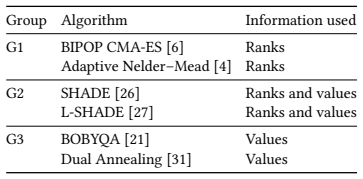
Table 3 : Algorithms and the information about objective values that they use in their search.
出典 · CC BY 4.0 · Shuhei Tanaka, Shoichiro Tanaka, Toshiharu Hatanaka · Shortcut Learning in Feature-Based Algorithm Selection · 論文の図を引用 · 元のPDFの5ページ目から図の部分を抽出しています。順位ベースの特徴量抽出の効果
順位ベースの特徴量抽出では、G1とG2で変換後のR2が最低0.61でした。同じ条件での値ベースの特徴量抽出は、最大でも0.23でした。G1の順位ベースのR2は、入力もJも変わらないため、変化しませんでした。
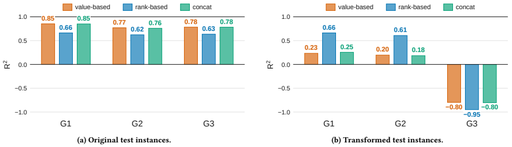
Figure 4 : Rank-based extraction has the lowest 𝑅2 on original test instances but the highest for G1 and G2 on transformed ones.
出典 · CC BY 4.0 · Shuhei Tanaka, Shoichiro Tanaka, Toshiharu Hatanaka · Shortcut Learning in Feature-Based Algorithm Selection · 論文の図を引用 · 元のPDFの7ページ目から図の部分を抽出しています。G3では、順位ベースの抽出にも効果がなく、変換後のすべての抽出でR2が負になりました。G3のアルゴリズムは値を直接使うため、変換によってJが大きく変わったからです。順位ベースの抽出では、値のスケールに依存する探索は防げませんでした。
データ拡張の利点とコスト
データ拡張では、学習インスタンスごとに変換済みのコピーを追加します。この方法により、すべてのポートフォリオで、変換されたテストインスタンスに対する予測性能が改善しました。
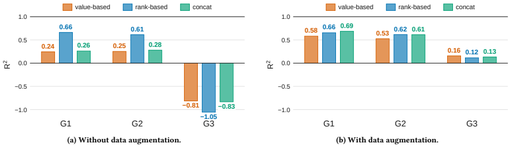
Figure 6 : Data augmentation raises the 𝑅2 of value-based extraction and concatenation on the transformed test instances.
出典 · CC BY 4.0 · Shuhei Tanaka, Shoichiro Tanaka, Toshiharu Hatanaka · Shortcut Learning in Feature-Based Algorithm Selection · 論文の図を引用 · 元のPDFの8ページ目から図の部分を抽出しています。ただしコストもあります。元のテストインスタンスでは、同じ特徴量のR2が最大0.31下がりました。同じサイズのuntransformedインスタンスを追加した対照実験では、この利得は見られませんでした。
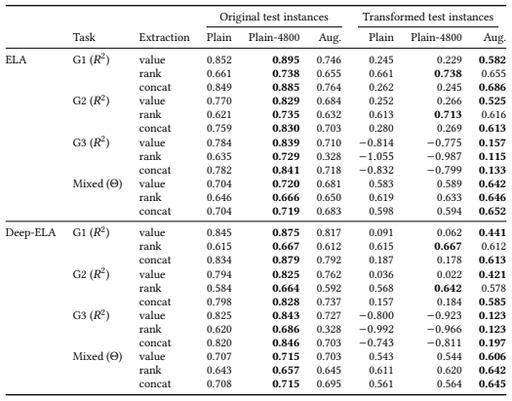
Table 13 : Data augmentation against a training set of the same size without transformations (medians over 11 model seeds).Plain: 2,400 training instances. Plain-4800: these and 2,400 new untransformed instances. Aug.: these and their 2,400 transformed copies. Transformed: mean over the four distributions that data augmentation does not use. Bold marks the best training condition in each cell.
出典 · CC BY 4.0 · Shuhei Tanaka, Shoichiro Tanaka, Toshiharu Hatanaka · Shortcut Learning in Feature-Based Algorithm Selection · 論文の図を引用 · 元のPDFの22ページ目から図の部分を抽出しています。残された課題と適用範囲
RQ1の直接的な証拠は、10次元のBBOB、LIO評価、一つの予算とサンプルサイズ、既知の最小値を設定した条件から得られたものです。未知の関数への一般化を調べたLOFO評価では、すべての条件でR2が負になりました。したがって、この論文の対策は、順序を保つ分布変化に限定して読む必要があります。
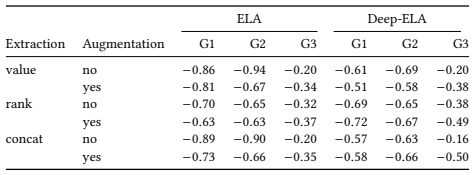
Table 9 : LOFO𝑅2 is negative in every condition (median over 11 model seeds).
出典 · CC BY 4.0 · Shuhei Tanaka, Shoichiro Tanaka, Toshiharu Hatanaka · Shortcut Learning in Feature-Based Algorithm Selection · 論文の図を引用 · 元のPDFの16ページ目から図の部分を抽出しています。また、G3ではサイズ調整だけで生じた変化は、どの対策でも取り除けませんでした。この限界は、著者らが明示的に述べている範囲です。
論文情報
- 著者
- Shuhei Tanaka, Shoichiro Tanaka, Toshiharu Hatanaka
- 学会・ジャーナル
- arXiv · プレプリント
- 公開日
- 2026年11月16日
- 登録日
- 2026年11月17日
- 更新日
- 2026年11月16日
- バージョン
- v1
- arXiv
- 2611.20440
- カテゴリ
- cs.NE · cs.LG
- ライセンス
- CC BY 4.0
- 掲載内容
- 論文情報・解説・論文の図
この解説は、Refivuの韓国語解説をAIで翻訳したものです。不正確な翻訳や誤りが含まれる可能性があります。論文と図の利用条件は各出典に従います。
アブストラクト
Landscape features give learning models information about the objective function for algorithm selection, algorithm configuration, and performance prediction. Should these features capture more information? Not always, because a model may rely on information that the algorithms ignore. This phenomenon is called shortcut learning, and in-distribution accuracy can hide it. We propose the Rubber Ruler Test. It transforms the objective values of test instances with random strictly increasing transformations, reruns the algorithms, and measures prediction performance. Comparison-based algorithms such as CMA-ES perform identically after the transformation, so for them any drop reveals shortcut learning. On 10-dimensional BBOB, a model for two comparison-based algorithms learned shortcuts even from normalized objective values. The R^2 of a model using all ELA features dropped from 0.85 to 0.23, below 0.45 with invariant features only. Rank-based features reduced the drop when algorithms search using ranks. Data augmentation with transformed training instances improved prediction on transformed instances for every portfolio we studied, but lowered R^2 on original instances by up to 0.31. These results suggest that models should rely only on information that the algorithms use. We recommend reporting the Rubber Ruler Test alongside in-distribution accuracy and using it to choose feature extraction and data augmentation.
この論文を引用
Shuhei Tanaka, Shoichiro Tanaka, Toshiharu Hatanaka (2026). Shortcut Learning in Feature-Based Algorithm Selection. arXiv:2611.20440v1. https://arxiv.org/abs/2611.20440v1
BibTeX
@misc{tanaka2026shortcut,
  title = {{Shortcut Learning in Feature-Based Algorithm Selection}},
  author = {Shuhei Tanaka and Shoichiro Tanaka and Toshiharu Hatanaka},
  year = {2026},
  eprint = {2611.20440},
  archivePrefix = {arXiv},
  url = {https://arxiv.org/abs/2611.20440v1}
}