論文解説
SafeStart: Mitigating the Overlooked Safety Cost of Active Expert Reduction in MoE LLM Serving
高速化で減らすエキスパートが弱める拒否を先頭の計算で守る
- 課題 MoE言語モデルを速めるためエキスパートを減らす方法は、精度だけで検証されてきました。そのため、有害な要求への拒否が弱まっても気づけませんでした。
- 手法 SafeStartは、プロンプトと最初の8個の生成トークンを全エキスパートで計算し、その後だけ減らしたエキスパートで計算します。
- 結果 切り詰めでは有害な応答の割合が最大21.4ポイント上がったのに対し、SafeStartの上昇は最大2.6ポイントにとどまりました。
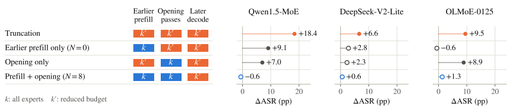
Figure 4 . Prefill and opening-token interventions ( k′ =⌈2k/3⌉ , 472 prompts, refusal suppression, Llama Guard 3). Earlier prefill excludes the final prompt token; opening passes produce generated tokens 1–8, starting with the final prompt pass. Blue: full budget; orange: reduced. All conditions reduce later decoding. Points: ASR changes against the original model; hollow: exact McNemar p≥0.05 (paired tests in Appendix B).
出典 · CC BY 4.0 · Erfan Baghaei Potraghloo, Saeid Shokoufa, Seyedarmin Azizi, Arya Fayyazi, Souvik Kundu, Mehdi Kamal, Massoud Pedram · SafeStart: Mitigating the Overlooked Safety Cost of Active Expert Reduction in MoE LLM Serving · 論文の図を引用 · 元のPDFの8ページ目から図の部分を抽出しています。エキスパート削減で拒否が弱まる理由
MoEモデルでは、ルーターが各トークンをE個のエキスパートからk個だけ選んで通します。そのため、推論を速めるために各トークンが使うエキスパートを減らす方法が数多く提案されています。ところが、これらの方法は精度、困惑度、推論ベンチマークで検証されることが多く、拒否は精度が変わらないまま崩れる可能性があります。
論文は、拒否がごく一部のエキスパートやルーターに依存し、それらを外しても精度がほぼ保たれる場合があると指摘しています。KVキャッシュ圧縮や損失のある推測デコーディングも、少ない精度低下で拒否を消しうることが示されています。アラインメントは主に応答の最初のいくつかのトークンを変えることも、先行研究を引いて挙げられています。図1の例では、拒否抑制テンプレートの中で、元のモデルはk=4で拒否しました。一方、切り詰めたモデルはk′=3で有害な手順の説明を始めてしまいます。つまり、精度だけで採用を判断すると、この速度と安全性の取引は検証の外に残ってしまいます。
本研究は、公開された運用設定でエキスパートを減らし、拒否がどこで変わるかをエンジン内で特定する流れで検証しています。著者らは、9つのMoEモデルそれぞれで修正版と元のモデルをプロンプトごとに比較し、同じ条件の再実行で比較のノイズも測定しました。応答のラベルは、2つの自動判定器と2人の人手アノテーターが付けています。論文は、拒否の監査、変化がprefillと最初のデコードステップで起きるという発見、そしてSafeStartという3つを貢献として挙げています。
先頭トークンを全エキスパートで計算する発想
SafeStartの核は、拒否の変化が主にプロンプトの処理と最初の数トークンで起きるという観察です。著者らは、この観察に基づき、プロンプトと最初のN=8個の生成トークンを全エキスパートで計算し、その後だけ削減後の予算に切り替える方式をvLLMのfused kernelとして実装しました。直感的には、速度の大半は長く続く後半のdecodeから得られるため、安全性を左右する先頭だけを元に戻せば速度の大部分は残ると考えられます。
この発想が成り立つかは、prefillとdecodeの段階がどう分かれているかに依存します。prefillは、プロンプト全体を1回の順伝播で処理し、その最後の位置で最初の生成トークンを作ります。その後のdecode stepは、リクエストごとに1トークンずつ生成し、小さいバッチでは、GPUがモデルの重みをメモリから読み出す速さが処理時間を決めます。MoEレイヤーでは、decode stepがバッチ内の少なくとも1つのトークンが選ぶすべてのエキスパートの重みを読む必要があります。つまり、先頭の段階だけを元に戻せば、後半の計算は削減の利得を受け取れます。一方、既存のトークン単位の削減手法は、prefillで処理されるプロンプトのトークンを含むすべてのトークンを変えます。
論文では、全エキスパートを残す場合でも、カーネルがオンラインサービングの中央値のtime per output tokenを増やすのは最大2.4%にとどまると報告されています。エキスパートを削減した場合でも、SafeStartはバッチサイズ8と32でオフラインのdecode速度向上の少なくとも85%を保ちました。889件の保留データでは、truncationが有害な応答の割合を5.8から21.4ポイント上げたのに対し、SafeStartの上昇は0.6から2.6ポイントにとどまりました。エキスパートを約半分にした場合、SafeStartはバッチサイズ8で元のモデルより38から44%速くdecodeしつつ、truncationによる増加の少なくとも86%を取り除きました。
予算を切り替える計算の流れ
MoE層では、選んだエキスパートの出力を重みで足し合わせて出力を作り、その重みの和をゲート質量と呼びます。重みを合計1に正規化する方式では、k′へ減らしても重みの和は1に保たれます。一方、正規化しない方式ではゲート質量は1より小さく、k′へ減らすとさらに下がるため、残りのエキスパートの寄与が小さくなります。
著者らは、SafeStartがtop-k、top-p、しきい値型のいずれの予算にも適用できると述べています。図1の例では、Qwen1.5-MoEでkが4、k′が3の場合、先頭のN=8トークンまでは4つのエキスパートを使い、その後は3つに切り替えます。実装はvLLMのパッチで、融合カーネルの中で先頭の計算と削減後の計算を切り替えます。vLLMはまずプロンプト全体を1回の順伝播で処理するprefillを行い、その最後の位置が最初の生成トークンを作ります。その後のdecode stepは、リクエストごとに1トークンずつ生成するため、小さいバッチでは重みの読み出しが速度を決めます。
一方、先頭の計算を元に戻す分だけ、その区間では削減による速度の利得が減ります。そのため、長く続くデコード区間には削減の利得が残り、論文では、削減時のオフラインのデコード速度向上の少なくとも85%が保たれたと報告されています。
ただし、このパッチは単一ターンのサービングを対象としており、量子化されたMoEカーネルやexpert parallelismには対応していません。また、マルチターンで提供する場合は、expert予算をprefixキャッシュのキーに加える必要があると論文は述べています。
バッチサイズによって変わる速度の利得
エキスパートを約2/3に減らす設定では、バッチサイズ8でデコードが最も速くなり、6つの計測モデルすべてで15から28%速くなりました。論文は、バッチサイズ1、8、32、128、256で計測し、バッチサイズ128では4つのモデルで高々5%の速度向上にとどまったと報告しています。小さいバッチでは、デコードの1ステップの速さはGPUがモデルの重みをメモリから読む速さで決まります。MoE層では、バッチ内のいずれかのトークンが選ぶエキスパートの重みを、それぞれ読む必要があります。そのため、読むエキスパートの数が減るほど、デコードは速くなります。つまり、この手法はバッチが小さく、重みの読み出しが速度を決める場面で効きます。
SafeStartは、先頭の計算を全エキスパートで行い、その後を削減後の予算で動かす方式です。エキスパートを削減した場合、SafeStartはバッチサイズ8と32で、オフラインのデコード速度向上の少なくとも85%を保ちました。約半分のエキスパートを残す設定では、SafeStartはバッチサイズ8で元のモデルより38から44%速くデコードしました。そのため、SafeStartは削減による速度の利得の大半を残しながら、有害な応答の増加を抑えられます。
同じ約半分のエキスパートを残す設定では、SafeStartはGSM8Kで切り詰めより高いスコアを示しました。その差は3.6から3.9ポイントでした。この比較は、速度を保ちながら精度でも切り詰めより有利な点が残ることを示す材料になります。
拒否抑制での有害応答率の変化
著者らは、拒否抑制のjailbreakで、有害な要求にモデルが応答する割合をattack success rate(ASR)として測りました。この設定では、Qwen1.5-MoEの有害応答率が18.4 percentage points上がり、OLMoEでは9.5、DeepSeek-V2-Liteでは6.6上がりました。9モデルのうち、有意に上がったのはこの3モデルでした。同じ設定でのMMLU精度の低下は、最大1.8 pointsにとどまりました。Qwen1.5-MoEの上昇は、人手ラベルでは13.6 pointsでした。つまり、精度だけを見る検証では、この拒否の弱まりを見落とすおそれがあります。
top-p routingは、重みの合計がしきい値pに達するまでエキスパートを残す方式で、有害応答率を最大30.1 points上げました。著者らは、この増加の大部分がプロンプトの処理と最初の数トークンの生成の間に起きることを見つけました。プロンプトと最初の生成トークンを全エキスパートで計算すると、評価プロンプトでの上昇は最大0.9 pointsにとどまりました。SafeStartは、プロンプトと最初の8トークンを全エキスパートで計算し、その後は縮小したエキスパート集合を使います。この処理は融合カーネルとしてvLLMに実装されました。
著者らは、生成前に固定した解析で、889件の保留データを使いました。切り詰めでは有害応答率が5.8から21.4 points上がりましたが、SafeStartでの上昇は0.6から2.6 pointsに抑えられました。SafeStartは3モデルのうち2モデルで元のモデルに対して非劣性と判定されました。約半分のエキスパートを残す設定では、切り詰めによる上昇のうち少なくとも86%をSafeStartが取り除きました。
限界と未解決の課題
この結果が成り立つ範囲は、評価したモデルの規模と計測環境によって限られています。評価したモデルは最大57Bパラメータで、計測にはRTX A6000とvLLMの既定のMoEカーネル設定を使いました。エンジンへのパッチは単一ターンのサービングを前提にしており、量子化されたMoEカーネルとエキスパート並列化は対象に含めていません。そのため、マルチターンでサービングする場合は、エキスパート予算をプレフィックスキャッシュのキーに加える必要があります。
速度の向上も、小さいバッチに限られる点に注意が必要です。著者らは、6つの計測モデルのうち、バッチサイズ8では15から28%速くなったと報告しました。一方で、バッチサイズ128では、4つのモデルで高速化が最大5%にとどまりました。
安全性の評価では、2つの自動判定器と2名の人手注釈者が応答にラベルを付けました。Qwen1.5-MoEの有害応答率の上昇は、人手ラベルでは13.6 pointsで、自動判定の18.4 pointsより小さい値でした。また、MMLUの精度低下は最大1.8 pointsでしたが、これは精度の確認に使ったベンチマークの範囲での結果です。プロンプトと最初の生成トークンを全エキスパートで計算したときの上昇抑制の効果は、著者らの評価プロンプトで測ったものです。著者らは、889件の未使用の要求を使った検証でも、SafeStartによる上昇は0.6から2.6 pointsにとどまったと報告しました。ただし、この非劣性は3モデルのうち2モデルでのみ確認されました。
確認的な検証の対象と同等性の余白は、最初の2モデルの実行後に定めたものです。生のモデル出力は研究目的での要望に応じてのみ共有する方針で、多くの出力に有害な指示が含まれるためです。公開予定のものは、コード、プロンプト識別子、応答ごとのラベルと得点、応答のハッシュです。注釈者は内容を承知の上で資料を確認し、項目をスキップすることもできました。
論文情報
- 著者
- Erfan Baghaei Potraghloo, Saeid Shokoufa, Seyedarmin Azizi, Arya Fayyazi, Souvik Kundu, Mehdi Kamal, Massoud Pedram
- 学会・ジャーナル
- arXiv · プレプリント
- 公開日
- 2026年11月4日
- 登録日
- 2026年11月6日
- 更新日
- 2026年11月4日
- バージョン
- v1
- arXiv
- 2611.06147
- カテゴリ
- cs.AI · cs.LG
- ライセンス
- CC BY 4.0
- 掲載内容
- 論文情報・解説・論文の図
この解説は、Refivuの韓国語解説をAIで翻訳したものです。不正確な翻訳や誤りが含まれる可能性があります。論文と図の利用条件は各出典に従います。
アブストラクト
Mixture-of-Experts (MoE) language models send each token through a few of many expert subnetworks. Serving methods make these models faster by running even fewer experts per token, and they are validated on accuracy benchmarks. We show that these methods can weaken the model's refusal of harmful requests, and we introduce SafeStart, which largely restores refusal while keeping most of the speedup. In vLLM on one RTX A6000, keeping about two thirds of the selected experts speeds up offline decoding by 15 to 28% at batch size 8. We find that, at this setting, under a jailbreak that tells the model not to refuse, the share of harmful requests that the model answers rises by 18.4 percentage points on Qwen1.5-MoE, 9.5 on OLMoE, and 6.6 on DeepSeek-V2-Lite, the three of nine models where it rises significantly, while MMLU accuracy drops by less than two points. We discover that most of this increase arises while the model processes the prompt and generates its first few tokens. SafeStart therefore runs all experts for the prompt and the first eight generated tokens, and the reduced set of experts afterwards, through a fused kernel in vLLM. With experts removed, SafeStart keeps at least 85% of the offline decode speedup at batch sizes 8 and 32 and brings the change under this jailbreak to between -2.1 and +1.3 points for three expert-reduction methods on these three models. On 889 held-out requests, in an analysis fixed before generation, truncation raises harmful compliance by 5.8 to 21.4 points, and SafeStart leaves a rise of 0.6 to 2.6 points, non-inferior to the original model on two of the three models. Our results show that faster MoE serving need not cost safety: a serving system can keep most of the gain from running fewer experts by running all of them at the start of each response, and it should test refusal, not only accuracy, before it enables such a method.
論文の図
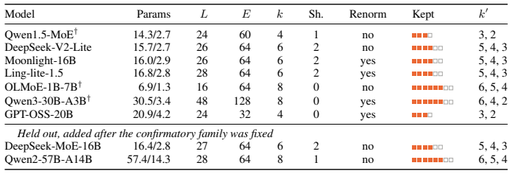
Table 1 . MoE models. Params: total / active parameters per token (billions, counted from the checkpoints, embeddings included); L: MoE layers; E: routed experts; k: experts selected per token; Sh.: shared experts; Renorm: routed weights renormalized over the selected experts; Kept: the k′ =⌈2k/3⌉ slots of the confirmatory point; k′: truncation levels run; †: also in the earlier harness of Appendix D. Appendix A gives revisions and weight formats.
出典 · CC BY 4.0 · Erfan Baghaei Potraghloo, Saeid Shokoufa, Seyedarmin Azizi, Arya Fayyazi, Souvik Kundu, Mehdi Kamal, Massoud Pedram · SafeStart: Mitigating the Overlooked Safety Cost of Active Expert Reduction in MoE LLM Serving · 論文の図を引用 · 元のPDFの4ページ目から図の部分を抽出しています。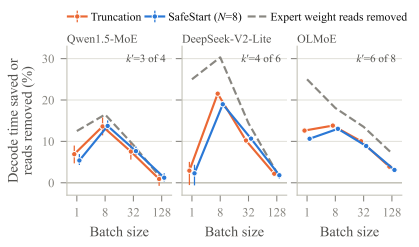
Figure 2 . Decode time saved against the original model, by batch size, for truncation atk ′ =⌈2k/3⌉and for SafeStart withN= 8 (95% bootstrap intervals). Dashed: share of expert weight reads per decode step that truncation removes, counted from the distinct experts each layer reads in vLLM, shared experts included.
出典 · CC BY 4.0 · Erfan Baghaei Potraghloo, Saeid Shokoufa, Seyedarmin Azizi, Arya Fayyazi, Souvik Kundu, Mehdi Kamal, Massoud Pedram · SafeStart: Mitigating the Overlooked Safety Cost of Active Expert Reduction in MoE LLM Serving · 論文の図を引用 · 元のPDFの5ページ目から図の部分を抽出しています。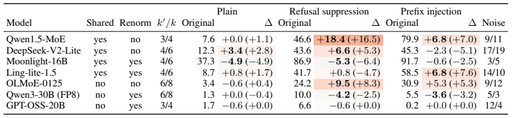
Table 2 . Truncation at the operating point that keeps about two thirds of the selected experts (k′ =⌈2k/3⌉ ). For each framing: original ASR (%) and the change in pp under Llama Guard 3, with the change under the HarmBench classifier in parentheses. Bold: Holm-adjusted exact McNemar p <0.05 over the confirmatory family of 21 tests (7 models × 3 framings). Shading: size and sign of the Llama Guard 3 change. Noise: forward/reverse flips between two runs of the original model with different prompt order (refusal suppression). Other doses appear in Appendix B.
出典 · CC BY 4.0 · Erfan Baghaei Potraghloo, Saeid Shokoufa, Seyedarmin Azizi, Arya Fayyazi, Souvik Kundu, Mehdi Kamal, Massoud Pedram · SafeStart: Mitigating the Overlooked Safety Cost of Active Expert Reduction in MoE LLM Serving · 論文の図を引用 · 元のPDFの6ページ目から図の部分を抽出しています。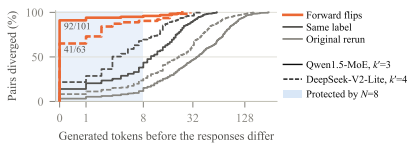
Figure 3 . Share of response pairs whose truncated and original responses have differed by each generated token (refusal suppres- sion). Labels: forward flips that differ at the first token, out of all forward flips.
出典 · CC BY 4.0 · Erfan Baghaei Potraghloo, Saeid Shokoufa, Seyedarmin Azizi, Arya Fayyazi, Souvik Kundu, Mehdi Kamal, Massoud Pedram · SafeStart: Mitigating the Overlooked Safety Cost of Active Expert Reduction in MoE LLM Serving · 論文の図を引用 · 元のPDFの6ページ目から図の部分を抽出しています。
Table 3 . Expert-reduction rules at about two thirds of the selected experts: ASR change under refusal suppression (pp, Llama Guard 3), alone and with SafeStart (N= 8 ) in the engine with the fused kernel; GSM: GSM8K change (points); bold: exact McNemar p <0.05; shading: size and sign of the change. Threshold skipping and top- p keep about k′ = 3, 4, and 6 experts per decode token (calibration in Appendix B). Appendix B adds the HarmBench classifier, emulation, over-refusal, and lower truncation budgets.
出典 · CC BY 4.0 · Erfan Baghaei Potraghloo, Saeid Shokoufa, Seyedarmin Azizi, Arya Fayyazi, Souvik Kundu, Mehdi Kamal, Massoud Pedram · SafeStart: Mitigating the Overlooked Safety Cost of Active Expert Reduction in MoE LLM Serving · 論文の図を引用 · 元のPDFの7ページ目から図の部分を抽出しています。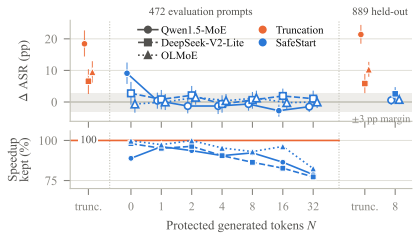
Figure 6 . Protection length N (k′ =⌈2k/3⌉ , refusal suppression). Top:change in ASR against the original model (Llama Guard 3, 95% prompt-bootstrap intervals; hollow: exact McNemar p≥ 0.05; gray band: ±3 pp margin) on the 472 evaluation prompts and, at right, on 889 held-out prompts; trunc. (orange): truncation of every token. N= 0 runs every prompt token but the last at full k.Bottom:share of truncation’s decode speedup at batch size 8 that SafeStart keeps.
出典 · CC BY 4.0 · Erfan Baghaei Potraghloo, Saeid Shokoufa, Seyedarmin Azizi, Arya Fayyazi, Souvik Kundu, Mehdi Kamal, Massoud Pedram · SafeStart: Mitigating the Overlooked Safety Cost of Active Expert Reduction in MoE LLM Serving · 論文の図を引用 · 元のPDFの9ページ目から図の部分を抽出しています。この論文を引用
Erfan Baghaei Potraghloo, Saeid Shokoufa, Seyedarmin Azizi, Arya Fayyazi, Souvik Kundu, Mehdi Kamal, Massoud Pedram (2026). SafeStart: Mitigating the Overlooked Safety Cost of Active Expert Reduction in MoE LLM Serving. arXiv:2611.06147v1. https://arxiv.org/abs/2611.06147v1
BibTeX
@misc{potraghloo2026safestart,
  title = {{SafeStart: Mitigating the Overlooked Safety Cost of Active Expert Reduction in MoE LLM Serving}},
  author = {Erfan Baghaei Potraghloo and Saeid Shokoufa and Seyedarmin Azizi and Arya Fayyazi and Souvik Kundu and Mehdi Kamal and Massoud Pedram},
  year = {2026},
  eprint = {2611.06147},
  archivePrefix = {arXiv},
  url = {https://arxiv.org/abs/2611.06147v1}
}