論文解説
V-JEPA-LM: Video-Language Models That Read Dynamics Beyond Static, Text-Aligned Representations
V-JEPA-LM:静的でテキストに整合した表現を超えて動的な変化を読むVideo-Languageモデル
- 課題 キャプションと質問応答を中心にした学習では、言語モデルが映像の変化を答えに使わなくなるため、凍結された予測型エンコーダの動的な情報が活用されません。
- 手法 公開ビデオにピクセル変換を適用し、変換によって正解が決まる反実仮想の学習行を作ります。そのうえで、凍結したV-JEPAエンコーダとスペクトラルブリッジを介して、言語モデルを単一段階で学習します。
キャプションと質問応答が動的な変化を読ませない理由
予測型のビデオエンコーダV-JEPAは、映像だけから、シーンの向き、速度、順序、状態の変化を学習します。しかし、このエンコーダをキャプションと質問応答で学習した言語モデルに接続すると、モデルは質問が尋ねるいくつかの属性を探して答える方向に学習されます。1フレームを見るだけで答えられる問題が多いため、エンコーダが持つ動的な変化の情報は回答に使われません。そこで、この研究は言語モデルに変化を実際に読ませるにはどのような監督が必要かを問います。
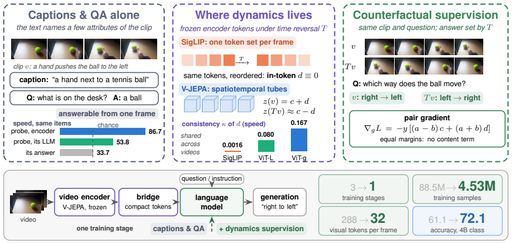
Figure 1 . Top: what captions and QA teach (left), where the dynamics lives in the encoder (middle), and the supervision built from it (right). Bottom: the model, trained in one stage, and what the recipe changes (before→after: the V-JEPA 2 video LLM [4]; accuracy: the best open 4B model).
出典 · CC BY 4.0 · Keuntae Kim, Dongjun Kim, Yong Suk Choi · V-JEPA-LM: Video-Language Models That Read Dynamics Beyond Static, Text-Aligned Representations · 論文の図を引用 · 元のPDFの2ページ目から図の部分を抽出しています。変形の前後で答えが変わる反実仮想の学習行
中心となるアイデアは、同じクリップと同じ質問に対して、ピクセル変換の前後で答えが変換によって決まるように学習行を作ることです。生成器は公開ビデオクリップvと変換Tを受け取り、T vをレンダリングします。そのうえで、質問、選択肢、正解π_T(y)を一緒に記録します。正解は変換規則から導かれるため、新たな手動アノテーションも言語モデルも必要ありません。1つのシーン内で正解が同じ頻度で現れるように変形を選び、回答の均衡を取ります。
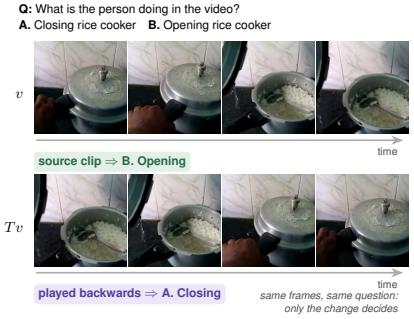
Figure 2 . One generated pair: the same clip forward and backward, with the same question and opposite answers (4 of 32 frames). Other constructions: Fig. 6.
出典 · CC BY 4.0 · Keuntae Kim, Dongjun Kim, Yong Suk Choi · V-JEPA-LM: Video-Language Models That Read Dynamics Beyond Static, Text-Aligned Representations · 論文の図を引用 · 元のPDFの3ページ目から図の部分を抽出しています。
Table 1 . The fourteen counterfactual constructions (33 sources, 509k rows, 6.1% of sampled training rows). Each row is rendered at training time from a clip of a public dataset and a transformation; the answer follows fromπ T . Pair%: rows whose counterpart from the same clip with a different answer is also in the same source. Per-source details, real questions and rendered examples: Sec. B.
出典 · CC BY 4.0 · Keuntae Kim, Dongjun Kim, Yong Suk Choi · V-JEPA-LM: Video-Language Models That Read Dynamics Beyond Static, Text-Aligned Representations · 論文の図を引用 · 元のPDFの4ページ目から図の部分を抽出しています。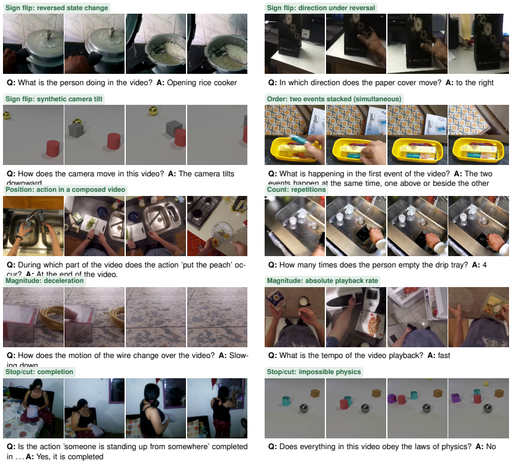
Figure 6 . One training row per construction (4 of 32 frames, after the transformation), with its question and answer.
出典 · CC BY 4.0 · Keuntae Kim, Dongjun Kim, Yong Suk Choi · V-JEPA-LM: Video-Language Models That Read Dynamics Beyond Static, Text-Aligned Representations · 論文の図を引用 · 元のPDFの15ページ目から図の部分を抽出しています。内容係数が0になるペア損失
反実仮想ペアの損失は、元の余白s(v)と変換後の余白s(T v)に対するロジスティック損失の和です。命題3によれば、ペア損失の勾配は−y[(a−b)c+(a+b)d]で与えられます。ここでcは2つの動画が共有する内容、dは変化成分です。2つの余白が等しいとき、a=bなので、内容係数はちょうど0になります。そのため、答えが変化だけに依存するように学習が導かれます。ただし、この結論は内容と変化を独立に読み取れる場合の条件付きの結果です。論文では、2成分が共線的であれば同じ結論は成り立たない例も示されています。
スペクトラルブリッジと単一段階の学習
モデルは、凍結したV-JEPA 2.1エンコーダが32フレームを読み取り、スペクトラルブリッジが各クリップを1,024個のトークンに変換する構造です。ブリッジは、エンコーダの統計量で一度計算したPCA回転とスケーリングの後に、学習可能なMLPプロジェクタを置きます。言語モデルは、ブリッジのウォームアップの後に単一段階で全体を学習し、4.53M個の公開サンプルを使います。凍結されるのはエンコーダで、ブリッジと言語モデルは学習されます。ViT-Lは1Bと2Bに、ViT-gは3Bから8Bまで使われています。

Table 11 . Training settings. All: frozen V-JEPA 2.1 encoder at 32 frames, spectral bridge to 1,024 tokens (fixed PCA rotation and rescaling, then a trainable MLP), bridge learning rate2×10 −4 (3B:2.83×10 −4), weight decay 0.01 (LLM) / 0.05 (bridge), linear warm-up over 0.2–0.3% of steps with the LLM frozen for the first 0.6–0.8%, cosine decay, maximum sequence 2,560 tokens, 4.53M rows drawn at fixed per-source weights from the 175-source mixture (4.60M for the ViT-L models). Compute: Tab. 12; EFLOPs (1018): trained parameters× trained tokens×6 plus attention and the frozen encoder’s forward pass, measured per clip (activation recomputation excluded).
出典 · CC BY 4.0 · Keuntae Kim, Dongjun Kim, Yong Suk Choi · V-JEPA-LM: Video-Language Models That Read Dynamics Beyond Static, Text-Aligned Representations · 論文の図を引用 · 元のPDFの17ページ目から図の部分を抽出しています。エンコーダごとの変化成分の一貫性
著者らは、凍結したエンコーダのトークンから変化成分dを分解し、複数の動画で同じ方向を指しているかをκで測定しました。SigLIPは時間を逆にしたとき、トークン内の変化が0になり、速度と鏡映変化のκは0.002を下回る値にとどまりました。一方、V-JEPAの2つのエンコーダは、κがSigLIPの20倍から100倍大きい変化成分を示し、8組のペアで読み出したプロトタイプでも読み取れました。この測定は、SSv2の学習クリップ1,200個を対象としたものです。
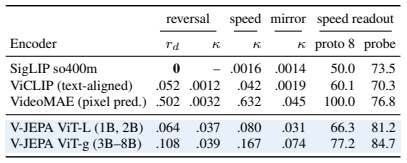
Table 2 . Change component of frozen encoders (1,200 clips; 70% fit, 30% held out).r d: relative size of the in-token change after aligning token positions;κ: cross-video consistency; proto 8: ac- curacy of a prototype read from 8 pairs (chance 50); probe: linear probe on all training clips. ViCLIP and VideoMAE: diagnostic encoders with joint space–time attention, not used in our models. All measures: Tab. 22.
出典 · CC BY 4.0 · Keuntae Kim, Dongjun Kim, Yong Suk Choi · V-JEPA-LM: Video-Language Models That Read Dynamics Beyond Static, Text-Aligned Representations · 論文の図を引用 · 元のPDFの4ページ目から図の部分を抽出しています。エンコーダと監督を分けた2×2実験
2Bのモデルでは、V-JEPA ViT-LとSigLIP so400mを、それぞれ反実仮想行の有無を変えて学習しました。混合データと学習スケジュールは同じにしています。反実仮想行を加えると、平均スコアが8kステップと最終ステップでそれぞれ4.5点上がったと論文では報告されています。速度の項目では、V-JEPAで反実仮想行の効果が大きく現れ、SigLIPでは小さくなりました。同じ混合データに時間の質問だけを入れた対照群は、この向上を再現できませんでした。
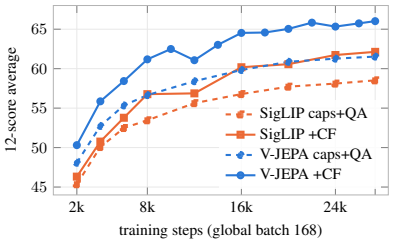
Figure 4 . Twelve-score average during training (2B). Solid: with counterfactual rows; dashed: captions and QA only.
出典 · CC BY 4.0 · Keuntae Kim, Dongjun Kim, Yong Suk Choi · V-JEPA-LM: Video-Language Models That Read Dynamics Beyond Static, Text-Aligned Representations · 論文の図を引用 · 元のPDFの7ページ目から図の部分を抽出しています。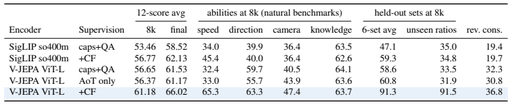
Table 6 . Encoder×supervision (2B; same mixture and schedule). +CF: with the counterfactual rows; AoT only: an arrow-of-time question in their place. Final: step 27,382. Abilities: Sec. 6.1; held-out chance 33.3; rev. cons.: original and reversed video both correct (Tab. 27). All steps and benchmarks: Tab. 24.
出典 · CC BY 4.0 · Keuntae Kim, Dongjun Kim, Yong Suk Choi · V-JEPA-LM: Video-Language Models That Read Dynamics Beyond Static, Text-Aligned Representations · 論文の図を引用 · 元のPDFの8ページ目から図の部分を抽出しています。
Table 23 . From encoder structure to gain. For each family: the transformation, the result that predicts how its change is carried, the prediction, the measured cross-video consistencyκof the frozen ViT-L and SigLIP (Tab. 22; SigLIP reversal hasr d = 0, no in-token component), and the CF gain on the matching natural-benchmark ability at 8k steps (Tab. 26). Order changes token positions rather than token content, so both encoders gain alike. Speed is the one family the propositions do not cover for V-JEPA (a rate change gives no shared direction by Proposition 2, Sec. A); its prediction rests on the measuredκalone, with Proposition 1(i) giving SigLIP only scene-specific frame differences. Gains are those of the whole counterfactual mixture against captions and QA, read per ability; at the final step the direction and state-change gains of the two encoders draw closer, while speed stays far apart (Tab. 26).
出典 · CC BY 4.0 · Keuntae Kim, Dongjun Kim, Yong Suk Choi · V-JEPA-LM: Video-Language Models That Read Dynamics Beyond Static, Text-Aligned Representations · 論文の図を引用 · 元のPDFの23ページ目から図の部分を抽出しています。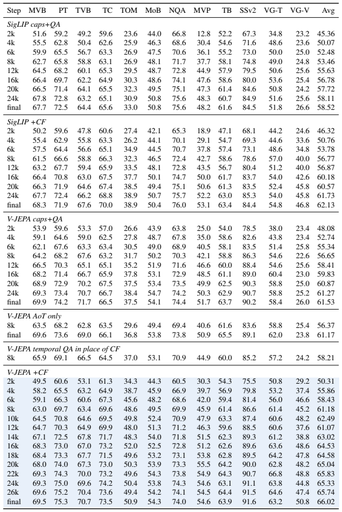
Table 24 . Encoder×supervision, every evaluated checkpoint (2B, global batch 168). The V-JEPA caps+QA arm was trained to 8k first and then continued to the final step; the AoT-only arm likewise, and the temporal-QA arm was trained to 8k. Temporal QA: the counterfactual rows removed and their weight given to the 22 annotation-based temporal-QA sources of the mixture (temporal grounding, highlights, step order, before/after, next action, repetition counting, unintentional action).
出典 · CC BY 4.0 · Keuntae Kim, Dongjun Kim, Yong Suk Choi · V-JEPA-LM: Video-Language Models That Read Dynamics Beyond Static, Text-Aligned Representations · 論文の図を引用 · 元のPDFの25ページ目から図の部分を抽出しています。
Table 26 . Ability groups over the natural benchmarks’ own categories (2B; final: step 27,382). Items: speed 527, direction 1,170, order 1,457, camera 585, count 1,776, state change 711, localization 360, reversal/antonym 520, rotation 286, tracking 425, TemporalBench 2,765, SSv2 2,088, NExT-QA 8,564, knowledge (objects, scenes, knowledge) 9,254. Paired bootstrap 95% intervals: speed on V-JEPA [+27.9,+37.8], on SigLIP[+6.3,+16.5](8k) and[+12.7,+23.3](24k); direction between encoders without CF[+16.7,+22.7]; speed between encoders without CF[−4.9,+1.7].
出典 · CC BY 4.0 · Keuntae Kim, Dongjun Kim, Yong Suk Choi · V-JEPA-LM: Video-Language Models That Read Dynamics Beyond Static, Text-Aligned Representations · 論文の図を引用 · 元のPDFの26ページ目から図の部分を抽出しています。12個のスコア平均の比較
11個のビデオベンチマークにまたがる12個のスコアを、同じプロトコルで評価しました。評価は32フレーム、同じプロンプト、選択肢の文字のスコアリング方式で行いました。Ours-4B-Qは平均72.14で、同じクラスで最も高いオープンな4Bモデルを11.1点上回りました。特にTOMATOでは53.5を記録し、同じクラスで最高のオープンモデルの36.5を上回りました。この数値は著者らが同じプロトコルで再測定した値で、モデルと学習データの規模は比較対象ごとに異なります。
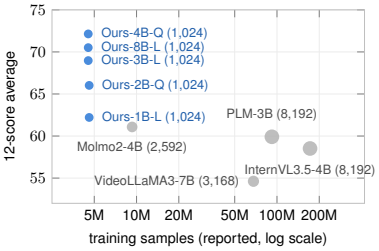
Figure 3 . Twelve-score average against training samples as re- ported (log scale). Marker area: visual tokens per clip. Sample counts: Sec. C.
出典 · CC BY 4.0 · Keuntae Kim, Dongjun Kim, Yong Suk Choi · V-JEPA-LM: Video-Language Models That Read Dynamics Beyond Static, Text-Aligned Representations · 論文の図を引用 · 元のPDFの7ページ目から図の部分を抽出しています。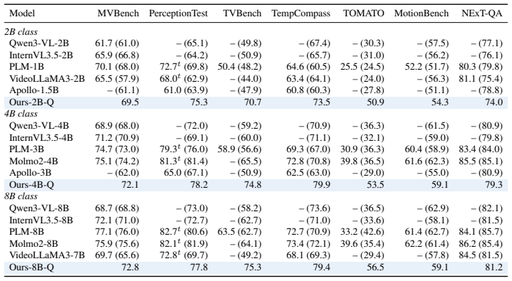
Table 14 . Scores reported by the models’ authors, with ours under the common protocol in parentheses (32 frames, option-letter scor- ing; Tab. 4). Reported settings differ from ours: PerceptionTest test split ( t; ours: validation), Qwen3-VL at 2 fps up to 2,048 frames, InternVL3.5 the best of 16–64 frames, Molmo2 at 2 fps up to 128 frames, VideoLLaMA3 at 1 fps up to 180 frames, PLM 32 frames; PLM’s TVBench from its repository. –: not reported. Gemma 4 reports no video benchmark; MVP, TemporalBench (binary), SSv2 and Vinoground are not reported by any of these models.
出典 · CC BY 4.0 · Keuntae Kim, Dongjun Kim, Yong Suk Choi · V-JEPA-LM: Video-Language Models That Read Dynamics Beyond Static, Text-Aligned Representations · 論文の図を引用 · 元のPDFの19ページ目から図の部分を抽出しています。シードおよび保留セットでの汎化
反実仮想行で学習したモデルは、速度比1.6、2.5、4.0のように学習に含まれていない比率でも高い精度になりました。2Bモデルの速度比の保留セットでは、V-JEPA+CFが最終ステップで98.7を記録しました。一方、SigLIP+CFは同じ行で学習したものの、未観測の比率では最終ステップで55.7にとどまりました。中央のフレームだけを繰り返す単一フレームの対照では、保留セットのスコアが37.9に下がり、答えが静止したシーンの手がかりでは解けないことが示されました。
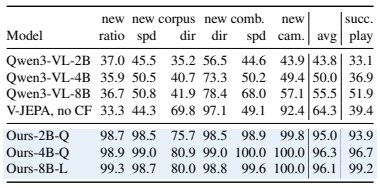
Table 7 . Generalization (chance 33.3): the six held-out sets of Sec. 5.2 and successive playback (succ. play). V-JEPA, no CF: the 2B captions and QA arm of Tab. 6; like the open models, it never saw these constructions. All models: Tabs. 18 and 20.
出典 · CC BY 4.0 · Keuntae Kim, Dongjun Kim, Yong Suk Choi · V-JEPA-LM: Video-Language Models That Read Dynamics Beyond Static, Text-Aligned Representations · 論文の図を引用 · 元のPDFの8ページ目から図の部分を抽出しています。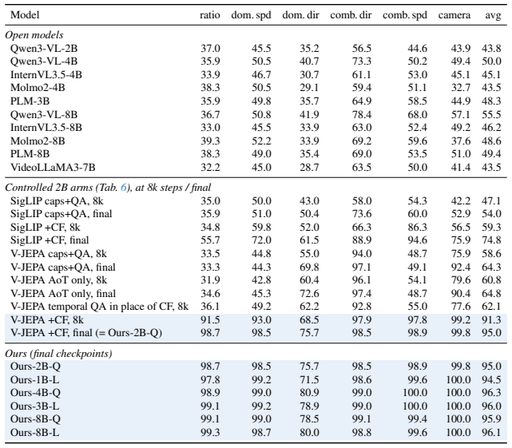
Table 18 . Held-out construction sets (definitions in Tab. 17: unseen speed ratios, an unseen source for the speed and direction families, unseen combinations, a simulator unused for camera rows). Ratio: unseen playback-speed ratios (chance 33.3); dom.: speed / direction on a new source corpus; comb.: unseen mirror×reversal and acceleration×reversal combinations; camera: simulated camera motion. 4B-class open models average 43.5–50.0 and Qwen3-VL-2B 43.8.
出典 · CC BY 4.0 · Keuntae Kim, Dongjun Kim, Yong Suk Choi · V-JEPA-LM: Video-Language Models That Read Dynamics Beyond Static, Text-Aligned Representations · 論文の図を引用 · 元のPDFの21ページ目から図の部分を抽出しています。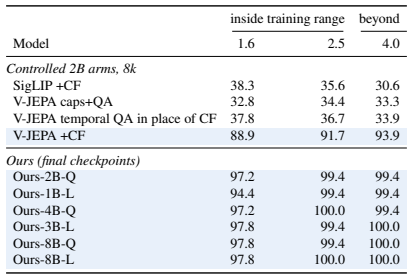
Table 19 . Unseen speed ratios separately (180 items each, chance 33.3). Training uses equal, 2:1 and 3:1 and fine ratios up to 1.4, so 1.6 and 2.5 lie between trained ratios and 4.0 beyond them.
出典 · CC BY 4.0 · Keuntae Kim, Dongjun Kim, Yong Suk Choi · V-JEPA-LM: Video-Language Models That Read Dynamics Beyond Static, Text-Aligned Representations · 論文の図を引用 · 元のPDFの21ページ目から図の部分を抽出しています。残された課題
この研究は短いクリップを対象とし、1時間以上の長い動画、テキストの認識、画像の質問応答は扱いません。V-JEPAはテキストを読むように学習されていないため、この領域はこの研究の範囲外です。NExT-QAやPerceptionTestのように知識への依存が大きいビデオベンチマークでは、データが2倍から38倍多いオープンモデルが依然として優位だと論文では述べられています。学習はそれぞれ1回ずつ行われました。収束の有無と大規模学習の効果は、この論文では検証していません。
論文情報
- 著者
- Keuntae Kim, Dongjun Kim, Yong Suk Choi
- 学会・ジャーナル
- arXiv · プレプリント
- 公開日
- 2026年11月13日
- 登録日
- 2026年11月16日
- 更新日
- 2026年11月13日
- バージョン
- v1
- arXiv
- 2611.17831
- カテゴリ
- cs.CV · cs.AI
- ライセンス
- CC BY 4.0
- 掲載内容
- 論文情報・解説・論文の図
この解説は、Refivuの韓国語解説をAIで翻訳したものです。不正確な翻訳や誤りが含まれる可能性があります。論文と図の利用条件は各出典に従います。
アブストラクト
World-model video encoders such as V-JEPA learn how scenes change (direction, speed, order, state) from video alone. To answer questions, they are joined to a language model trained on captions and question-answer pairs. But each caption or question names only a few attributes of a clip, so the model learns to retrieve those attributes rather than to read the clip, and the dynamics the encoder carries go unused: on the same items, a linear probe reads speed from frozen V-JEPA features at 87% while the VLM answers at chance. We show where dynamics lives in a frozen encoder: in a subspace shared across videos for predictive encoders such as V-JEPA, but not as a shared component of frame-wise, text-aligned encoders such as SigLIP. We then build counterfactual supervision that makes the language model read it: pixel transformations turn public videos into answer-balanced variants whose answers are set by the transformation and differ only in the change. Trained in a single stage on 4.53M public samples with 32 visual tokens per frame, where open video LLMs use several stages, 9M to 172M samples and 64 to 256 tokens per frame on average, the resulting V-JEPA-LM models (1B to 8B, Qwen3 and Llama) lead every size class in average score across eleven video benchmarks; our 4B model scores 72.1, against 61.1 for the best open 4B and 64.8 for the best open 8B model. A controlled encoder x supervision study shows that the encoder decides what can be read and the supervision what is read: at a matched budget, counterfactual supervision adds 4.5 points on average and 38 on the speed questions of natural benchmarks. Code and models: https://github.com/kkt94/Llama-V-JEPA-LM.
この論文を引用
Keuntae Kim, Dongjun Kim, Yong Suk Choi (2026). V-JEPA-LM: Video-Language Models That Read Dynamics Beyond Static, Text-Aligned Representations. arXiv:2611.17831v1. https://arxiv.org/abs/2611.17831v1
BibTeX
@misc{kim2026jepa,
  title = {{V-JEPA-LM: Video-Language Models That Read Dynamics Beyond Static, Text-Aligned Representations}},
  author = {Keuntae Kim and Dongjun Kim and Yong Suk Choi},
  year = {2026},
  eprint = {2611.17831},
  archivePrefix = {arXiv},
  url = {https://arxiv.org/abs/2611.17831v1}
}