論文解説
A Deep Cascade of Convolutional Neural Networks for Dynamic MR Image Reconstruction
動的MR画像再構成のための畳み込みニューラルネットワークの深層カスケード
- 課題 undersampled MR画像はaliasingのため再構成が難しく、既存の圧縮センシングと事前学習の方法は、加速率が高いほど誤差が大きくなります。
- 手法 CNNによる再構成モジュールとデータ一貫性層を交互に積み重ねたカスケードネットワークを、end-to-endで学習します。動的入力には、隣接フレーム間のデータ共有を追加しています。
- 結果 2D再構成では、CNNは3倍と6倍のどちらの加速でもDLMRIより低いMSEを報告しており、動的シーケンスの実験でも既存の比較手法より低い誤差が報告されています。
aggressive undersamplingで再構成が難しい理由
MRIはk-spaceのサンプルを順番に取得するため、撮像時間が長くなります。これは患者の負担やアクセスのしにくさにつながります。撮像時間を短くするためにk-spaceをundersamplingすると、Nyquist-Shannon条件を満たさず、再構成画像にaliasing artefactが生じます。圧縮センシングは、画像の疎性と、サンプリングと疎表現の間の非一貫性を仮定してこの問題を解きますが、固定された疎変換や学習された辞書に依存するため、加速率を上げるほど細部の構造を復元しにくくなります。この論文は、この問題をaliasing除去(de-aliasing)の問題として捉え、2D心臓cine MR画像と動的シーケンスのCartesian undersampling再構成に焦点を当てています。
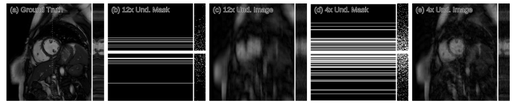
Fig. 1 . An example of the image acquisition with Cartesian undersampling for a sequence of cardiac cine images. (a) A ground truth sequence that is fully- sampled ink-space, shown alongx-y andy-t for the image frame and the temporal profile respectively. (b) A Cartesian undersampling mask that only acquires 1/12 of samples ink-space, where white indicates the sampled lines. Each image frame is undersampled with the mask shown along kx-ky. The undersampling pattern along the temporal dimension is shown in ky-t. (c) The zero-filled reconstruction of the image acquired using the 12-fold undersampling mask. (d, e) 4-fold Cartesian undersampling mask and the resulting zero-filled image. Note that the aliasing artefact becomes more prominent as the undersampling factor is increased.
出典 · CC BY 4.0 · Jo Schlemper, Jose Caballero, Joseph V. Hajnal, Anthony Price, Daniel Rueckert · A Deep Cascade of Convolutional Neural Networks for Dynamic MR Image Reconstruction · 論文の図を引用 · 元のPDFの2ページ目から図の部分を抽出しています。データ一貫性層とCNNのカスケード
この方法は、CNNによる再構成モジュールとデータ一貫性(DC)層を交互に積み重ねたカスケードネットワークです。入力xuは、測定値yから計算したzero-filled画像です。各CNNモジュールがaliasingを減らした画像を出力すると、DC層が取得されたk-spaceサンプルを改めて反映します。DC層の順伝播は、Fourier変換、取得位置での線形結合、逆変換で構成されます。取得された位置j∈Ωでは、CNNの予測と測定値をノイズレベルλに応じて重み付きで結合し、取得されなかった位置ではCNNの予測をそのまま使います。この演算は誤差逆伝播ではJacobian FHΛFで与えられるため、カスケード全体をend-to-endで学習できます。
著者らは、この構造がDLMRIの反復最適化を展開した形に似ていると解釈しています。
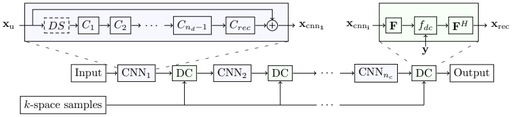
Fig. 4 . A cascade of CNNs. DC denotes the data consistency layer and DS denotes the data sharing layer. The number of convolution layers within each network and the depth of cascade is denoted by nd and nc respectively. Note also that DS layer only applies when the input is a sequence of images.
出典 · CC BY 4.0 · Jo Schlemper, Jose Caballero, Joseph V. Hajnal, Anthony Price, Daniel Rueckert · A Deep Cascade of Convolutional Neural Networks for Dynamic MR Image Reconstruction · 論文の図を引用 · 元のPDFの6ページ目から図の部分を抽出しています。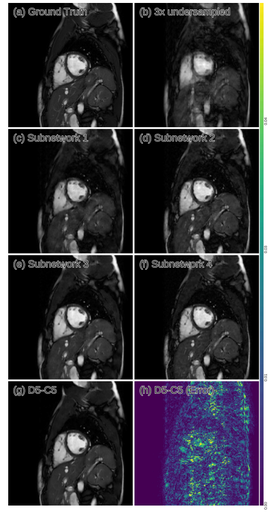
Fig. 8 . 2D reconstruction results of D5-C5 for one of the test subjects. Here we inspect the intermediate output from each subnetwork in D5-C5. (a) Ground truth (b) The input to the network that was 3x undersampled image. The output of (c) first, (d) second, (e) third, (f) fourth cascading subnetwork respectively. (g,h) The final output and the corresponding error. Note that this is not the reconstruction results from the networks in Experiment in VII-B2.
出典 · CC BY 4.0 · Jo Schlemper, Jose Caballero, Joseph V. Hajnal, Anthony Price, Daniel Rueckert · A Deep Cascade of Convolutional Neural Networks for Dynamic MR Image Reconstruction · 論文の図を引用 · 元のPDFの8ページ目から図の部分を抽出しています。隣接フレームのデータ共有と動的入力
動的シーケンスでは、隣接フレームのk-spaceサンプルを一緒に使うデータ共有(data sharing)層を追加します。各フレームtについて、t−nadjからt+nadjまでのフレームで欠けているk-spaceサンプルを埋めます。同じ位置に複数のサンプルがある場合は、重み付き平均を使います。こうして作られたdata-shared画像は、チャネル方向に連結され、CNNの最初の畳み込み層の入力になります。この方法は、隣接フレームの重なった線のために、実際の加速率より低い加速率に見えるようにしますが、心臓のように動きが大きい領域ではデータの不一致が生じます。そのため著者らは、この画像を最終的な再構成としては使わず、CNNへの入力として与え、aliasingと動きを同時に推定させています。
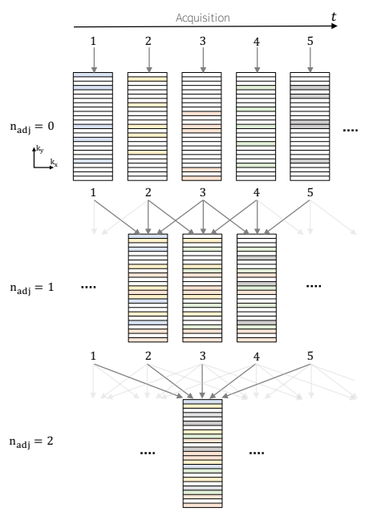
Fig. 2 . The illustration of data sharing approach. The acquired lines, which can be seen as nad j = 0 , are colour-coded for each time frame. For each nad j, the missing entries in each frame are aggregated using the values from up to ±nad j neighbouring frames. The overlapped lines are averaged.
出典 · CC BY 4.0 · Jo Schlemper, Jose Caballero, Joseph V. Hajnal, Anthony Price, Daniel Rueckert · A Deep Cascade of Convolutional Neural Networks for Dynamic MR Image Reconstruction · 論文の図を引用 · 元のPDFの4ページ目から図の部分を抽出しています。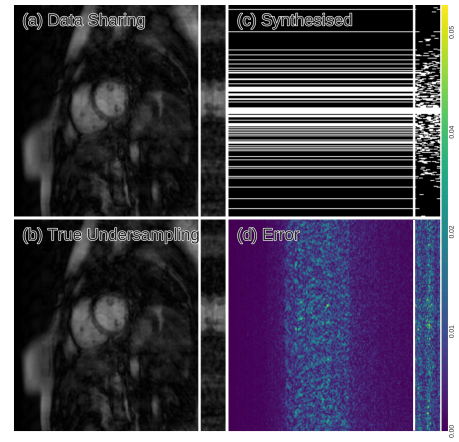
Fig. 3 . The illustration of data sharing approach applied to the image and the mask from Fig.1(a,b). In this figure, (a) shows the appearance of the resulting sequence for nad j = 2 . (b) The entries in k-space that are either acquired or aggregated using the data sharing approach with nad j = 2, which conceptually defines a sampling mask. (c) For a comparison, we show the resulting zero-filled reconstruction if (b) were treated as a mask. (d) The error map between the (a) and (b). One can observe their similarity except for the data inconsistency of the dynamic content around the heart region. Note that for nad j = 2 , the obtained image has the appearance similar to acceleration factor around 4 (rather than 12/5 = 2.4, which is the maximum achievable from 5 frames) due to overlapping lines.
出典 · CC BY 4.0 · Jo Schlemper, Jose Caballero, Joseph V. Hajnal, Anthony Price, Daniel Rueckert · A Deep Cascade of Convolutional Neural Networks for Dynamic MR Image Reconstruction · 論文の図を引用 · 元のPDFの5ページ目から図の部分を抽出しています。2D再構成のDLMRIとの比較結果
2D実験では各フレームを独立に再構成し、3倍と6倍の加速でDLMRIと比較します。評価指標は平均二乗誤差(MSE)です。論文の表では、3倍加速時のCNN(2D)のMSEは0.89(0.46)×10^−3、DLMRIは2.12(1.27)×10^−3です。6倍加速時のCNN(2D)は3.42(1.65)×10^−3、DLMRIは6.31(2.95)×10^−3です。この比較では、CNNは両方の加速率で平均誤差が低く、標準偏差も小さくなっています。2D再構成の一つのスライスは、GeForce GTX 1080で23±0.1ミリ秒かかったと報告されています。この結果は10人の被験者を対象とした交差検証の結果であり、DLMRIはCPUで被験者あたり約6.1時間かかったと報告されています。
動的シーケンスのアブレーション実験と既存手法との比較
動的実験では、まずデータ共有の効果を確認しました。9倍加速の条件では、D5-C10(S)はデータ共有を使い、D6-C10はデータ共有の代わりに追加の畳み込み層を使います。著者らは、D5-C10(S)の学習誤差とテスト誤差がより小さかったと報告しており、これはデータ共有が汎化に役立ったという解釈につながります。既存手法との比較では、DLTG、kt-SLR、L+Sを3倍、6倍、9倍、11倍の加速で比較しました。CNNは事前学習の後、加速率ごとにファインチューニングされました。代表的な評価では、CNNがすべての加速率でより低い誤差を示しています。3倍加速では手法間の差は小さいものの、加速率が高くなるとkt-SLRとL+Sの誤差が速く大きくなると報告されています。
動的シーケンスの再構成は、GPUで平均8.21秒かかりました。
適用範囲と残された課題
著者らが挙げた限界は次のとおりです。実験データは、生の多コイルデータをSENSEで再構成した後、単一コイルの形式に戻したretrospective undersamplingデータです。そのため、実際のアレイコイルでの取得環境への適用には、さらなる検討が必要です。また、CNNは局所的な表現を学習するため、病理や他の変動する画像内容でどのように動作するかは決まっていません。著者らは、CNNの局所的な特性が全体構造に影響しないと推定していますが、これは検証された結論ではなく解釈です。データセットは小規模なので、より大きなデータでの汎化は別途評価する必要があります。
論文情報
- 著者
- Jo Schlemper, Jose Caballero, Joseph V. Hajnal, Anthony Price, Daniel Rueckert
- 学会・ジャーナル
- arXiv · プレプリント
- 公開日
- 2017年4月8日
- 登録日
- 2026年11月5日
- 更新日
- 2017年11月23日
- バージョン
- v2
- arXiv
- 1704.02422
- カテゴリ
- cs.CV
- ライセンス
- CC BY 4.0
- 掲載内容
- 論文情報・解説・論文の図
この解説は、Refivuの韓国語解説をAIで翻訳したものです。不正確な翻訳や誤りが含まれる可能性があります。論文と図の利用条件は各出典に従います。
アブストラクト
Inspired by recent advances in deep learning, we propose a framework for reconstructing dynamic sequences of 2D cardiac magnetic resonance (MR) images from undersampled data using a deep cascade of convolutional neural networks (CNNs) to accelerate the data acquisition process. In particular, we address the case where data is acquired using aggressive Cartesian undersampling. Firstly, we show that when each 2D image frame is reconstructed independently, the proposed method outperforms state-of-the-art 2D compressed sensing approaches such as dictionary learning-based MR image reconstruction, in terms of reconstruction error and reconstruction speed. Secondly, when reconstructing the frames of the sequences jointly, we demonstrate that CNNs can learn spatio-temporal correlations efficiently by combining convolution and data sharing approaches. We show that the proposed method consistently outperforms state-of-the-art methods and is capable of preserving anatomical structure more faithfully up to 11-fold undersampling. Moreover, reconstruction is very fast: each complete dynamic sequence can be reconstructed in less than 10s and, for the 2D case, each image frame can be reconstructed in 23ms, enabling real-time applications.
この論文を引用
Jo Schlemper, Jose Caballero, Joseph V. Hajnal, Anthony Price, Daniel Rueckert (2017). A Deep Cascade of Convolutional Neural Networks for Dynamic MR Image Reconstruction. arXiv:1704.02422v2. https://arxiv.org/abs/1704.02422v2
BibTeX
@misc{schlemper2017deep,
  title = {{A Deep Cascade of Convolutional Neural Networks for Dynamic MR Image Reconstruction}},
  author = {Jo Schlemper and Jose Caballero and Joseph V. Hajnal and Anthony Price and Daniel Rueckert},
  year = {2017},
  eprint = {1704.02422},
  archivePrefix = {arXiv},
  url = {https://arxiv.org/abs/1704.02422v2}
}