論文解説
DiFiT: Distribution-Fidelity-guided Visual Token Pruning for Multimodal Large Language Models
DiFiT:マルチモーダル大規模言語モデルのための分布忠実度に基づく視覚トークン枝刈り
- 課題 視覚トークンの枝刈りでは、正解率などのタスクスコアだけでは応答確率分布の変化を捉えられません。
- 手法 固定したMLLMで、全トークンの応答分布と参照回答を用いてスコアラーを学習し、1つの順位から複数の保持率のTop-Kトークンを選びます。
正答が同じでも変わりうる応答分布
視覚トークンの枝刈りは推論コストを下げますが、正解率のようなタスクスコアだけでは、枝刈りが応答位置の確率分布をどれだけ変えるのかはわかりにくいです。全トークンのモデルと枝刈りモデルが同じグリーディ回答を出しても、語彙確率の配分は異なることがあります。著者らはこの差を予測ドリフトと呼び、共有参照プレフィックスの下で応答位置ごとに測定しました。
固定した正解サンプルでは、圧縮率が高くなるほど平均ドリフトが大きくなりました。この観察は、Qwen2.5-VL-7Bの固定サンプル統制実験で確認しています。
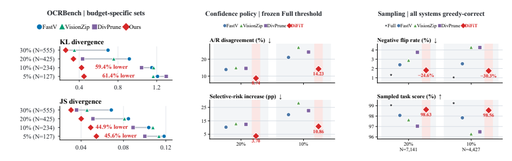
Fig. 1 . Probability drift and behavior changes beyond greedy answers. Left: KL/JS drift on OCRBench common-correct sets at each budget, a broad control. Middle: four-task accept/reject disagreement and selective-risk increase when reusing a full-model threshold set for 90% coverage. Right: negative flips and sampled score on sets all systems answer correctly under greedy decoding ( N= 7,141 at 20%; N= 4,427 at 10%). Pale-red bands identify DiFiT and are not confidence intervals. Figure 3 and Table X provide stricter output controls and adjusted drift–behavior associations.
出典 · CC BY 4.0 · Jingyuan Zhang, Nihao Niu, Xinyang Lv, Beibei Han, Xiaoyun Wang, Yanning Hou, Ke Xu · DiFiT: Distribution-Fidelity-guided Visual Token Pruning for Multimodal Large Language Models · 論文の図を引用 · 元のPDFの2ページ目から図の部分を抽出しています。教師分布と参照回答によるトークン順位の学習
DiFiTは視覚エンコーダ、プロジェクタ、言語モデルを固定し、スコアラーだけを学習します。学習中は、全トークン入力とソフトマスクを適用した生徒入力を、同じテキスト履歴で2回計算します。生徒側の応答分布は、教師の全トークン分布に温度τ=2を適用したKL損失で合わせます。
スコアはDPSが計算します。視覚トークンのquery-keyスコアと入力トークン埋め込みとの最大類似度を、学習されたゲートαで足し合わせ、ゲートは0で初期化します。得られたスコアを予算制約付きシグモイドマスクに入れ、重み和が選択トークン数kになるように、オフセットλを二分法で求めます。学習は交差エントロピー、DVD、MBLを足し合わせた損失で行い、MBLの重みは0.1から2.0まで線形に増やします。推論では、学習されたスコアの上位k個のトークンだけを元の順序で残し、短いシーケンスを作ります。
タスク性能と動画評価
Qwen2.5-VL-7Bでは、DiFiTの平均性能保持率が最も高くなりました。10%保持では、DiFiTの平均が89.36%、VisionSelectorが86.55%で、差は2.81パーセントポイントです。追加のバックボーンであるQwen2.5-VL-3BとLLaVA-OneVision-1.5-8Bでも、バックボーンごとにスコアラーを別々に学習して比較しました。Qwen2.5-VL-3Bの30%と10%では、VisionSelectorとの差は小さかったです。
MVBenchでは、20%保持でDiFiTが66.38%を記録し、全トークンモデルの68.10%の97.47%を維持しました。
サンプリングによる失敗と信頼度判定の変化
グリーディ回答が同じサンプルで、nucleus samplingを10回実行したところ、Qwen2.5-VL-7Bの10%保持では、DiFiTのnegative flip率が1.75%、FastVが2.51%でした。これは相対減少30.3%です。ただし、両方とも全トークンモデルのnegative flip率よりは高い値でした。
補正後のJSが1標準偏差大きくなるときのオッズ比は、A/R判定ではDiFiTが1.283、FastVが1.589でした。negative flipではDiFiTが1.335、FastVが1.547でした。著者らは、この関係が手法全般で見られると考えています。
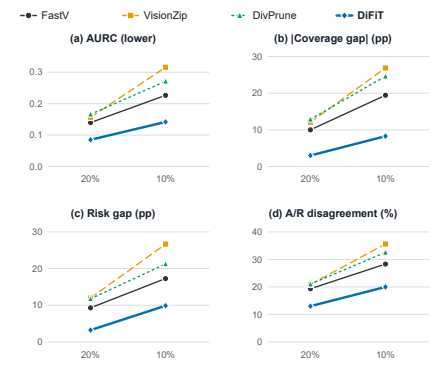
Fig. 4 . Confidence-threshold results on the full set, averaged over five splits and equally across four tasks. AURC evaluates selective prediction across confidence thresholds; the remaining panels transfer a threshold calibrated to 80% full-model coverage. Coverage gap is plotted by magnitude. Lower is better in all panels, and lines connect the 20% and 10% budgets for the same method. DiFiT gives the lowest AURC and most closely preserves the full model’s decisions at the same confidence threshold.
出典 · CC BY 4.0 · Jingyuan Zhang, Nihao Niu, Xinyang Lv, Beibei Han, Xiaoyun Wang, Yanning Hou, Ke Xu · DiFiT: Distribution-Fidelity-guided Visual Token Pruning for Multimodal Large Language Models · 論文の図を引用 · 元のPDFの9ページ目から図の部分を抽出しています。ソフト教師分布と複数予算損失の効果
Table XIIIでは、同じデータと最適化設定で学習させた変種を比較しました。soft DVDとMBLを併用したDiFiTは、CE + MBL変種よりmacro retentionを91.06%から94.16%に高め、macro JSは0.0298から0.0233に下げました。交差予算MBLを外した単一予算の変種は、retentionもJSもDiFiTより低い結果でした。
限界
ハード選択はトークン全体を捨てるため、捨てた領域の証拠が失われる可能性があります。視覚エンコーダは固定されているため、小さいトークン予算に合わせて特徴を変えることはできません。共有参照プレフィックスでは、自由生成中の初期トークンの変化が後続トークンに積み重なる誤りを捉えられません。
一部の分析はサンプル数が少ないです。OCRBenchの固定正解出力一致セットはサンプルが20個しかないため除外しました。10%出力一致セットも、split当たり15~21例に限られます。TextVQA 10%では、FastVがAURCとA/R比率でDiFiTより低い結果でした。
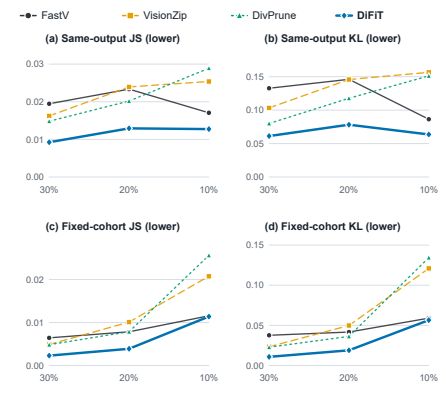
Fig. 3 . Predictive divergence under output matching. Panels (a,b) use four- task output-matched sets containing 9,189, 7,201, and 4,383 samples at 30%, 20%, and 10%. Panels (c,d) track fixed output-matched sets: AI2D (1,665), DocVQA (674), OCRBench (20), and TextVQA (1,755). Points are equally weighted task averages; lower is better. The small OCRBench fixed sample set limits interpretation. The stricter three-task fixed correct output-matched set appears in Table VI(B); it is distinct from panels (c,d).
出典 · CC BY 4.0 · Jingyuan Zhang, Nihao Niu, Xinyang Lv, Beibei Han, Xiaoyun Wang, Yanning Hou, Ke Xu · DiFiT: Distribution-Fidelity-guided Visual Token Pruning for Multimodal Large Language Models · 論文の図を引用 · 元のPDFの9ページ目から図の部分を抽出しています。論文情報
- 著者
- Jingyuan Zhang, Nihao Niu, Xinyang Lv, Beibei Han, Xiaoyun Wang, Yanning Hou, Ke Xu
- 学会・ジャーナル
- arXiv · プレプリント
- 公開日
- 2026年11月11日
- 登録日
- 2026年11月13日
- 更新日
- 2026年11月11日
- バージョン
- v1
- arXiv
- 2611.15069
- カテゴリ
- cs.CV
- ライセンス
- CC BY 4.0
- 掲載内容
- 論文情報・解説・論文の図
この解説は、Refivuの韓国語解説をAIで翻訳したものです。不正確な翻訳や誤りが含まれる可能性があります。論文と図の利用条件は各出典に従います。
アブストラクト
Visual token pruning reduces the inference cost of multimodal large language models, but answer accuracy only partly reflects its effect. Pruning can change the probabilities of alternative response tokens even when greedy answers remain correct and unchanged. We compare full and pruned response distributions under shared reference prefixes. Average predictive drift grows with compression on fixed correctly answered samples. Separate analyses associate larger drift with more confidence-decision disagreements and sampling failures. We propose DiFiT (Distribution-Fidelity-guided Token pruning) to learn discrete selection from reference answers and full-token response distributions. Dual-View Distillation matches probabilities across the vocabulary, while answer supervision supports task quality. A learned scorer and differentiable Top-$K$ learn which visual evidence to retain. A multi-budget mask objective supports different retention ratios through one shared ranking over a frozen model. On Qwen2.5-VL-7B, DiFiT reduces sampling-induced negative flips by 30.3% relative to FastV at 10% retention on four-task greedy-correct controls. It preserves 98.74% of baseline performance on MME at 30% retention.
この論文を引用
Jingyuan Zhang, Nihao Niu, Xinyang Lv, Beibei Han, Xiaoyun Wang, Yanning Hou, Ke Xu (2026). DiFiT: Distribution-Fidelity-guided Visual Token Pruning for Multimodal Large Language Models. arXiv:2611.15069v1. https://arxiv.org/abs/2611.15069v1
BibTeX
@misc{zhang2026difit,
  title = {{DiFiT: Distribution-Fidelity-guided Visual Token Pruning for Multimodal Large Language Models}},
  author = {Jingyuan Zhang and Nihao Niu and Xinyang Lv and Beibei Han and Xiaoyun Wang and Yanning Hou and Ke Xu},
  year = {2026},
  eprint = {2611.15069},
  archivePrefix = {arXiv},
  url = {https://arxiv.org/abs/2611.15069v1}
}