論文解説
Kimera: from SLAM to Spatial Perception with 3D Dynamic Scene Graphs
Kimera:SLAMから3D Dynamic Scene Graphsによる空間認識へ
- 課題 ロボットの内部表現が幾何要素や物体の集合にとどまり、人のような多階層の空間理解を表せない問題を扱います。
- 手法 幾何と意味を階層グラフで表す3D Dynamic Scene Graphを提案し、視覚慣性データから自動で構築するKimeraを実装します。
- 結果 EuRoCとuHumans2でKimeraモジュールの軌道誤差と再構成結果を示しています。階層経路計画はESDFベースの計画より計算時間を減らすとされています。
ロボット表現のギャップとDSGの必要性
ロボットの内部表現は、点、線、平面、ボクセルといった幾何要素や物体の集合にとどまることが多く、人が持つ部屋、建物、人のような多階層の理解を十分に表せません。この論文では、このギャップを減らすために、幾何と意味を一緒に表す3D Dynamic Scene Graph(DSG)を提案しています。DSGは、ノードが異なる抽象化レベルの空間概念を表す階層グラフで、エッジはノード間の時空間関係を表します。既存のscene graph研究は、物体だけを扱うか階層を欠いており、動的な対象をモデル化していないという限界がありました。この論文は、その限界もあわせて扱います。
DSGの階層構造とKimeraによる自動構築
DSGは、メトリック・意味メッシュ、物体とエージェント、場所と構造、部屋、建物の5つの層からなる例を示しています。Kimeraは、ステレオまたはRGB-D映像とIMUの計測値を入力として、このDSGを出力するSpatial Perception Engineです。最初の層であるメトリック・意味メッシュはKimera-Coreがリアルタイムに作り、その後の層はKimera-DSGモジュールがメッシュから構築します。著者らは、この構成を視覚慣性データからDSGを自動で作った最初の事例として示しています。
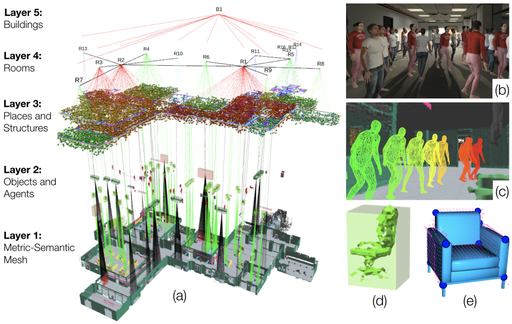
Figure 1 . (a) A 3D Dynamic Scene Graph (DSG) is a layered and hierarchical representation that abstracts a dense 3D model (e.g., a metric-semantic mesh) into higher-level spatial concepts (e.g., objects, agents, places, rooms) and models their spatio-temporal relations (e.g., “agent A is in room B at timet”). Kimera is the first Spatial Perception Engine that reconstructs a DSG from visual-inertial data, and (a) segments places, structures (e.g., walls), and rooms, (b) is robust to extremely crowded environments, (c) tracks dense mesh models of human agents in real time, (d) estimates centroids and bounding boxes of objects of unknown shape, (e) estimates the 3D pose of objects for which a CAD model is given.
出典 · CC BY 4.0 · Antoni Rosinol, Andrew Violette, Marcus Abate, Nathan Hughes, Yun Chang, Jingnan Shi, Arjun Gupta, Luca Carlone · Kimera: from SLAM to Spatial Perception with 3D Dynamic Scene Graphs · 論文の図を引用 · 元のPDFの4ページ目から図の部分を抽出しています。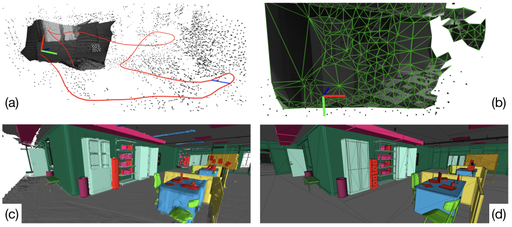
Figure 4 . Kimera-Core is an open-source library for real-time metric-semantic SLAM. It provides (a) visual-inertial state estimates at IMU rate (Kimera-VIO), and a globally consistent and outlier-robust trajectory estimate (Kimera-RPGO), computes (b) a low-latency local mesh of the scene (Kimera-Mesher), and builds (c) a semantically annotated 3D mesh (Kimera-Semantics), which can be optimized for global consistency (Kimera-PGMO) and accurately reflects the ground truth model (d).
出典 · CC BY 4.0 · Antoni Rosinol, Andrew Violette, Marcus Abate, Nathan Hughes, Yun Chang, Jingnan Shi, Arjun Gupta, Luca Carlone · Kimera: from SLAM to Spatial Perception with 3D Dynamic Scene Graphs · 論文の図を引用 · 元のPDFの6ページ目から図の部分を抽出しています。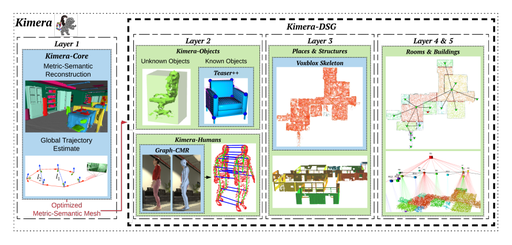
Figure 6 . Kimera’s architecture, with Kimera-Core and Kimera-DSG as sub-modules. Kimera-Core generates a globally consistent 3D metric-semantic mesh (Figure 5) that represents the first layer of the DSG and is further used by Kimera-DSG to build the subsequent layers. Kimera-DSG further comprises three key modules: Kimera-Objects, Kimera-Humans, and Kimera-BuildingParser (which generates layers 3 to 5).
出典 · CC BY 4.0 · Antoni Rosinol, Andrew Violette, Marcus Abate, Nathan Hughes, Yun Chang, Jingnan Shi, Arjun Gupta, Luca Carlone · Kimera: from SLAM to Spatial Perception with 3D Dynamic Scene Graphs · 論文の図を引用 · 元のPDFの7ページ目から図の部分を抽出しています。ループクロージングとメッシュの変形
Kimera-Semanticsが作るメッシュはVIOの姿勢を使うため、時間が経つにつれてドリフトが生じます。Kimera-PGMOは、ループクロージングで軌道とメッシュを一緒に補正します。メッシュは再構成せず、変形グラフを通して変形させます。ロボットのポーズグラフと単純化されたメッシュ頂点を1つの変形グラフにまとめ、単一の最適化で軌道と環境を同時に更新します。この最適化はポーズグラフ最適化と同じ形に再構成され、GTSAMで解かれます。Kimera-RPGOも同じPCMベースの外れ値棄却を使いますが、メッシュは最適化せず軌道のみを最適化します。そのため、Kimera-PGMOはこれをより広く一般化した手法として説明されています。
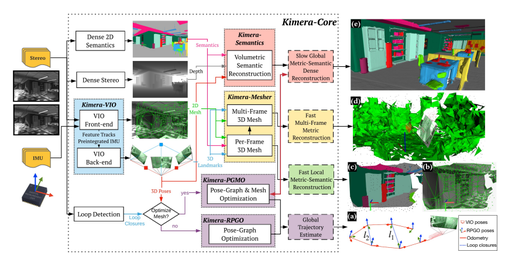
Figure 5 . Kimera-Core’s architecture. Kimera-Core uses stereo images (or RGB-D) and IMU data as input (shown on the left) and outputs (a) pose estimates and (b-e) multiple metric-semantic reconstructions. Kimera-Core has four key modules: Kimera-VIO, Kimera-PGMO (alternatively, Kimera-RPGO), Kimera-Mesher, and Kimera-Semantics.
出典 · CC BY 4.0 · Antoni Rosinol, Andrew Violette, Marcus Abate, Nathan Hughes, Yun Chang, Jingnan Shi, Arjun Gupta, Luca Carlone · Kimera: from SLAM to Spatial Perception with 3D Dynamic Scene Graphs · 論文の図を引用 · 元のPDFの6ページ目から図の部分を抽出しています。姿勢推定とループクロージングの評価
EuRoCでは、Kimera-VIOとKimera-RPGOを既存のVIOおよびループクロージングのパイプラインと比較しており、絶対軌道誤差はSE(3)アライメント後のRMSEで報告されています。ループクロージングの閾値を変えた実験では、PCMを使わないPGOの値が1.59から0.45の間で大きく変わりました。一方、PCMを使ったKimera-RPGOは、閾値の全範囲で0.05のままでした。これはPCMが閾値の選び方への感度を下げるという観察として解釈すべきで、他のデータセットにも一般化できる結論ではありません。uHumans2のNeighborhoodとSubwayのシーンでは累積ATEが大きく、Kimera-PGMOはKimera-RPGOより低い誤差を示しました。
EuRoCではDVIOがすでに正確だったため、改善幅は小さくなりました。
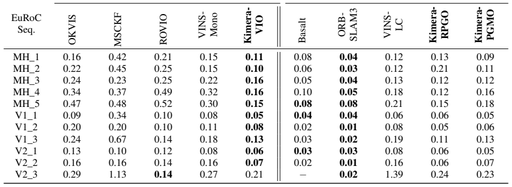
Table 1 . RMSE [m] for the absolute translation error (ATE) of state-of-the-art VIO pipelines (reported from (Delmerico and Scaramuzza 2018), and the results from the respective papers) compared to Kimera, on the EuRoC dataset. In bold the best result for each category: fixed-lag smoothing, and PGO with loop closure. − indicates missing data.
出典 · CC BY 4.0 · Antoni Rosinol, Andrew Violette, Marcus Abate, Nathan Hughes, Yun Chang, Jingnan Shi, Arjun Gupta, Luca Carlone · Kimera: from SLAM to Spatial Perception with 3D Dynamic Scene Graphs · 論文の図を引用 · 元のPDFの16ページ目から図の部分を抽出しています。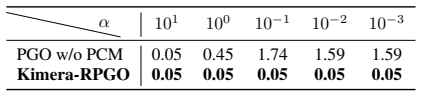
Table 2 . RMSE ATE [m] vs. loop closure thresholdα, on the V1_01 EuRoC dataset.
出典 · CC BY 4.0 · Antoni Rosinol, Andrew Violette, Marcus Abate, Nathan Hughes, Yun Chang, Jingnan Shi, Arjun Gupta, Luca Carlone · Kimera: from SLAM to Spatial Perception with 3D Dynamic Scene Graphs · 論文の図を引用 · 元のPDFの16ページ目から図の部分を抽出しています。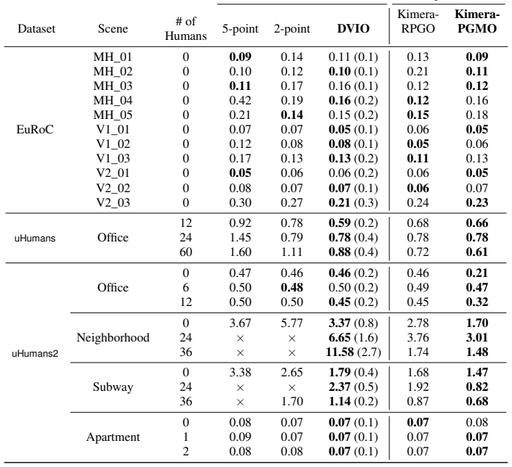
Table 4 . RMSE for the absolute translation error in meters when using 5-point, 2-point, and DVIO poses, as well as Kimera-RPGO and Kimera-PGMO’s optimized trajectory. We show the drift in % for DVIO to account for the length of the different trajectories.
出典 · CC BY 4.0 · Antoni Rosinol, Andrew Violette, Marcus Abate, Nathan Hughes, Yun Chang, Jingnan Shi, Arjun Gupta, Luca Carlone · Kimera: from SLAM to Spatial Perception with 3D Dynamic Scene Graphs · 論文の図を引用 · 元のPDFの18ページ目から図の部分を抽出しています。メトリック・意味再構成と時間コスト
Kimera-Semanticsは、深度マップと2Dの意味ラベルを使い、ボリュームTSDFにレイのまとまり単位で確率を蓄積して、最終的なメッシュを抽出します。シミュレーション実験では、真の深度と真の姿勢を使うとmIoUは80.10%でしたが、高密度ステレオとVIOを使うと57.23%に下がりました。著者らは、この大きな低下をテクスチャのない壁での高密度ステレオの誤差によるものと解釈しています。時間の面では、Kimera-Semanticsのメッシュ更新はEuRoCで平均約0.1sかかります。Kimera-Mesherは、これより2桁短い時間で高速な多フレームメッシュを作ると報告されています。この高速なメッシュは、速い一方でEuRoCの全実験で比べると精度が低いという短所もあります。
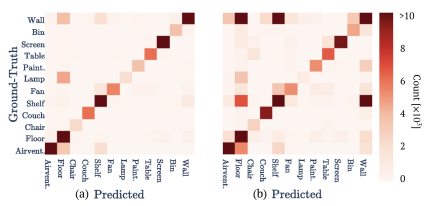
Figure 17 . Confusion matrices for Kimera-Semantics using bundled raycasting and (a) ground truth stereo depth or (b) dense stereo (H. Hirschmüller 2008). Both experiments use ground-truth 2D semantics. Values are saturated to 104 for visualization purposes.
出典 · CC BY 4.0 · Antoni Rosinol, Andrew Violette, Marcus Abate, Nathan Hughes, Yun Chang, Jingnan Shi, Arjun Gupta, Luca Carlone · Kimera: from SLAM to Spatial Perception with 3D Dynamic Scene Graphs · 論文の図を引用 · 元のPDFの17ページ目から図の部分を抽出しています。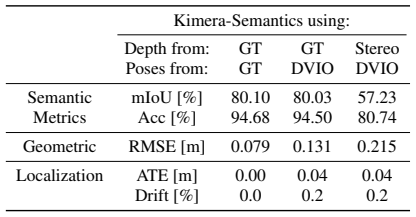
Table 6 . Evaluation of Kimera-Semantics using the simulated dataset from Rosinol et al. (2020a), which has no humans, using a combination of ground-truth (GT) and dense stereo (Stereo) depth maps, as well as ground-truth (GT) and DVIO (DVIO) poses.
出典 · CC BY 4.0 · Antoni Rosinol, Andrew Violette, Marcus Abate, Nathan Hughes, Yun Chang, Jingnan Shi, Arjun Gupta, Luca Carlone · Kimera: from SLAM to Spatial Perception with 3D Dynamic Scene Graphs · 論文の図を引用 · 元のPDFの19ページ目から図の部分を抽出しています。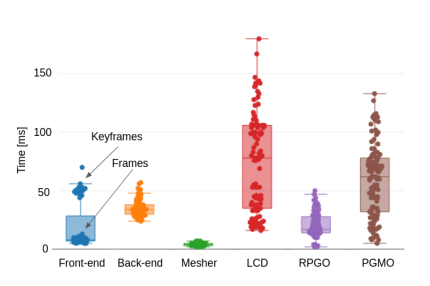
Figure 19 . Runtime breakdown for Kimera-VIO, Kimera-Mesher, loop-closure detection (LCD), Kimera-RPGO, and Kimera-PGMO. Note that the timing for Kimera-RPGO and Kimera-PGMO will increase with the size of the pose graph and the mesh. The timing here is collected on the EuRoC V1_01 dataset. The complete run of the dataset consists of 728 poses and 71 loop closures, and the final mesh has 324474 vertices.
出典 · CC BY 4.0 · Antoni Rosinol, Andrew Violette, Marcus Abate, Nathan Hughes, Yun Chang, Jingnan Shi, Arjun Gupta, Luca Carlone · Kimera: from SLAM to Spatial Perception with 3D Dynamic Scene Graphs · 論文の図を引用 · 元のPDFの21ページ目から図の部分を抽出しています。動的シーンと物体・人のノード
Kimera-HumansはGraphCMRでSMPLメッシュを推定し、人ごとにポーズグラフを保持して同一人物を結び付けます。動的マスキングでは、人と分類されたピクセルから自由空間の情報だけを使うことで、人がメッシュに残す残像を減らします。物体ノードでは、形状が未知の物体にはバウンディングボックスを付け、形状が既知の物体にはTEASER++でCADモデルを位置合わせします。これらの結果はuHumansとuHumans2のシミュレーションシーンで得たもので、実データでの人の追跡や物体の位置合わせにそのまま適用できるとは見なせません。
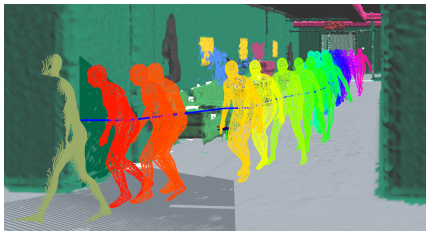
Figure 10 . Human Pose-Graph: Optimized pose-graph (blue line) for a single human. The detected human shape is shown as a 3D mesh, color-coded from the most recent detection in red to the oldest one in pink.
出典 · CC BY 4.0 · Antoni Rosinol, Andrew Violette, Marcus Abate, Nathan Hughes, Yun Chang, Jingnan Shi, Arjun Gupta, Luca Carlone · Kimera: from SLAM to Spatial Perception with 3D Dynamic Scene Graphs · 論文の図を引用 · 元のPDFの12ページ目から図の部分を抽出しています。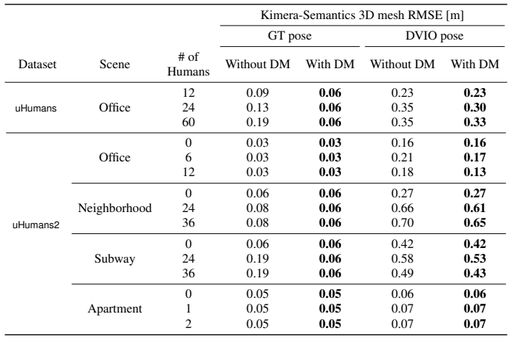
Table 5 . 3D Mesh RMSE in meters with and without Dynamic Masking (DM) for Kimera-Semantics when using ground-truth pose (GT pose) and DVIO’s estimated pose (DVIO pose) in theuHumans and uHumans2 datasets. The third column shows the number of humans in each scene (# of Humans).
出典 · CC BY 4.0 · Antoni Rosinol, Andrew Violette, Marcus Abate, Nathan Hughes, Yun Chang, Jingnan Shi, Arjun Gupta, Luca Carlone · Kimera: from SLAM to Spatial Perception with 3D Dynamic Scene Graphs · 論文の図を引用 · 元のPDFの18ページ目から図の部分を抽出しています。場所と部屋の分割および階層経路計画
Kimera-BuildingParserはESDFの2D断面を切り出して部屋構造を分割し、場所ノードを部屋にラベル付けします。OfficeとSubwayでは部屋分割の精度と再現率が高いと報告されていますが、ApartmentとAeroAstroでは過分割が見られました。階層経路計画は、建物、部屋、場所の順にA*を適用し、ESDFベースの計画より数桁速い時間を報告しています。ただし、過分割によって部屋が複数になると経路計画の中間段階が増えます。その場合でも実行時間はミリ秒単位にとどまると、著者らは解釈しています。
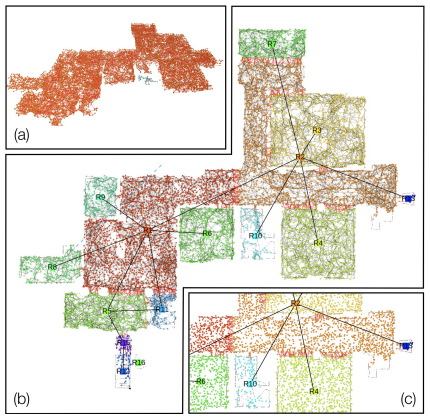
Figure 2 . Places and their connectivity shown as a graph. (a) Skeleton (places and topology) produced by (Oleynikova et al. 2018) (side view); (b) Room parsing produced by our approach (top-down view); (c) Zoomed-in view; red edges connect different rooms.
出典 · CC BY 4.0 · Antoni Rosinol, Andrew Violette, Marcus Abate, Nathan Hughes, Yun Chang, Jingnan Shi, Arjun Gupta, Luca Carlone · Kimera: from SLAM to Spatial Perception with 3D Dynamic Scene Graphs · 論文の図を引用 · 元のPDFの4ページ目から図の部分を抽出しています。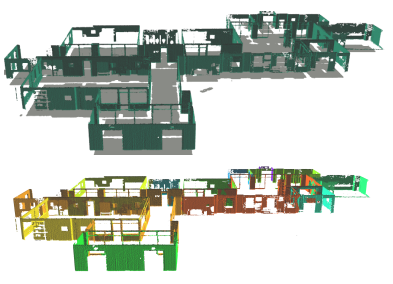
Figure 3 . Structures: exploded view of walls and floor (top). Segmented walls according to the room id (bottom).
出典 · CC BY 4.0 · Antoni Rosinol, Andrew Violette, Marcus Abate, Nathan Hughes, Yun Chang, Jingnan Shi, Arjun Gupta, Luca Carlone · Kimera: from SLAM to Spatial Perception with 3D Dynamic Scene Graphs · 論文の図を引用 · 元のPDFの5ページ目から図の部分を抽出しています。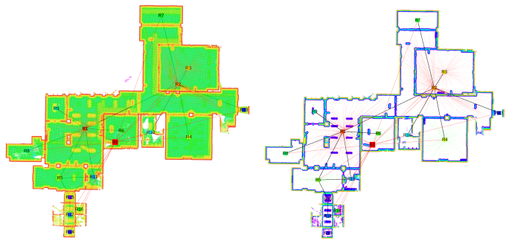
Figure 11 . (Left) 2D slice of 3D ESDF . The euclidean distance is color coded from red (0m) to green (0.5m). (Right) Truncated (≤ 0.10m) 2D ESDF , revealing the room’s contours. Overlaid in both figures are the estimated room layout (square nodes) and their connectivity (black edges).
出典 · CC BY 4.0 · Antoni Rosinol, Andrew Violette, Marcus Abate, Nathan Hughes, Yun Chang, Jingnan Shi, Arjun Gupta, Luca Carlone · Kimera: from SLAM to Spatial Perception with 3D Dynamic Scene Graphs · 論文の図を引用 · 元のPDFの13ページ目から図の部分を抽出しています。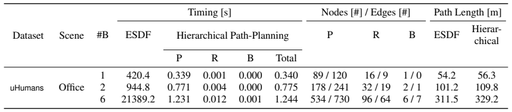
Table 9 . Hierarchical semantic path-planning using A* at different levels of abstraction. Planning at the level of buildings (B), rooms (R), and then places (P), in a hierarchical fashion, is several orders of magnitude faster than planning at the volumetric level (ESDF). We ‘copy-paste’ the 3D DSG of the office scene from uHumans to form a neighborhood of offices in a grid-like pattern where each office is a building; hence creating a scenario of a much larger scale. We also show the number of nodes and edges in the path, as well as the length of the estimated trajectories for comparison.
出典 · CC BY 4.0 · Antoni Rosinol, Andrew Violette, Marcus Abate, Nathan Hughes, Yun Chang, Jingnan Shi, Arjun Gupta, Luca Carlone · Kimera: from SLAM to Spatial Perception with 3D Dynamic Scene Graphs · 論文の図を引用 · 元のPDFの24ページ目から図の部分を抽出しています。限界と適用範囲
この論文の主な評価は、EuRoC、uHumans、uHumans2といくつかの実収集データに限られています。実際のシーンの一部では、過分割、ノイズ、不完全なメッシュといった問題が見られました。DSG全体は現在の実装で数分単位で計算されるため、リアルタイムでの構築はまだ課題として残っています。また、物体・構造・部屋の層は実行終了後に生成されるため、完全なリアルタイムDSGではない点に注意が必要です。
論文情報
- 著者
- Antoni Rosinol, Andrew Violette, Marcus Abate, Nathan Hughes, Yun Chang, Jingnan Shi, Arjun Gupta, Luca Carlone
- 学会・ジャーナル
- arXiv · プレプリント
- 公開日
- 2021年1月18日
- 登録日
- 2026年11月6日
- 更新日
- 2021年10月20日
- バージョン
- v3
- arXiv
- 2101.06894
- カテゴリ
- cs.RO · cs.CV
- ライセンス
- CC BY 4.0
- 掲載内容
- 論文情報・解説・論文の図
この解説は、Refivuの韓国語解説をAIで翻訳したものです。不正確な翻訳や誤りが含まれる可能性があります。論文と図の利用条件は各出典に従います。
アブストラクト
Humans are able to form a complex mental model of the environment they move in. This mental model captures geometric and semantic aspects of the scene, describes the environment at multiple levels of abstractions (e.g., objects, rooms, buildings), includes static and dynamic entities and their relations (e.g., a person is in a room at a given time). In contrast, current robots' internal representations still provide a partial and fragmented understanding of the environment, either in the form of a sparse or dense set of geometric primitives (e.g., points, lines, planes, voxels) or as a collection of objects. This paper attempts to reduce the gap between robot and human perception by introducing a novel representation, a 3D Dynamic Scene Graph(DSG), that seamlessly captures metric and semantic aspects of a dynamic environment. A DSG is a layered graph where nodes represent spatial concepts at different levels of abstraction, and edges represent spatio-temporal relations among nodes. Our second contribution is Kimera, the first fully automatic method to build a DSG from visual-inertial data. Kimera includes state-of-the-art techniques for visual-inertial SLAM, metric-semantic 3D reconstruction, object localization, human pose and shape estimation, and scene parsing. Our third contribution is a comprehensive evaluation of Kimera in real-life datasets and photo-realistic simulations, including a newly released dataset, uHumans2, which simulates a collection of crowded indoor and outdoor scenes. Our evaluation shows that Kimera achieves state-of-the-art performance in visual-inertial SLAM, estimates an accurate 3D metric-semantic mesh model in real-time, and builds a DSG of a complex indoor environment with tens of objects and humans in minutes. Our final contribution shows how to use a DSG for real-time hierarchical semantic path-planning. The core modules in Kimera are open-source.
この論文を引用
Antoni Rosinol, Andrew Violette, Marcus Abate, Nathan Hughes, Yun Chang, Jingnan Shi, Arjun Gupta, Luca Carlone (2021). Kimera: from SLAM to Spatial Perception with 3D Dynamic Scene Graphs. arXiv:2101.06894v3. https://arxiv.org/abs/2101.06894v3
BibTeX
@misc{rosinol2021kimera,
  title = {{Kimera: from SLAM to Spatial Perception with 3D Dynamic Scene Graphs}},
  author = {Antoni Rosinol and Andrew Violette and Marcus Abate and Nathan Hughes and Yun Chang and Jingnan Shi and Arjun Gupta and Luca Carlone},
  year = {2021},
  eprint = {2101.06894},
  archivePrefix = {arXiv},
  url = {https://arxiv.org/abs/2101.06894v3}
}