論文解説
CreditFilter: Calibrated Token Weights over the Within-Response Entropy Rank for RLVR
応答内のエントロピー順位で、トークンごとの学習の重みを決める手法
- 課題 従来は、応答内のすべてのトークンに同じ評価を与えるか、バッチ全体でエントロピーの高い順に選んでいました。どのトークンが正答率を実際に変えるかは測れていませんでした。
- 手法 CreditFilterは、各応答の中でエントロピーが高い順に並べ、順位が上位のトークンほど重みを大きくします。追加の順伝播は要りません。
- 結果 平均で、DAPOと比べてMATH500は7.7点、AIME24は10.5点高くなりました。
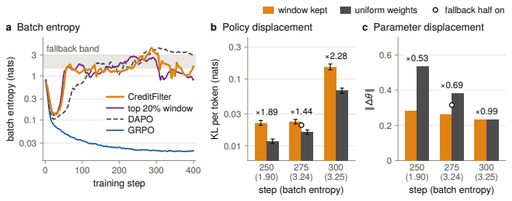
Figure 2 : Training dynamics and local displacement. (a) Batch entropy as a five-step moving av- erage, with the fallback band of 1.5–3 nats shaded: GRPO collapses and DAPO stays above 3 nats after step 263. (b, c) Five-step continuations from three checkpoints of the CreditFilter run, each labeled with its step and batch entropy. Keeping the window moves the policy 1.4–2.3 times further in KL than uniform weights in (b), and moves the parameters,∥∆θ∥=∥θ t+5 −θ t∥2, no further in (c). Numbers: window/uniform ratio; error bars: 95% prompt-bootstrap intervals, all listed in Table 26; open circle: a third continuation at step 275, with the fallback half on,m gov ≈0.5.
出典 · CC BY 4.0 · Hanqing Zhao, Liuyue Xie, Rong-Cheng Tu, Xu Zhang, Davide Modolo, Dacheng Tao · CreditFilter: Calibrated Token Weights over the Within-Response Entropy Rank for RLVR · 論文の図を引用 · 元のPDFの9ページ目から図の部分を抽出しています。一様なアドバンテージの限界
RLVRでは、応答全体に与えられる1つのスカラー報酬を数千のトークンへどう配るかが中心的な課題です。価値関数やプロセス報酬モデル、分岐ごとのロールアウトは、批評器や追加の生成といったコストを伴います。そこで実務では、批評器を使わないGRPO系の手法が広がり、応答内のすべてのトークンに同じアドバンテージを与えるのが一般的になりました。
80/20マスクは、バッチ全体でエントロピーの高い上位20%のトークンだけを残し、残ったトークンに重みを与えます。エントロピーを分岐の可能性の代理と見なす発想は直感的ですが、どのトークンが実際に正答確率を変えるかは測られていません。さらに、トークンをバッチ全体で順位づけると、長くて不確かな誤答が多くのトークンを残し、確かな正答が全トークンを失うことがあります。
分岐値という測りどころ
本研究の鍵は、トークンが結果を変える度合いを、次トークン選択の成功確率の分散である分岐値で測ることです。この値を応答内で足し合わせると、同じプロンプトの応答全体での期待値が報酬の分散\(V(1-V)\)に一致します。つまり、重みは応答内で信用を組み替えるものであり、応答間で信用を移すものではないという立場です。
分岐値は\(\nu = C\kappa\)と分解でき、Cは分岐確率、κは分岐の影響です。Cは2つの独立な次トークン抽出が異なる確率で、softmaxから追加の計算なしに得られます。一方、κを求めるには分岐後の継続を実際に生成して評価する必要があり、コストがかかります。
そこで論文は、Cの包絡線を窓の形に使い、κがほぼ平坦だとみなす近似を採りました。κが順位によらず一定とみなせれば、分岐スペクトルは包絡線に比例し、窓が目標に近づくと論じています。窓は追加の順伝播なしで計算でき、この点が既存の手法との違いです。
応答内順位の窓と重みの計算
まず、各応答内で位置ごとのエントロピーを降順に並べ、トークン数Tで割った順位を求めます。順位\(q = r/T\)は0に近いほど、その応答の中で最も不確かな位置を指します。窓の核は、重みが半分になる順位の区間を幅λとし、床εより下がらない指数の形を取ります。
式(2)では、この核をクラスごとの幅と床で作り、難易度の減衰とフォールバックを掛けます。難易度の減衰は、正のアドバンテージを持つ応答に対し、グループの通過率から\((1-\hat{p})^{\gamma}\)を掛けて重みを下げます。バッチ平均エントロピーが1.5から3.0 nats の範囲を超えると、窓を一様な重みへ戻していきます。
幅は正答クラスでλ+=0.10、誤答クラスでλ−=0.14と丸めて使い、測定値は0.111と0.155となりました。正答クラスだけに床ε+=0.1を置くのは、2クラスの重みの総和をほぼ等しくするためです。Adamは勾配の定数倍を打ち消すため、更新に効くのは窓の形と2クラスの質量比だけになります。
窓が分岐値に近づく理由
命題1では、応答内の増分が互いに直交し、その分散の総和が報酬分散\(V_1(1-V_1)\)に一致することを示しています。命題3は、非負の重みの中で平均二乗誤差を最小にするのは正部分の係数であり、その目標は価値で重み付けした分岐スペクトルだと述べます。この結論は、後続トークンの情報を含む順位を重みに使っても現在の増分に情報を加えないというAssumption 2の下で成り立ちます。
この上界は、包絡線の低い裾を重みで抑える理由になります。ただし、分岐の影響が順位やCに依らないという条件Kは近似的にしか成り立たず、包絡線だけでは分岐値を特定できません。
包絡線と分岐の影響の測定
Qwen3-8B-Baseのベース方策で測ると、分岐確率は順位に対して指数的に減衰し、幅は正答で0.111、誤答で0.155となりました。分岐の影響がほぼ平坦である点は、κを一様とみなす近似を支えます。
主要結果:DAPOとの差
評価はmean@32で、MATH500(n=500)、AIME24とAIME25(各n=30)を後期平均で比べています。DAPOの標準偏差はMATH500で0.107と大きく、3シードの平均差は、ばらつきを見て読む必要があります。
表1の第1シード(データシード201)では、CreditFilterの後期平均がMATH500で0.876、DAPOで0.830です。同じシードで、80/20マスクに4から5点、STAREとSC-GRPOに4から15点の差をつけています。
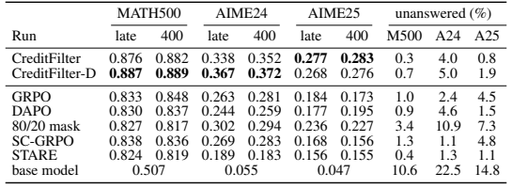
Table 1 : mean@32 after training Qwen3-8B-Base with data seed 201, on MATH500 (n=500), AIME24 and AIME25 (n=30each): the average over checkpoints 350/375/400 (late), the value at step 400, and the share of step-400 samples left unanswered at the 20,480-token cap. Bold: best accuracy in each column; the base-model row is step 0.
出典 · CC BY 4.0 · Hanqing Zhao, Liuyue Xie, Rong-Cheng Tu, Xu Zhang, Davide Modolo, Dacheng Tao · CreditFilter: Calibrated Token Weights over the Within-Response Entropy Rank for RLVR · 論文の図を引用 · 元のPDFの7ページ目から図の部分を抽出しています。この比較は、同じトークン数で揃えた比較(付録F.1)と合わせて読む必要があります。
アブレーションで効いた要素
ダンピングを外した窓のみの変種は、DAPOに対してMATH500で4点低く、AIME24で6点高くなりました。ダンピングだけを使う変種は4から12点低く、両方を組み合わせると5から10点高くなります。著者らは、窓が正答の更新を分岐トークンへ寄せ、実行トークンの更新を減らすためだと解釈しています。
順位の付け方では、逆順にするとMATH500が0.694まで落ち、ランダムな応答内順位はDAPOより1から4点高いにとどまりました。バッチ全体の順位は、DAPOに対して2点以内にとどまり、MATH500ではランダムな順位より2点低くなります。つまり、応答内の順位とエントロピーの順序の両方が利得の大部分を生んでいるという読み方です。
学習中の局所的な動き
窓を残すと、方策のトークン単位のKLは一様重みに比べ1.4から2.3倍大きく動きます。一方、パラメータ変位は窓の側が一様重みより大きくならず、同じ移動量で方策の分布が大きく動いています。著者らは、これを窓がパラメータを増やさずに方策を動かす効果の表れと解釈しています。
限界
学習結果は1つの基盤モデルと1つのプロンプト集合に限られ、AIMEは各30問、トークン上限は20,480です。アブレーションと再現した比較手法は単一実行のため、差の大きさには揺らぎがあり得ます。CreditFilterの応答は比較手法より長く、同じステップ数で約2倍のトークンを使うため、比較条件は完全には揃っていません。
理論はベース方策の上でしか検証されておらず、Assumption 2と分岐の影響の平坦さは近似的にしか成り立ちません。窓は価値因子を除いて作られており、16,384トークンを超える応答の報酬を下げる過長ペナルティは命題の対象外です。包絡線は学習中に動くため、固定幅の窓の適用範囲はCreditFilter-Dによる再測定と合わせて読む必要があります。
論文情報
- 著者
- Hanqing Zhao, Liuyue Xie, Rong-Cheng Tu, Xu Zhang, Davide Modolo, Dacheng Tao
- 学会・ジャーナル
- arXiv · プレプリント
- 公開日
- 2026年11月20日
- 登録日
- 2026年11月23日
- 更新日
- 2026年11月20日
- バージョン
- v1
- arXiv
- 2611.27227
- カテゴリ
- cs.LG · cs.AI
- ライセンス
- CC BY 4.0
- 掲載内容
- 論文情報・解説・論文の図
この解説は、Refivuの韓国語解説をAIで翻訳したものです。不正確な翻訳や誤りが含まれる可能性があります。論文と図の利用条件は各出典に従います。
アブストラクト
Critic-free reinforcement learning with verifiable rewards (RLVR) typically assigns a uniform advantage to every token. Token-reweighting heuristics like the 80/20 mask favor high-entropy tokens, but fail to measure a token's actual impact on the outcome. We formalize this impact as the forking value: the variance of the success probability over the policy's next-token choices. The expected forking values along a response sum exactly to the reward variance. Token credit is thus, in expectation over a prompt's responses, a fixed budget spent at the forks. This motivates weights that redistribute credit within a response. The forking value factorizes into a fork consequence, which requires costly continuations to estimate, and a fork probability, which the softmax provides. On Qwen3-8B-Base, this fork probability decays exponentially with a token's within-response entropy rank at class-specific rates, revealing that most tokens carry negligible forking value. CreditFilter weights each token by an exponential window over the same rank. The window is calibrated to this fork-probability envelope, under an approximately flat fork consequence. CreditFilter needs no extra forward passes and is stabilized by difficulty damping and an entropy-gated fallback. Averaged over three seeds, it outperforms DAPO by 7.7 points on MATH500 and by 10.5 and 9.1 points on AIME24 and AIME25. Its dynamically adaptive variant matches it. The ablations show that both parts matter: ranking tokens within each response rather than across the batch, and matching the window's decay rate to the envelope. Code is available at https://github.com/yoctta/CreditFilter.
論文の図

Table 2 : Late averages over three data seeds, mean±standard deviation. Table 24 lists the runs of each seed.
出典 · CC BY 4.0 · Hanqing Zhao, Liuyue Xie, Rong-Cheng Tu, Xu Zhang, Davide Modolo, Dacheng Tao · CreditFilter: Calibrated Token Weights over the Within-Response Entropy Rank for RLVR · 論文の図を引用 · 元のPDFの8ページ目から図の部分を抽出しています。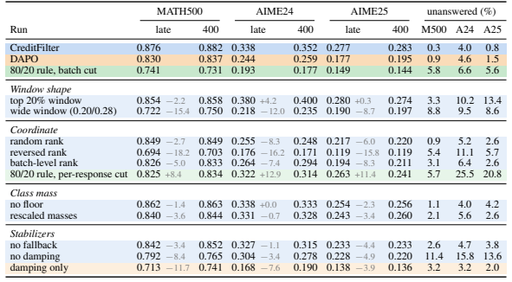
Table 3 : Ablations: each row changes one component of CreditFilter; the DAPO row repeats Table 1, and the two 80/20-rule rows apply the mask’s selection rule on the settings of the DAPO row, with the cut taken over the rollout batch or within each response. Columns as in Table 1; the late columns add the difference in points from the row’s reference, marked by the row shading (reference rows darker).
出典 · CC BY 4.0 · Hanqing Zhao, Liuyue Xie, Rong-Cheng Tu, Xu Zhang, Davide Modolo, Dacheng Tao · CreditFilter: Calibrated Token Weights over the Within-Response Entropy Rank for RLVR · 論文の図を引用 · 元のPDFの9ページ目から図の部分を抽出しています。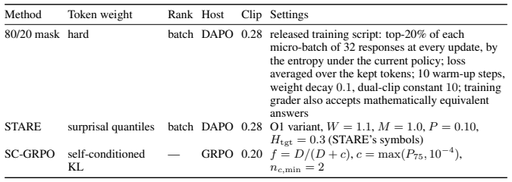
Table 7 : Reproduced baselines: the 80/20 mask, STARE and SC-GRPO of Table 1. Token weight and rank as in Table 6; host recipe with its upper clip ratio (Clip); none of these runs carries the fallback or the damping (fallback off, damping0/0). Fidelity notes at the end of this appendix.
出典 · CC BY 4.0 · Hanqing Zhao, Liuyue Xie, Rong-Cheng Tu, Xu Zhang, Davide Modolo, Dacheng Tao · CreditFilter: Calibrated Token Weights over the Within-Response Entropy Rank for RLVR · 論文の図を引用 · 元のPDFの16ページ目から図の部分を抽出しています。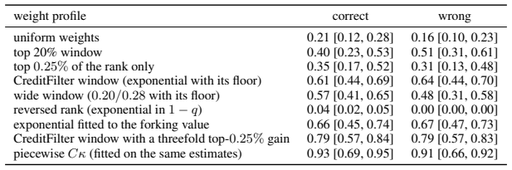
Table 16 : Matched-filter gain retained by weight profiles against the forking-value profile of the full- support instrument (16 strata, width-weighted; the exact profile retains1). Brackets: 95% question- cluster bootstrap intervals (2,000 replicates).
出典 · CC BY 4.0 · Hanqing Zhao, Liuyue Xie, Rong-Cheng Tu, Xu Zhang, Davide Modolo, Dacheng Tao · CreditFilter: Calibrated Token Weights over the Within-Response Entropy Rank for RLVR · 論文の図を引用 · 元のPDFの28ページ目から図の部分を抽出しています。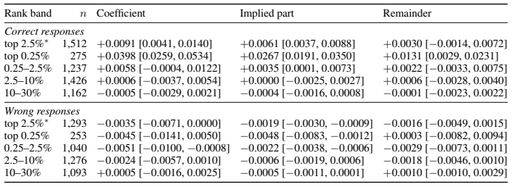
Table 17 : Test of Assumption 2 on the base policy: the coefficient of each rank band, the part the assumption implies and the remainder (95% intervals in brackets). ∗: one indicator for the top2.5% of the rank; other rows: four bands, against the remaining70%.n: positions in the band.
出典 · CC BY 4.0 · Hanqing Zhao, Liuyue Xie, Rong-Cheng Tu, Xu Zhang, Davide Modolo, Dacheng Tao · CreditFilter: Calibrated Token Weights over the Within-Response Entropy Rank for RLVR · 論文の図を引用 · 元のPDFの29ページ目から図の部分を抽出しています。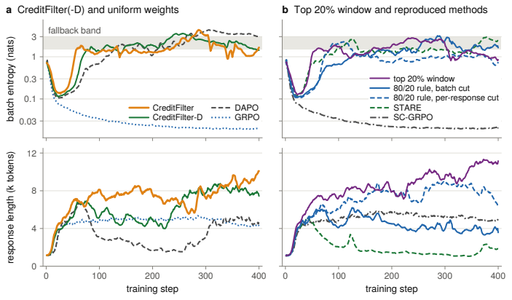
Figure 4 : Training dynamics of CreditFilter against the baselines. Top: batch entropy as a five-step moving average on a log axis, with the fallback band shaded. Bottom: mean response length as a five-step moving average. (a) CreditFilter and CreditFilter-D against the uniform-weight recipes DAPO and GRPO; (b) the top 20% window, the 80/20 rule on the settings of the DAPO row, with the cut taken over the rollout batch or within each response, and the reproduced methods STARE and SC-GRPO.
出典 · CC BY 4.0 · Hanqing Zhao, Liuyue Xie, Rong-Cheng Tu, Xu Zhang, Davide Modolo, Dacheng Tao · CreditFilter: Calibrated Token Weights over the Within-Response Entropy Rank for RLVR · 論文の図を引用 · 元のPDFの30ページ目から図の部分を抽出しています。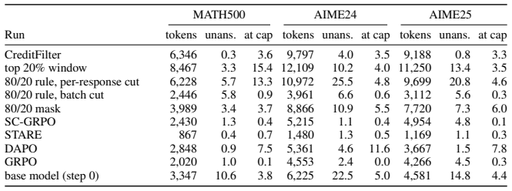
Table 18 : Step-400 checkpoints under the mean@32 protocol: mean generated tokens and share of samples (%) that reach the 20,480-token cap without a boxed answer (unans.) or after having boxed one (at cap), per set (MATH500n= 500, AIME24n= 30, AIME25n= 30; 32 samples per problem). The base model is given at step 0.
出典 · CC BY 4.0 · Hanqing Zhao, Liuyue Xie, Rong-Cheng Tu, Xu Zhang, Davide Modolo, Dacheng Tao · CreditFilter: Calibrated Token Weights over the Within-Response Entropy Rank for RLVR · 論文の図を引用 · 元のPDFの30ページ目から図の部分を抽出しています。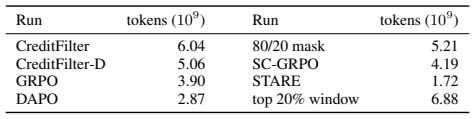
Table 19 : Training tokens over 400 steps: tokens through the optimizer, in billions.
出典 · CC BY 4.0 · Hanqing Zhao, Liuyue Xie, Rong-Cheng Tu, Xu Zhang, Davide Modolo, Dacheng Tao · CreditFilter: Calibrated Token Weights over the Within-Response Entropy Rank for RLVR · 論文の図を引用 · 元のPDFの31ページ目から図の部分を抽出しています。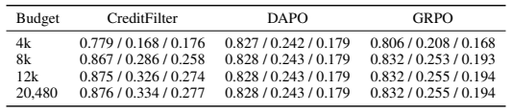
Table 20 : Accuracy at equal decoding budgets (mean@32, late average): each response cut at the budget. MATH500 / AIME24 / AIME25.
出典 · CC BY 4.0 · Hanqing Zhao, Liuyue Xie, Rong-Cheng Tu, Xu Zhang, Davide Modolo, Dacheng Tao · CreditFilter: Calibrated Token Weights over the Within-Response Entropy Rank for RLVR · 論文の図を引用 · 元のPDFの31ページ目から図の部分を抽出しています。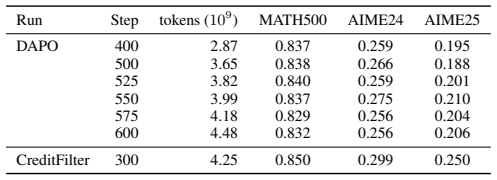
Table 21 : The DAPO run continued from step 400, and CreditFilter’s checkpoint at equal training tokens: cumulative training tokens and mean@32.
出典 · CC BY 4.0 · Hanqing Zhao, Liuyue Xie, Rong-Cheng Tu, Xu Zhang, Davide Modolo, Dacheng Tao · CreditFilter: Calibrated Token Weights over the Within-Response Entropy Rank for RLVR · 論文の図を引用 · 元のPDFの31ページ目から図の部分を抽出しています。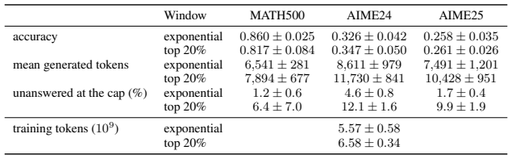
Table 22 : Exponential window (CreditFilter) against the within-response top 20% window, mean± standard deviation over the three data seeds of Table 24: late averages under the mean@32 protocol, and training tokens over 400 steps.
出典 · CC BY 4.0 · Hanqing Zhao, Liuyue Xie, Rong-Cheng Tu, Xu Zhang, Davide Modolo, Dacheng Tao · CreditFilter: Calibrated Token Weights over the Within-Response Entropy Rank for RLVR · 論文の図を引用 · 元のPDFの32ページ目から図の部分を抽出しています。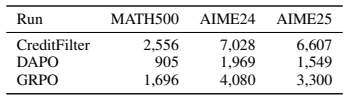
Table 23 : Mean number of tokens up to the first statement of the final answer, over the responses that state one (late average, mean@32 protocol).
出典 · CC BY 4.0 · Hanqing Zhao, Liuyue Xie, Rong-Cheng Tu, Xu Zhang, Davide Modolo, Dacheng Tao · CreditFilter: Calibrated Token Weights over the Within-Response Entropy Rank for RLVR · 論文の図を引用 · 元のPDFの32ページ目から図の部分を抽出しています。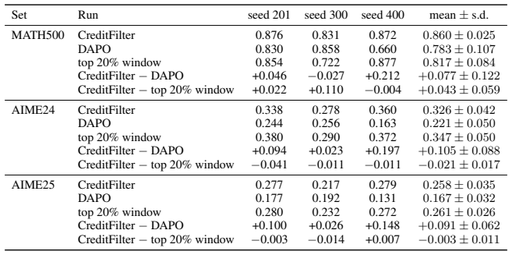
Table 24 : Three data seeds: late averages (mean@32), the differences between runs of the same seed, and the mean±standard deviation of each row over the seeds. Differences, means and standard deviations are computed before rounding.
出典 · CC BY 4.0 · Hanqing Zhao, Liuyue Xie, Rong-Cheng Tu, Xu Zhang, Davide Modolo, Dacheng Tao · CreditFilter: Calibrated Token Weights over the Within-Response Entropy Rank for RLVR · 論文の図を引用 · 元のPDFの33ページ目から図の部分を抽出しています。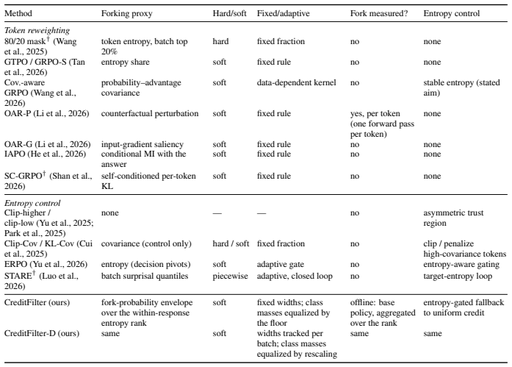
Table 25 : Token reweighting and entropy control in critic-free RLVR, as each paper describes its method. Among prior methods only OAR-P measures the fork (how much replacing the token shifts the final-answer distribution), per token and with one extra forward pass per token; CreditFilter measures it offline, on the base policy and aggregated over the entropy rank, and builds its weight on the fork probability alone, with no extra pass.
出典 · CC BY 4.0 · Hanqing Zhao, Liuyue Xie, Rong-Cheng Tu, Xu Zhang, Davide Modolo, Dacheng Tao · CreditFilter: Calibrated Token Weights over the Within-Response Entropy Rank for RLVR · 論文の図を引用 · 元のPDFの34ページ目から図の部分を抽出しています。この論文を引用
Hanqing Zhao, Liuyue Xie, Rong-Cheng Tu, Xu Zhang, Davide Modolo, Dacheng Tao (2026). CreditFilter: Calibrated Token Weights over the Within-Response Entropy Rank for RLVR. arXiv:2611.27227v1. https://arxiv.org/abs/2611.27227v1
BibTeX
@misc{zhao2026creditfilter,
  title = {{CreditFilter: Calibrated Token Weights over the Within-Response Entropy Rank for RLVR}},
  author = {Hanqing Zhao and Liuyue Xie and Rong-Cheng Tu and Xu Zhang and Davide Modolo and Dacheng Tao},
  year = {2026},
  eprint = {2611.27227},
  archivePrefix = {arXiv},
  url = {https://arxiv.org/abs/2611.27227v1}
}